
Genuine Inclusivity Means Rejecting “Comparative Suffering” by Dr. Hadia Mubarak

Moderator’s Note: Part 1 was posted yesterday. You can read it here.

Rejecting the notion of “comparative suffering” is critical for those who are committed to the work of social justice, human rights, and antiracism. There is no Guinness world record for “human suffering” for which groups or individuals need to vie to outrank one another. The human capacity to empathize with one people’s suffering does not diminish our capacity to empathize with another group’s suffering, even when those respective groups are at war with one another.

On March 26, I began my talk on a women’s panel titled, “Global Women Speak,” for Mount Saint Mary University with this reminder. Before I could speak about the humanitarian challenges facing Palestinian women in Gaza today, I felt compelled to make this argument due to my experience six days earlier at another women’s interfaith panel. In this previous panel, a co-panelist rudely cut me off four times within a span of one minute when I began to address Palestinian suffering, although she had already addressed Israel’s current challenges in response to a question that we were all asked. For several days following this jarring experience, I kept wondering, what felt so threatening to this co-panelist about the stories of Palestinian suffering that she felt compelled to shut it down?

Continue reading “Genuine Inclusivity Means Rejecting “Comparative Suffering” by Dr. Hadia Mubarak”

The Policing of Muslim Women’s Speech: Invited, then Silenced on a Women’s History Month Panel by Dr. Hadia Mubarak  

Moderator’s Note: This is part 1 of a 2 part series. A version of this article first appeared in The Charlotte Post on March 25

In her paradigm-shifting book, Why I am No Longer a Feminist: A Feminist Manifesto, Jessa Crispin reminds us that having token “female representation” does not solve the problem of systemic oppression or marginalization.  I was recently reminded of this truth when a female co-panelist attempted to silence me twice, when I shared my perspective on women’s challenges in Gaza.

On March 20, I joined an all-female interfaith panel for an elite retirement community center in Charlotte, NC in honor of Women’s History Month. As three female panelists, we were invited to represent our respective faiths, Judaism, Islam, and Christianity. After we each responded to the scripted questions posed to us, community members began to ask us questions. One man stood up and said, “I have visited Jordan, Egypt, and Israel. Will it be safe to travel to Israel again given the current situation?”

Continue reading “The Policing of Muslim Women’s Speech: Invited, then Silenced on a Women’s History Month Panel by Dr. Hadia Mubarak  “

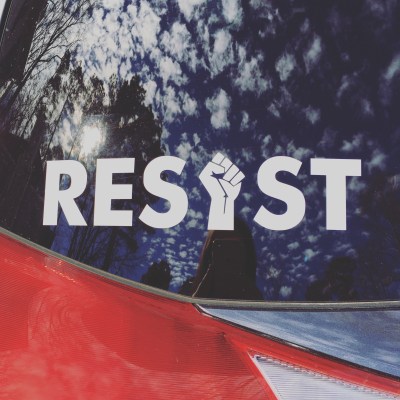
Coexist or Contradict? How about Resist Instead by Katey Zeh

Version 2

While stopped at a red light on my way home one day I noticed that the two cars immediately in front of me had the same “Coexist” bumper sticker. You’ve probably seen one like it. Each of the letters of is a symbol representing a major religious or spiritual ideology. For example, the “C” is a crescent moon symbolizing Islam, and the “X” is a Star of David symbolizing Judaism.

This was a particularly long traffic light, which gave me time to realize that I was mistaken. In actuality the bumper sticker on the car just ahead of me did not read “Coexist” but “Contradict.” Underneath that it read, “They can’t all be true-John 14:6.” Despite my early days of earnest scripture memorization I couldn’t recall this particular passage, but I had a hunch it was the verse in which Jesus said, “I am the way, the truth, and the life.” I was right.

I’ll admit my eyes rolled back in my head over this display of Christian moral superiority. Continue reading “Coexist or Contradict? How about Resist Instead by Katey Zeh”

Islam, Ali, and Reformation by Kile Jones

Kile JonesDoes Islam need a reformation? The ever-controversial Ayaan Hirsi Ali’s new book Heretic: Why Islam Needs a Reformation Now argues that it does. Do you agree with her? Or do you find problems with the way Ayaan Ali frames the discussion?
I ask these questions a few weeks after the first all-women’s mosque was opened. It has also only been a short time since Muslims for Progressive Values (MPV), headed by Ani Zonneveld, sent an open letter to Salman bin Abdul Aziz, King of Saudi Arabia. These, and the innumerable condemnations of the Charlie Hedbo shootings, remind us that this “reformation” Ali is looking for is not entirely absent. Continue reading “Islam, Ali, and Reformation by Kile Jones”

A Church With No Walls By Sheila E. McGinn, Ph.D.

Last year about this time, I spent a month in Malaysia, at the invitation of Alpha Omega International College, a school in Petaling Jaya, a suburb of Kuala Lumpur. I was rather surprised at the initial invitation, since AOIC is sponsored by the Assemblies of God and I myself am a feminist Roman Catholic. To put it mildly, the two denominations tend not to be “on the same page” on various aspects of the Christian tradition, so I wanted to ensure that the college administrators knew what they would be getting if I were to come. Happily, the AOIC president who had proffered the invitation confirmed that indeed they did want me to come for the guest lectureship, so the beginning of October saw me making my way almost exactly to the opposite side of the globe, to run my New Testament ethics seminar at the college and to spend time learning from Malaysian Christian and Muslim leaders about interreligious dialogue and inter-ethnic relationships in their country.

Malaysian hospitality was faultless—generous, thoughtful, inviting—and everyone made time to tell me about their cross-cultural experiences and their concerns for the religious climate in Malaysia. I continually was impressed by the sincere convictions of these religious leaders and their constituencies, and by the political and cultural difficulties they faced in any kind of collaborative endeavor or even attempts at dialogue. Wherever I looked, will or nil, boundary issues continued to arise. Although other ethnic groups had the right to choose their religious affiliation, the Malay ethnic group was legally defined as Muslim. Within the Christian tradition, certain denominations traditionally were connected with one ethnic group or another. Continue reading “A Church With No Walls By Sheila E. McGinn, Ph.D.”