
The Legend of Istehar by Jill Hammer

Blue supermoon 2024

This summer I had the opportunity to travel to Fire Island, New York, which is a long sand bar full of small beach towns with no cars. Fire Island’s been a haven not only for beachgoers but for queer folk for many decades. We stayed in the town of Cherry Grove with friends, and one night we went out to look at the supermoon/blue moon. The moon rose over the horizon, red and a little scary, a sight like none of us had ever seen. Not far from the moon was a star so bright it came out in the photographs. I wondered if that was the morning star.  Venus, in our current understanding. Inanna or Ishtar, among some of the ancients. And that made me think of Istehar.

Istehar, in Jewish legend, is a maiden who became one of the Pleiades. Her legend is unusual among Jewish legends because it reads like a Greek myth. It takes place during the time when some angels had descended to earth because they desired human women. One of these angels, Shemhazai, noticed a certain woman named Istehar, and desired her and wanted to be intimate with her.  Istehar wished to flee this angel, and so she said: “I won’t accept you as a lover until you give me your wings and teach me the Divine Name that allows you to fly to heaven.” The angel gave her his wings and taught her the Divine Name.  Istehar immediately uttered the Name and flew up to the sky, thus escaping the angel. God was impressed by her virtue and decided that she would be placed among the seven stars, in the constellation of the Pleiades, “that humans might never forget her.” (Legends of the Jews I:4:11).

Continue reading “The Legend of Istehar by Jill Hammer”
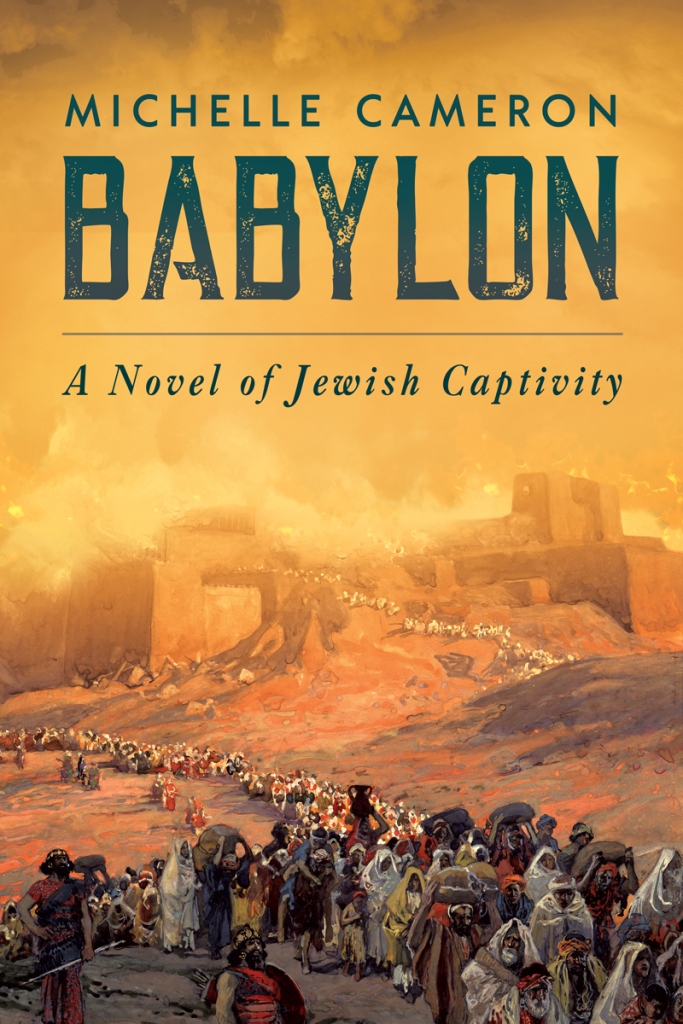
The Queen of Heaven Cakes: Asherah and Ishtar by Michelle Cameron

When one nation conquered another in antiquity, vanquished peoples typically switched allegiances to that country’s gods, since those deities were clearly stronger than their own. In my novel, Babylon: A Novel of Jewish Captivity, the prophet Daniel warns against this tendency, so the Judean exiles would remain faithful despite their captivity:

“You may be tempted to slip away from your Hebrew roots. Many of us struggle to remain steadfast to our faith. We are seduced by the lure of the gods of Ishtar and Marduk, Sin, Damkina, and Ea. Their temples overflow with riches and their ways are strange and compelling.

Continue reading “The Queen of Heaven Cakes: Asherah and Ishtar by Michelle Cameron”

To Stand in the Presence of the Ancients! – Enheduanna, Part 1 by Janet Maika’i Rudolph

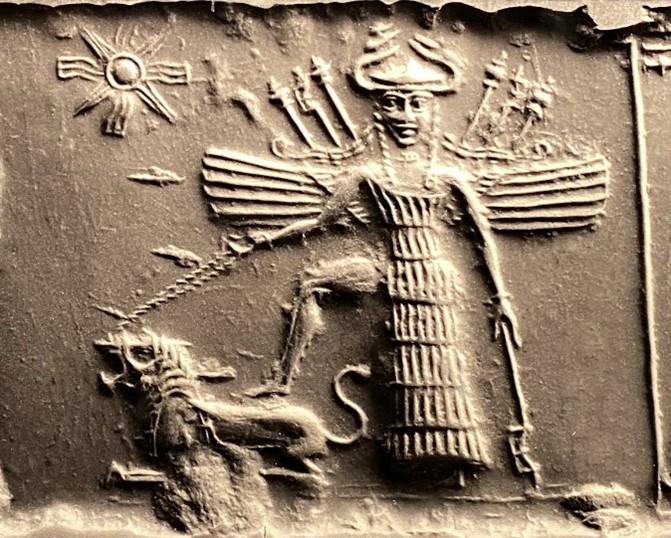
Ishtar controlling a lion ca 2334-2154 BCE

To be in the presence of antiquities is powerful. They carry an energy which is palpable.  I found this to be true at the recent exhibit at the Morgan Library in Manhattan that ran from October 14, 2022 through February 19, 2023. 

Enheduanna is a fascinating woman who lived in the lands of Mesopotamia circa the 23rd century BCE. She was a priestess who was also a writer and chronicler of her times. She named herself in her writings making her the first known author of any written works in history. She was so influential that for centuries after her death, scribes learned their craft in scribal schools by reading and copying out her work. Scholars have referred to her as the Sumerian Shakespeare[1]

Her main temple was in Ur, the very city that hundreds of years later gave rise to the biblical priestess Sarah and her husband, Abraham. We can only image how much they had been influenced by her.

Continue reading “To Stand in the Presence of the Ancients! – Enheduanna, Part 1 by Janet Maika’i Rudolph”

Esther’s Choice — And Ours by Joyce Zonana

The Book of Esther tells a story in which women’s power is not so much repressed as asserted. The king who banishes one queen finds himself submitting to the will of another. Numerous women writers of various ethnic, religious, and racial backgrounds in the nineteenth, twentieth, and twenty-first centuries have found inspiration in the stories of both Esther and Vashti’s disobedience to an autocratic king.

jz-headshotThis year, February 28th, the 14th of Adar on the Jewish calendar, is the first night of Purim, a holiday the orthodox Chabad organization blithely calls the “most fun-filled, action-packed day of the Jewish year.” Purim is celebrated with two full readings of the Megillah–the Book of Esther–in synagogues; whenever the tale’s villain Haman is mentioned, congregants drown out his name with noisemakers and foot-stomping. Children and adults masquerade and often cross-dress. Plays are performed; Haman is burned in effigy. After a daylong fast, everyone shares a festive meal, where drinking is encouraged, even mandated:

A person should drink on Purim until the point where he can’t tell the difference between “Blessed is Mordechai” and “Cursed is Haman. (Talmud – Megillah 7b; Code of Jewish Law 695:2)

It all sounds like great fun. But what exactly are we celebrating when we celebrate Purim?

Continue reading “Esther’s Choice — And Ours by Joyce Zonana”