Progressive Islam: A Critical View from Latin Muslim Feminists by Vanessa Rivera de la Fuente & Eren Cervantes-Altamirano

Progressive Islam(s) in the West, particularly in Canada and the US, have been defined as movements that primarily encompass Islamic feminism(s), LGBTQI affirming movements, anti-Conservative theologies, feminist theologies, women-centered liturgies, etc. From within this umbrella, we have seen calls to embrace women-led prayers, women-only spaces, LGBTIQ inclusive and affirming mosques and practices like ijtihad, which are said to be useful in breaking away from Conservative understandings of Islam. All in all, Progressive movements often depict themselves as “reformers” within a paradigm that is usually conceived to be dominated by Orthodox theologies and attitudes mainly driven by Saudi Arabia and Iran.

However, to what degree are Progressive movements truly inclusive? Are they as “radical” as they have been made out to be? Are Progressive spaces any safer for women and trans-women? Are Progressives free of misogyny and violence? Continue reading “Progressive Islam: A Critical View from Latin Muslim Feminists by Vanessa Rivera de la Fuente & Eren Cervantes-Altamirano”

Gender Jihad and Epistemic Justice by Vanessa Rivera de la Fuente

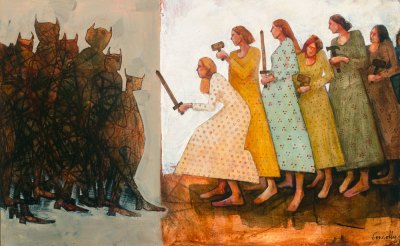
women-fighting-demons_web

In previous articles I have developed my personal perspective on Islamic feminism as a third narrative pathway that responds to the two traditional hegemonic discourses that exist on Muslim women, which I call “idealization of inequality” and “demonization of Islam

The search for gender justice within the framework of Islam has been called Gender Jihad is focused on installing a legal and social equality for Muslim women and groups or identities in the otherness, in line with the equality of divine origin established in the Qur’an. I think this socio-political equality begins with unpacking the epistemic violence prevailing in religious narratives that affects the representations and validation of women and persons in the otherness as equals, ie, like people, like men, the discursive and biopolitics referent of what is “Humankind”.

Islamic feminism is a narrative that provides answers to the epistemic violence represented by the speeches of idealization and demonization. As Gayatri Spiviak said, such epistemic violence is an orchestrated, widespread and heterogeneous project to constitute the colonial subject, as other. Women in religion are colonized subjects. Epistemic violence leads to epistemic injustice that results in unfair practices such as, for example, considering that the testimony of some people is less credible because they belong to certain gender, based on a distorted image of the other, which dehumanizes the individuals who are giving testimony.

The Gender Jihad posed by Islamic Feminisms seeks to establish a declaratory place that is an authentic expression of the agencies women and people in the otherness in relation to a hegemony with a strong colonial bias, represented for the narratives of idealization and demonization. Gender Jihad is the building of an episteme, understanding the right of Muslim women to enunciate and interpret a reality that challenges them, for and by themselves since, as Amina Wadud says “defining religion is to have power over it.”

This discursive possibility is possible thanks to the Tawhidic paradigm developed by Amina Wadud in the early 90s and  in her book “Qur’an and Woman,” a methodology that can decolonize fields of  knowledge, bodies and representational policies of the mainstream narrative about Muslim women and Others.

The merit of her paradigm, among many, is to systematize existing concepts in the Muslim cosmogony, in a way that provides a frame for gender analysis from Islamic theology and promoting the empowerment of women through it. Recognizing, on the one hand, the inherent equality of women as human beings, it gives theological support to a legal equality that for centuries have been at the discretion of Muslim scholars. On the other, it enables women, through rescuing Ijtihad, in our enunciation and narrative capacity as religious subjects. If humans are equal before God, then Women and Others are, by divine right, equally able to read, decipher, interpret and convey their perspective on religious matters.

There cannot be any political transformation, without having an equal right to speak, equal freedom to express thoughts, equal entitlement of movement of the body and ideas, equal agency to occupy material and symbolic spaces, without restrictions.

There can be no Gender Jihad without appropriating the  readings and discourses on gender, religion and jihad.

Gender Jihad begins with the recovery of the right to say and represent, therefore, is a struggle that could have as a prior aim the acquiring of epistemic justice.

This is relevant because “Who can speak” will mark simultaneously “on what terms that person talk.” What concepts and meanings can be used within the framework of the construction of a particular view of reality? What terms become the lens for discerning reality: development, democracy, gender equality, civil society, religion, social agency, etc. Only and exclusively from the enunciation (the power to speak) and from the ability to define the context in which speaking occurs, can one have a voice, that is, be a subject.

This framework for a new reality, based on the epistemic justice, will allow Muslim women to define their own place and have a voice to counteract epistemic injustice. Wadud offers a system of hermeneutic model that enables a “who can speak” and “on what terms” from an interpretation of the Quran from a gender perspective, which recognizes Muslim women agency to define and interpret religion, to build a speech based in empowerment and to rise as “political individuals of faith,” establishing a mapping for the construction of a reality in which they position themselves as people, beyond stereotypes and myths.

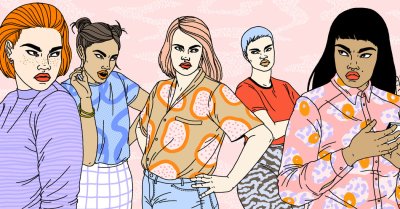
Image: Women Fighting Demons – Caitlin Conolly

Vanessa Rivera de la Fuente is a social communicator, writer, mentor in digital activism and community educator in gender and capacity development. She has led initiatives for grass roots female leaders’s empowerment in Latin America and Africa. She is an intersectional feminist interested in the crossroads between Religion, Power and Sexuality. Her academic work adresses Feminist Hermeneutics in Islam, Muslim Women Representations, Queer Identities and Movement Building. Vanessa is the founder of Mezquita de Mujeres (A Mosque for Women), a social media and educational project based in ICT that aims to explore the links between feminism, knowledge and activism and highlights the voices and perspectives of women from the global south as change makers in their communities.

Islamic Feminism and Heterosexual Dogma by Vanessa Rivera de la Fuente

12065675_170600583286234_3734458453482361154_n
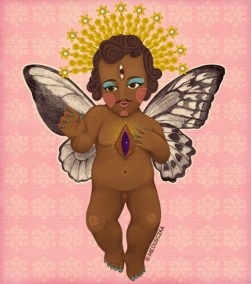
Santa Niña Marica

Reza Aslan says in his book “No God But God” that religions are myths. He explains that “religion” is a set of stories fluctuating between truth and fantasy that serve to explain and answer questions about human fate. Taking this idea as base, I think “religion” is a historical product that enables other mythical stories and must be addressed critically about its truth and meanings.

Patriarchal religious discourses, currently mainstream, have a common element that often is left outside the reading of equality and is part of the myth: Heterosexual belief.

Feminisms in Religions aim at challenging patriarchal readings. However, questioning the nature of God is not enough if we don´t challenge heterosexual belief that may or may not include the idea of a God Father/Male. In Islam, Allah has no sex or gender, is not masculine nor feminine. However, the heterosexual belief exists in the Islamic religious narrative. Continue reading “Islamic Feminism and Heterosexual Dogma by Vanessa Rivera de la Fuente”

Islamophobia is Gender Violence and a Feminist Issue

The case of Larycia Hawkins, an African-American Christian, Associate Professor of political science at Wheaton College in the United States, who published a photo on Christmas day on Facebook wearing a headscarf in solidarity with Muslim women victims of Islamophobia, has raised a significant controversy about whether non-muslim women wearing the hiyab is useful for Muslim women and our feminists struggle in Islam or not. Beyond the debate about veils, the heated discussion that followed reminds us that Islamophobic violence against Muslim women is a gender matter that must be addressed not only by Islamic feminists, but also by all decolonial feminists.

According to Itzea Goicolea Amiano, a Spanish researcher, in her work “Feminismo y Piedad” (“Feminism and Piety”):

Gender Islamophobia is a term that refers to the xenophobic and Islamophobic attitudes mixed with sexist and misogynist discourses that oppress, discriminate and targets with a negative preference for Muslim women more than muslim men …

Continue reading “Islamophobia is Gender Violence and a Feminist Issue”

All Male Panels and Feminist Movement Building by Vanessa Rivera de la Fuente

All Male Panels and Movement BuildingMaking visible gender inequities in the accessibility, acquisition, and transmission of knowledge is essential to breaking ceilings and barriers that prevent women from full participation. This is especially critical in religion, an area in which Patriarchy has bashed women in a systematic, deliberate and cumulative way throughout history.

The current dominant discourses about Muslim women: idealization (sustained by religious patriarchy) and demonization (which corresponds to a Western vision) universalize their own particular way of seeing reality through privilege and representation of female otherness and don´t give women a voice or the chance to declare an epistemic space, meaning a symbolic place of discussion where our experiences with knowledge are relevant.

This is why initiatives like “Not More All Male Panels” and other similar are important. Who dominates knowledge, manages explanations and represents reality is important. If women are excluded, then it is as if women do not exist. The inclusion of women in knowledge serves two purposes: one is simply our presence in instances where knowledge is produced; the other, which my reflection is about, concerns appropriation of knowledge and spaces via movement building.

Panels, Ceilings and Walls

A few weeks ago I participated in a panel to discuss women and feminism in religion. One of my peers spoke to me about the perception of Islamic Feminism. To paraphrase my fellow panelist:

In ‪‎Islamic‬ ‪Feminism‬, your voice is ignored and disposable, because you lack all of what gives one authority in that field– You are a Latina, living in the South, with no formal education in Islam. You have no Arab/Asian name and you speaks Spanish. In a Feminist world that should be ‪‎Intersectional‬ and ‪Decolonial‬ by definition, you’re a woman racialized in contrast with you peers. If not, tell me in how many lists of Muslims Feminist your name is written.

That was hard to hear, but led me to think that the struggle against our lack of presence in matters of knowledge has not only to do with visibility, but also with access and representation. In this sense, I wonder: who is in charge of knowledge in Islamic Feminism? What are the possibilities for any Muslim woman to become a scholar? This is still something only privileged women seem to be able to do. Continue reading “All Male Panels and Feminist Movement Building by Vanessa Rivera de la Fuente”

Women Fighting Patriarchy … Against Each Other by Vanessa Rivera de la Fuente

Vanessa Rivera de la Fuente. Women and PatriarchyIt is painful to find out the lack of understanding among feminists when controversial issues are discussed, to the point that it seems we have failed in achieving a key factor: transforming the way women perceive and interact with each other. I have been in discussions that begin with great aptitude for addressing issues about which a voice is needed, to finish in symbolic violence by stances in which I can hardly find a trace of feminism. I offer here  just a few examples.

Invisibility: At least in two situations

Case nº1: “No. A woman like you can’t be feminist. That doesn’t exist.” Denying my existence as a feminist is to deny that there are women in the world able to empower themselves, beyond your permission, in their contexts. No one owes you an explanation, by the way.

Case nº2: “She is not my ally (because she is not like me), say feminists who do not accept Muslim women as such, but praise the pro-women statements uttered by a privileged man, well advised by his publicist, because “Everyone can be feminist.” Continue reading “Women Fighting Patriarchy … Against Each Other by Vanessa Rivera de la Fuente”

Enemy of (H)Islam by Vanessa Rivera de la Fuente

Vanessa Rivera de la Fuente. Misogyny in IslamSo, again, you, the most holy and enlightened man of the mosque have pointed your finger at me to declare, noisy and hysterical, that I am an “Enemy of Islam.” Then you, who preaches and recites best, have gone out there slandering me, “eating my flesh,” devotedly.

“Enemy of Islam.” Well, which Islam? Is there one unique Islam? Why is your Islam, THE Islam? There are so many ways to be Muslim, or, didn’t you know?

You seem to follow the principle “you believe like me or you believe against me,” especially when the discussion is about women. In your narrow view, I am an enemy of Islam because I’m a feminist, radical, progressive woman. I am engaged in interfaith dialogue and in political struggle against discrimination instead of “being at home serving [my] husband as a good Muslimah.” Continue reading “Enemy of (H)Islam by Vanessa Rivera de la Fuente”

Islamic Feminism, Body Autonomy and Spiritual Liberation by Vanessa Rivera de la Fuente

Vanessa Rivera de la Fuente. Women and Body AutonomyWomen’s bodies are the preferred territory in which religious oppression becomes cruelly evident. Misogynist narratives in religions are always addressed to them: decency, honor, virtue, holiness, discretion, and shame are embodied in us, We pay for the absence of these patriarchal principles of control, on our bodies too: imprisonment, slut-shamming, bullying, rape, punishment, mutilation, and death.

Feminism makes sense in this world because women allow their struggles to push the boundaries that have been imposed on us by patriarchy, on our minds, spirits and bodies. The right to decide issues concerning our bodies is not only linked to reproductive rights and planning parenthood, but also to the experience of sexuality on the terms we freely decide and the way we interact with our body and relate to it. Freeing women from the traditions’ narratives of oppression accumulated over hundreds of years and designed to indoctrinate a hatred against our bodies is one of the purposes of feminism, including the work of feminists inside those religious traditions. If I have no right to my body, then I have no right to anything. A God who considers me free and worthy, but allows others to decide how I should embody that worth and that freedom is not a God of justice and equality at all.

Continue reading “Islamic Feminism, Body Autonomy and Spiritual Liberation by Vanessa Rivera de la Fuente”

A Reflection on Feminist Theology and the Real Woman by Vanessa Rivera de la Fuente

 Vanessa Rivera de la Fuente. Feminism and TheologyThe XVII Conference of Latin American Religious Alternatives is being held this week in Porto Alegre, Brazil. This event will bring together scholars and researchers from across the continent to talk together about religion, integration, and identity. I will be presenting three papers, all about Islamic feminism. I am pleased to have such a space to discuss new ways of understanding the phenomenon of religion in Latin America and the role of feminism in Latin American religion.  I want to share some of my personal reflections regarding gender, feminism and religion with you today.   

It is true that today all so-called ‘major’ religions—Islam, too—are patriarchal and male minded. It would be a fall into denial to say that abuses in the name of religion do not have a concrete impact on the lives of many women around the world. While it is possible to differentiate between what the Qur’an says and the discourse of patriarchy on Islam, the reality is that it is this patriarchy that dominates our understanding of religion

The revealed messages have been used to reinforce gender oppression in bans on “women’s issues” from therapeutic abortion to driving a car. But we know these bans do not come from the holy books themselves, as the revealed messages can support a reading of oppression or liberation. The problems are the historical authority of sexist readings as criteria of truth and the incorporation of androcentrism as the axis in relation to the divine. Sexist readings and androcentrism both give rise to oppression and violence in the name of God.

Feminists have denounced these abuses over and over again. Many feminists say religions are patriarchal, so let’s leave them without feminist intervention. I think this is not enough. We need to recognize that the religious world is patriarchal. We must name and draw attention to women and their contributions to the development of religion. We must also remove the legitimacy and authority of the androcentric understandings of the spiritual, which have caused much damage throughout history. Feminism in religion is essential.

It is often said that feminists want to undermine the foundations of the faith. Who says this? The same people who justify the exploitation of human beings, the degradation of women, and wars in the name of a God whose message is peace, mercy and social justice. But I ask—is it so dangerous that women and groups historically segregated from society want to own their spiritual experiences and live them autonomously?

What kind of God is adored by those who oppose our approaching the Divine from a feminist point of view? Just listening to their diatribes is to know that it is misogyny and not piety that motivates their messages. Misogyny also lies behind the violence against women. And behind the violence lurks the fear.

Beyond the Female Believer

Patriarchy has silenced its fear and built an “ideal believer” to legitimize the control of women in religion. But feminists no longer want to remain silent and obedient. We are seek to respond by creating our own theologies.

However, even in feminist theology, heteronormativity is still present. It is a bias that still sees gays, lesbians, trans and queer people as “abnormal” outsiders. This approach validates the patriarchal ideas of “minority” and “marginality” regarding the male-female heteronormative assumptions that dominate the religious world.

Dismantling the patriarchy in religion is not only about making the feminine more visible in the mystical, historical, and experiential approaches to religion. We must also demystify and dismantle the axis of androcentrism and heteronormativity and the hold it has in the academy and the “mainstream”.

For example, more than once, sisters who call themselves feminists, have called me “whore,” “deviant,” and “immoral” for my queer understanding of gender roles and my critique of marriage as “half the Deen” [the Islamic idea that for women marriage completes their faith, which in Arabic is ‘Deen’], a replica of the romantic patriarchal discourse of the “other half” that is so damaging to the autonomy and the self-esteem of women in the real world.

This is a problem. Feminism in religion is not landing in the everyday lives of women. Feminist theology still speaks to a woman who is cis-gendered and heterosexual, who wants to marry and have children. Feminist theology is still quoting patriarchy.

The master’s tools will never dismantle the master’s house

The reality is that not all women in religious communities are heterosexual, not all heterosexuals wish to get married, and not all married woman understand their position in marriage as subordinate and complementary to the male.

Along with eliminating the patriarchal “revelations,” feminists who theorize regarding faith must be decolonized from the need to build another “perfect believer.” We should not assume an archetype of woman, as this exercise gives authority to patriarchy’s model of the female believer that imprisons women in destructive and limited dimensions with labels like saint, mother, and whore.

I think we must remove from women the roles that are supposed to make them proper “believers.” In fact, I think we have to destroy once and for all both the concept of “believer” itself and the category of “woman” as we know it in religion. Assessing the degree of spiritual development and the agency of the religious woman according to the degree of her functionality as a “Model” is NOT emancipatory, but is both limited and sexist. If there are “role models,” someone will always be outside the norm.

Instead, let us take over the theologies and feminisms, regain power over ourselves, and raise awareness in communities that feminism is not only a field of study and analysis but also an outlook on life. We can legitimize the authority of the feminist perspectives of religion, and commit sacrilege against the exemplary women and models that are imposed on us.  Let us not talk anymore about “Muslim women” or “Christian women” or “Jewish women,” but about ourselves as women.

Above all, and essentially, we must act on behalf of women of everyday, on behalf of those women who do not want to be “perfect believers,” but who want to be happy and fulfill their goals in a world that belittles them in many ways on a daily basis. Reasonable, imperfect, diverse and ‘under-construction’ women were created by God to be in this world as an expression of life and humanity.

Vanessa Rivera de la Fuente is a Writer, Mentor and Community Educator in Capacity Building for Grass Roots Female Leaders and Advocates. A Muslim Feminist who is an Independent Researcher of Gender and Islam in Latin America on Feminist Hermeneutics, Muslim Women Representations, Queer Identities and Movement Building. She blogs in Spanish at Mezquita de Mujeres, a site dedicated to explore the links between Gender, Religion and Feminism as well to Women from the Global South as Change Makers in their communities.

Why I am an Islamic Feminist by Shehnaz Haqqani

FAR - SHWhile Islam has undoubtedly granted women many rights—some of which were radical for much of the world in the 7th century, such as the rights to divorce, consent in marriage, education, and financial independence—many Muslim women around the world are denied those rights in practice. That these rights were “radical” for the 7th century is significant: one would think that this is an indication that our rights should be “radical” in all times. What Islamic feminism does is to help us deal with this tension of the existence of women’s rights in theory but their denial in practice.

I understand Islamic feminism to be a response to the mistreatment of Muslim women, whose rights have been marginalized, or completely denied, because of interpretations of Islam that do not acknowledge their full humanity and view them as inferior to men; Islamic feminism therefore requires re-visiting the Qur’an to re-interpret it from a standpoint that does not favor any one gender over another and sees all as equally valuable. Needless to say, Islamic feminism, or any other form of feminism, does not claim that women and men are “the same”; men and women need not be the same in order to be viewed as and treated equally and fairly. Continue reading “Why I am an Islamic Feminist by Shehnaz Haqqani”