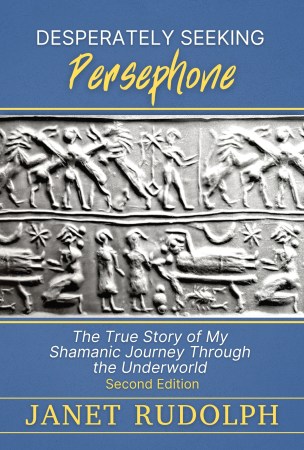
Desperately Seeking Persephone by Janet Rudolph, Book Review by Carolyn Lee Boyd, Part Two

In Part One of this review (posted yesterday), we learned how Janet descended into the Underworld, like Inanna and Persephone, after child abuse and rape, and how she began a decades-long journey back to our own world, healed and empowered. To learn more about her return from the Underworld and how she became the shaman and author she is today, I invite you to join the journey in Part Two as we continue to explore “Signposts” that marked her ascent.

Signpost #3. Be aware, be free, be focused, be here, be loved, be strong, be healed.

Janet’s teachers at the Mystery School had brought together shamanic traditions from throughout then world. Among them was Huna, or Hawaiian Adventure Shamanism as practiced by Serge Kahili King. A summary of Huna is shown in a mantra: Be aware, be free, be focused, be here, be loved, be strong, be healed (114) and “focus on the gifts that come to us through adversity” (116). 

Continue reading “Desperately Seeking Persephone by Janet Rudolph, Book Review by Carolyn Lee Boyd, Part Two”
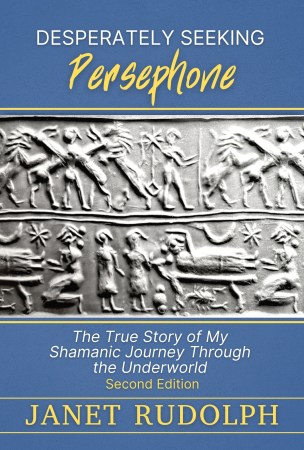
Desperately Seeking Persephone by Janet Rudolph, Book Review by Carolyn Lee Boyd, Part One

The myths of the descents of the Sumerian Inanna and the Greek Persephone to the underworld have fascinated and inspired women for millennia with their violence and betrayal, leaving behind all you love and that hold you up, and facing your deepest fears, even death. We recognize our own traumas in their struggles and seek guidance as to how to navigate our ascents back to wholeness and well being in their stories.

After her own experience of childhood abuse and stranger rape as a young woman, Janet Rudolph, one of FAR’s co-weavers, also pored over the myths in hopes of finding a helpful account of their journey home. “Once I had tumbled metaphorically, literally and mythically into the thorny quagmire of the underworld, it was devilishly hard to escape. I felt lost. I needed a guide, a role model to find my path outward”(xii). The problem is, Janet says, “The stories of their return are glossed over. There is no detailed story called From the Great Below Back to the Great Above” (15). Until now in Janet’s recently re-published book, Desperately Seeking Persephone.

Continue reading “Desperately Seeking Persephone by Janet Rudolph, Book Review by Carolyn Lee Boyd, Part One”

Delilah, Lost by Janet Maika’i Rudolph


Delilah is a beautiful name on its own merits. As a biblical personage Delilah is forever connected to Samson for their tales are intertwined. As it is told in Judges, Samson is the clear hero of the tale and Delilah is merely the temptress who betrays him. But as in all spiritual accounts there is more here than meets the eye. A spiritual journey is never a linear affair. When reading the story of Samson and Delilah, it immediately becomes clear that something mythical is afoot. The root of Samson’s name is the same as the word shamash, the Hebrew word for sun. The root of Delilah is lila, meaning night. Right away we understand that this story contains apparent opposites, heavenly aspects, the sun and the night, light and dark . . . Continue reading “Delilah, Lost by Janet Maika’i Rudolph”

Yes, there are Goddesses in the Bible, Part 5 by Janet Maika’i Rudolph


As I wrote my last blog post, the Great Goddess of the Canaanites, Ashera was honored and worshipped (according to the bible) within and through groves of trees. Ashera and El, the “great bull god” were deeply connected. In fact, in Canaanite mythology, El and Ashera were married.

But before delving into their relationship, I would like to start in a different (but connected) direction – the lovely archetype of the morning star and the evening star. The planet Venus, named for her namesake Goddess (or vice versa), is both the planetary vision of the morning star and the evening star. Whether She be Goddess, planet or evening/morning star, when She appears in one form, She embodies them all. Continue reading “Yes, there are Goddesses in the Bible, Part 5 by Janet Maika’i Rudolph”

Yes, There are Goddesses in the Bible by Janet Maika’i Rudolph

“Freud once asserted that mortals are not made to keep secrets;
what they would like to conceal oozes from all their pores.”
Psychoanalyst Theodore Reik[1]

It’s remarkable how much female imagery there is in the Bible hidden within its wording. The more I delve into its passages, the more that I have found these hidden/not so hidden sacred feminine images, even deities. I have begun a project of digging in and rooting out these little gems. When people think about the sacred feminine or female deities in the Bible the most well known is the Shekinah. The Shekinah is a lovely presence. The word means “dwelling” and usually represents “god’s divine presence” or a place where the divine resides.

The problem is that the Shekinah as a feminine essence of the divine is never stated explicitly, it is an interpretation of how the word is used.  I love the concept of the Shekinah but as an essence that upholds the entire weight of the feminine divine in the bible, I find it unsatisfying by itself. Luckily for me, Goddess Shekinah has lots of company. Sometimes they are indeed hiding in plain sight. Sometimes they hide in the translations. The passage I am presenting today has some of both going on. The following is the King James Version of Genesis 49:25. Jacob has been giving blessings to each of his sons and this is part of the blessing he gives to Joseph: Continue reading “Yes, There are Goddesses in the Bible by Janet Maika’i Rudolph”

An Outrageously Strange, Bizarrely Weird, Completely True Tale by Janet Maika’i Rudolph

The word apocalypse keeps coming up when I talk to friends about how our present times feel. We’ve all noted how cracks in our society are tearing open and fault-lines are rising to the surface. It is disorienting yet also potentially transforming. I realized I’ve felt this way before:

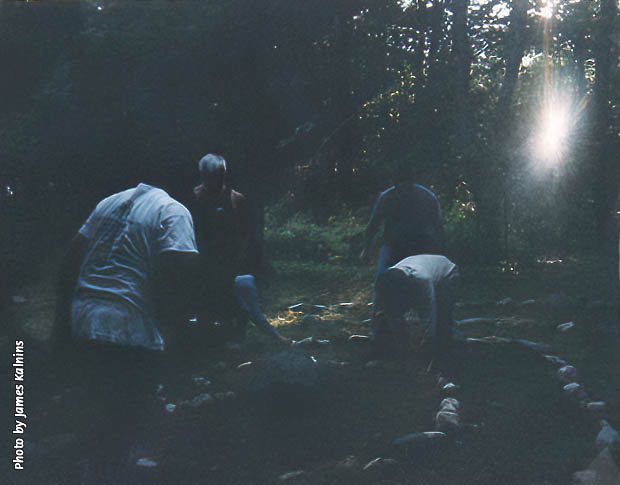
In January 1997, I became an apprentice to a husband and wife shaman team. They ran an old-style mystery school with regular weekend workshops in Maine and a 4-day in the summer. In August 1997, we met on forested private property that was far from any “civilization.”

Regular weekend meetings began after dinner which gave our small NYC area contingent plenty of time for a leisurely drive up the coast. In August, our teachers wanted us to arrive earlier. We arranged to take the Long Island Sound ferry to Connecticut to avoid the time-consuming drive around the city. About ½ way through our 1 ½ hour ferry ride, a shocking event happened. An elderly woman sitting near us dropped like a rock to the ground. Her daughter began screaming. No one could rouse her. The ferry returned to NY where an emergency crew tried and failed to revive her. She had literally died at our feet. By this time, I was not only thoroughly rattled, I was also deep into contemplating issues of life and death. Because of our delayed arrival in Conn, we began hitting evening rush hour along the major cities of our route. We did not arrive in Maine until well after dark. Continue reading “An Outrageously Strange, Bizarrely Weird, Completely True Tale by Janet Maika’i Rudolph”

The Sacred HU by Janet Maika’i Rudolph

Sing to the LORD, all you godly ones! Praise his holy name.
Psalm 30:4 (New Living Translation)

Therefore I will give thanks unto thee, O LORD, among the heathen, and I will sing praises unto thy name.
2 Sam 22:50

Let them praise the name of the LORD: for this name alone is excellent.
Psalm 148:13

The wording of these passages is very odd. After all, why is God’s name always being praised? It’s like saying to someone, “you must be a wonderful person because you have a lovely name,” or “the LORD must be great because ‘he’ {sigh} has such a great name.” Actually though, as I began to go deeper into my own personal practices of spirit work and chanting, I found that there is a profound truth to this use of praise. Most, if not all, of the ancient names of deities are made up of power syllables. By this I mean certain sounds that have a vibrational essence which not only resonate within our bodies but connect us with all the vibrations that surround us. Sounds made by these syllables are a bridge between worlds created by our breath.

Mystically speaking we could say that the breath of creation and our own breath interfuse. We can experience this through the vibration of power syllables. The most common syllables in the west are familiar ones – AL LA HA AH YA LO WAH and the mighty HU. Think of all the names of divinity that can be created by experimenting with these syllables. Continue reading “The Sacred HU by Janet Maika’i Rudolph”

What the Mystics Say by Janet Maika’i Rudolph

When Rachel Pollack wrote the foreword to my book, When Moses Was a Shaman, she wrote a haunting line. She was discussing the importance of asking questions as a life practice. She wrote, “Perhaps Questions are the ultimate Homeland for all of us.” Respecting the power of the question, this blogpost poses more questions than answers.

I originally started writing about his idea when it was just authoritarian cruelty and creeping fascism that I had to worry about. Now there is a deadly virus afoot.

It seems to me that living among human suffering (war, famine, disease, inhumanity, abuse, prejudice) throughout history and even today is far more common than living in places and times of stability and abundance. And a goodly amount of it is human-caused. Why are we always drawn to suffering? Is there something to be learned from it? Or are we just an impossibly wounded species that insists on inflicting harm? I wanted to see what the mystics say about it. Continue reading “What the Mystics Say by Janet Maika’i Rudolph”

Beauty, Blessings and Bistros: The Hawaiian Huna approach to dealing with the virus as well as everyday stresses by Janet Maika’i Rudolph

One of my favorite trainings I have received on my spiritual pathway is with Aloha International. I was ordained as an alaka’i (Hawaiian spiritual guide) in 2016. I began studying Huna intensely in 1997. In 2015, I personally met and studied with our Kumu Kupua (founder and shamanic guide) Serge Kahili King. I love the Hawaiian way as it is gentle, loving and teaches us to examine our beliefs, life practices and thought-patterns in a way which heals our wounds and nurtures our lives in many beautiful ways. Huna means secret but not as something we can’t share, rather something that is hard to discover or grasp like the mists of the sea. Dr. King, however, makes it easy and I am happy to share some of his teachings here.

I have several medical people in my family. They study science and closely follow journals to find treatments and cures. I bless those efforts because their findings are wonderful tools when we, ourselves, are in need of medical treatment. The shamans, however, have a different approach to disease. Instead of looking to see what medications work, we like to explore why other methods work. Placebos, for example, are so powerful that scientists must go to extreme measures to avoid activating them with practices such as double-blind studies. What if instead of working to eliminate the placebo effect, we work to strengthen it? What if our goal is to harness the power of our minds to explore how our expectations, beliefs and thoughts affect our health and well-being? Continue reading “Beauty, Blessings and Bistros: The Hawaiian Huna approach to dealing with the virus as well as everyday stresses by Janet Maika’i Rudolph”

The Serpent and The Seed by Janet Maika’i Rudolph

I was so inspired by Judith Shaw’s blog post, “The Serpent and the Goddess” (Feb 26th) that I began to dust off my old notes on serpent imagery. I was reminded a concept that kept jumping out at me. In discussing the Kabbalah, Rabbi David A Cooper, writes that mystics describe the universe as the “the skin of the serpent.”[1] What a beautiful yet puzzling concept! I wanted to dig deeper.

The serpent’s connection to the Great Goddess has been an excellent place to begin this quest. Barbara Walker notes the etymological connection between the serpent, and the Great Goddess from the Bible whose name is Eve. Walker writes, “The names of Eve, the Serpent, and ‘Life’ are still derived from the same root in Arabic.”[2] But the Goddess connection is not the totality of the serpent’s magic. Continue reading “The Serpent and The Seed by Janet Maika’i Rudolph”