Miriam the Prophetess as Guardian and Healer by Jill Hammer

jill hammer cropped

The biblical traditions of Miriam the prophetess have captured the imaginations of Bible-readers throughout the ages.  Miriam, Moses’ sister, watches over Moses in his cradle (Exodus 2), and leads the Hebrew women in dance at the shore of the Sea of Reeds to celebrate redemption  (Exodus 15).  Rabbinic lore identifies Miriam with Puah, the midwife who saved Hebrew babies from Pharaoh, and depicts her as the herald of Moses’ birth (Exodus Rabbah 1:13; Babylonian Talmud, Sotah 12a). Contemporary Jewish feminists have established traditions of singing to Miriam the prophetess on Saturday night, parallel to the tradition of singing to Elijah the prophet at that time.   It has also become popular among some feminist/egalitarian Jews to place a cup of Miriam on the seder table at the time of Passover.  This cup is usually filled with water in order to recall the ancient legend that a well of water followed Miriam through the wilderness, quenching the thirst of the wandering people (cf: Babylonian Talmud, Taanit 9a).  It was even said that healing herbs grew near this well, so that Miriam’s prophetic power became a source of healing.

The veneration of Miriam is especially deep in Sephardic Jewish traditions—those Jewish traditions stemming from the Spanish Jewish diaspora, which may be found everywhere from North Africa to Holland to Greece and Bulgaria.  Sephardic women used incantations along with various rituals involving salt, herbs, and other substances, as healing for various ailments and troubles; women skilled in these practices were called precanteras or precantadoras.  Some of their healing incantations invoke Miriam as the ancestress of all women healers, as in the following prayer:

Continue reading “Miriam the Prophetess as Guardian and Healer by Jill Hammer”
Meeting Phrike: Feminist Theology and the Experience of Horror by Jill Hammer

Myself, I saw the numb pools amidst the shadows; myself, the wan gods and night in very truth.  My frozen blood stood still and clogged my veins.  Forth leaped a savage cohort… Then grim Erinys (Vengeance) shrieked, and blind Furor (Fury), and Horror (Phrike), and all the forms which spawn and lurk amidst the eternal shades.

Seneca, Oedipus (trans. Frank Justus Miller)

Horror is not a cognitive but a physiological or affective extra-discursive state of being. Not unlike the state of, say, feeling nausea, horror is a state of being, whose manifestation, based on the etymologies of the Greek φρiκη [phrike] and the Latin horror, may be described, as Adriana Cavarero writes, as “a state of paralysis, reinforced by the feeling of growing stiff on the part of someone who is freezing,” and further, through her mythological reference to the prototypical figure of horror, Medusa, as a state of “petrification” …

205. Kiarina Kordela, “Monsters of Biopower: Terror(ism) and Horror in the Era of Affect”, Philosophy Today 60(1), 2016, p. 193-205.

Surging anti-Semitism in the United States, as witnessed by many news reports and also anecdotes related by friends and acquaintances, holds a particular horror for Jews of my generation.  Some of us thought that we were relatively safe from that age-old bigotry.  It’s disorienting to be reminded that we are not.  My wife, whose father (alone of all his relatives) survived Auschwitz, has the skin-crawling sense as she reads the news that somehow we have gone back to that time.  Twenty-eight Jewish community centers have been evacuated in the last two weeks because of bomb threats, and a rabbi in the Midwest has received death threats for protesting neo-Nazi activities. A midwife/rabbi friend in Toronto had her house vandalized with swastikas.  A judge of my acquaintance in the New York area saw a statue of Martin Luther King vandalized with Nazi symbols.  Walking down the street in New York City, I myself heard someone exclaim gleefully: “Trump is going to get rid of the Jews!”  

While I hope that is not anywhere near true, the horror evoked by hearing such words is a real entity: a physiological state of being.  The Greeks personified the feeling of horror as a daimona (spirit) or goddess called Phrike.  The word phrike implies shivers, goosebumps: a physicalized emotion. The Romans called her Horror.  There are no stories about her, but the ancient Greeks used the word phrike when speaking about theater, believing that the pity and terror evoked by a play effected a catharsis for the viewers.  Via their beliefs about theater, the Greeks gifted Phrike to the world.  Lately I feel that Phrike is living in my house.   Continue reading “Meeting Phrike: Feminist Theology and the Experience of Horror by Jill Hammer”

The Book of Earth & Other Mysteries: a book review by Elizabeth Cunningham

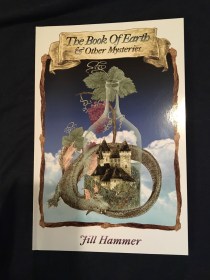
book-of-earth-photojpgWhen a poem shows me something in a strange and wonderful light and at the same time awakens some bone-deep knowing of my own, I feel more alive, I feel less alone. My soul is stirred and satisfied. The Book of Earth & Other Mysteries by Rabbi Jill Hammer, author, teacher, midrashist, mystic, poet, essayist, and priestess, is a whole collection of such poems.
Collection is not a vivid enough word. The structure of this book is more like a fairy palace, a sandcastle blazoned with shells, a dragon’s lair, a bold work of art in itself.  The book begins with a five part prose piece called “Intentions,” the first four invoking an element and the last one holding open the door for us to enter the world of the poems.  Here are a couple of sentences excerpted from each. Continue reading “The Book of Earth & Other Mysteries: a book review by Elizabeth Cunningham”

Judaism, Feminism, and The Twoness of Creation by Jill Hammer

Rabbi Amorai said: “Where is the garden of Eden:  He answered himself: “In the earth.”

Sefer haBahir, 12th century Provence

For many liberal Jews, the phrase “tikkun olam” has been an important rallying cry.  The phrase is often used as synonymous with “social justice,” but has more esoteric roots.  Tikkun olam, repair of the world, refers to a kabbalistic view of creation.  In this view, the Divine set out to create the world by vacating a space, an empty space within which creation could occur.  The Divine then created vessels, planning to pour divine light into them, in order to form all created things.  But when the divine light was poured into the vessels, the vessels could not hold the effulgence.  They shattered, scattered sparks of light and shards of the vessels everywhere.  Since then, the cosmic job of humanity is to find these sparks of light and free them to rejoin the One.

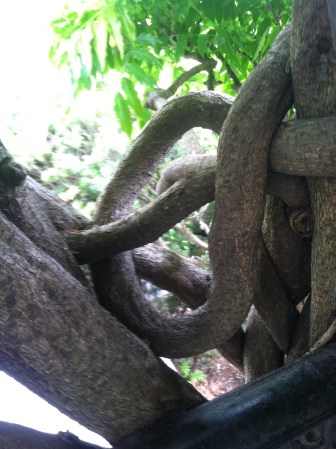
wisteria-knotIsaac Luria, a Jewish mystic in the city of Sfat, told this tale of creation in the seventeenth century.  It caught the Jewish imagination and has been wildly popular as a Jewish creation myth ever since.  It captures our longing for wholeness and our experience of brokenness.  It also offers a parallel with the Big Bang (a hot seed of light that expands into the universe as we know it) that many find quite compelling.  I have loved this story for a long time.  To me, it is reminiscent of the story of birth: an empty space that becomes full, then leaks out into the world as a new being.  Yet as a feminist who is also committed to sustainability, as more news of our planet’s scorching rolls in, I find this myth is beginning to crack.   Continue reading “Judaism, Feminism, and The Twoness of Creation by Jill Hammer”
The Red Thread, the Red Heifer, and Red Ritual by Jill Hammer

Jill Hammer

There is an old Jewish custom to use a red thread, tied around a bedpost or a child’s wrist, to keep away demons.  In particular, the red thread is said to keep away Lilith, the female demon who steals children.  Women still give away red threads at the Western Wall in Jerusalem as a segulah, or protection amulet.  Feminist poet Alicia Ostriker reclaims this symbol as a reminder of the umbilical cord, the connection between a human childbearer and a child, and an intimation of the cosmic interconnectedness of all things.  She writes:

the disturbing red thread
invisible yet warm
travels between earth and heaven,
vibrates through starless void…

does it carry the pulse
of our prayers
like a bulge in a snake 

dozing, like a stream
of hungry, bloody hope, do all
the red threads join 

form a web

Alicia Ostriker, The Volcano Sequence (University of Pittsburgh Press, 2002), p.11-12.

Continue reading “The Red Thread, the Red Heifer, and Red Ritual by Jill Hammer”

“Seeking Harbor in Our Histories” – ASWM 2016 Conference

aswmThe Association for the Study of Women & Mythology (ASWM) will be hosting this year’s Conference, “Seeking Harbor in Our Histories: Lights in the Darkness” at the Boston Marriot Burlington Hotel on 1-2 April 2016.
ASWM conferences strive to support the scholarship, artistry, & practice of those who explore and engage the sacred feminine through study and creativity. Offering keynote presentations at this year’s conference are Dr. Elinor Gadon, Dr. Margaret Bruchac, and Dr. Lucia Ciavola Birnbaum.

On Friday night, there will be a plenary session and book-signing moderated by Miriam Robbins Dexter and Vicki Noble and featuring Max Dashu, Starr Goode, Mama Donna Henes, Donna Read, Genevieve Vaughan, Cristina Biaggi, Lydia Ruyle, Miranda Shaw, Elinor Gadon, and Susun Weed. They will be sharing stories from the anthology, Foremothers of the Women’s Spirituality Movement: Elders and Visionaries. FAR contributor Carol P. Christ has a chapter in the book.

FAR is excited to share that three of our contributors are on this year’s conference schedule!

Nancy Vedder-Shults will be joining the “Artists, Activists, & Scientists and the Lineage of the Goddess” panel with her presentation, Science and Divination: The Blurring Lines between the Secular and the Sacred. 

Jill Hammer will present The King and the Priestess: Mythic Motifs and Motives in the Tale of Judah and Tamar as part of the “Male-Female Relationships in the Hebrew Texts: Three Feminist Analyses” panel.

Kate Brunner will be participating in the “Women’s Spirituality, Transformative Scholarship and Personal Quest” panel with Rhiannon, Great Queen of the Mabinogi: Ancient Mythology in Modern Context. She will also be offering her meditative writing workshop, Becoming Branwen the Peaceweaver. 

In addition to the main conference, there will be a Matriarchal Studies Day seminar and celebration, in the same location the day before (31 Mar). Hosted by Vicki Noble and Lydia Ruyle, the program looks to be a great addition to the weekend. Dr. Heide Goettner-Abendroth, founder of Modern Matriarchal Studies will present via Skype. Other presenters will include Max Dashu, Polly Wood, Beverly Little Thunder, and Genevieve Vaughan, exploring woman-centered arts, themes of motherhood, and the gift economy. There will be a keynote presentation by Lucia Chiavola Birnbaum, and evening entertainment by folksinger, Julie Felix.

For registration information & more conference details, see the ASWM 2016 Conference blog.

Feminism & Religion Project contributors past, present, & future interested in connecting with FAR at the conference, are encouraged to get in touch with Kate Brunner at feminismandreligionblog@gmail.com. If there is enough interest, we may be able to organize meeting up for a meal together some time during the weekend.

The Hebrew Priestess: A Book Review by Joyce Zonana

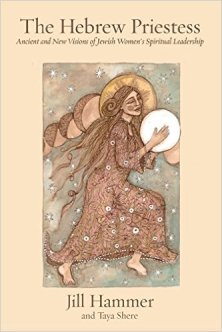
Hebrew Priestess coverWeaver, Prophetess, Shrinekeeper, Witch; Maiden, Mother, Queen, Midwife; Wise-Woman, Mourning-Woman, Seeker, Lover, Fool . . . . Thirteen possibilities for the female self, thirteen aspects of the Goddess, thirteen archetypes for the Hebrew (or any other) Priestess . . . thirteen fact- and dream-filled chapters in Jill Hammer and Taya Shere’s thrilling—and much-needed—new book, The Hebrew Priestess: Ancient and New Visions of Jewish Women’s Spiritual Leadership.

Nearly fifty years ago, anthropologist Raphael Patai introduced readers to the Hebrew Goddess, documenting the influence of Near Eastern Goddess religions on the practices and beliefs of the ancient Israelites. Since then, feminist scholars of religion, along with poets and novelists, have offered brilliant new interpretations of Torah and Talmud, creating feminist midrash and liturgy that open the ancient patriarchal faith to modern (and perhaps also ancient) notions of female authority and autonomy. At the same time, the increasing presence of women rabbis has transformed the congregational, communal Jewish experience for many women and men.

But what we have not had is a shamanic, visionary form of Jewish practice—“earth-based, embodied, ecstatic, energetic” (9)—that integrates ancient and contemporary Goddess spirituality with Judaism: while we have had female rabbis, we have not had formally trained and recognized Hebrew Priestesses.

Jill Hammer
Jill
Taya Shere
Taya

Enter Jill Hammer, who in the compelling Introduction to her book recounts with passion and precision her own meandering but steady journey to the Goddess and her establishment, with co-author Taya Shere, of the Kohenet Hebrew Priestess Institute, a school dedicated to ordaining contemporary Hebrew Priestesses, kohanot.Kohenet,” although it does not appear in the Bible, is the ancient Hebrew word for “priestess.” Continue reading “The Hebrew Priestess: A Book Review by Joyce Zonana”

Stealing the Yarn: Jewish Women and the Art of Feminist Dreaming (Part 2) by Jill Hammer

Jill HammerIn my last post, I discussed the uses of dreamwork for Jewish women who are uncovering their own spiritual language. The protagonists of recorded Jewish dreams, from Joseph to the dream interpreters of the Talmud to the kabbalists, tend to be male. Yet there is a legacy of Jewish women dreaming, occasionally documented, and painstakingly uncovered by researchers. This hidden history offers us resources for understanding the women of the past, and for connecting to women in the present.
The Roman poet Juvenal (2nd. cent. CE) mocks a poor Jewish woman of his time for sitting under a tree and telling the meaning of dreams, calling her “high priestess with a tree as temple.” Much later in history, Hayyim Vital, the disciple of master kabbalist Isaac Luria, records in his diary that Jewish women in the city of Sfat (Jewish holy city in Galilee known as a center for Kabbalah) in the early 17th century were actively engaged (along with men) in recording, sharing, and interpreting dreams. Vital mainly records women’s dreams when the women dream about him! He saves these dreams from the dustbin of history, ironically, because he sees the dreams as prophecies of his greatness.

For example, Vital records the dream of a friend and patron, Rachel Aberlin. In the dream, Aberlin watches Vital eat a feast of vegetables at a table full of sacred books. Behind Vital, a fire rages, yet does not consume the pile of straw in which it burns. When Aberlin shares the dream, Vital understands this dream to be a manifestation of a biblical verse: “The house of Jacob shall be fire, and the house of Joseph flame, but the house of Esau shall be straw” (Obadiah 1:18). Aberlin, however, responds to Vital’s interpretation: “You quote me the words as they are written, but I see them as a reality.” (Between Worlds: Dybbuks, Exorcists, and Early Modern Judaism, p. 106ff).

Vital sees the dream’s fire as his own spiritual fire, witnessed by Aberlin. Yet we might read the dream differently. In our dream of Aberlin’s dream, we might imagine that Aberlin’s dream encodes her experience of watching Vital consume the nourishment of sacred books, which she, as a woman, is denied. Yet, the dream suggests, the fire of revelation is behind Vital, eluding him. Within the dream and in waking life, Vital is focused on text, but Aberlin, like Moses, perceives the fire that does not consume. Aberlin, not Vital, is the prophet in the dream— and the waking Aberlin says so. Vital records the dream, without recognizing Aberlin’s implicit criticism of his way of knowing.

Continue reading “Stealing the Yarn: Jewish Women and the Art of Feminist Dreaming (Part 2) by Jill Hammer”

Entering The Cave: Jewish Women and the Art of Feminist Dreaming (Part 1) by Jill Hammer

Jill HammerDreams are my window on my wildest self. They are also a way to observe the conflicts within, and therefore they are a feminist practice, teaching me about my relationship to power, gentleness, love, and brokenness. Claiming my dreams is a way of claiming all the parts of myself. I am inspired in my dream practice by my own Jewish tradition, which has many dream practices, as well as by contemporary knowledge about dreams. Frequently in my dreams, I am able to observe my own longing for the company of women and for the presence of Goddess—deity in a female mode—in my life. Frequently, I learn about my experience as a woman by watching my dreams.

In one recent dream, I found myself in a town called Ursula, visiting a cave. Inside the cave were statues of holy women. After my visit, I expressed a desire to move to this town, Ursula. When I woke up, I remembered a painting I had seen in London when I was young: a depiction of St. Ursula, a fourth-century Catholic saint said to have led eleven thousand women on pilgrimage. Ursula is also the she-bear, an archetype of the sacred feminine. The desire to live in the town of Ursula could be read as a desire to live in the realm of the she-bear: in the company of women. The town of Ursula is also a town of the ancestors: the priestesses, prophetesses and wise women of old, represented by the statues in the cave. Though the imagery in my dream comes from a variety of cultures, the dream reminds me of my desire to connect to the women my tradition through dreams.

I teach Jewish dreamwork (based on biblical, Talmudic, kabbalistic and contemporary texts) to rabbinical and cantorial students at the Academy for Jewish Religion. I have seen how deeply it adds to my students’ spiritual lives. And, as one of the co-founders of the Kohenet Hebrew Priestess Institute, I have seen dreamwork transform the lives of women who are becoming ritual leaders and healers. Kohenet’s dream practice includes dream circles in which each participant offers a different reading of each dream, beginning with “In my dream of this dream.” We begin this way because each of us has a different understanding, influenced by who we are.

At Kohenet retreats, we often find that the dream of one person provides powerful healing for the whole community. For example, one woman dreamed of finding a bearded father-figure in a house. When she went into the basement, she found her mother working and writing next to a goddess shrine (Jill Hammer and Taya Shere, The Hebrew Priestess: Ancient and New Visions of Jewish Women’s Spiritual Leadership, p. 70). The dream expressed an experience many of us shared: the process of unearthing the power of women and the mythic feminine in our own lives.

Continue reading “Entering The Cave: Jewish Women and the Art of Feminist Dreaming (Part 1) by Jill Hammer”

Embracing the Hebrew Priestess by Jill Hammer

Jill HammerEven after I was ordained as a rabbi, I longed to be a priestess. The spiritual leadership I wanted most was less about leading traditional Torah study and prayer (though I’d done plenty of that) and more about immersing in the ocean, creating new rituals, reading kabbalistic sources on Shekhinah (the divine feminine mentioned in Talmud and kabbalah), or interpreting legends about women. My deepest desire was for there to be a school for Jewish women on a priestess path.

Ten years ago, my dream came true. In 2005, Taya Shere and I founded the Kohenet Hebrew Priestess Institute to bring to life the traces of the priestesshood we were finding in the Bible, in Near Eastern archaeology, and in Jewish lore and history. In Kohenet sacred space, we explore the women of spirit among our ancestors, resist their erasure, and bring forward the practices that were sacred to them. We discover in these forgotten teachings the mysticism of the material: the understanding that in our lived experience on the earth we are closest to divinity. At Kohenet, we meet the submerged version of deity called Shekhinah, Imma Ilaah, Elat, Goddess, Divine Mother, and understand why she has been so feared and rejected, yet also has been a deep and lasting part of our tradition as Jews.

The Kohenet Institute has ordained four classes of women and now meets twice a year for training weeks at the Isabella Jewish Retreat Center in Falls Village, Connecticut, and at Ananda Meditation Retreat in Nevada City, CA. We and our students run workshops and services in venues like Limmud UK and the Parliament of World Religions, as well as classes at retreat centers, local synagogues and women’s centers. Days at Kohenet are filled with spiritual exploration: prayer in the feminine in Hebrew and English; ceremony to grant new names or celebrate elders or heal the sick; making incantation bowls in the style of ancient Babylonia; slideshows of ancient priestess and Goddess art from the lands of the Bible; drum circles and labyrinths; stories of witches dueling with Talmudic sages, immersing in the lake before the Sabbath. At Kohenet, we celebrate and embody the sacred feminine, and prepare our students to lead ritual in an earth-based, embodied, feminist way that is rooted in Jewish tradition. Continue reading “Embracing the Hebrew Priestess by Jill Hammer”