


French philosopher and mystic Simone Weil, in Gravity and Grace, says forgiveness is knowing I am other than what I imagine myself to be (9). For Weil, our true selves seem to be inextricably intertwined with each other, with the universe; knowing this can bring compassion for the self and world.
Upholding the constructed self that needs to be justified, protected, and admired can cause a lot of stress within our bodies and perhaps violence in relationships. Weil says that the cause of war is that we do not know we have access to the universe in our own bodies (86). Sometimes I feel that we avoid each other, looking in to each other’s eyes, because we cannot bear the weight of energy, the collision of spinning vortex that might occur the closer we move. Our DNA might hold memories, shared vibrations with ancient mountains, and the bodies we inhabit feel so intensely. Every cell seems alive with sensation, and most of us want to avoid the pain that cannot always be extracted from the pleasure that is also ready to be encountered.
One of my students asked me, as we discussed Weil in class, why we should improve, try to become better people, what the point was of anything. I don’t always know the answer to these questions or what might prompt them, but what I think for the time being is that we get up off the floor because there are these moments of intimacy where the universe is felt through our veins, and to experience that, even occasionally, might be worth everything. To do what we might be destined to do, to co-create and do that in healing, pleasurable ways, is to align with something beyond, but not excluding, ourselves.
Continue reading “Reflections on the Theology of Simone Weil by Elisabeth Schilling”
 Since I am teaching in a charter high school this year, this is the level of education I am speaking about. I teach college English, and often craft my writing classes in thematic ways. This semester, I did units on mindfulness and the environment. Some of my younger students were resistant to the texts that were Buddhist in tradition, and when I suggested, perhaps to take a more comparative and inclusive approach, we actually do a world religions unit for my classes next semester, the administration was very kind and supportive, yet hesitant due to the “conservative” nature of our institution. I am grateful that the administration is willing to work with me and possibly allow me to do the unit next academic year with some guidance and advisement. But, again on the younger student level, I hear “This is an English class and not a Religious Studies class” or even the question, “Can we study religion in school?”
 Betty Friedan interviewed the unhappy housewives, their human potential unfulfilled by a lack of vocation outside the home. I wonder if her claim was just a premise of the lawn being more manicured on the other side. The book received criticism by reviewers asking who was really oppressed and what perspectives were ignored. I’ve been on a few lawns, and I am here to confirm there is no true green grass anywhere. Mostly it’s either covered with the blood of women who die in the Global South because of the poor working conditions that pay them too little to support their families or laced with pesticides for profit or sheets of concrete to the dismay of our feet. I suppose there might green grass somewhere, but it costs more than some of us can afford, meaning a woman would have to earn more than what is only enough to rent a room in someone else’s house, an apartment of her own being too expensive much less any sort of fund for a cabin in the woods.
  In the times of our environmental crisis, I long for rituals, literature, music that can help me navigate the challenge of figuring out how to help, that can inspire me, keep this reality in my mind. I would love to write earth-based poetry myself, but I’m not nearly as connected or intimate or hopeful within my soul as such a task might require.
  This last week, my students watched
  When I was in high school, I remember being preoccupied with being my “authentic” self. I am quite sure I had little idea of what that meant because I think it was akin to knowing the content of my ego, my likes and dislikes, and simply being honest about them. For someone who avoids confrontation and tends to hide or lie about the truth far too often with the more persistent people in her life, this might not have been a bad ethics to practice; although, if that was what I was aiming for, I didn’t achieve my goal then and still have not.
  My idleness has been cured as I take a new job teaching college English to high school students at a charter school for eight hours a day. At exactly my 80th and last job application since January 2017, I received the offer just a few hours after my interview and had just a few days to pack up my life and leave. Traveling through desolate flatlands, relieved tornado season was quelled at late summer, I would finally embark on a full-time job, my last one having been almost a decade ago.
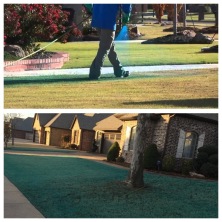 If Gaia is a living body, why are we painting her blue? Whether it is public parks or residential lawns, when there is that special odor in the air, I know to look down and there it is, an endless dye job on the grass indicating treatment. My city is concrete and blue dye for miles. Furthermore, I have sales people knocking at my door monthly asking if I want to spray pesticide around the house to decimate wasps, ants and spiders.
  There are quite a few post-apocalyptic shows out these days.
  Feminism and Religion