

E Pluribus Unum: The Woman From Africa by Stuart Dean

Stuart WordPress photoShe’s his only savior.  African in origin, her figure bears witness to her homeland: her hair twisted in dreads, her lips full, her color dark, her chest broad with pendulous breasts, her stomach flat and firm, her legs slender, her feet broad and ample.

The passage above translates the portrayal of Scybale, the black female slave of the farmer in the poem Moretum, that as discussed in an earlier post, is the source of the phrase ‘e pluribus unum.’  It is reasonable to infer it is a self portrait.

The case for Moretum being the work of a woman (and perhaps incorporating a self portrait) begins with the very fact that it portrays a woman so positively.  Portrayals of women in such positive terms in ancient literature are rare.  The details are impressive because they seem so real.  The form of the description manifests a diagnostic technique (head to feet) well attested in ancient poetry.  That includes Sappho’s self portrait (S. 58b), which reads as if composed while standing in front of a mirror, as does this portrait. Continue reading “E Pluribus Unum: The Woman From Africa by Stuart Dean”
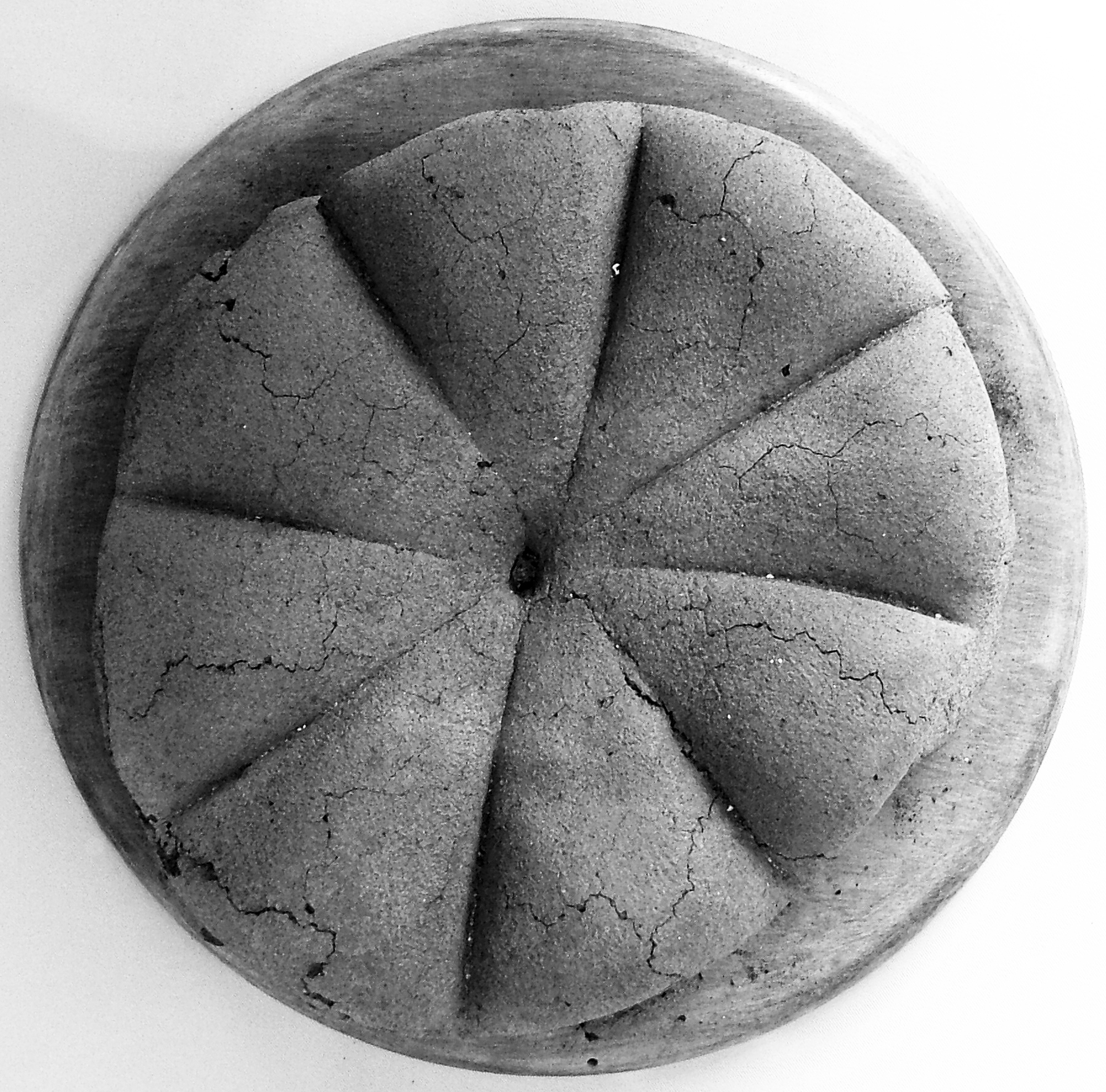
Why Is Pizza Round? The Black Goddess of Rome by Stuart Dean

The remains of an ancient Roman bread pie from Pompeii, carbonized in the eruption of Vesuvius in 79 CE
The remains of an ancient Roman bread pie from Pompeii,
carbonized in the eruption of Vesuvius in 79 CE

The poem Moretum (discussed in my last post) narrates the preparation of a meal that can be characterized in modern English as ‘pizza.’  Round flatbread is baked; to go on it, a cheese spread is mixed.  The details of the narration are such as to create a recipe of its ingredients and related cooking instructions.  

The most important ingredient, however, is not an ‘ingredient’ as such, but a shape.  The bread, the cheese, and the cheese spread are all round.  That by itself might not seem remarkable, but the Latin terminology (words from which ‘orbit’ and ‘globe’ derive) is identical to then contemporary astrological terminology.  The bread is even scored into quadrants, symbolizing, among other things, the four elements and the quadrants of an astrological observer’s circle. 

The ancient audience of Moretum would have recognized in all this the world view of the Italian poet from southern Campania, Parmenides.  Though the only poem he is known to have composed is in Greek, the combination of the fact that he likely wrote it while in Italy and that it had over the centuries since its composition become one of the most influential philosophical works of pre-Christian antiquity meant Parmenides had special importance to Romans.  It is not surprising Moretum has the same meter and many of the poetic images as are found in the poem of Parmenides. Continue reading “Why Is Pizza Round? The Black Goddess of Rome by Stuart Dean”

E Pluribus Unum and The Unrecognized Black Goddess of Rome by Stuart Dean

Stuart WordPress photoE pluribus unum (‘EPU’), which first began to be used by the U.S. in the 18th century, comes from a poem entitled Moretum that until well into the 19th century was generally attributed to Vergil.  During those centuries Latin would have been studied from what was the equivalent of today’s elementary school through at least high school.  Because Vergil is to the study of Latin what Shakespeare is to the study of English, Moretum would have been read by anyone lucky enough to receive formal education in those centuries–mostly boys–including the white sons of slave owners.

Those boys, however, would have been motivated not just to read, but to memorize Moretum.  That is because Moretum, through a variety of clues, encourages allegorical interpretations, one of which is that it celebrates the sexual intercourse of a single white farmer and his sole companion, his black female slave.  Such an interpretation requires ignoring the clues that the author thinks of such sex as rape (as anyone other than a male slave owner would); those clues lead me to think the author may have been a woman.

Illustration of Moertum (1558 Edition of Vergil's works)

Illustration of Moretum from a 1558 edition of the works of Vergil available here.

Continue reading “E Pluribus Unum and The Unrecognized Black Goddess of Rome by Stuart Dean”