February, the month designated as Black History Month, will see us focus on the voice, the faith, and the heartbeat of one of the greatest singers in all of US History. Many have stated that the voice and songs of Mahalia Jackson can be considered one of the most influential voices of the 20th Century. She not only became one of the most modern voices to bridge popular music, blues, and religious hymns but she also is intrinsically linked to the Civil Rights Movement. She is one of the first commercially successful Black musicians of the modern era.
Mahalia (1911-1972) was born Mahala in New Orleans, Louisiana. Both sets of her grandparents were born into slavery. Mahala’s childhood was filled with hardship, yet a persistent faith emerged. Mahala was raised in a very charismatic Baptist church, Mount Moriah Baptist Church. It is at church that Mahala would start to sing, find her voice, and start to uplift the souls around her.
I dedicate this article, an excerpt from my dissertation to Rita Rosalind Kolb Grenn, Hanna Eule, Verena La Mar Grenn & their mothers, Franziska Silberstein, Kaye Schuman and Regina Possony, and to the Kolb, Berlstein, Bernstein, Mathivha, Sabath, Gruenbaum, Silberstein, Lawler and Scott female ancestors.
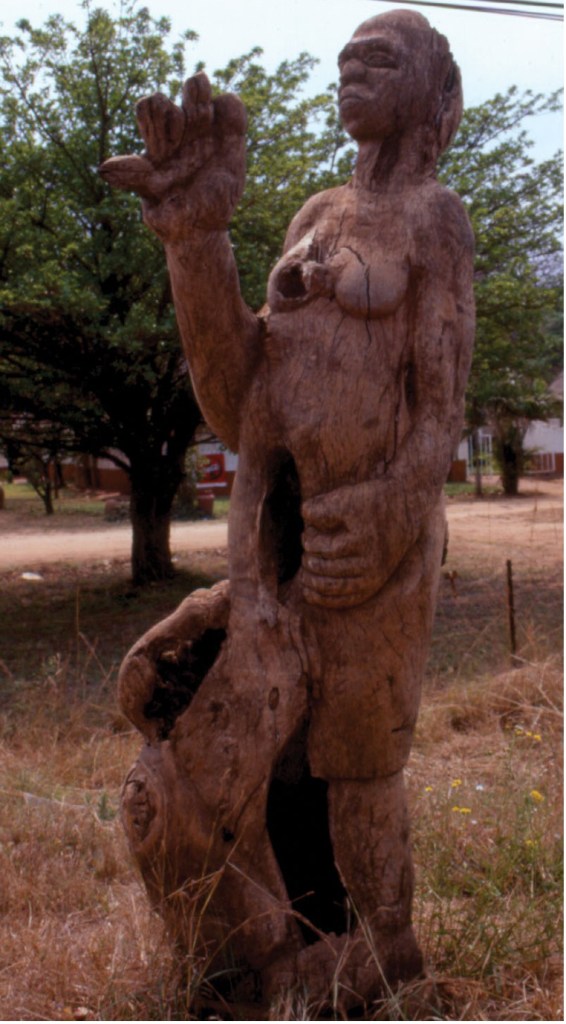
Creator woman by Raphalalani
“She is Creator of the Universe, and of Mankind…She is Creator Woman” – Meshack Raphalalani, Venda artist describing his sculpture, 2001
“The Shekhinah1 is considered an alternative way of thinking about God in the orthodox community… not the major way of thinking about God… but not heresy at all. It’s right there in the tradition.“ – Blu Greenberg, co-founder, Jewish Orthodox Feminist Alliance, interview, 2001
“He created me in his image so he’s inside, within me.“ – Hanna Motenda, Lemba translator at Hamangilasi village, 2001
I recently attended an event in Salem, Virginia, put on by The Salem Choral Society titled “People Get Ready,” directed by S. Reed Carter IV. This popular group has sung on numerous occasions locally as well as performing at Carnegie Hall in New York City and the National Cathedral in Washington D.C. The choir (11 men and ~45 women) sang fourteen selections. The song arresting my attention was “People Get Ready.”
From Wikipedia: “‘People Get Ready’ is a 1965 single by the Impressions, the group’s best-known hit, reaching number three on the Billboard R&B chart. The gospel-influenced track was a Curtis Mayfield (1942–1999), American singer-songwriter, guitarist, and record producer. This particular composition displayed [his] growing sense of social and political awareness…. In 2021, Rolling Stone named this song the 122nd greatest song of all time. Martin Luther King Jr. named the song the unofficial anthem of the Civil Rights Movement and often used the song to get people marching or to calm and comfort them.”
I often find myself sitting in conservative Catholic spaces. My brother is a Roman Catholic priest in the Dominican order and I remain in support of his vocation. Every time, before a Mass officially starts, I’m overcome with a sense of: “You belong here…and you don’t.”
The part of me that has always felt at home in a Catholic setting is that love of the ritual and ceremony, the smell of the incense, the familiarity of the chants and songs. It was a Catholic priest, the late Fr. Ciaran O’Donnell, who taught me how to play the guitar and got me started with the healing practice of songwriting. When I sink into these associations, I feel connected to my Croatian ancestors and our Catholic faith. And there’s the other part of me—the queer feminist and an advocate for other queer and transgender people to live the fullest, most open expressions of themselves in all spaces of life, especially faith-based spaces. As a survivor of several forms of sexual assault and as a trauma specialist who has guided countless other survivors in their healing process over the years, I can’t sit in a Catholic Church and not feel uneasy about the legacy of abuse and silencing survivors within the church. Between my queer identity and dedication to supporting survivors, I feel that I don’t belong.
February, the month designated as Black History Month, will see us focus on the voice, the faith, and the heartbeat of one of the greatest singers in all of US History. Many have stated that the voice and songs of Mahalia Jackson can be considered one of the most influential voices of the 20th Century. She not only became one of the most modern voices to bridge popular music, blues, and religious hymns but she also became intrinsically linked to the Civil Rights Movement and became one of the first commercially successful Black musicians of the modern era.
A few months ago, a friend and I were having one of our many hundreds of random conversations when we started to talk about the differences in the commercialization of the two major Christian holidays: Christmas and Easter. We started really getting invested it this question and what factors lead to Christmas become the juggernaut that it currently is.
Both holidays are given official status. Christmas is a designated federal holiday due to it being permanently celebrated in the Western Christian community on December 25th. Whereas Easter shifts due to seasonal and lunar changes but is always celebrated on a Sunday, meaning it did not need to be given a designated status as Sundays are recognized by the State as a non-work day. Schools across the globe used to call it Christmas and Easter breaks. In the last 10 years, all schools have adopted the politically correct terms of Winter and Spring Breaks. Yet, they still function around the religious observances.
Christmas, it seems comes more and more early in shops. Decorations, candy, gifts, and marketing can be seen as early as September. Christmas music can start to play on radio stations and coffee houses as soon as early November.
September 17 marks the feast day of 12th century Benedictine abbess and powerfrau, Hildegard von Bingen.
Born in the Rhineland in present day Germany, Hildegard (1098–1179) was a visionary and polymath. She founded two monasteries, went on four preaching tours, and wrote nine books addressing both scientific and religious subjects, an unprecedented accomplishment for a 12th-century woman. Her prophecies earned her the title Sybil of the Rhine.
Over eight centuries after her death, Hildegard was finally canonized in May 2012 and in October 2012 was elevated to Doctor of the Church, a rare and solemn title reserved for the most distinguished theologians.
But most people today know Hildegard best for her soaring ethereal music.
The first composer for whom we have a biography, she composed seventy-seven sacred songs, as well as Ordo Virtutum, a liturgical drama set to music.
Her melodies are completely unlike the plainchant of her era—or anything that has come before or since. Likewise her lyrics are highly original and feel fresh to us even today. She was the only 12th century writer to compose in free verse.
Hildegard and her nuns sang the Divine Office eight times a day. She believed that song was the highest form of prayer—the mystical power of music reunited humankind to the ecstasy and beauty of paradise before the fall, connecting the singer directly with the divine, and joining heaven and earth in celestial harmony.
I’ve spent years researching Hildegard. I’ve visited the sites of her abbeys along the Nahe and Rhine, studied her writings, and written a novel about her, Illuminations: A Novel of Hildegard von Bingen, published in 2012. I’ve had the privilege of discussing Hildegard’s life and work with scholars, musicians, and people of faith from around the world. But not until last month did I have the opportunity to experience firsthand what it would be like to sing Hildegard’s wondrous music.
In August I took part in a retreat entitled “Connecting Heaven and Earth: The Chant of Hildegard” at Hawkwood College in Stroud, southern England, led by renowned soprano Dame Emma Kirkby and by author, spirituality teacher, and musician Caitlin Matthews. I’ve been reading Caitlin’s sublime books from the moment she started publishing in the 1980s. Caitlin’s Sophia: Goddess of Wisdom, Bride of God is a spiritual classic I highly recommend. I also own and adore Emma’s iconic 1985 album, Feather on the Breath of God, which first introduced Hildegard’s music to a wide mainstream audience.
This course was open to singers of all abilities. I would describe myself as an enthusiastic amateur, better suited for folk songs than Hildegard’s soaring octave leaps, but as a lover of Hildegard, how could I not at least give it a try? I’ll confess I was somewhat intimidated to learn that many of the participants were professional or semi-professional singers who were quite adept at sight-reading and that some of the scores we worked with were not in modern notation but in the medieval neume pattern. I found our singing classes quite daunting, even grueling, for we were experiencing a heat wave and our classrooms were all south facing with huge glass windows and radiators we could not shut off!
Hildegard’s music is challenging, especially for amateurs like me. It requires a huge range of voice, from ascendant scales that even the experienced sopranos sometimes struggled with, to deeper, profounder notes. But as the weekend went on, I began to slowly grow in confidence, following the stronger voices around me, and enjoying the sheer beauty of the music.
Caitlin helped balance the retreat by sending us on outdoor walking meditations through the beautiful gardens and woodlands where we could meditate on Hildegard’s vision of Viriditas–the sacred as manifest in the green, growing world.
On our last evening, we performed a recital with an audience of one, a friend of one of the participants. Some of the more accomplished singers sang solos while the rest of us joined in the chorus and in other songs. Listening to the soloists, I nearly wept, it was so beautiful and transformative. Listening to Hildegard’s music, particularly when performed live, moves the spirit within. These sacred songs are literally uplifting, just like the dramatic leaps in scales. After our recital, our single audience member told us that she felt the music lifting her heart energy toward heaven.
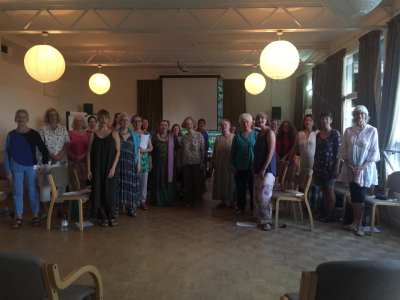
Our evening recital at Hawkwood. Caitlin and Emma are front and center. I am the short one with the long hair in the back, on the right.
While writing Illuminations: A Novel of Hildegard von Bingen, I listened nonstop to CDs of Hildegard’s music, creating a wall of sacred sound that helped inspire and empower my writing. But singing her music live as an amateur was a completely different and possibly more authentic experience than listening to polished and digitally mastered CDs. Hildegard composed her music to be sung by her sister nuns, not all of whom would be accomplished vocalists. She might have had sisters who were tone deaf or had a very limited vocal range. In sacred song what matters most is the spiritual intention behind it, rather than talent or technique or polish. Each song is a prayer offered to the divine. Sacred song is all about the mystery of devotion rather than the mastery of notes or neumes. Singing in a group of like-minded women, even with such a broad range of ability as we had, we reached a sublime place, our voices joining, so that we could hear the Voice behind our individual voices.
“There is the music of heaven in all things,” Hildegard wrote. “But we have forgotten to hear it until we sing.”
We cannot force a connection with God through a faulty conduit. What is important is that we affirm ourselves when we find it — when we feel it. Embrace those experiences, name them for what they are and recognize that you are sacred and the divine – whatever that means to you – is present.
When I’m in a funk, I generally feed into it and make it worse. Once we are in a rut it is easy to continue the spiral downward. I’m good at admonishing myself for lacking gratitude when I feel this way. It might be a Catholic guilt thing.
A few days ago, I was in a dark place; but this time I tried to own my sadness, acknowledge it, and let it go. The only thing I could think to do in hopes of shifting my emotions was to put on music – something up beat that would allow me to transcend the moment.
I listened to a live version of “Stay” by The Dave Matthews Band, a song about embracing the beauty of our lives and the idea that those moments where it feels like we are just wasting time are often our most precious; the ones that allow us to connect with each other and ourselves. It was the sermon I needed — and an important lesson my uncle taught me — but more on that shortly.
I often say that I think music is the sound of my spirit — our spirits. As I started writing this, I struggled with finding the words to articulate the feeling music provokes within me. There is little else that creates such an indescribable experience and that is why I think that music is where I find my connection to the divine.
Traditional religious services have always felt challenging to me. I don’t connect to much of anything and generally find myself feeling angry and rejected by the Church and the community where I am supposed to find God. My grappling with Catholicism aside, we are told that our spiritual lives must take place within particular dimensions, and for many of us God is not there. Continue reading “Finding God in Music by Gina Messina”
For many of us, listening to women-loving-women songs is a spiritual experience. That is because somehow it makes us feel seen, puts a sense of hope into our world as well as daydreams of romance. We can understand the challenges and the regret or guilt that comes with disappointing others and ourselves, them for not being who they wanted us to be and for us, not being who we are for far too long. Holly Near’s Simply Love album narrates a story that I might envision as a musical theatre production, and I really wish someone would ask me to write it and then hold the casting call (yeah, I’d want to be in it too, so save me a part). I offer some of my thoughts on two central songs in the would-be musical in hopes of sacred liturgy on a potential stage.
Simply Love has 28 songs and was released (according to Spotify) in 2000. I think the synopsis would be surrounding Cassandra, in a loving relationship with her partner, reflecting on her journey to this place of authenticity. I can imagine how it might be living one’s live in an exploratory way and coming to new revelations later in life.
To a large extent, women have been written out of history. Any surviving record of female accomplishment is often trivialized or dismissed. This seems especially true in the male-dominated world of classical music. When asked to name a single female composer, many people draw a blank. This isn’t because they’re ignorant, but because women’s music has been buried and neglected for far too long. Even pioneering women composers themselves lived and worked in ignorance of their foremothers.
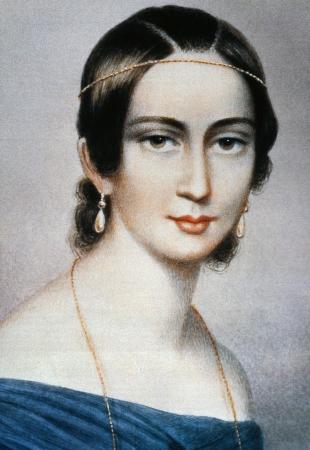
Clara Wieck Schumann, wife of Robert Schumann, composed her first piano concerto at the age of fourteen and wrote a significant body of work in her early life. Mother of eight children and family breadwinner, she became the foremost concert pianist of 19th century Europe. In her sixty-one-year performance career, she interpreted the work of contemporary composers such as Robert Schumann and Johannes Brahms. Yet when it came to establishing herself as a composer in her own right, she was crippled with self-doubt. “I once believed that I had creative talent, but I have given up this idea,” she wrote in her diary in 1839. “A woman must not wish to compose—there never was one able to do it.” She was only twenty when she wrote these words that condemned her music to obscurity. Continue reading “Missing from History: Women Composers by Mary Sharratt”


 When I’m in a funk, I generally feed into it and make it worse. Once we are in a rut it is easy to continue the spiral downward. I’m good at admonishing myself for lacking gratitude when I feel this way. It might be a Catholic guilt thing.
 Feminism and Religion