How to Talk to a War Goddess: A Poetic Lesson From Sekhmet by Annie Finch

Consensus decision making, according to the mother of matriarchal studies Heidi Goettner-Abendroth, is woven into the definition of matriarchal societies. In these cultures, the respect, empathy, kindness, maturity, and belief in sustainable relationships that consensus implies are foundational.  War, as the inimitable Yael Deckelberg sings to us, is “not a woman’s game”; any society that truly hears women will not play it.  Overseen through the caring wisdom of circles of elder women in what Genevieve Vaughan calls the Maternal Gift Economy, matriarchal societies have less than no use for such a cruel, stupid, wasteful custom.  As my great-aunt Jessie Wallace Hughan, founder of the War Resisters League, used to say, someday humanity will consider war as absurd as we now consider the custom of dueling. But we won’t see the end of this integral outrage in our lifetimes; that day will likely arrive only after we’ve all come to our matriarchal senses.

Meanwhile, here we are again.

Continue reading “How to Talk to a War Goddess: A Poetic Lesson From Sekhmet by Annie Finch”
How Women Construct And Are Formed By Spirit: She Who Is Everywhere In Women’s Voices, part 2 By D’vorah Grenn, PhD

part 1 was posted yesterday

 How God is Constructed

During my doctoral research, I worked in the field with a Lemba co-
Researcher who remains a good friend, Dr. L. Rudo Mathivha of Johannesburg and the Northern Province.  When we sat with the women in the village of Hamangilasi, we asked Hanna Motenda, one of the interpreters and a retired schoolteacher, about the women’s concept of God. Throughout the interviews, the women’s conversations both in this village and elsewhere reflected God imaged as male.
I also asked whether the women imagine God as an external force, living in Nature or in Heaven, or as something living within themselves.

Hanna Motenda: Ourselves. God is in us.  They say God is everywhere. 
Even in Nature, when we look at anything, we see God.  Quoting others, she
added, “God is like the wind, He’s everywhere and wherever I am, He’s
there.”

Continue reading “How Women Construct And Are Formed By Spirit: She Who Is Everywhere In Women’s Voices, part 2 By D’vorah Grenn, PhD”

How Women Construct And Are Formed By Spirit: She Who Is Everywhere In Women’s Voices, part 1 By D’vorah Grenn, PhD

I dedicate this article, an excerpt from my dissertation to Rita Rosalind Kolb Grenn, Hanna Eule, Verena La Mar Grenn & their mothers,
Franziska Silberstein, Kaye Schuman and Regina Possony,
and to the Kolb, Berlstein, Bernstein, Mathivha, Sabath, Gruenbaum,
Silberstein, Lawler and Scott female ancestors.

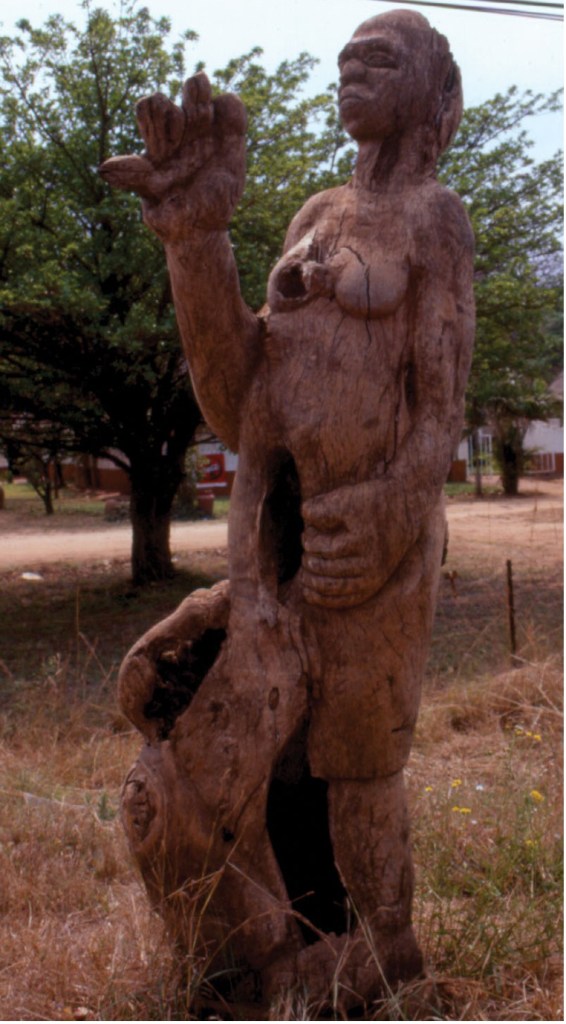
Creator woman by Raphalalani

“She is Creator of the Universe, and of Mankind…She is Creator Woman”
– Meshack Raphalalani, Venda artist describing his sculpture, 2001

The Shekhinah1 is considered an alternative way of thinking about God in the orthodox community… not the major way of thinking about God…
but not heresy at all.  It’s right there in the tradition.
– Blu Greenberg, co-founder, Jewish Orthodox Feminist Alliance, interview, 2001

He created me in his image so he’s inside, within me.
– Hanna Motenda, Lemba translator at Hamangilasi village, 2001

Continue reading “How Women Construct And Are Formed By Spirit: She Who Is Everywhere In Women’s Voices, part 1 By D’vorah Grenn, PhD”

She in Archetypes, Images, Energy… Emerging by Dale Allen

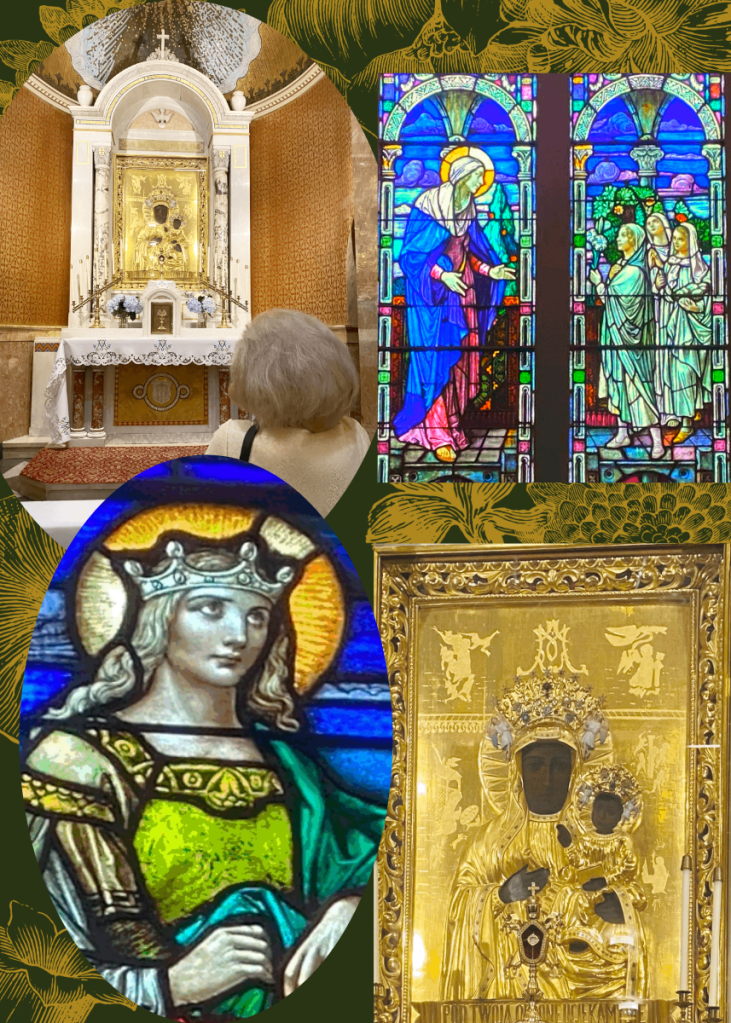
If it weren’t for my mother, I wouldn’t have gone to church on Saturday evening at 5pm.  It was a special trip made by me, my daughter and my 89-year-old mother who is visiting here in Connecticut from Ohio.  We are met at Holy Name of Jesus Church in Stamford, CT by one of my aunts, some cousins, one of my sisters, a brother-in-law, nieces and nephews – part of our big family.

Holy Name of Jesus Church is in walking distance from the house where my mother grew up: the house where her Polish-immigrant parents raised 8 children. My mother and her siblings attended Holy Name of Jesus Catholic School next to the church from 1st through 9th grade. The school is still there and now houses a daycare and learning center.

Continue reading “She in Archetypes, Images, Energy… Emerging by Dale Allen”

Healing What Ails Us and Coming Together: Politics and Other Forbidden Subjects by Caryn MacGrandle

I met my best friend growing up in Third Grade.  I moved around the country after high school, but regardless, her and I have managed to stay in touch.  I spoke with her last weekend and asked about her parents.  Even though its been years since I’ve seen them, I remember them as if it were yesterday. Going out to their cabin at Lake Texoma. Seeing them around the house. 

You see Kim and I were tight.  We saw each other pretty much daily for years.  In some ways it was a much more innocent time.  I remember summers leaving the house in the morning and not going back until sunset, muddy and barefoot.  Crawdads and horse models.  Playgrounds and baseball games.  

But in some ways, it was a much less innocent time. We dabbled in quite a lot that we should not have as the term helicopter parent was unheard of.  Our skies were wide open.  The good and the bad. The large majority of us were latch key kids, and we raised ourselves.  No apps to tell our parents where we were or check in. We went as the wind blew us.

Continue reading “Healing What Ails Us and Coming Together: Politics and Other Forbidden Subjects by Caryn MacGrandle”

Legacy of Carol P. Christ: Essentialism Reconsidered

This was originally posted on September 15, 2014

In my Ecofeminism class we have been discussing essentialism because some feminists have alleged that other feminists, particularly ecofeminists and Goddess feminists, are “essentialists.” They argue that essentialist views reinforce traditional stereotypes including those that designate men as rational and women as emotional. I too find essentialism problematic, but I do not agree that Goddess feminism and ecofeminism are intrinsically essentialist.

Goddess feminists and ecofeminists criticize classical dualism: the traditions of thinking that value reason over emotion and feeling, male over female, man over nature. We argued that the western rational tradition sowed the seeds of the environmental crisis when it separated “man” from “nature.”

Goddess feminists and ecofeminists affirm the connections between women and nature in an environmental worldview that acknowledges the interconnection of all beings in the web of life.

Continue reading “Legacy of Carol P. Christ: Essentialism Reconsidered”

Legacy of Carol P. Christ: The Sacred Feminine or Goddess Feminism?

This was originally posted on January 25, 2016

Carol Molivos by Andrea Sarris 2

In recent years “the Sacred Feminine” has become interchangeable with (for some) and preferable to (for others) “Goddess” and “Goddess feminism.” The terms Goddess and feminism, it is sometimes argued, raise hackles: Is Goddess to replace God? And if so why? Does feminism imply an aggressive stance? And if so, against whom or what?

In contrast, the term “sacred feminine” (with or without caps) feels warm and fuzzy, implying love, care, and concern without invoking the G word or even the M(other) word–about which some people have mixed feelings. Advocates of the sacred feminine stand against no one, for men have their “sacred feminine” sides, while women have their “sacred masculine” sides as well.

Nothing lost, and much to be gained. Right? Wrong.

Continue reading “Legacy of Carol P. Christ: The Sacred Feminine or Goddess Feminism?”

Legacy of Carol P. Christ: Sacred Marriage or Unholy Cover-up?

This was originally posted on November 7, 2016

Many women are drawn to the image of the Sacred Marriage—perhaps especially those raised in Roman Catholic or Protestant traditions where sex is viewed as necessary for procreation but nothing more, and who learn that the naked female body as symbolized by Eve is the source of sin and evil. In this context, the positive valuing of sexuality and the female body found in symbols of the Sacred Marriage can feel and even be liberating.

Jungians have claimed that the Sacred Marriage is an archetype of the wedding between the “masculine” and the “feminine.” Many women have been attracted to this idea as well. It “softens” the radical feminist critique of patriarchy and male dominance. Rather than “castrating” the “phallocracy” as Mary Daly urged, we can think in terms of the “marriage” of qualities traditionally associated with male and female roles. Women, it is said, can use a good dose of ego and assertiveness traditionally associated with the masculine, while men need to have their dominating rational egos tempered by feminine qualities like care and compassion.

Continue reading “Legacy of Carol P. Christ: Sacred Marriage or Unholy Cover-up?”

Mother Goddess and Mothers Hold the Key

judith shaw photoI am of my mother –
from the swirling stars of the cosmos
through the long passage,
contacting and expanding –
birthed of her body,
nourished by her love.

Continue reading “Mother Goddess and Mothers Hold the Key”

Sacred Marriage or Unholy Cover-up? by Carol P. Christ

carol-p-christ-photo-michael-bakasMany women are drawn to the image of the Sacred Marriage—perhaps especially those raised in Roman Catholic or Protestant traditions where sex is viewed as necessary for procreation but nothing more, and who learn that the naked female body as symbolized by Eve is the source of sin and evil. In this context, the positive valuing of sexuality and the female body found in symbols of the Sacred Marriage can feel and even be liberating.

Jungians have claimed that the Sacred Marriage is an archetype of the wedding between the “masculine” and the “feminine.” Many women have been attracted to this idea as well. It “softens” the radical feminist critique of patriarchy and male dominance. Rather than “castrating” the “phallocracy” as Mary Daly urged, we can think in terms of the “marriage” of qualities traditionally associated with male and female roles. Women, it is said, can use a good dose of ego and assertiveness traditionally associated with the masculine, while men need to have their dominating rational egos tempered by feminine qualities like care and compassion. Continue reading “Sacred Marriage or Unholy Cover-up? by Carol P. Christ”