Legacy of Carol P. Christ: Women For Peace–Take To The Streets

This post was originally published on Nov. 19th, 2012

Sometimes we are told that domination and violence and war are innate in human nature; therefore, it is futile to protest war.  But this is not true.

I oppose war because I oppose all forms of power-over, domination, and violence.  As a radical feminist and ecofeminist I believe that power can and should always be power-with, the power that nurtures the growth and development of self and others.  The power of Goddess/God is always and everywhere power-with and not ever power-over. 

Are violence and domination innate in human nature?  We have been told that we are the “naked ape” descended from “apes” who, like the chimpanzees with whom we share 98% of our DNA, were male dominant and violent. Do we, then, have any hope not to be violent and dominant?

Franz de Waal’s studies of the other “ape” species that shares 98% of our DNA, the bonobo, debunks this popular myth.  The bonobo live in peaceful matriarchal clans, and their response to conflict is to rub each others’ genitals until the desire to fight goes away.  They are living proof that species very much like us can choose to “make love not war.” De Waal says that the most we can conclude from studies of our ape relatives is that ancestors of human beings, chimpanzees, and bonobos had the capacity to evolve toward dominance enforced by violence, or toward more peaceful ways of resolving conflict.

Continue reading “Legacy of Carol P. Christ: Women For Peace–Take To The Streets”

Legacy of Carol P. Christ: Is ‘Having To Have’ One Of The Roots Of Suffering?

Carol P. ChristThis post was originally published on Aug. 6th, 2012

There is a strong thread of fatalism in modern Greek culture that has been a powerfully healing antidote to my American upbringing in the culture of “I think I can, I can.”  When confronted with an obstacle, many Greeks throw up their hands, raise their eyebrows, and say, “What can we do?” This phrase is not an opening toward change, but a closing–an acknowledgment that there are many things in life that are not under our control.

In American culture we are taught that if we work hard enough, we can achieve our goals. This view can bring a light of possibility into fatalistic cultures. The truth, however, lies somewhere in the middle–between fatalism and belief in the power of individual or collective will.

In American culture the belief that we can “have it all” if only we work hard enough is the root of much personal suffering.  If things don’t turn out as we imagined they should have, we often blame ourselves. Continue reading “Legacy of Carol P. Christ: Is ‘Having To Have’ One Of The Roots Of Suffering?”

Legacy of Carol P Christ: WAR, WAR, WHAT ARE WE FIGHTING FOR?

This was originally posted Sept 16, 2013. It is sadly pertinent today

“They used chemical weapons, we must do something to stop them.”  A justification widely used in support of President Obama’s decision to launch a military strike against Syria.

We fought the Civil War to end slavery and racism. We fought the Second World War to end fascism. Did we end racism? Did we end fascism? Howard Zinn

At the time of the Revolutionary War, “a not inconsiderable Quaker element was on principle opposed to war, as itself a greater evil than any it might seek to right.”

Michelle Obama is against military intervention in Syria. Does the President dismiss Michelle’s dissent as “womanish”?

Continue reading “Legacy of Carol P Christ: WAR, WAR, WHAT ARE WE FIGHTING FOR?”

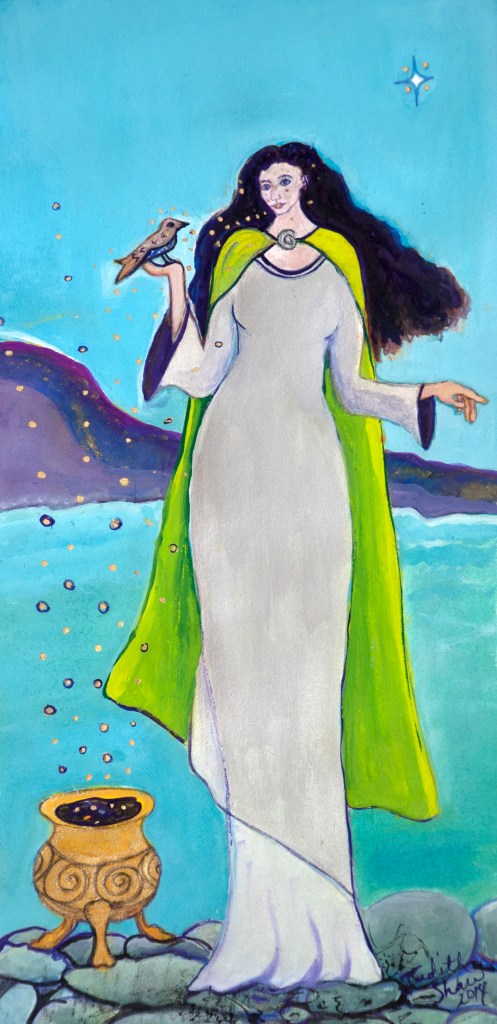
Celtic Goddess Branwen: A Path to Empathy by Judith Shaw

From the mists of Welsh mythology Celtic Goddess Branwen provides important wisdom for our modern world. Themes of the destructiveness caused by viewing those different from us with distrust and fear are found in her story. Vengeance is revealed as a downward spiral of pain and suffering. She illustrates the healing role empathy, compassion and forgiveness can play in a world gone mad with war. Her story reveals the importance of restorative justice and the many factors at play preventing its application. 

Branwen, Celtic Goddess painting my Judith Shaw

Branwen was the sister of the giant, King Bran of the Isle of the Mighty. She was loved by her people for her gentleness, compassion and beauty. In the tradition of the Old Tribes of the British Isle — most likely a hold-over from the days before kings, when Goddess was supreme — her son would become king upon the death of King Bran.

Continue reading “Celtic Goddess Branwen: A Path to Empathy by Judith Shaw”

Legacy of Carol P. Christ: A CLASH OF CULTURES IN OUR GENES

This was originally posted on February 27, 2012

I carry the exact replica of MDNA handed down from mother to daughter since the depths of the last Ice Age 17,000 years ago.  My father carries  the YDNA of the Indo-Europeans handed down from father to son since the time when his male ancestors invaded Europe about 5000 years ago.   

My female ancestors moved with the seasons as they gathered fruits and nuts, roots and greens to feed their families. Some of them may have blown red ochre around their hands to leave their marks in ritual cave-wombs.

Mitochondrial DNA is passed down exclusively from mothers to their children. My MDNA “T2b” was given the name “the clan of Tara” by Bryan Sykes in The Seven Daughters of Eve.  According to Sykes the earliest female ancestor with this gene lived about 17,000 years ago, perhaps in Tuscany.

Most Europeans–male and female–are related to only eight or ten female ancestors. Going further back, all Europeans, Asians, and Aboriginal Australians are related to the women among the San “bushmen” who left Africa 100,000 years ago. The San are one of 13 lineages in Africa that can be traced back to a single African foremother. We really are one big family.

Continue reading “Legacy of Carol P. Christ: A CLASH OF CULTURES IN OUR GENES”

To See Ourselves In Others: Part One by Beth Bartlett

I have felt both a responsibility and a reluctance to write about the escalating conflict in the Middle East.  The situation is so complex and such an unspeakable tragedy – acts of such terror and violence on the part of Hamas toward civilian populations met with even greater violence and repressive measures on the part of Israel toward the people of Gaza. It is a perplexity of the human condition that a people with such a deep history of being displaced and oppressed rather than refusing to oppress in turn, instead engage in the displacement and oppression of others that then erupts into more violence. Both are traumatized peoples acting out of deep pain and woundedness. Thousands have died, more are wounded and displaced, all will carry more trauma into generations to come. The very earth bears the scars of war. In the face of such unspeakable suffering, any kind of analysis feels distancing at a time when what we most need is to let the suffering move us to our depths.

Continue reading “To See Ourselves In Others: Part One by Beth Bartlett”

Crete is the Cradle of a Culture of Peace – Part One by Laura Shannon

These are difficult days. We awaken daily to the ongoing horror of senseless killing. My heart is filled with a yearning for peace. Now is the time to dream of peace, to choose peace, to practice peace – within our selves, with those we love, in our communities and in our world.

But what might a peaceful world look like? It can be hard to even imagine – not only because we live in a world filled with war, but because we have been taught to believe, as Carol Christ explains, that “patriarchy and with it war and domination are universal and inevitable.” However, she goes on, “this is a myth perpetrated by those who do not want to give up the power and privilege the patriarchal system has accorded to them.” War is not inevitable. Peace is possible.

Continue reading “Crete is the Cradle of a Culture of Peace – Part One by Laura Shannon”

From the Archives: Green Tara by Jassy Watson

This was originally posted on March 6, 2015

Goddess Tara is one of the oldest goddesses who is still worshipped extensively in modern times. Tara originated as a Hindu goddess, a Great Goddess or Mother Creator, she who represents the eternal life force that fuels all life. In Sanskrit, the name Tara means Star, but she was also called The Great Compassionate Mother and The Great Protectress.

A version of the Goddess Tara exists in most cultures. It is believed that she will assume as many forms on earth as she is needed by the people.

Adopted by Buddhism in the third century BCE, Tara came to be the most widely revered deity in the Tibetan pantheon. Not only is she a Tibetan Goddess, but she is considered a female Buddha; an enlightened one was has attained the highest wisdom, capability and compassion. One who is able to take  human form and remain at one with every living thing.

Continue reading “From the Archives: Green Tara by Jassy Watson”

Calling All Biblical Wise Women by Rabbi Jill Hammer, PhD

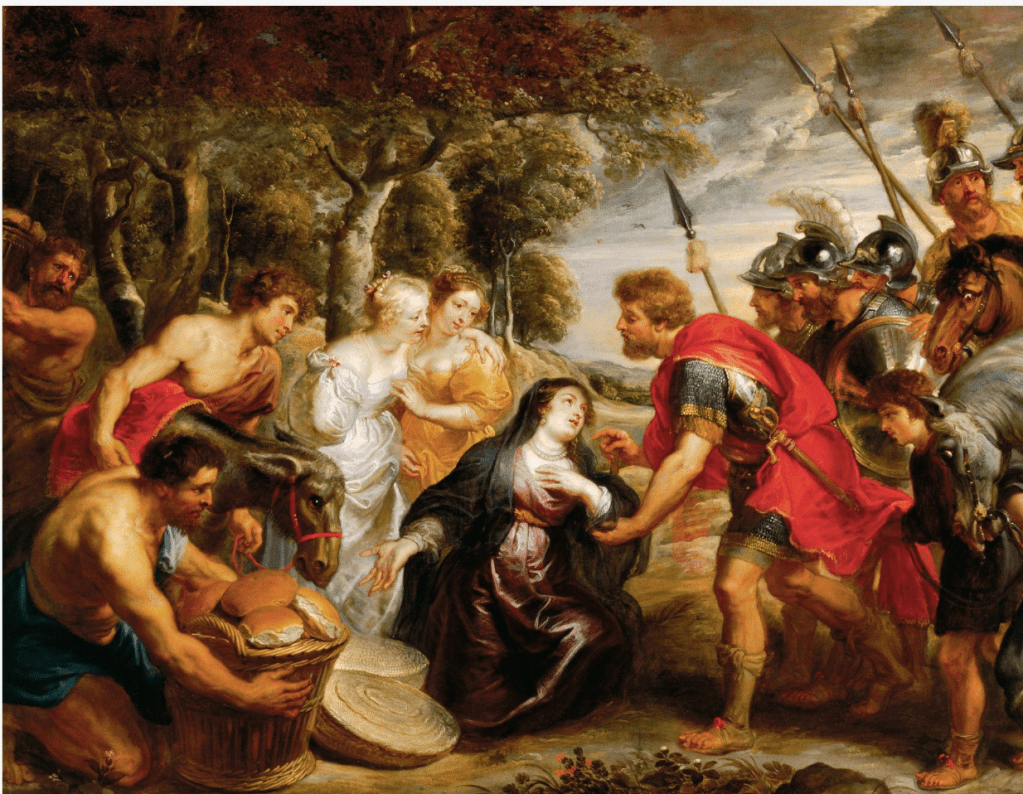
The meeting of David and Abigail by Peter Paul Rubens circa 1630

In these days when so many are afraid and aching for the people of Ukraine, and concerned about the lasting impacts of this war around the world, I cannot help thinking of the wise women of ancient Israel. These wise women, unafraid of confronting dangerous men, used their intelligence and storytelling skill to defuse violent situations between powerful adversaries and restore peace. May their wisdom be felt in the world now. 

The institution of “wise woman” appears several times in the Bible. In the Book of Samuel, a wise woman (chachamah in Hebrew, from chochmah, wisdom) steps in when there is a war, or political conflict, to promote peace. In II Samuel 14, after King David’s son Amnon rapes David’s daughter, Tamar, the king does nothing. Tamar’s full brother Absalom takes matters into his own hands and kills Amnon, then flees to another country.  David grieves for Absalom but won’t send for him. The wise woman of Tekoa appears before King David, pretending to be a woman whose sons fought, and one killed the other. The story she tells helps to reconcile King David with his son Absalom, at least temporarily.  

Continue reading “Calling All Biblical Wise Women by Rabbi Jill Hammer, PhD”

Goddess Embroideries of Ukraine as Prayers for Peace by Laura Shannon

I imagine many of you share my feelings of anger, grief and dread about this invasion of Ukraine. It is hard to know what to do and terrible to feel so powerless. I would like to offer a practice which I am finding very helpful: to meditate on Ukrainian Goddess embroideries as a prayer for peace.

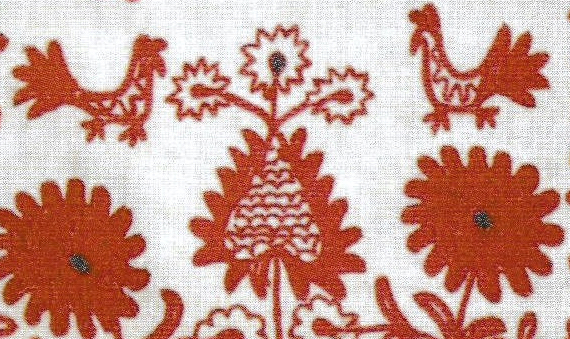
 Early 20th C. Goddess embroidery, central Ukraine. Photo: Ukrainian Museum. In The Tree of Life, the Sun, the Goddess: Symbolic Motifs in Ukrainian Folk Art, p. 99

Goddess figures are ubiquitous in Ukrainian folk art, in woven and embroidered clothing, ritual textiles, pottery, painting, and pysanky, ceremonially decorated Easter eggs (which I will explore in a future post). Goddess embroideries are also found throughout the entire Slavic world, Eastern Europe, the Near East and North Africa, and even farther afield, as Mary Kelly and Sheila Paine have diligently shown.

Continue reading “Goddess Embroideries of Ukraine as Prayers for Peace by Laura Shannon”