Three Wishes for the New Year: Peace, Kindness, and Dialogue in the Catholic Church by Michele Stopera Freyhauf

Freyhauf, Feminism, Religion, Durham, Old Testament, Blogger, Bible, Gender, Violence, Ursuline, John Carroll While I sit and write this post, Christmas celebrations are concluded and I prepare, with the rest of the world, to embark on a new year; a year with my idealistic hopes and want for a better future for humanity.  So for New Year’s I am taking out my golden lamp and making three big wishes:  peace, kindness, and dialogue in the Catholic Church.

Peace

“True peace is not a balancing of opposing forces. It’s not a lovely façade which conceals conflicts and divisions…. peace calls for daily commitment.” – Pope Francis

Peace transcends governments and countries.  Peace should be a daily commitment that each one of us lives every day and practiced in each of our relationships. Looking forward to a new year, I hope to put this into practice and  we will see a shift in politics and attitudes that reflect an ideal of peace and reconciliation – not just nationally, but communally. 

With peace also comes reconciliation.  Fighting takes too much energy.   Making a point to reconcile with that relative or friend that you had a falling out with is a goal that has the potential to bear fruit and be restorative.

Kindness

Kindness is the language which the deaf can hear and the blind can see.” – Mark Twain

With peace and reconciliation comes kindness.  This wish is a large request and one that the Pope calls us to embrace.    A kindness is required that reaches the poor and oppressed, that reaches non-Catholics including atheists, and, that touches every race, class, and orientation. We do not have the right to judge – a sentiment that the Pope continues to reiterate.

According to Julia Baird, “even scientists are now touting the physical and psychological benefits of kindness, compassion, and selflessness.  Multiple studies now show: a single act of kindness can trigger dozens more … and repetitive acts of kindness can make people happier, and less depressed.” This is not a new revelation, but a reminder of the benefits of kindness – a reminder we need to carry into the New Year.

We should, however, remember help the homeless, the children, and the oppressed. This group of people is often ignored the news media, but lack of attention to a problem does not diminish it.  According to the Pope, scandals are the news of today, but the children without food are not news worthy.  According to Pope Francis, we should not “interfere in the lives of others” in a way that is malicious, like gossiping or being boastful.  This behavior brings hurt, bitterness and envy.  Kindness is necessary for a better future for all of humanity.

Dialogue with the Catholic Church

“Fifty years ago, Vatican II spoke of communications.  Let us listen to, dialogue with, and bring Christ all those we encounter in life.” – Pope Francis

Let us not focus on rituals and rules in the Church; rather, we need to focus on the people of the Church.  People,

http://acatholicview.blogspot.com/2013/12/pope-francis-christmas-gift-to-romes.html

after all, make up the Church – not brick and mortar.  Because of this, we need to focus on dialogue – a dialogue with each other, regardless of belief or life choices.  This dialogue should be rooted in a positive attitude and carried out with love and humility.  It should include a focus that reaches out to facilitate peace.  This dialogue should also include the discussion of women’s roles in the Church.  There are so many things to discuss.  The Church is a human church.  With the invitation to dialogue and re-address so many of the untouched or misinterpreted teachings of Vatican II, might we move forward and rebuild this Catholic Church on the shoulders of one who served the poor, loved everyone, and gave of himself?

What are your wishes for the new year?  I would love to hear from you.

From my family to yours, may you have a peace-filled, prosperous, and delightful 2014.

Michele Stopera Freyhauf:  Doctoral Student in the Department of Theology and Religious Studies and a Member of the Centre for Catholic Studies at Durham University as well as an Instructor at John Carroll University’s Department of Theology and Religious Studies, Adjunct Professor in Religious Studies at Ursuline College and the University of Mount Union. Michele has an M. A. in Theology and Religious Studies from John Carroll University,  and did post-graduate work at the University of Akron in the area of History of Religion, Women, and Sexuality.  She is also a Member-at-Large on the Student Advisory Board for the Society of Biblical Literature and the student representative on the Board for Eastern Great Lakes Biblical Society (EGLBS).  Michele is a feminist scholar, activist, and author of several articles including “Hagia Sophia: Political and Religious Symbolism in Stones and Spolia”  and lectured during the Commission for the Status of Women at the United Nations (2013). Michele can be followed on Twitter @msfreyhauf  and @biblicalfem.  Her website can be accessed here and is visible on other social media sites like LinkedIn and Google+

WAR, WAR, WHAT ARE WE FIGHTING FOR? by Carol P. Christ

carol-christ“They used chemical weapons, we must do something to stop them.”  A justification widely used in support of President Obama’s decision to launch a military strike against Syria.

We fought the Civil War to end slavery and racism. We fought the Second World War to end fascism. Did we end racism? Did we end fascism? Howard Zinn

At the time of the Revolutionary War, “a not inconsiderable Quaker element was on principle opposed to war, as itself a greater evil than any it might seek to right.”

Michelle Obama is against military intervention in Syria. Does the President dismiss Michelle’s dissent as “womanish”?

Dwight-D-Eisenhower-Pacifistic-QuotePatriarchy is a system of male dominance, rooted in the ethos of war which legitimates violence, sanctified by religious symbols, in which men dominate women through the control of female sexuality, with the intent of passing property to male heirs, and in which men who are heroes of war are told to kill men, and are permitted to rape women, to seize land and treasures, to exploit resources, and to own or otherwise dominate conquered people.

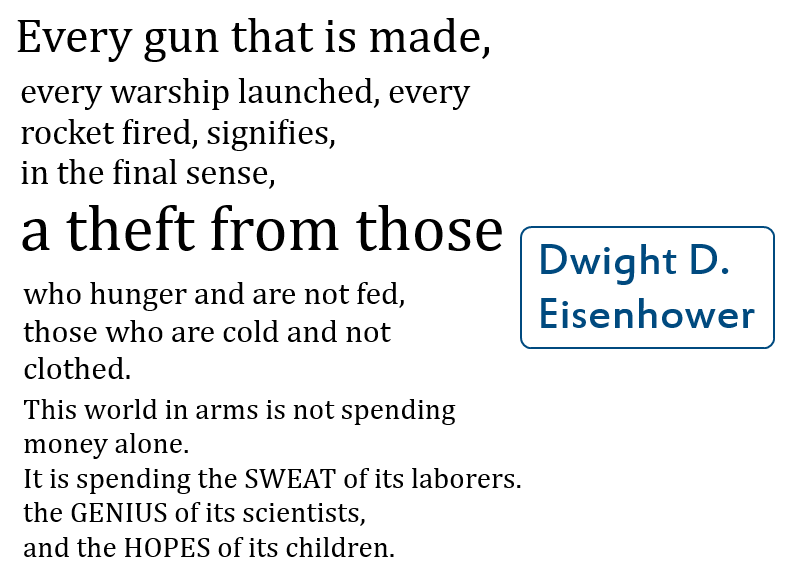
“[W]e must guard against the acquisition of unwarranted influence, whether sought or unsought, by the military–industrial complex.”  Dwight D. Eisenhower

The drums of war have stopped beating publically–at least for now. Obama’s decision to ask Congressional authorization to bomb Syria for 90 days—remember that number, 90 days–has been tabled—at least for now.  But make no mistake, the  military industrial complex is still barking at the heels of US government decison-makers.  The notion that while women may be for peace, “real men must make war” is still operative in the American psyche. Continue reading “WAR, WAR, WHAT ARE WE FIGHTING FOR? by Carol P. Christ”

WOMEN FOR PEACE–TAKE TO THE STREETS by Carol P. Christ

Sometimes we are told that domination and violence and war are innate in human nature; therefore, it is futile to protest war.  But this is not true.

I oppose war because I oppose all forms of power-over, domination, and violence.  As a radical feminist and ecofeminist I believe that power can and should always be power-with, the power that nurtures the growth and development of self and others.  The power of Goddess/God is always and everywhere power-with and not ever power-over. 

Are violence and domination innate in human nature?  We have been told that we are the “naked ape” descended from “apes” who, like the chimpanzees with whom we share 98% of our DNA, were male dominant and violent. Do we, then, have any hope not to be violent and dominant?

Franz de Waal’s studies of the other “ape” species that shares 98% of our DNA, the bonobo, debunks this popular myth.  The bonobo live in peaceful matriarchal clans, and their response to conflict is to rub each others’ genitals until the desire to fight goes away.  They are living proof that species very much like us can choose to “make love not war.” De Waal says that the most we can conclude from studies of our ape relatives is that ancestors of human beings, chimpanzees, and bonobos had the capacity to evolve toward dominance enforced by violence, or toward more peaceful ways of resolving conflict.

Continue reading “WOMEN FOR PEACE–TAKE TO THE STREETS by Carol P. Christ”

IS ‘HAVING TO HAVE’ ONE OF THE ROOTS OF SUFFERING? by Carol P. Christ

There is a strong thread of fatalism in modern Greek culture that has been a powerfully healing antidote to my American upbringing in the culture of “I think I can, I can.”  When confronted with an obstacle, many Greeks throw up their hands, raise their eyebrows, and say, “What can we do?” This phrase is not an opening toward change, but a closing–an acknowledgment that there are many things in life that are not under our control.

In American culture we are taught that if we work hard enough, we can achieve our goals. This view can bring a light of possibility into fatalistic cultures. The truth, however, lies somewhere in the middle–between fatalism and belief in the power of individual or collective will.

In American culture the belief that we can “have it all” if only we work hard enough is the root of much personal suffering.  If things don’t turn out as we imagined they should have, we often blame ourselves. Continue reading “IS ‘HAVING TO HAVE’ ONE OF THE ROOTS OF SUFFERING? by Carol P. Christ”

Feminist Family Values by Gina Messina-Dysert

As a new mother, something that is constantly on my mind is how to teach my daughter morals and values.  She just turned three and has a strong awareness of what is going on around her.  Her vocabulary is vast and continues to grow daily.  I know that if I don’t start teaching her values now, I am missing out on an important opportunity.

Although I was raised Catholic and consider myself a “cultural Catholic,” I am uncomfortable with Catholic traditional prayers because of their lack of gender inclusiveness, among other things.  We don’t attend church as we have not yet found a community that we feel is a good fit for our family.

Thus, I have found myself creating new prayers to recite at dinner and bed time; prayers that encompass our family values, are feminist in nature, and are simple enough that our daughter can remember and recite them on her own.   Continue reading “Feminist Family Values by Gina Messina-Dysert”

The Need for a Positive Counter-Narrative of Religious Involvement in Feminism by Ivy Helman

I’ve admired JC for years.  That’s Joan Chittister, OSB the Benedictine nun of course.  I first saw her speak when I was in graduate school and she visited Yale.  I’ve also read a number of her books.    Her life is an example of how religious people support feminist ideals.    There is a story in Beyond Beijing: The Next Step for Women: A Personal Journal that I would like to share with you

Chittister began her historic journey on the Peace Train to the UN Conference on Women in Beijing in 1995.  As she  entered a conference room to register as a Peace Train participant, she was handed a large manila envelope.  To her surprise it was filled with condoms. At first, she thought that the woman who handed them to her meant to hand them to someone else.  However, Chittister was told (quite emphatically according to her) that she should distribute the condoms to the health workers she encounters while on the train and in the small towns she visits along the way to Beijing.  Eventually after much thought, Chittister decided to do just that and stuffs the manila envelope into her backpack.  Trying to find some humor in what she considered an awkward situation for a nun to be in she remarked, “Now all I have to do is to try not to die in front of some bishop with condoms in my backpack.”

My first reaction to this story is to laugh along with her.  I am also struck by her thoughtfulness to share the story publicly.  She could have been given the envelope, quietly distributed the condoms and then never told a soul.  But, no.  She includes the account of this feminist action she undertook in her book for the world to read.  What an amazing amount of courage and integrity this woman has! Continue reading “The Need for a Positive Counter-Narrative of Religious Involvement in Feminism by Ivy Helman”

Peace Begins at Home by Gina Messina-Dysert

I began my career in the field of social services as a woman’s advocate for rape and domestic violence survivors.  The motto for an organization I was employed with early on was “peace begins at home,” a significant point that must be acknowledged. While much attention around women’s involvement in peacebuilding efforts have been focused at the macro level, there has been little consideration of women’s efforts towards peace at the micro level.  Certainly, women’s involvement in formal peacebuilding processes at the larger public level is crucial.  This being said, we must not undermine the leadership roles that women play in their homes, their families, and their religious and immediate communities, and how those roles can have an incredible impact on greater society.

I would like to start off by defining “peace.”  It is a word that we all use quite frequently and often with different meanings.  Some would claim that peace equates the cessation of conflict.  However, within our world conflict is inevitable; daily life is riddled with internal, interpersonal, intergroup, and international conflict. Thus, when defining peace, we must understand it as being able to deal creatively with inevitable conflict.  According to Jean Zaru, “It is the process of working to resolve conflicts in such a way that both sides win, with increased harmony as the outcome of the conflict and its resolution.  Peace is based on respect, cooperation, and well being.  Peace is the presence of social justice” (Occupied with Non-Violence, p. 81-2).

Zaru’s comments here are important in that she acknowledges a clear relationship between peace and justice.  In the words of Pope Paul VI, “if you want peace, work for justice.”  Because peace is not only the absence of war, but also the absence of poverty and disease, the access to clean water, the freedom from slavery; peace is the affirmation of the full humanity of every person. Peace is salaam, peace is shalom, peace is the well being of all.  Thus, there are many elements that come together in the word peace.  It is not simply government initiatives, it is not a patchwork solution to the conflicts of the world, nor is it submission or silent acceptance, rather we must understand peace as justice. Continue reading “Peace Begins at Home by Gina Messina-Dysert”

Preying on Victims: Radical Christianity and Exploitation of Tragedy in the Name of God By Michele Stopera Freyhauf

It is our moral responsibility, whether we identify as Christians or not, to pray for not prey on the victims of tragedies.

Over the last month, dare I say years, society has witnessed or been subjected to an all out war from radical Christians across America deploying the wrath of God and reveling in the tragedy of others to perpetuate their apocalyptic message of rhetoric and terror.   As I hear the news over the last few months, an old Billy Joel song starts to play in my head “We didn’t start the fire.”  Whether we started the fire or not, we should not feed the flames of hatred but figure out a way to extinguish it.

Here is a brief synopsis of current events that reflect this hatred and radicalism perpetuated in the name of God – examples of Christianity terrorizing or preying on victims through their actions.

The Westboro Southern Baptist Church: Preying on Victims at Funerals and Thanking God for their Tragic Deaths

Original Picture found at http://www.newsnet5.com

Their web address says it all: www.godhatesfags.com.  This group, which one cannot call Christian but rather “hate-mongers,” threatened to burn the Qur’an, was banned from Facebook for spreading hatred against homosexuals, and recently had the audacity to picket funerals of Americans killed in natural disasters, most recently, a teen-age shooting victim, Daniel Parmertor (age 16), from Chardon, Ohio.  Thankfully, volunteers across Ohio and a local group of bikers formed a human barricade to keep these people away from the funeral and grieving family and community.

This group preys on tragedy.  They “praise God for sending a shooter to a High School in Ohio.”  They “praise God for killing a coast guard member.’  They praise God for killing UK Singer Davy Jones.”  They also picketed the funerals of the Arizona shooting victims where Congresswomen Gabrielle Giffords was shot and six others, including federal Judge John M. Roll was killed stating, “God sent the shooter to shoot you!  And He’s sitting in Heaven laughing at you!”  The article goes on into quite graphic detail, which you can read for yourself  but concludes with the statement “Thank God for his Righteous Judgments!”  This group picketed over 47,500 funerals and events to date. One has to wonder what bible they are reading and what God they are praying to. Continue reading “Preying on Victims: Radical Christianity and Exploitation of Tragedy in the Name of God By Michele Stopera Freyhauf”

A CLASH OF CULTURES IN OUR GENES by Carol P. Christ

I carry the exact replica of MDNA handed down from mother to daughter since the depths of the last Ice Age 17,000 years ago.  My father carries  the YDNA of the Indo-Europeans handed down from father to son since the time when his male ancestors invaded Europe about 5000 years ago.   

My female ancestors moved with the seasons as they gathered fruits and nuts, roots and greens to feed their families. Some of them may have blown red ochre around their hands to leave their marks in ritual cave-wombs.

Mitochondrial DNA is passed down exclusively from mothers to their children. My MDNA “T2b” was given the name “the clan of Tara” by Bryan Sykes in The Seven Daughters of Eve.  According to Sykes the earliest female ancestor with this gene lived about 17,000 years ago, perhaps in Tuscany. Continue reading “A CLASH OF CULTURES IN OUR GENES by Carol P. Christ”

Songs We Sing By Barbara Ardinger

Even though I’m a spiritual feminist—and a pretty cranky one—I like the old familiar Christmas carols. I’m listening to a CD of Christmas songs in my car. One of the songs on the CD has the line, “God is watching us from a distance.”

There’s a reason Plato banned music from the Republic. Music gets into our heads and it stays there. Not only the tune and the rhythm, but the lyrics, too. So what idea does this song plant in our heads? God is out there. Watching us like we’re being baby-sat From a distance. So if we should happen to fall down, maybe he’s only watching and he doesn’t have long-enough arms to reach down and pick us up.

Passive watching is a key difference, of course, between the standard-brand religions (also called the religions of the book) and the Goddess religion. They’ve got a transcendent god somewhere up in heaven, up in outer space, up on the mountain, sitting up in the judge’s throne. Keeping an eye on us so if we misbehave, he can slam some thunderbolts down at us. Continue reading “Songs We Sing By Barbara Ardinger”