I spent hours writing you snaked by underground roots entering my story with your forked stick ‘witches’ are a lie that christians made up to legitimize harm done to our kind Artists, Writers, Healers, Visionaries, Trees, (men too) Women whose Difference others defined. Nature defiled.
Do the sandhill cranes stop singing? Do the junipers cease to release their scent? Do the stars fall into the sea? Does the white moon weep??
I want to keep writing stories…
The wind still ruffles fine sand in the wash. Cottontails leap, jumping through twilight. Scaled quail still peep as they scurry over red ground. The thrasher gobbles his suet without restraint. A woodpecker taps at my window.
After being nailed as a witch I separated myself from the word and witch power in general. The word witch had a very dark side and could be used in the same frightening manner as it had been during medieval times to label and to expel any woman who lived on the edge (source of my original sense of unease). Especially one who lived alone in the woods and loved animals like I did.
Why had I been singled out? I was an outsider whose crime was to animate nature. Anything associated with nature was suspect if not ‘evil’.
Feminists beware. If you claim to be a witch – recall that the word is loaded. Personally, I think the label has backfired reducing our overall power as women. Perhaps making us more suspect than we already are.
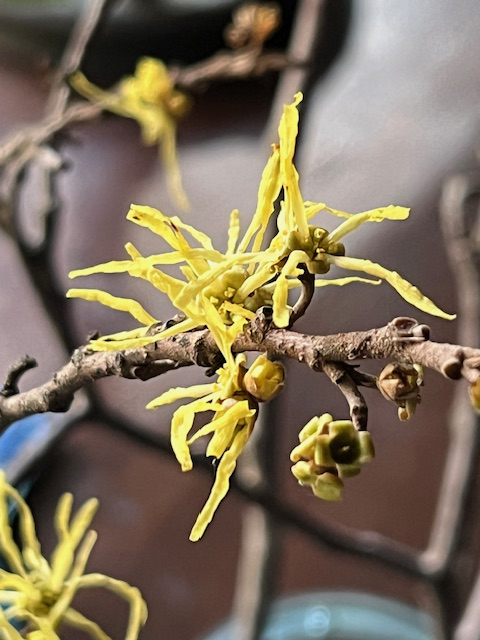
On my grandparent’s farm witch hazel trees were common, sprouting up around old fieldstone walls at the edges of the forest. I loved these trees that bloomed in the fall after all the leaves had fallen. Masses of buttery yellow spindles covered bare twigs. Clusters of blossoms stood out starkly against the trunks of most of the hardwoods – hickory, beech, maple and oak.
As a child I carefully inspected each clump of blossoms. On some branches I found empty seed capsules which I learned much later expelled their seeds all at once the year before. Even these bird beaked pods looked to me like a kind of flower. I also saw little round balls that I later learned were next year’s buds already formed and that the identical looking flowers were either male or female. If I stood beneath a tree, the tangled shapes of the branches wove a loose string -like tapestry above me, one that was often mirrored by a cobalt blue sky.
Twice a year, once in May for a few days and during the first week of October I can’t leave home because I’ll miss the next moment of spring flowering or scarlet flames.
Last week I was captivated by how the golden morning light affects each deciduous leaf. For about five days I ran inside and out all morning to feast upon the astonishing leaf color changes as the sun rose higher. ‘Fire on the Mountain’, crimson, gold, seductive sultry salmon brilliance. In and out for hours. I drove my dogs crazy. Noting the bees on the blushing hydrangea, glad for dragonflies cruising around the house. Greeting little green frog framed against his log. Breathing in the Light. Infused by all too brief moments of swamp maple’s fierce fiery splendor.
Part 1 was posted last week. You can read it here.
Yesterday on the day before the equinox I returned to my favorite hemlock forest after another morning of unproductive research on the mycelial web. The scarcity of information on this critical source of all life on land is troubling. As my frustration mounted I heard a little voice say, ‘Go visit with the hemlocks’. I did.
After I crossed the bridge into the forest something amazing happened. An invisible cloud of incredibly fragrant mushroom scent slipped over me like a shroud. I just stood there for a moment inhaling sweet earth, astonished and bewildered.
Walk lightly pay keen attention… practice gratitude but not at the expense of truth take sparingly share
an Underground Web writes the Story my roots belong to Earth
‘Listen to feathered voices, seek mushroom clouds keep breathing deep into the forest floor feel that luminous Light rooted beneath my feet’
(my fall equinox prayer)
During these days of mindless violence and fearful political upheaval, I feel driven to enter the woods on a daily basis. Lately, I haven’t even left my property. As I cross the bridge over the brook, I brush by the first lacy hemlocks and lovingly touch a branch of witch hazel whose lemony fingered flowers reach for mine. I am on the trail of mushrooms, but not as a forager.
I am drawn to these fungal fruiting bodies because I am trying to learn more about the complex relationships between certain fungi that emerge as mushrooms and their relationship to the trees around them. Some fungi that are in a symbiotic (or mycorrhizal) relationship with one tree or many, do fruit above ground but there are only about 20,000 mushrooms in all. The rest (which is most of the fungal world) fruit underground.
Every year at the end of August I celebrate the Wild Harvest by gathering elderberries to make a medicinal tincture that I use all year long and share with close friends.
This gathering is a process that begins in the spring as I search for new bushes and then later blossoming elderberry flowers in old and new places. As the summer progresses, I continue to monitor the bushes searching for those with berries. Beginning in early August I am on alert for ripening. I am especially mindful because our weather is changing rapidly. If the trend of bad air, fog, and too many deluges continues unabated it’s probable that the times for harvesting berries may shift. In addition, many of the wild places that once supported elderberry bushes have been manicured to get rid of the wild plants by mowing them down, bulldozing the soil to remove all greenery, etc. The rape of wild nature has escalated with time.
This year I have been especially fortunate because I found new clusters bursting out in places they weren’t before. I think the Elder – Berry Woman is helping me. Destroying these precious wild plants and their habitat means that a once common ancient Native plant remedy may be disappearing. Despite horticultural advertising our elderberry bushes do not do well in cultivation, if they survive at all.
I have been involved with plants since I was a toddler. My first word was ‘fower’ for bright yellow buttercups, a nickname I was given by my grandfather that stuck.
I guess it’s no surprise that I started out with gardening as a three-year-old under my grandmother’s tutelage. Her large vegetable plot fed us for most of the year. I seeded my first yellow summer squash into rich moist earth and watched with wonder as the seed emerged with two emerald ears.
In college when students were decorating their rooms with drapes and bedspreads, I bought a pepper plant to brighten my cement surroundings and soon had a windowsill full of plants.
As a young adult I grew many house plants and often talked to them, noting that we seemed to have an uncanny personal relationship, a childhood reality that I had been educated out of. I also gardened with herbs outside my back door, because I loved to cook and needed tasty condiments. Soon I moved on to planting a full – fledged vegetable plot. I canned what I could like my grandmother still longing for the bountiful flower gardens of my dreams. I come from a lineage of female flower gardeners and farmers that stretched back three generations (that I know of) but as a young single mother who worked and one who was frozen from loss, I didn’t make the time.
I went into the dark woods today to look for mushrooms. Mycelial threads made visible. Golden chanterelles, lactarias, russulas, waxy caps, corals, spindly fingers burst out of rich moist earth. Not a ghost pipe in sight.
The fungi know who they are and who they are attached to. I feel like a stranger in this land where everyone is related. I feel those connections but cannot name them. This network so mysterious as to be incomprehensible, a living being that stretches across the earth. What branch of fungi evolved here?