The Wisdom of Cerridwen: Transforming Her Cosmic Brew by H. Bryon Ballard

Moderator’s Note: This is the Preface to the recently published anthology, The Wisdom of Cerridwen: Transforming Her Cosmic Brew.

Cerridwen, ancient Queen,
Dark Mother, take us in.
Cerridwen, ancient Queen,
Let us be reborn.
—a Reclaiming chant
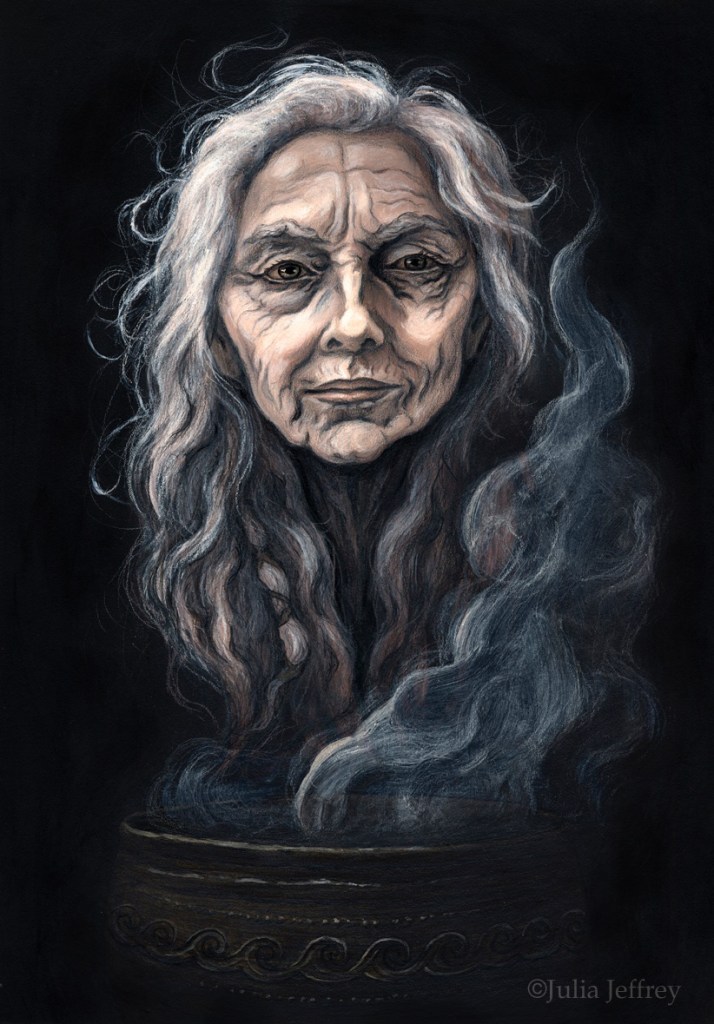
The Cauldron, Julia Jeffries

Open these pages and relish the words of this divine Mother, this wild Sister, this trickster and keeper of the Cauldron of Eternity! Spend time with Her. Learn Her sacred ways, Her stories, Her lore.

I learned the chant above at the Glastonbury Goddess Conference where I taught several years ago. I often use it in both my private meditations and in public rituals. It is simple but direct, quite unlike the Goddess it honors. I learned how to pronounce Her name from a Welsh-speaking colleague who gave it a rolling “r” and an emphasis on the second syllable. Keh-RRRHID-wen. Try it. So delicious to say.

Continue reading “The Wisdom of Cerridwen: Transforming Her Cosmic Brew by H. Bryon Ballard”
Priestess or Goddess? The Real Morgan le Fay by Kelle ban Dea

Morgan le Fay is a popular figure for goddess-women and those interested in depictions of female spirituality, as well as a role model for some witches and pagans. Entire modern spiritual traditions such as the Avalonian tradition in Glastonbury have been created around her. She’s been portrayed in various ways in popular media and culture, and for many is more beloved than her mythical contemporaries, Arthur and Merlin. Which is interesting, because she’s a wholly fictional character, first encountered in the medieval Vita Merlini. Or is she?

While Morgan herself is, indeed, a fictional creation, many have seen echoes of ancient Celtic myth in her story. She’s a healer and magic worker, living on an Otherworldly island, sometimes with her eight sisters, guardian of Avalon with its magical apples and mists. In later iterations she’s a darker figure, an enemy of her brother Arthur, a witch and a seductress. A story we’ve all heard before.

Continue reading “Priestess or Goddess? The Real Morgan le Fay by Kelle ban Dea”

Cerridwen’s Brew; the Psychedelic Priestesses and the Theft of Indigenous Wisdom by Kelle Ban Dea

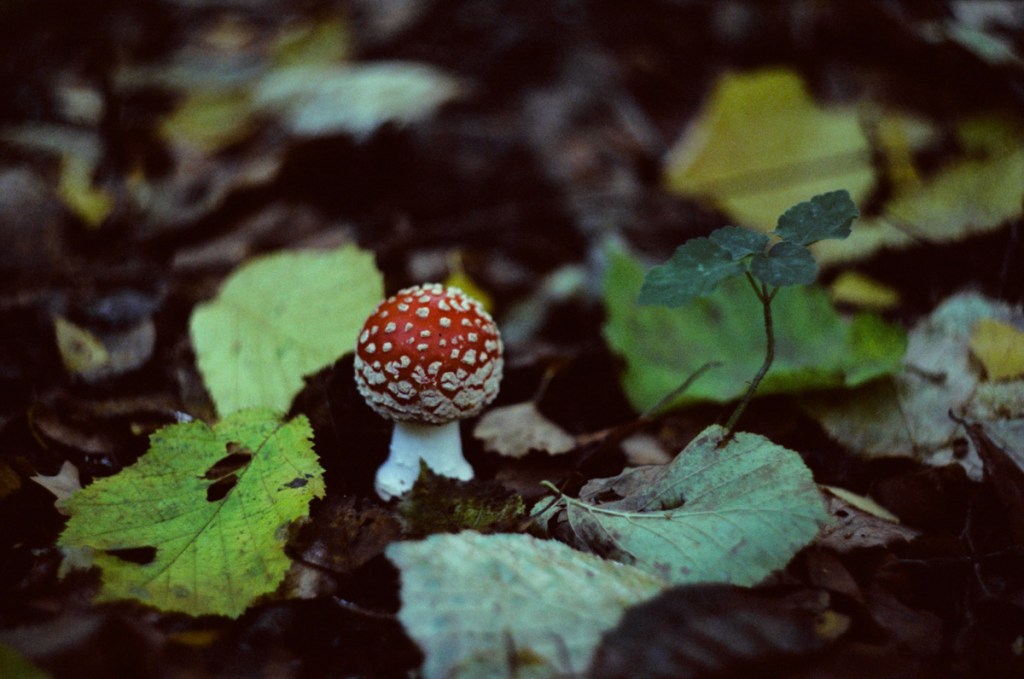
Katerina Shkribey, mushroom. Unsplash stock

Recently I wrote about how the story of Cerridwen and Taliesin is not a muse and hero tale but a tale of stealing from the goddess. Violating her priestesses and exploiting the land.

That is one reading of it. There is another though, which may have some grounding in historical fact and may be a warning to a particular issue gaining prominence today; the rise of the psychedelic industry.

Although neo-Druids, for whom this tale forms part of their core mythology, interpret the awen that Cerridwen brews in her cauldron as the ‘flowing spirit of inspiration,’ the original text makes it clear it is a potion. Cerridwen gathers ‘every kind of charm-bearing herb’ for the potion. Three drops of it turn the boy Gwion Bach into the shaman-bard Taliesin, but the rest is poison.

Continue reading “Cerridwen’s Brew; the Psychedelic Priestesses and the Theft of Indigenous Wisdom by Kelle Ban Dea”

Cerridwen’s Cauldron; Stealing from Old Mother Universe by Kelle ban Dea

Catherine Kay Greenup, blue well
Unsplash stock

The story of how Cerridwen, the witch goddess, brews a magic potion full of awen (inspiration) which is then accidentally imbibed by the boy Gwion Bach, is well loved across the Western world, especially by neo-Druids. Gwion Bach is then reborn as Taliesin, the greatest bard in Britain. It is a typical heroes tale, with Cerridwen as the muse and initiatrix.

Or is it? This tale has always left a funny taste in my mouth, and when I recently read The Broken Cauldron by Lorna Smithers, I understood why. In the oldest version we have of this tale, Gwion Bach doesn’t accidentally taste the awen. He steals it.

Continue reading “Cerridwen’s Cauldron; Stealing from Old Mother Universe by Kelle ban Dea”

Praise Arianrhod by Diane Finkle Perazzo

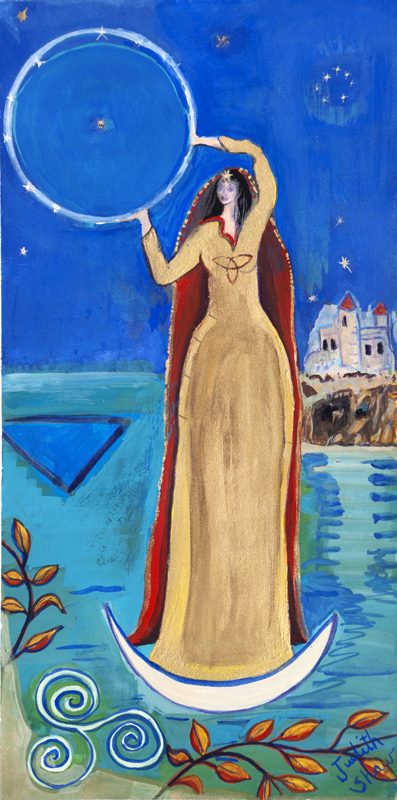
arianrhod-silver-wheel painting by Judith Shaw
Artwork: Judith Shaw from her post on Arianrhod, Feb 23, 2013 which can be read here.

Divine Arianrhod, Beloved Goddess.
Your truth is an inspiration to all living beings.
As you weave the light and the dark so do you scatter.
Joy is in our hearts while you live among the heavens

Celestial Arianrhod, Your crown shines among the stars.
You are the Goddess of the silver wheel upon which all magic is bound together.
Fortunate are we that you are a child of the land and the sky
and mother of the sea and the sun.

Continue reading “Praise Arianrhod by Diane Finkle Perazzo”

I Am Kaleidoscope by Janet Maika’i Rudolph

Art work designed by Jaysen Waller – http://www.jaysenwaller.com/

FAR was founded in June 2011 by four women, Xochitl Alvizo, Cynthia Garrity-Bond, Caroline Kline, and Gina Messina.  They are and have been revolutionary thinkers in the world of feminism. Below is a portion of what they write on our “About” page

There is no single definition of feminism and this is a place of many voices. Important work in women’s studies in religion continues as more attention is paid to the intersection between gender, race, culture, and sexual identity, within feminism and religion.” They go on to say: “We establish this blog in the hope that feminist scholars of religion — and all who are interested in these issues — will use this forum to share their ideas, insights, and experiences, so that this community of thinkers will be nurtured as we explore diverse and new directions.”

Continue reading “I Am Kaleidoscope by Janet Maika’i Rudolph”

From the Archives: Aren’t We All Divine Children? by Janet Maika’i Rudolph

This was originally posted March 18, 2021
Note from Janet: Thank you all who supported the launch of my book Desperately Seeking Persephone on May 19. Due to a printer’s error, the original books sent out were deeply damaged without formatting, editing and with uncertain content. If you received one of these books you are entitled to a free replacement. I have put instructions at the bottom of the post for anyone affected to receive their copy.

Consider the following four birth stories:

Continue reading “From the Archives: Aren’t We All Divine Children? by Janet Maika’i Rudolph”

Aren’t We All Divine Children? by Janet MaiKa’i Rudolph


Consider the following four birth stories:

  1. A high priestess became pregnant in a manner that was forbidden in her society. She gave birth to a baby boy. Fearing for her child’s life, she fashioned a basket of rushes and cast him into a river. He was retrieved by a man named Akki whose name means “the drawer of water.” Akki raised the boy.
  2. A son was born to a young princess who had been forced to keep her pregnancy a secret because it was forbidden. When her son was born, she placed him in a basket and floated him down the river. He was found and raised by foster parents. He grew up to become a noted warrior, speaker and eventually a king. 
  3. A young boy accidentally ingested some drops of star-studded wisdom from the cauldron of a goddess and, in this manner, was suddenly awakened to divine knowledge. The goddess grew furious that her divine wisdom was stolen. Desperate to escape her life-threatening wrath, a wild chase ensued. The boy turned himself into a rabbit, but the goddess turned herself into a dog to chase him down. The boy turned himself into a fish to swim away but the goddess became an otter to continue the chase. The boy then turned himself into a bird, but the goddess became a hawk. Finally, the boy turned himself into a seed and hid in a large pile of grain. The goddess turned herself into a hen and ate up all the grain including the boy-as-seed. In this manner she found herself pregnant. She planned to kill the baby when he was born, but when she saw him, he was so beautiful that she fell in love and she could not bring herself to do so. The goddess sewed the baby into a leather sack and threw him into the river. He was retrieved by a man named Elphin who renamed and raised him.
  4. A woman of the priestly caste of her tribe gave birth to a baby boy. At the time, all boys born to her tribe were under a decree of death. To save her son’s life, she created a basket of reeds and floated him down the river. He was found by a royal princess who retrieved him from the water, gave him a new name and raised him to adulthood.

Continue reading “Aren’t We All Divine Children? by Janet MaiKa’i Rudolph”