

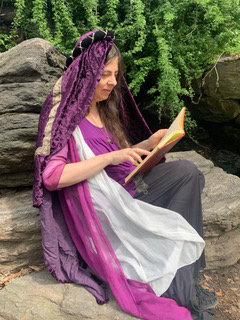
Right before Passover every year, my wife and I visit a botanical garden to look at the spring flowers: daffodils, tulips, cherry and apple blossoms, magnolia. One year, in 2004 or so, we were on our way there when I had an idea. I grabbed a pen and started scribbling long lists of biblical women.
“What are you doing?” my wife asked.
“Making an Omer Calendar,” I said.
Since biblical times, there is a Jewish practice of counting the forty-nine days between the holiday of Passover (the barley harvest and festival of freedom) and the holiday of Shavuot (the first fruits festival and the season of receiving Torah). These forty-nine days were the time of the barley and wheat harvest and were a fraught time for biblical farmers. According to the Talmud, each day of the Omer must be counted along with a blessing. One must count consecutively each day (usually in the evening) and one loses the right to say the blessing if one misses a full day of the count. The Omer is often understood as a time of semi-mourning because of plagues said to occur during this time, but it is also a joyful season when nature’s abundance is at the forefront. This seven-week period embodies both fear that the harvest will be damaged and gratitude for the harvest.
Continue reading “An Omer Calendar of Biblical Women by Jill Hammer”
 Around the age of 8, or maybe 10, I learned my aunt had had a hysterectomy. I remember visiting her house either shortly before or after the operation. I can’t remember which, and it doesn’t really matter. At the time, I don’t think I even knew what a uterus was or that I too had one.
  It is quite common, I think, for Jewish feminists to gravitate to the first creation story of Genesis/Bereshit as an example of human equality but struggle to claim this same passage as an example of the goodness of embodiment. Genesis/Bereshit 1:27 reads, “So G-d created humankind in the divine image, in the image of G-d, the Holy One created them; male and female G-d created them.” In this passage, we have not only equality between men and women, in direct contrast to the second creation story, but also a description of human nature.

 Feminism and Religion