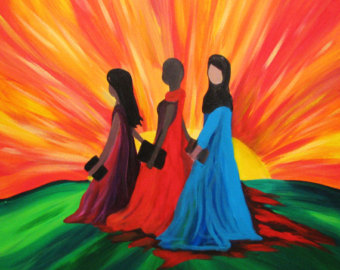
For Mahsa by Lori Stewart

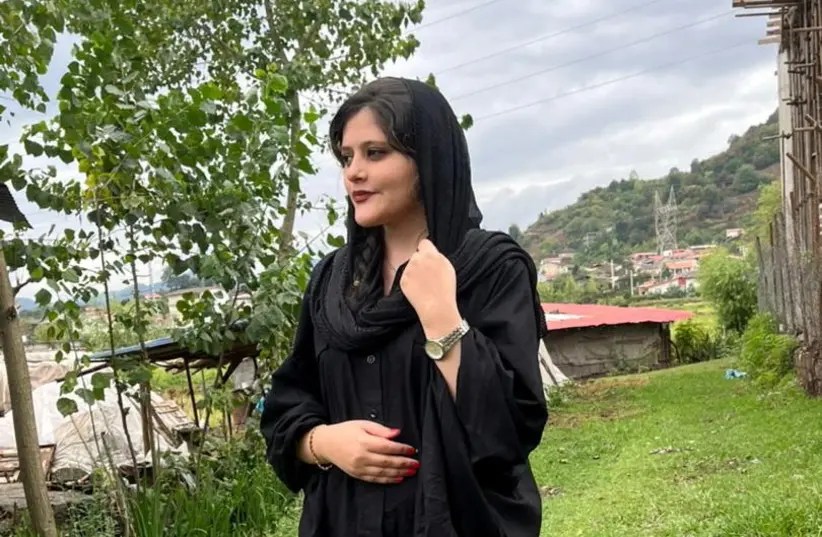
On Friday, September 16, 2022 Mahsa Amini died in a Tehran hospital having been arrested by Iranian morality police on September 13 for wearing “inappropriate attire”. She was 22. Mahsa’s family claims she had bruises to her head and limbs from being beaten. The Iranian police dispute that claim saying Mahsa died from a pre-existing health condition.

Mahsa’s death sparked major protests against the Islamic Republic in Iran and protests of support are occurring around the world. Women are burning their hijabs, which they are mandated by Iranian law to wear, chanting, “Women, life, freedom”. They are cutting their hair which is a longstanding symbol of protest and loss in Iran’s history. This action harkens back to the epic Persian poem “Shahnameh” by Ferdowsi in which hair is a theme and the cutting of hair a symbol of mourning. Around the world, people have followed suit by cutting their hair in solidarity with the protesters in Iran. A recent chant by the protesters is “it’s the beginning of the end” as they challenge their theocratic government.

Continue reading “For Mahsa by Lori Stewart”

If this be Madness … by Vanessa Rivera de la Fuente

Shams

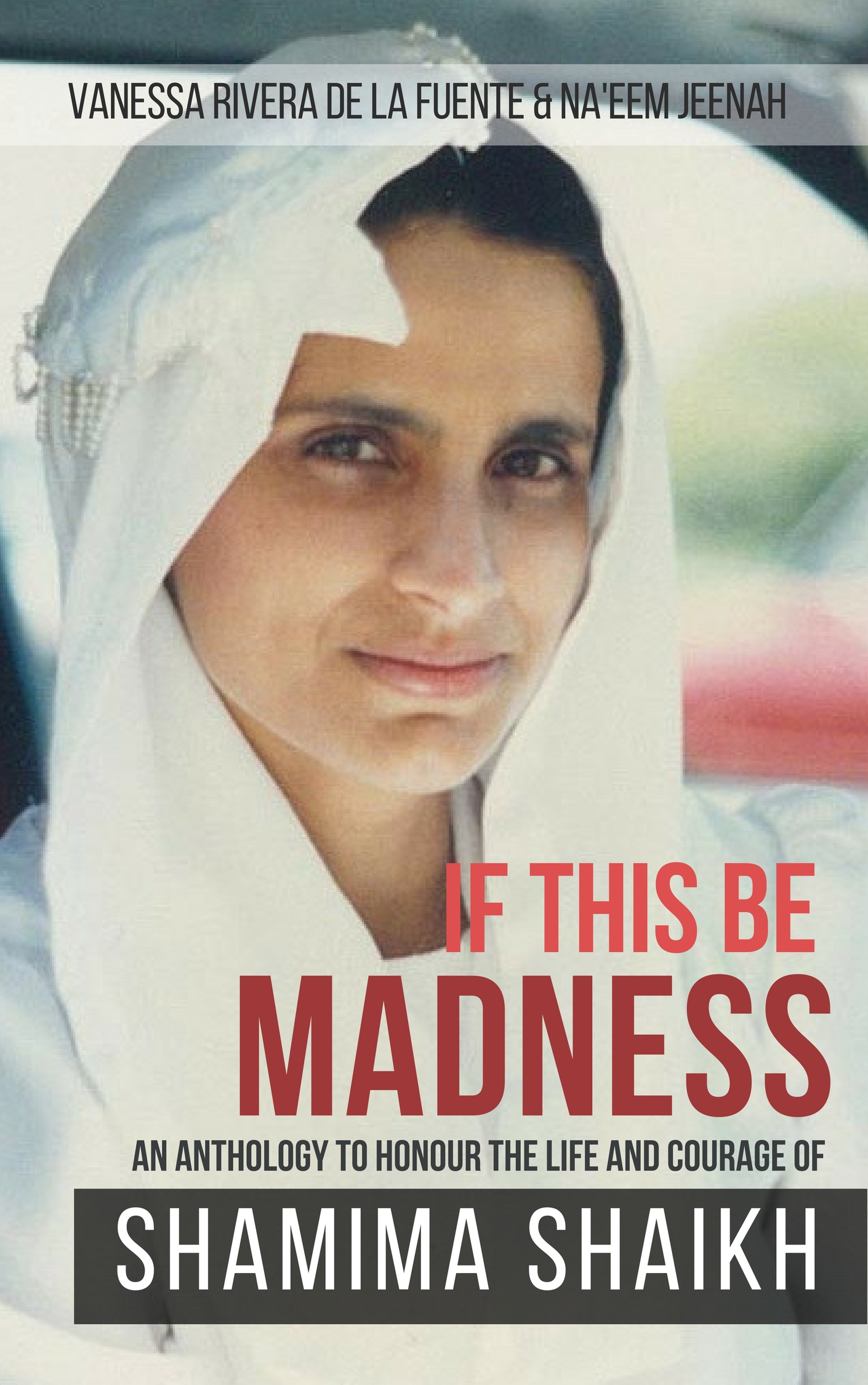
Shamima Shaikh (1960 – 1998) was South Africa’s best-known Muslim women’s rights activist. She was also a brave anti-Apartheid activist, notable Islamic feminist, community worker, journalist and devoted mother who died, 37 years old, from breast cancer. After the Holy month of Ramadan in 2016, I spoke with Islamic Feminist Shehnaz Haqqani about the new-to-me figure of Shamima. I was very excited to know about her and inspired by her fierce and at the same time compassionate moral courage. That year I wrote some pieces about her.

I asked, 18 months ago, Na’eem Jeenah, who was married to late Shamima, if there was a book about her where I could amplify my knowledge about her activism. He said, so far, there wasn´t. Later, I commented to my friend and Chilean feminist comrade, Rocio A., that the idea of an anthology book for Shamima Shaikh had arisen in me.

You must be mad, completely mad, you know? – she said

I am a feminist claiming that we women are people in a patriarchal world – I replied – of course I am mad. Continue reading “If this be Madness … by Vanessa Rivera de la Fuente”

Women, Theology and Identity as Believer by Vanessa Rivera de la Fuente

eve

Like all my reflections, this is not intended to be conclusive, but rather, to share some impressions about theology and the way in which women are created or given an identity as believers.

In the androcentric and misogynist narratives of religious traditions lies the root of much violence against women. This is not new, since the same diagnosis has already been raised by the theologian José Luis Tamayo when he says that although women are the majority presence of religious communities and those most involved in the transmission and practice of traditions “they are the biggest losers” for all the exclusion and violence exercised against them in the name of religion.

The influence of religion on the lives of women goes beyond the realm of religion itself. From theology comes the gender discourses that impact our lives as political subjects. In all the most obvious (sociological, historical, economics) causes of the weak status of women, we can find theological roots or argument religion-based. These  roots are discursive. What is said about women from religions, as well as from the social and exact sciences, institutions and the media, are stories, narratives that are the product of the interaction of mechanisms of power, enunciation authority and historical accumulation of performative actions. Continue reading “Women, Theology and Identity as Believer by Vanessa Rivera de la Fuente”

Latin Identities and Muslim Malinches by Vanessa Rivera de la Fuente and Sumayah Soler

scdqgosrseo_vjrs3uaz-biiyjq

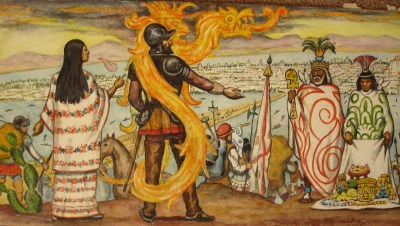
The myth says that Malinche, an Aztec princess, betrayed her people, her culture and faith, for the love and the desire to be loved and accepted by the foreign Spanish conquer, colonialist and exploiter. Her name, said with contempt, is used in Latin America to point those who sacrifice their identity and tradition in order to please foreigners over their own people and family.

Latin America has experienced in recent years an increase in the presence of Islam on the continent. As Muslims, we support and promote freedom of conscience that leads to our brothers and sisters to embrace Islam as their spiritual journey, as we did ourselves. However, we also know, because we have lived and learned from other latin muslims, that converting to Islam for Latinamericans means assuming the position of Malinche; this means to undertake a violent process of detachment and alienation of everything that identifies them as Latin, to prove their love and desire to be recognized as part of Islam. Continue reading “Latin Identities and Muslim Malinches by Vanessa Rivera de la Fuente and Sumayah Soler”

Progressive Islam: A Critical View from Latin Muslim Feminists by Vanessa Rivera de la Fuente & Eren Cervantes-Altamirano

Progressive Islam(s) in the West, particularly in Canada and the US, have been defined as movements that primarily encompass Islamic feminism(s), LGBTQI affirming movements, anti-Conservative theologies, feminist theologies, women-centered liturgies, etc. From within this umbrella, we have seen calls to embrace women-led prayers, women-only spaces, LGBTIQ inclusive and affirming mosques and practices like ijtihad, which are said to be useful in breaking away from Conservative understandings of Islam. All in all, Progressive movements often depict themselves as “reformers” within a paradigm that is usually conceived to be dominated by Orthodox theologies and attitudes mainly driven by Saudi Arabia and Iran.

However, to what degree are Progressive movements truly inclusive? Are they as “radical” as they have been made out to be? Are Progressive spaces any safer for women and trans-women? Are Progressives free of misogyny and violence? Continue reading “Progressive Islam: A Critical View from Latin Muslim Feminists by Vanessa Rivera de la Fuente & Eren Cervantes-Altamirano”

Have You Seen These Muslim Women? by Vanessa Rivera de la Fuente

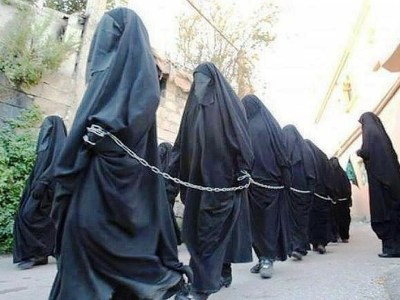
Shia Women AshuraThe photo that accompanies this article, or others similar, have been posted, shared and commented through social networks as expression of the inherent misogyny of Islam, with descriptions such as “DAESH taking women to sell in the concubine’s market” or “Muslim women being carried to forced marriages”. I’ve also seen this picture being used by some feminists in academic conferences to illustrate their presentations on the “Status of Women in Islam.”

This photo has been misused. This image is taken from a religious event which is celebrated for Shiite Muslims to describe the terrible events that took place in Karbala 1,200 years ago. This act recalls the occasion when the family of the Prophet Muhammad, formed mostly by women, was taken prisoner, including children and forced to walk chained. History records and praises the courage of women who bear this painful pilgrimage instead of submit themselves to their captors.

 “Muslim Women” is a Hoax Continue reading “Have You Seen These Muslim Women? by Vanessa Rivera de la Fuente”

Khutba “A Call to Radical and Angry Women of Faith” by Vanessa Rivera de la Fuente

Sacred+Circle+home+page+image+oneI am grateful to the Interfaith Group of Feminist Theologians and Women of Faith for remembering my spiritual affiliation and giving me the opportunity to lead this service in this fully of blessings month of Ramadan and share with you a reflection in the form of a sermon or khutba. Perhaps you know that in orthodox Islam, tradition, without any theological basis, still forbids women to speak or lead rituals. So, this is a joyful occasion for me and I want to start with my usual invocation:

I thank God for this day. I praise Allah for the paths I had to walk that led me to its light and the present day. I ask the protection of the Divine that lives in the essence of everything. and I invite my female ancestors to walk with me in this journey.

A Call to Radical and Angry Women of Faith

My dear sisters, I want to invite you this evening to reflect on what it means to be a radical woman of faith, in a context of extreme upsurge of violence against women and minoritized groups we live in. What does mean being a radical woman? As we know, radical women are feared even by their activist and feminists peers. For the mainstream of society, a radical woman is a little crazy, a little witch, a little ugly, and especially, a very angry woman.

Well, they are right about anger. To be radical is to be as outraged enough to, fearlessly and tirelessly, claim and work for the total end of all kinds of oppression. You heard it right, the total end of all kinds of oppression. For women of faith, like us, who believe in social justice as the prior duty and principle of living in the creation, the current status of abuse, violence and exploitation to which a part of humankind is subjected must provoke us to rage, anger and outrage.

Aren`t you upset? Because I am. Religious patriarchy has historically exercised and endorsed, until today, violence against women and those group defined as “minority.” This religious patriarchy, composed for priests, imams, lamas and rabbis legitimize multiple forms of exclusion of women, sexism, control of our bodies, misogyny and rape culture.

This week we mourn the death of about 50 of our Latino siblings in Orlando. We have to add to this list the hate crimes against queer people in Veracruz, México, as well the slaughtering of women in thousands of gendercides that have become the standard cover of newspapers every day, and the violence against lesbians and trans women, crimes that fail to capture the visibility and solidarity of a homophobic and androcentric society.

Without denying the misogyny and homophobia existing in my community, I want to say that the specific religion of those criminals doesn´t matter, you know why? The pernicious influence of religious patriarchy extends beyond the limits of our assemblies. People blame misogyny and LGTBQphobia on religions as if this is something external to their lives. But each day, at the school, workplace and media our society reproduces all that hetero-sexist, colonial, racist, elitist violence. Heterosexuality as a political regime, validated by hegemonic religious narratives, present in all belief systems, is a source of violence and a form of terrorism itself. Continue reading “Khutba “A Call to Radical and Angry Women of Faith” by Vanessa Rivera de la Fuente”

All Male Panels and Feminist Movement Building by Vanessa Rivera de la Fuente

All Male Panels and Movement BuildingMaking visible gender inequities in the accessibility, acquisition, and transmission of knowledge is essential to breaking ceilings and barriers that prevent women from full participation. This is especially critical in religion, an area in which Patriarchy has bashed women in a systematic, deliberate and cumulative way throughout history.

The current dominant discourses about Muslim women: idealization (sustained by religious patriarchy) and demonization (which corresponds to a Western vision) universalize their own particular way of seeing reality through privilege and representation of female otherness and don´t give women a voice or the chance to declare an epistemic space, meaning a symbolic place of discussion where our experiences with knowledge are relevant.

This is why initiatives like “Not More All Male Panels” and other similar are important. Who dominates knowledge, manages explanations and represents reality is important. If women are excluded, then it is as if women do not exist. The inclusion of women in knowledge serves two purposes: one is simply our presence in instances where knowledge is produced; the other, which my reflection is about, concerns appropriation of knowledge and spaces via movement building.

Panels, Ceilings and Walls

A few weeks ago I participated in a panel to discuss women and feminism in religion. One of my peers spoke to me about the perception of Islamic Feminism. To paraphrase my fellow panelist:

In ‪‎Islamic‬ ‪Feminism‬, your voice is ignored and disposable, because you lack all of what gives one authority in that field– You are a Latina, living in the South, with no formal education in Islam. You have no Arab/Asian name and you speaks Spanish. In a Feminist world that should be ‪‎Intersectional‬ and ‪Decolonial‬ by definition, you’re a woman racialized in contrast with you peers. If not, tell me in how many lists of Muslims Feminist your name is written.

That was hard to hear, but led me to think that the struggle against our lack of presence in matters of knowledge has not only to do with visibility, but also with access and representation. In this sense, I wonder: who is in charge of knowledge in Islamic Feminism? What are the possibilities for any Muslim woman to become a scholar? This is still something only privileged women seem to be able to do. Continue reading “All Male Panels and Feminist Movement Building by Vanessa Rivera de la Fuente”
Invisible Giants: On Women, Mosques, and Radical Activism by Juliane Hammer

hammerAt times, being ignored, erased, and made invisible, is more hurtful than open debate and disagreement. Such silencing and marginalization render the energy, activism, and work of so many people mute and, ultimately, they do not serve the communities and society we are attempting to change. In what follows I insist on uplifting and naming some of the radical Muslim activists and advocates for gender justice I saw ignored in a recent Muslim community event.
On Labor Day weekend, the Islamic Society of North America (ISNA) met for its annual convention in Chicago. On Friday evening, in a well-attended panel, ISNA unveiled (pun intended) its latest statement and campaign on “the inclusion of women in masjids” (places of worship) and issued a call and invitation to sign the statement and implement its central demands in mosques and community centers across the United States and Canada. Panelists at the launch included Hind Makki, the creator of Side Entrance, a tumblr collecting pictures of the various (good, bad and in between) accommodations for women in mosques, and member of the ISNA task force on the issue; Dr. Ingrid Mattson, professor of Islamic studies and former president of ISNA; Imam Mohamed Magid, also a former president of ISNA; Dr. Sarah Syeed, chair of the ISNA task force and Dr. Ihsan Bagy, another member of the task force. Continue reading “Invisible Giants: On Women, Mosques, and Radical Activism by Juliane Hammer”

Reconstructions of the Past 4: Hafsa bint Sirin (“Women’s Withdrawal is Women’s Piety”) by Laury Silvers

silvers-bio-pic-frblog - Version 2Despite the public roles women most likely played in the first century, hadith, biographical, and legal literature of the following centuries positioned women’s ritual activity at home as a norm for pious behavior. The earlier blogs noted that women were present at the Prophet’s home mosque while he was alive and just after, but that public worship seems to have become a problem for men by the middle of the first century. Continue reading “Reconstructions of the Past 4: Hafsa bint Sirin (“Women’s Withdrawal is Women’s Piety”) by Laury Silvers”