
Plant Trees, Trees, and More Trees by Carol P. Christ

I dream that all of us who are suffering burn-out because of national and world politics come together to plant and nurture trees. Scientists say that planting ONE TRILLION TREES would neutralize two-thirds of carbon emissions and reverse climate change. Yes, we need to march, to organize, and to vote. But it is also important to embody our commitment to life and the living. Putting our hands in the soil, tenderly teasing the roots of the trees we plant as we nestle them into the earth, we move from our heads to our bodies, re-membering the interdependence of life.

This has already begun to happen in India—a country where what Vandana Shiva named “maldevelopment” has produced massive deforestation. At the Paris climate change conference India pledged to “make India green again” by reforesting 235 million acres of land. The government allotted 6.2 billion dollars to support the plan. What was not expected was the overwhelming enthusiasm of those who volunteered to plant trees. Continue reading “Plant Trees, Trees, and More Trees by Carol P. Christ”
And We Are Singing, Singing for Our Lives! by Carol P. Christ

Last week I wrote about the grief I feel for the state of my nation (the United States) and of the world. A few days later one of my favorite writers, Katha Pollitt, asked why we are not all in the streets all the time, keeping alive the enormous energy that came together in the first of the women’s marches against Trump and that continued for several months thereafter in protests women’s rights, for immigrants, for the planet.

After reading Pollitt’s essay, I thought: we should be weeping and wailing in the streets. Instead of pink hats we should be wearing black, the color of mourning. But then I pulled myself up short. In the symbolism of our Old Europe, black is the color of rebirth and regeneration: the dark place where seeds must be placed if they are to germinate, the color of rich and fertile earth. If we are going to protest the racism of the Donald and his followers, we must be careful not to repeat the Indo-European binary in which light is associated with truth and goodness, while the devil and all that is evil is dark.

Nonetheless, I like the idea of acknowledging our grief for all that is being lost publicly and with others. Continue reading “And We Are Singing, Singing for Our Lives! by Carol P. Christ”

Grief, Have I Denied You? by Carol P. Christ

I have never had so much trouble trying to find a topic for blog and to begin writing it as I have this time. It is 6:58 am in Greece, three hours and two minutes before my blog is due to be posted, and I still do not have a topic. It is not that topics have not occurred to me. There is the rape allegation against Donald Trump by E. Jean Carroll. There is the fact that it was ignored by the press—as if it somehow does not matter that the President of the US is or might be a rapist. There is the declaration by Kamala Harris that if elected President she would move to immediately process hundreds of thousands of unprocessed rape kits. There are the new reports of the horrendous conditions in which children, women, and men are being kept in detention at the US border. And this morning there is the President’s racist rant against progressive congresswomen Alexandria Ocasio-Cortez of New York, Ilhan Omar of Minnesota, Rashida Tlaib of Michigan and Ayanna S. Pressley of Massachusetts. Continue reading “Grief, Have I Denied You? by Carol P. Christ”

Trial by Fire, Healing by Water by Carol P. Christ

It wasn’t really fire. I came home to Lesbos from a soulful Goddess Pilgrimage to Crete and a discouraging emergency meeting of the Green Party Greece totally exhausted and wanting nothing more than to rest. It was the hottest June on record and my house with its many windows felt like a furnace. Due to a dispute with the installer, it took eleven days to get the air-conditioning fixed. My little dog who could see when I left for Crete, was blind when I returned. I wondered if I would have to put her down and could not bear the thought. I was so tired and so hot that I could not think straight. It was beyond my capacity to even consider moving to a hotel. I didn’t have the energy to unpack. And I didn’t have a car as the old one had been sold and the new one was still at the dealership in Crete. So I couldn’t escape. Instead I tried to hold back tears.
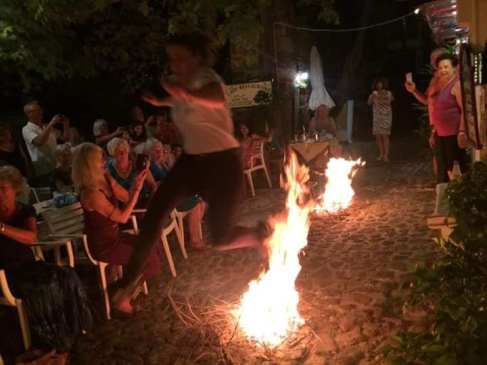
After the air-conditioning was finally fixed, I was able to unpack, wash my clothes, and repack for my return to Crete. The night before I was to leave, I jumped the St. John’s day (midsummer) fires. The locals say they jump the fires for fertility (jumping fires does warm the nether parts) and health. In the photo I am sitting at a table directly behind the first fire, but I soon got up and jumped all three of them, affirming the powers of birth, death, and regeneration.

Continue reading “Trial by Fire, Healing by Water by Carol P. Christ”

Patriotism Reconsidered by Carol P. Christ

Originally published on July 8, 2013 on FAR under the title “What Is Patriotism?,” this blog asks questions that seem even more important today, when tanks have been paraded in front of the Lincoln Memorial and children are held in appalling conditions at our borders because their parents dared to seek asylum in the United States.
July 4, American Independence Day, has come and gone. Perhaps now is as good a time as any to reflect on patriotism. What is it? What does it mean from a feminist perspective?  What is the relationship between patriotism and militarism?  Can one be a patriot and oppose war?  Can one be a patriot and deny that “America is the greatest country in the world,” the foundation of  the doctrine of American exceptionalism?

In a recent blog, Caroline Kline called attention to the use of patriarchal God language in the patriotic hymns her child was asked to sing in the 1st grade.  She wondered if this God language could be changed to female positive or gender neutral.  Her post prompted me to ask if changing pronouns would be enough and to revisit the question of patriotism and nationalism. Continue reading “Patriotism Reconsidered by Carol P. Christ”

Seared by Vietnam by Carol P. Christ

Warning: This post discusses and includes images of the violence of war. 

Recently I have been binge-watching the American comedy-drama series This Is Us. I am of the same generation as Jack and Rebecca, the parents of the triplets, but I didn’t think much about that connection during the first two seasons. The middle class father works-mother stays home family and the “father knows best” story line seemed like a throwback to the generation of my parents. Though everyone was supposed to have loved him, I didn’t like Jack, and I didn’t identify with Rebecca. The children’s lives seemed much more interesting to me, and I resented it when the flashbacks to the parents’ lives began to take over the script.

When the plot turned to Jack’s experiences in Vietnam, I fast-forwarded. “Been there, done that,” I said to myself, “I don’t need to see it again.” But eventually I realized I had to watch some of the scenes of the Vietnam War or I would not be able to follow the plot. Continue reading “Seared by Vietnam by Carol P. Christ”

My Body, My Self by Carol P. Christ

The other night I was invited out by a new friend to meet a group of his friends. It was a lovely gathering, and I felt welcomed. As we hugged good night outside the restaurant, one of the women commented, “Wow you really are tall.” Without missing a beat, I responded, “Yes it has been the bane of my life.” As the words tumbled out of my mouth I was aware that I spoke them dispassionately, not as is usual with a catch in my throat.
Don’t get me wrong about this. I don’t go around hating myself or my body. I know I am striking. I know I stand out in a crowd. I believe I am beautiful even as I age. Still, it is difficult to be singled out as different—especially when you are just going about your business. Moreover, comments about a woman’s height are never neutral: women who are taller than men challenge gender norms by our sheer physical being. Part of what is being said is almost always: you shouldn’t be so tall.

One of these things is not like the others, one of these things just isn’t the same. Continue reading “My Body, My Self by Carol P. Christ”

Kassiani’s Song: Woman at the Center of the Easter Drama by Carol P. Christ

Today I am reposting the song and story of Kassiani, the Byzantine composer, poet, and hymnographer, who is not well-known to western feminists or in western history in general. In Christian Orthodox tradition, Kassiani’s most famous song will be sung this week on Easter Tuesday night or very early Easter Wednesday morning, placing a woman’s love for Jesus at the heart of the Easter drama.

For many this song is the high point of Easter week.

Kassiani, also known as St. Kassia, was a Greek woman born into a wealthy family in Constantinople (now Istanbul) about 805 to 810 AD. According to three historians of the time, she was intelligent and beautiful and selected as a potential bride for the Emperor Theophilos. The chroniclers state that the Theophilos approached her and said: “Through woman, the worst,” referring to the sin of Eve. Clever Kassiani responded, “Through woman, the best,” referring to the birth of the Savior through Mary.

Apparently unable to accept being put in his place by a woman, Theophilos chose another bride. Perhaps relieved, Kassiani founded a monastery in Constantinople becoming its first abbess. She was an outspoken theological advocate of icons during the iconoclastic crisis (for which she was flogged). One of only two women to publish under her own name during the Byzantine Middle Ages, Kassiani wrote both poetry and hymns. Up to 50 of her hymns are known today, with 23 of them being part of the Greek Orthodox liturgy. Continue reading “Kassiani’s Song: Woman at the Center of the Easter Drama by Carol P. Christ”

The Room Where We Support Each Other, Part 2 by Carol P. Christ

Last week, In the Room of Undressing where women strip themselves to the bone, my great-great-grandmothers on my father’s side spoke in me. I had been afraid they would judge me for not being a wife and mother like they were, but they did not.

The story continues with my great-great-grandmothers on my mother’s side.

Ingrid Mattsdottor, born 1829, Överhogdal, Jämtlands Län, Sweden, died 1918, Kansas City, Missouri, proprietor of a boarding house, mother of five daughters:

I was the oldest of eight children. Our father died when I was eleven. At sixteen I was sent to work as a servant in a village far from home. I stayed for six years. After that, I worked for two years on a farm in our village. I was twenty-nine, and wondering if I would be an old maid, when Olof and I married. Our five daughters came quickly. I knew a lot more about work and children he did, so I took charge. When the crops failed all over Sweden for two years running, I said enough was enough. As soon as our last daughter was born, I sold the farm, and we left for America.

Iowa was worse than Sweden. Our little Carin died the first year. Olof gave Ingrid to a wealthy Swedish couple without so much as a word to me. He kept talking about going back to Sweden. One day he took the money I set aside and bought his ticket.

By the time he came back for us, Anna, Sarah, Belle, and I had moved to Kansas City. I was running a boarding house. I told Olof that we had no intention of going back to Sweden with him. When Anna married, instead of moving out, she brought her husband and his children to live with us. Belle became quite the business woman and took over my role as provider. Sarah and her family were always close by.

I worked as hard as any man and Belle did too. “Far better off on our own,” we would often say. We are proud to have another strong woman in our family. I am sorry you didn’t get to meet Belle. You would have liked her.

Continue reading “The Room Where We Support Each Other, Part 2 by Carol P. Christ”

The Room Where We Support Each Other, Part 1 by Carol P. Christ

Over the past year or so I have been reciting my mother line, seven generations back, as a mantra of gratitude that helps me sleep at night. Sometimes I also name my sixteen great-great-grandparents, though I often fall asleep before finishing.

I have gained courage from the strength of their lives, but I never wondered what my eight great-great grandmothers would think of me. My life feels so different from theirs. Perhaps I feared they would judge me and my life.

This weekend, while re-reading Woman and Nature, I followed the narrator through a Passage to the Room of Dressing:

Where the women are not close. Where the women keep themselves at a distance.  . . . where the women tell each other that they are happy.  . . . The room where the daughter denies she is anything like her mother. (156)

Continue reading “The Room Where We Support Each Other, Part 1 by Carol P. Christ”