

 Feminist spirituality is often disparaged in academic feminist and progressive communities. Many of the strongest critics are Marxists, but there is a general agreement that religion is the opiate of the people, a false belief system that diverts energy from the difficult work of creating justice in this world. This view is rooted in the habit of thought known as classical dualism in which spirit and nature, spirit and body, and this world and the next are viewed as antithetical. From this, it would seem to follow, feminist spirituality focuses attention on an imagined spiritual world as opposed to the material world in which real people live and interact with each other. Nothing could be farther from the truth.
Feminist spirituality is rooted in a strong critique of classical dualism, which sets mind above body, spirit above nature, and male above female. Feminist Goddess spirituality asserts that the female body has been especially disparaged in traditional theologies rooted in classical dualism. This can be seen in the image of the naked Eve as the source of evil, sin, and temptation. In contrast, Goddess spirituality is inspired by images of the female body of the Goddess as a symbol of the Source of Life. Goddess spirituality understands nature (or the world) to be the body of the Goddess and affirms this world as our true home. This world is understood to be an interconnected web of life shared by humans and other than human beings. Continue reading “I Am a Progressive because of Not in spite of My Feminist Spirituality by Carol P. Christ”
 Over the past few weeks of lockdown in Greece, I have asked myself numerous times: if we can shut down the world economy because of a virus, why don’t we shut everything down until we end war or find real solutions to global climate change? In my mind the horrors of war are much worse than the horrors of disease and dying and the threat and reality of global extinctions pose a much greater threat to humanity (not to mention nature) than the Coronavirus.
 Just over a month ago and shortly before Greece went into Coronavirus lockdown, I signed the contract on my new apartment in Crete (after waiting 6 months for the owner to submit his paperwork). Though I did not realize it until I had been sitting in the notary’s office for several hours, the date of the signing was February 25, my father’s birthday. My father and I had a troubled relationship, due to the fact that he could not accept that I did not “know my place” in a world where women were expected to be submissive to men.
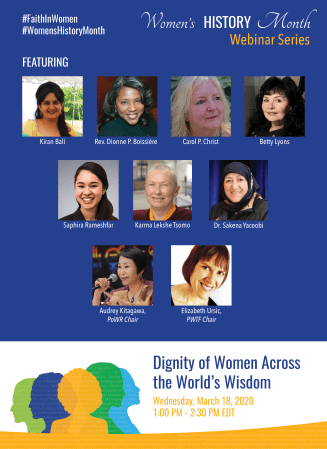 I have been asked to post my contribution to the Parliament of World Religions Webinar: Dignity of Women Across World’s Wisdom.
  In a recent blog on Feminism and Religion,
  As the results from America’s Super Tuesday election primaries came in, I found myself feeling disoriented. I could not focus on any task and found myself obsessively reading the news and checking my Facebook timeline. Many of my friends who had supported Elizabeth Warren were embracing Biden as the next best hope to defeat Donald Trump. Sometime on Thursday, I came across Starhawk’s
  On a cold and rainy morning in Lesbos, I ponder the advice of my intuitive friend Cristina to reflect on the spiritual dimensions of my decision to move to Crete. When asked why I am moving from Lesbos to Crete, I tend focus on the negative: I am lonely in my small village; and I am disheartened by my neighbors’ lack of compassion for the refugees who come to our island from Syria, Iraq, Iran, and Afghanistan.
 “And a rich old white man shall lead them.” Is this saying found in the Bible or any other collection of sacred texts that those committed to social justice admire? If not, then why are liberal pundits (and even some of my friends) rushing to declare Michael Bloomberg to be the candidate—and perhaps the only candidate—who can save America from Donald Trump?
 The term “panpsychism” is made up of two Greek words: pan, meaning all, and psyche, often translated mind or soul. Panpsychism is the view that (forms of) soul or mind or consciousness are found throughout the web of life. This view is in contrast to the traditional western philosophical and theological consensus that having a soul or a mind is what sets human beings apart from other forms of life. In contrast, mystics, children, and many indigenous people assume that human beings are not the only form of life with consciousness.
 I have been thinking of moving to Crete for almost two years. I signed the pre-contract for my new apartment in Heraklion on September 28 last year and anticipated signing the final contract in October. However, the owner did not submit his paperwork until the end of November, and little work gets done in Greek offices over the holidays. Moreover, the sitting tenant was doing just that. She been asked to move in July, and with an expired lease, she lost the formal eviction case in October. The realtor and the owner felt certain she would move before the holidays. She did not.
 Feminism and Religion