Human Elements in Plants: Wisdom and Botanical Lore by Nazia Islam

My paternal side of the family comes from an extensive line of farmers. They were notable for growing eggplants, but they held all sorts of agricultural knowledge. My maternal side of the family has a hushed history of female kobiraj/ natural medicine practitioners. General folk knowledge was passed through mothers and mothers-in-law.

Much of this “folk knowledge” would peek into my life as I was growing up in New Jersey–especially through our garden. It didn’t matter where we lived, we would always grow something somewhere even if it was just germinating seeds for other people. My parents would go to great measures to bring back seeds of vegetables they could not find in the US–specifically gourds and beans– from Bangladesh whenever they visited.

Continue reading “Human Elements in Plants: Wisdom and Botanical Lore by Nazia Islam”

Sheela na gig: The Dark Goddess of Sacred Power BOOK REVIEW by Kay Bee

If there are devotees of the Dark Goddess on your Yuletide gift list, Starr Goode’s gorgeous book, Sheela na gig: The Dark Goddess of Sacred Power, may be the best gift you could choose for them.
Goode’s connection to the Sheela is profound. Equal parts scholastic study, visual feast, & ardent devotional, this book will take the reader along on the author’s epic journey into the Mysteries of the Sheela na gig. As Goode explains thoroughly, there are no written primary source documents illuminating the origins & purposes of the Sheelas that survive today. Scholars and thea/ologians argue about the truth behind Her presence, but no one can yet definitively declare Her history and meaning. However, that does not mean one cannot  still study that history as one way of connecting deeply with Her Mysteries today. Continue reading “Sheela na gig: The Dark Goddess of Sacred Power BOOK REVIEW by Kay Bee”

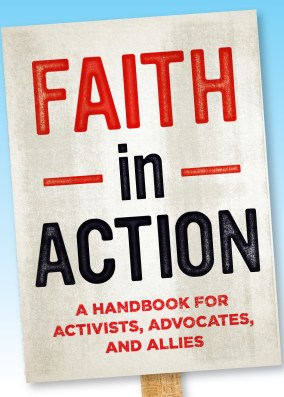
Faith in Action by Lisa Kloskin

Nearly a month ago, American voters showed up at the polls and delivered some big wins: the first openly transgender person was elected to a statehouse—Danica Roem in Virginia. Roem defeated an incumbent candidate who authored an anti-trans bathroom bill. Also in Virginia: the boyfriend of a reporter shot and killed on live TV, Chris Hurst, won a seat to the statehouse on a gun-control platform, defeating the three-term NRA-backed incumbent. And Hoboken, New Jersey, got its first Sikh mayor: Ravi Bhalla. These and others are encouraging signs that love and tolerance are gaining ground in the public sphere. But there’s still so much work to do. White Supremacists and Nazis still walk boldly in the streets, LGBTQIA teens still face bullying and higher rates of self-harm, women are still paid less for equal work and harassed in every arena, sea levels are rising at faster rates than we previously thought, people of color are still being killed by police, mass shootings are still a regular part of our news cycle, refugees are still waiting in camps around the world for a chance at a better, safer life.

Activists and advocates have been working for justice in these and other areas for decades. In the last year, spurred on by events like the Women’s March, a growing group of would-be activists has emerged. These allies are a welcome addition to the justice movement, but many worry they won’t do or say the right things, and want to have their perspectives deepened on important issues. They need guides and resources to give them the knowledge, tools, and confidence to make a real impact.

Continue reading “Faith in Action by Lisa Kloskin”

My Connection to Bengali Vaishnavism by Nazia Islam

Last summer I began a deep inquiry of Gaudiya/Bengali Vaishnava culture. That inquiry had its origins in a dream I had two years prior where Radha and Krishna appeared in the form of miniature clay figurines. Krishna went missing and Radha asked me to help find him like how she implores her sakhis/friends in much Vaishnava literature. Seeing deities in that manner, as I know in some aspects of Bengali culture, is a big deal. It usually signifies some spiritual connection to those deities. I wrote the dream down because of how vividly I saw it but brushed off as anything significant to me personally though the dream sparked my inquiry.

I had gotten some great information from an academic I met at the American Academy of Religion conference in 2015 who recommended I start with an ethnographic study, The Place of Devotion (Open source by UC Press), published that year by scholar Sukanya Sarbadhikary on the diversity of Bengali Vaishnavism. That was my start of my spiritual-academic journey of understanding Bengali Vaishnavism, but it has taken a while for me, through a lot of counseling, to get mentally and emotionally stable before I could start processing and analyzing all the information I’ve been collecting on this topic. I’m not going to divulge on the details about this in depth, but I can say it is connected to the politics of religious purity found across South Asian Muslim and Hindu communities which is exacerbated by non-Muslims and Hindus who can’t comprehend, for lack of a better word, folk religion or religious syncretism apart from the framework of dual religious identity through intermarriages and the term “multiple religious belonging.” But even those terms are not readily ascribed to non-white bodies.

Continue reading “My Connection to Bengali Vaishnavism by Nazia Islam”

The Brazilian Great Mother by Mirella Faur (Part 2)

This article was originally published by The Beltane Papers issue #30 February 1998. FAR is republishing it with permission from the author in order to digitally archive this important work. Part 1 is available here.

The indigenous Brazilian tribes worshiped all Mothers and believed they created life without the male presence. All Goddesses were virgins, but their virginity was only a symbol of independence and self-sufficiency, without any physical meaning. In some myths, the virgins are impregnated by numinous energies, manifested as animals (snake, birds, porpoise), forces of Nature (rain, thunderbolts, rays of light), ancestors or Deities. As other native people, they weren’t aware of the male participation in the conception and respected and revered the menstrual blood as something sacred, filled with magical powers, because after the “supernatural” ceasing of the monthly flow, life was created. Only after the interference of the white settlers and the massive Catholic indoctrination that the native cosmology was distorted, the Father assumed the main place, the Son became the second one in the divine hierarchy and the Mother was transformed in a suffering and silent virgin. Even so, many native traditions survived in the legends, folk beliefs, shamanic healing and magical practices as the Pajelança and Encantaria.
Besides the “Good Mother”, some of the native legends also mention the “Terrible Mother”, Boiuna, the Giant Snake of the Amazon River. The bottom of the river was her habitat and she appeared only at night, destroying boats and devouring people. Her terrifying aspect and her connection with the darkness, death and night are, as a matter of fact, features of the Dark Goddess, the Reaper, who controls the eternal cycle of birth, life, death and transformation.

Another manifestation of the Dark mother is Caamanha, “Mother of the Woods”, protector of the wild life who punished all intruders and violators of her domain. In other myths, she was transformed either in the Curupira or the Caapora, strange male beings, with twisted feet, who walked backwards, thus acting as guardians by misleading hunters or even attacking them.

In some Guarani myths we find mentions to the “Mother of Gold”, described as a beautiful woman or a brilliant globe, which seduced the gold prospectors and took them deep in the mountains, far away from the gold mines. Considered a Guardian of Mother Earth’s treasures, she sometimes manifested herself as Boitatá, who could appear as a phantasmagorical snake, with a luminous body and huge eyes, or only as a giant head, floating over hidden treasures, frightening or punishing those who destroyed Nature in search of fortune. Continue reading “The Brazilian Great Mother by Mirella Faur (Part 2)”

The Brazilian Great Mother by Mirella Faur (Part 1)

This article was originally published by The Beltane Papers issue #30 February 1998. FAR is republishing it with permission from the author in order to digitally archive this important work.

Brazil is traditionally known as a Roman Catholic country, with a great influence of African cults and a growing number of various Protestant sects and different spiritualist, new age and esoteric groups. One of these, Wicca, has been catching up the public attention, appearing lately on the media and making us ask ourselves many questions such as – with so many myths and legends in our origins, why do we have to import from abroad, through books and especially virtual information, other cultures’ traditions and practices?

There are not, yet, reliable written records or academic research, except a few private studies, proving the existence of an ancient cult of a Brazilian Great Mother. On taking possession of Brazil’s primitive land, European conquerors discarded and destroyed the ancient universe of the native people. Modern archaeological discoveries prove that the rock art,  anthropomorphic and zoomorphic figurines and the ceramic objects left by the  people that inhabited Brazil 15.000 years ago, have magical and religious attributes, similar to those found in Europe. There are also plenty of native myths and legends left, some of them disguised in folklore or children’s stories, that can be, in the future, used to translate the country’s pre-history, shedding more light on the lost past and recovering the vestiges of an Ancestral Mother. For the time being, we must count upon the Afro-Brazilian cults and the hidden meaning of legends to discover images of a Mother Goddess, as the ones below.

Despite of its fundamentalist official religion and patriarchal society, Brazil concentrates, with the exception of India, the greatest amount of worshipers of one of the manifestations of the Divine Mother, which is Yemayá, the ancestral Goddess of Water, and Lady of the Ocean.

Every year, on New Year’s Eve and on February second, millions of Brazilians, dressed in white, take their offerings and prayers to the sea shore or sail in boat processions. These processions, similar to the Egyptian and Roman ceremonies called Navigium Isidi, dedicated to Isis, the protectress of the seafarers, who, like Yemayá, is also called “The Lady of the Navigators”. Although this huge Brazilian devotion to Yemayá, her cult is not an indigenous one, being brought to Brazil by the Yoruba slaves, in the XVIII century. Continue reading “The Brazilian Great Mother by Mirella Faur (Part 1)”

An Algorithm for Capturing White Heteropatriarchy: The Woman Caught in Adultery and the Failure of the Civil Rights and Feminist Movements to Embrace Intersectionality by Blanche Cook


The church occasioned one of my first conscious experiences with inequality — Sunday school to be exact. I was nine and bedecked in black platform shoes and a bright pink polyester suit.  It was the 70s, a moment in fashion history never to be revisited.  My Sunday school teacher, a spiritually angelic woman, was explaining the demise of the Woman Caught in Adultery. According to the story, the leaders of law and religion wanted to stone the woman to death for having intercourse with a man that was not her husband.  Although she was vulnerable to the death penalty, the man was not exposed to any punishment.  This lopsided sanctioning plagued my young mind.  Little did I know, I would spend my legal career, as a federal sex trafficking prosecutor and as a legal scholar, trying to vindicate the Woman Caught in Adultery.

Continue reading “An Algorithm for Capturing White Heteropatriarchy: The Woman Caught in Adultery and the Failure of the Civil Rights and Feminist Movements to Embrace Intersectionality by Blanche Cook”

Catholic Bishops: Corporate Executives or Prophets? by Dawn Morais Webster

Dawn Morais Webster, the Pope off to his summer palace, Castel Gandolfo. He tells the world he will now become just a “humble pilgrim.”

This is a moment to drive the merchants of hate out of the Temple, as Jesus did.  But will the United States Conference of Catholic Bishops (USCCB) bear prophetic witness? Do they have it in them to proclaim the Gospel?

I am a Catholic from Malaysia who has lived in the United States for nearly two decades. I became an American citizen two years ago.  Every day I look for two of the Big Ideas –Catholicism and American democracy—to which I am forever tethered, to be rearticulated by new, principled leaders. And they are: not by those who command the pulpit or political power but by those who live the Gospel through their faith-inspired service to the community.  People like Sister Erica Jordan who asked House Speaker, the conspicuously Catholic Paul Ryan to explain how he translates Church teaching into health care and tax policy. He could not.

Continue reading “Catholic Bishops: Corporate Executives or Prophets? by Dawn Morais Webster”

Call for Contributions: She Rises Volume 3 Goddess Feminism, Activism, and Spirituality

She Rises Goddess Feminist Activism Collective Writing Project: Call for Contributions

She Rises: What … Goddess Feminism, Activism, and Spirituality? Volume 3 Two books: The main book and a sectional booklet including poetry, prose, art, the like.

Coeditors include Deanne Quarrie, D.Min., Helen Hye-Sook Hwang, Ph.D.

I am the source, I dream the dreams, I am the spark, Creation lives in me. Jana Runnalls, The Source, Speaking in Tongues

Using She Rises Volume 1 and Volume 2 as a springboard, the collective writing project of She Rises Volume 3 aspires to interweave new patterns in the tapestry of Goddess feminist activism. She Rises Volume 3 invites possible contributors by asking the questions: What do you envision for Goddess Feminism, Activism, and Spirituality? What is Goddess Feminism, Activism, and Spirituality for you? What do you seek from Goddess Feminism, Activism, and Spirituality? What are our practices that will bring more Goddess Feminism, Activism, and Spirituality into the world?

You may like to engineer the question on your behalf or answer it for us all. Here are some examples of the question: “What keeps me continuing in Goddess Feminism, Activism, and Spirituality?” or “What does Goddess Feminism, Activism, and Spirituality mean to me?”

The first volume evolved around stating/proclaiming the rational or cause of our Goddessian/Magoist commitment by answering the question, “Why Goddess Feminism, Activism, and Spirituality?” and the second volume took a step further to ask the “How?” question, “How… Goddess Feminism, Activism, and Spirituality?”

It is our hope that the question “What?” potentially produces a record number of ways we engage in Goddess Feminism, Activism and Spirituality. We foresee the possibility that She Rises Volume 3 may become a guidebook of the common cause for Goddess feminists and activists.

She Rises, Volume One, asked WHY? and 93 contributors answered the question with depth, honesty, insight, creativity, imagination, and inspiration. She Rises, Volume Two, asked How? and 96 contributors answered the question with depth, honesty, insight, creativity, imagination, and inspiration.

Now we are asking What?  Your answers will offer:

  • a guidebook for those beginning their journey with Goddess feminism, activism, and spirituality,
  • a confirmation for those already engaged with Goddess feminism, activism, and spirituality,
  • another thread in the tapestry of Goddess feminism, activism, and spirituality that is being woven by women and men all over the World.

Let’s weave a tapestry of answers! Are you interested?

To be part of this weaving, please send your contribution to both emails (please indicate “She Rises Volume 3” in the subject line) See submission form and guidelines below:

Deanne Quarrie – deanne.quarrie@outlook.com

Helen Hwang – magoism@gmail.com

Primary Deadline: January 31, 2018

Submission details: 

Short writing – up to 200 words

Longer essays – up to 4,000 words

Research papers – 4,000-12,000 words,

Poetry – any length (please indicate formatting)

Art, photography, illustrations – any form, which may be accompanied by a descriptive paragraph attached as a separate Word file

Please include a brief bio of no more than 100 words at the end of your Word document.

Text: As attachment of Word files (.doc or.docx)

Font: Garamond or Times New Roman (12 font size, 1 spaced)

Style: Chicago Style, footnotes

Art, photography, and illustrations: As attachment of jpg files (must be 300 dpi)

For sample short writings, see below:
http://magoism.net/…/special-post-1-why-goddess…/

For ongoing submissions, see below:
https://www.facebook.com/groups/magoism/

Multiple proposals are allowed. The submission form is included below.

Submission Form

Please fill out the following form and pasted it in the body of your email submission.

Your name and email address:

“I agree that my proposals may be published in the main book AND the secondary sectional book (poetry, prose, and art).”

Number of proposals and their genres:
List the titles/contents of attachments including your short bio:

Embodying Gaia by Christy Sim

Rosemary Radford Ruether wrote a classic text: “Gaia and God: An Ecofeminist Theology of Earth Healing.” Ever since I laid eyes on this amazing book and was convinced of the genius Ruether offered within these pages, I adored images of Gaia.

The great goddess is usually pictured holding the world as her womb, a loving representation of compassionately pulling all the hurt and agony to her abdomen for healing.

Ruether says in “Classical Western cultural traditions” of which “Christianity is a major expression,” we “have justified and sacralized” notions of God and domination (3). Such ideas teach us that domination is “the ‘natural order'” and “the will of God” for the “male monotheistic God” and his followers (3).

But Gaia is so much more and challenges these patriarchical messages in today’s culture. To imagine the divine with this motherly image helps with “ecological healing” (as Ruether says), and, being able to picture a “personified being” in the feminine (4). Gaia is truly special.

Continue reading “Embodying Gaia by Christy Sim”
