Mixing Work and Faith: Redefining my Relationship with the United Methodist Church by Katey Zeh

photo-1457049946030-985b401546ce

The United Methodist Church (UMC) General Conference, the denomination’s legislative body that meets every four years, is currently underway in Portland, Oregon. For self-avowed “MethoNerds” this is a highly anticipated event akin to watching the Olympics. Meanwhile I’m doing my best to keep my distance from the happenings there.

For six years I worked in the public policy and advocacy office of the UMC, the church into which I had been baptized as a teenager. My position was one coveted by many and for good reason. I got to write, speak, and travel the country, connecting with congregations and training people of faith in advocacy for women and girls. But I was also required to witness the political infighting of General Conference in 2012, which left me in tears and with little hope for a more just, compassionate church.

After that experience my work in the church began to lose its luster. The daily grind of halfheartedly upholding an institution that didn’t align with my theological values, especially around LGBTQ inclusion and abortion care, took its toll. And my life circumstances changed dramatically: I moved from DC to North Carolina, got married, and had my daughter (without any paid time off, which is another matter needing attention.) As a breastfeeding mom of a newborn, many of the aspects of the work that once appealed to me—constant travel, trainings, speaking engagements—were now logistical nightmares. I decided it was time to move on. Continue reading “Mixing Work and Faith: Redefining my Relationship with the United Methodist Church by Katey Zeh”

From Competition to Collaboration: Reflections on Humility, Self-Promotion, and Gender

photo-1422190441165-ec2956dc9ecc

“Is self-promotion sinful?” Author Marlena Graves asked this question on Christianity Today’s Her.Meneutics blog back in 2010. Reflecting on her experience of having a manuscript rejected by publishers for being a “no name” and not having a big enough platform, she wrestles with questions like “how much of what we do as Christians and churches is about promoting ourselves?” and “are we using the church as a vehicle to make a name for ourselves?”

Graves never directly answers the question  but she imples that most of the time self-promotion is sinful. She concludes that when we are presented with platform-building opportunities, most of the time the most righteous path is to for us to take a step back in order to revaluate and humble ourselves. But, other than turning down opportunities to grow our professional presence, what does humbling ourselves mean? Continue reading “From Competition to Collaboration: Reflections on Humility, Self-Promotion, and Gender”

A Choir for Reproductive Freedom by Katey Zeh

choir-305352_1280

I was home watching the live stream of those gathered in front of the Supreme Court building to show their opposition to this law that has prevented so many women from accessing the abortion services they need. The speakers, many of them leaders in reproductive justice organizations, powerfully called out the many ways that this unjust law has targeted women of color, immigrant women, and poor women.

During one of the speeches, those gathered in support of this law began singing “Spirit of the Living God.” It was audible over even the most powerful voices speaking out against it. I began to get irritated. But as the song continued, I got angry–and then I got inspired. Continue reading “A Choir for Reproductive Freedom by Katey Zeh”

Human Beings, Not Wombs in Waiting by Katey Zeh

drink-1031701_1920

Earlier this month the Center for Disease Control (CDC) released a new infographic on alcohol consumption with some controversial recommendations for women of childbearing age. In short, if a woman is not on birth control, the CDC recommends that she avoid alcohol altogether because she might become pregnant.

My first take on the report was that this was simply another example of how we treat young women as if they are merely wombs in waiting. In her response to the recommendations Rebecca Ruiz wrote this for Mashable.com:

While the original recommendation may have been intended to ensure safe pregnancies and healthy children, its underlying message was unmistakable: Women should consider themselves first a vessel for human life and make decisions about their health and behavior based on that possibility.

Despite severe backlash CDC officials stand by their assertion that the primary goal of this infographic is to alert the public about the dangers of alcohol consumption, particularly for pregnant women. In an interview with the New York Times CDC deputy director Dr. Anne Schuchat said, “We’re really all about empowering women to make good choices and to give them the best information we can so they can decide what they want to do themselves.”

When my husband and I made the decision to have a child, I immediately immersed myself in research. I read Taking Charge of Your Fertility and began tracking my basal temperature. I started taking folic acid and yes, I did cut back on my alcohol consumption. The timing of that decision happened to coincide with attending a bachelorette party. As I nursed my club soda while the rest of our group had cocktails, I told myself that it was a small sacrifice to make. The thing is, I was trying to get pregnant. That decision about my future had shifted the way I thought about my day to day life. I was preparing for the real possibility that everything was about to radically change, so making some minor adjustments ahead of time felt small in comparison.

But the CDC’s recommendations are not intended only for women who are trying to conceive. They apply to any woman of childbearing age who has the possibility of becoming pregnant. The problem isn’t that they encourage women to be careful about how much alcohol they are consuming. The problem is that it reinforces the idea that a woman’s decisions and behaviors should be focused on a potential pregnancy, whether or not she wants one.

The fact that this is being promoted by a government agency is particularly troublesome in an age when the policing of pregnant women’s bodies is becoming more and more stringent. In 2014 Tennessee passed a law that allows the state to criminally charge women who give birth to babies who show signs of drug withdrawal. While this is the most extreme law on the books, other states have similar legislation that considers prenatal drug exposure a form of child abuse. What would stop a state from passing a law that would prosecute a woman for consuming alcohol during her pregnancy?

I’ve grown increasingly fed up with this emphasis on an individual woman’s personal responsibility and decision-making without an equally serious focus on the conditions in which she lives her life. Reproductive justice activists have been saying this for decades. Loretta Ross, co-founder of SisterSong Women of Color Reproductive Justice Collective, writes about the connection in her article “Understanding Reproductive Justice”:

We believe that the ability of any woman to determine her own reproductive destiny is directly linked to the conditions in her community and these conditions are not just a matter of individual choice and access.

As a person of faith committed to justice, I am compelled to take seriously what might appear on the surface to be innocuous and even ridiculous guidelines from the CDC and examine how they contribute to a larger, more dangerous narrative about women’s bodies. I fully support the CDC’s stated goals to reduce fetal alcohol syndrome and to ensure that every pregnancy is healthy. But we shouldn’t do so at the expense of women’s dignity and full humanity.

Katey Zeh, M.Div is a strategist, writer, and educator who inspires intentionalKatey Headshotcommunities to create a more just, compassionate world through building connection, sacred truth telling, and striving for the common good.  She has written for outlets including Huffington Post, Sojourners, Religion Dispatches, Response magazine, the Good Mother Project, the Journal for Feminist Studies in Religion, and the United Methodist News Service.  Find her on Twitter at @ktzeh or on her website www.kateyzeh.com.

A Renewed Vision of Being by Katey Zeh

Last Friday I spent the day at a re:New retreat led by author, speaker, and teacher Rosie Molinary. This year brought some big professional changes in my life and since I’ve never been one to make resolutions, I decided that I needed a different way to mark the transition into 2016. Instead of forming new habits, what new intentions would I be setting for this next chapter?

One of the biggest takeaways for me from the re:New retreat was something Molinary articulated at the very beginning of our time together. She said that as a culture we often use this formula:

doing–> having–> being

We start with the belief that if we do something, we’ll have something and then we’ll be something. An appropriate example for this time of year of resolutions: if I lose ten pounds, then I will have the self-acceptance I need to be more confident in my life.

Molinary said what we need to do is reverse the formula:

being–> having –> doing

If we focus on achieving the feeling that we want, then we have what we need to do the things we want to do. For a productivity junkie like me, this was a major shift in thinking.

Molinary led us through several journal and small-group exercises that helped us land on a single word that captured the feeling we wanted more of this year. One woman chose light. Another chose enjoy. I landed on resolve. The irony isn’t lost on me. I signed up for this retreat because I resisted the idea of resolutions, and yet I ended up selecting “resolve” as my 2016 world.

When I picture having more resolve in my life, I think of determination, focus, and decision. As a young leader I’m tempted to spend a significant amount of time fixated on how others perceive the job I am doing and when I sense dissatisfaction from anyone, I question myself. Not only is this detrimental to my own well-being, but it is also a distraction from the work.

Resolve also means that I will be careful in my decision making around opportunities that arise. Molinary shared with us a metric she uses when deciding when to say yes (and no). She calls it the whole-hearted continuum. From beginning to ending, will this opportunity bring her joy? If it will, she says yes, and if not, she lets it go with the faith that it will become an opportunity for someone else’s whole-hearted yes.

Surprisingly the most enjoyable part of the day for me was putting together my vision board for 2016. At first I felt a little like the way Brené Brown describes in this On Being interview with Krista Tippett:

I was one of those people who, if someone said, you know, “Hey, do you want to take this painting class with me, or do you want to scrapbook or do you want to …” you know, I was like, aw, that’s really cute. You know, “You do your A-R-T, I’ve got a J-O-B.”

As I sat on the floor and flipped through magazines, I pulled images and words that resonated with me, some of them for reasons I could not articulate until they came together on the board itself.  It now sits by my desk as a constant reminder of my goal to have more resolve in my life this year.

If you’re interested in learning more about Rosie’s retreats and coaching or if you’re looking for some ideas on renewal for this year (or anytime), please check out her website at rosiemolinary.com.

Katey Zeh, M.Div is a strategist, writer, and educator who inspires intentionalKatey Headshotcommunities to create a more just, compassionate world through building connection, sacred truth telling, and striving for the common good.  She has written for outlets including Huffington Post, Sojourners, Religion Dispatches, Response magazine, the Good Mother Project, the Journal for Feminist Studies in Religion, and the United Methodist News Service.  Find her on Twitter at @ktzeh or on her website www.kateyzeh.com.


What If Jesus Had Gone to Daycare? by Katey Zeh

Screenshot 2015-12-08 09.47.34

As a maternal health advocate, I cherish the season of Advent as an opportunity to connect a beloved Christian story to the lives of women today who struggle to bring new life into the world under horrific circumstances. Every year I write something about Mary’s pregnancy and birth. In many ways she is no different from the “Marys” around the world who are young, poor, and unexpectedly pregnant, and who go on to give birth in unclean environments. I often pose the question to communities of faith, wasn’t the Christmas miracle equally that Mary survived the birth? How different would Jesus’s life have been if he’d never known his mother?

I continue asking these questions, but after my daughter was born last October, I have found my Advent reflections shifting to mirror my own parenting experiences. I began to think beyond Mary’s birth and into her early months of motherhood. One morning last December, after a particularly awful night’s sleep, I came downstairs to hear “Away in a Manger” playing on the radio. When it got to the line “But little Lord Jesus/No crying he makes,” I rolled my eyes dramatically and pictured Mary doing the same as she bounced a screaming baby Jesus in her arms. Continue reading “What If Jesus Had Gone to Daycare? by Katey Zeh”

On Staying and Leaving by Katey Zeh

Katey HeadshotThe pastor couldn’t have been more than five minutes into his sermon when I starting getting antsy. I leaned over to my husband and whispered, “He needs to be careful with this.” We were visiting a new church, an experience that nearly always puts me on edge. Whenever I attend a worship service for the first time, I come prepared with my mental checklist of liturgical offenses, ready to check each one off, so I can tally them up later and justify why we need to eliminate yet another congregation from our list of possibilities.

I recognize that my attitude about church is downright terrible, and that if I want to participate in a faith community, I have to find a way to deal with this impulse to judge so quickly and fiercely. Up until that point I had been working really hard that morning not to go to that negative place in my mind. If that meant cutting the pastor some slack, then so be it. “Give him a chance,” I said to myself.

The sermon was the first in a series about church membership and was loosely inspired by the story found in both Mark and Matthew in which a man is healed of demons which Jesus casts into a herd of pigs.  When the man begs to stay with Jesus, Jesus says that he must go back to his community and share about how God had healed him. The pastor spoke about this as an example of when God calls us not to a new place, but to remain where we are. To stay put.

The pastor spoke about his own affinity for fleeing,  how almost like clockwork every four years he gets the itch to move to a new place. Speaking to a congregation of mostly young adults, he talked about the generational shift among millennials who unlike their older counterparts no longer expect to live in a single place for their entire lives, nor to work for a single employer for their entire careers. Millennials, of which I am technically a part, have grown so accustomed to upheaval and transition that fleeing has become our default mechanism for coping with boredom, conflict, and discomfort. When the going gets tough, the millennials get going…out the door.

This trend among young people is particularly alarming for institutions like the church, so it’s no wonder that a pastor preaching a sermon on church membership would focus on it. He talked about how over the last few decades our collective understanding of what it means to be a regular church attendee has shifted from showing up weekly to showing up a few times a year. To commit to a church, the pastor continued, means that we agree to show up and stay put.

Remain where you are.  Commit. 

Gazing  around the packed room I looked at all of the women, men, and children taking in his words. How many of them, I wondered, were in situations of abuse that they are trying to flee? What were these words on the virtue of staying put doing to them? Didn’t the pastor know that this was the first Sunday in October, and that it was Domestic Violence Awareness Month? I prayed a quick prayer that his words wouldn’t cause them harm.

Stay put.  Commit. 

As he continued talking, I couldn’t help but return to that my mental checklist of typical church behavior that irritates me: a white, privileged man not acknowledging his bias, referencing only biblical men, male scholars, and other male ministers. Check. Check. Check! The more he talked, the more agitated I became. But since the sermon was about staying, I stayed even though his words made me squirm. I listened even though I wanted to disengage completely. I tried my best to give him the benefit of the doubt. I waited patiently for the caveat that would surely come. But it never did.

Resist the urge to flee. Commit.On Staying
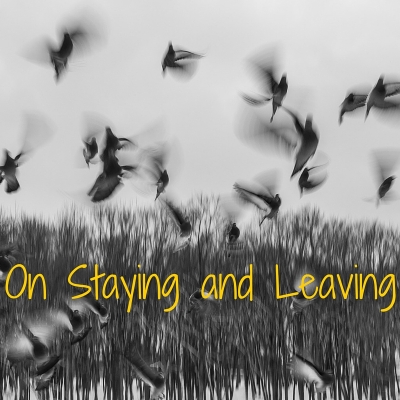
I’ve grown weary of the notion that church decline is due solely to my generation’s fear of commitment and nomadic tendencies. It’s also that we no longer subscribe to the notion that we ought to preserve the institution for the institution’s sake. As I’ve journeyed with my sisters and brothers who have made the decision to leave the church, I have witnessed their arduous struggle to break free. Sometimes leaving is a moment to be both grieved and celebrated at the same time.

Over the last few weeks I’ve had difficult, important conversations with close friends and colleagues  who are in the midst of huge transitions in their lives.  In their own ways, each of them has mustered up the strength to move on from their present circumstances, either to seek something they desperately need or to leave behind something that is sucking them dry. None of them is doing so without tremendous courage.

I know that this pastor had every good intention. In many ways his words were a much needed counterbalance to a culture that lures us into a perpetual search for “elsewhere.” But I also know that “for everything there is a season,” and there is both a time to stay and a time to leave. We must honor both.

Katey Zeh, M.Div is a strategist, writer, and educator who inspires intentional communities to create a more just, compassionate world through building connection, sacred truth telling, and striving for the common good. In 2010 Zeh launched the first and only denominationally-sponsored advocacy campaign focused on improving global reproductive health for The United Methodist Church. She has written extensively about global maternal health, family planning, and women’s sacred worth for outlets including Huffington Post, Sojourners, Religion Dispatches, Response magazine, the Good Mother Project, Mothering Matters, the Journal for Feminist Studies in Religion, and the United Methodist News Service.  Find her on Twitter at @ktzeh or on her website www.kateyzeh.com.

Relaxation as a Spiritual Discipline by Katey Zeh

Katey HeadshotI have a productivity obsession. I wouldn’t go so far as to call it an addiction, though in describing to a friend how euphoric it feels to check off a bunch of to-dos, he said, “You kind of sound like a junkie.” He may be right. Up until a year ago I didn’t think I had a problem. When I heard experts talk about self-care and meditation and “me” time, I’d roll my eyes a bit. Self-care is for wimps, I thought to myself. And I was certainly not one of those. I didn’t need time off for self-care. I had my to-do lists.
I started to question if I really had this all figured out when I was two weeks postpartum and back to work full-time because like most workers in the United States, I didn’t have paid family leave. Between the hormonal fluctuations and sleep deprivation, I lacked the mental clarity I needed to prioritize tasks. So then every task became the most urgent thing. On top of caring for a newborn and recovering from the birth, this created a perpetual state of mental exhaustion that was simply not sustainable. I needed to do something before I burned out completely.

One of the first steps I took was doing a self-assessment of the current state of my overall wellness–physical, mental, emotional, and spiritual. The first thing I jotted down was, “I’m stretched to my limits. I’m productive to a fault.” That was telling. My next step was to write out a wellness prescription. Since lists and schedules are my drugs of choice, could I try using them for good? I wrote out a self-care to-do list with a dozen different items, including weekly yoga sessions and scheduled downtime. Continue reading “Relaxation as a Spiritual Discipline by Katey Zeh”

Why I’m Not Watching by Katey Zeh

Katey HeadshotI just can’t. The Planned Parenthood sting operation videos. The GOP debates earlier in the month. I can’t bring myself to watch them. I used to jump without hesitation into the thick of the most vitriolic political exchanges and stand my self-righteous ground with the best of them, but I just can’t anymore.

I can’t. And I won’t. I do recognize that when I choose to tune out the noise of public debate, I am opting out of the conversation, at least in part. I shouldn’t be commenting directly on events of which I am not aware and informed. Nor should anyone else for that matter. I do end up relying on a community of commentators to fill in what I’ve missed by not watching. Continue reading “Why I’m Not Watching by Katey Zeh”