
Talking about Death with my Daughter & Remembering Carol Christ

Recently, facing the reality that I do not have definitive or perhaps, static “answers” for my little one when she asks me about death, I find comfort in Carol’s words—in the idea that I don’t have to “answer” my daughter with one, forever “truth.” Because I have to ability to give her “enough,” at least for now.

As I sit down to write, I am reminded of a post I wrote many years ago entitled “Where Do Cat’s Go,” about my mother’s cat, Mimi, who passed away at the age of twenty-four. At that time, I was struggling with what death meant outside of an Evangelical Christian ideology. I had rejected the doctrine of heaven (and hell) itself; but doubt lingered. Fear still held sway over my emotions. I wanted to “believe in,” something else. Whether to regain control or simply for comfort, I hoped for new belief.

Carol Christ, who has touched so many of us, who was my teacher and whom I miss, replied to that post (paraphrasing here), “Why does [Mimi] have to go anywhere? Isn’t it enough that she is a loved and remembered part of life?”

At the time it was not enough. But recently, facing the reality that I do not have definitive or perhaps, static “answers” for my little one when she asks me about death, I find comfort in Carol’s words—in the idea that I don’t have to “answer” my daughter with one, forever “truth.” Because I have to ability to give her “enough,” at least for now.

 As a feminist mom, I frequently think about what will give my daughter strength and a sense of her value outside of hetero-patriarchal standards. I am also an ex-vangelical agnostic married to an atheist. He and I want our daughter to have choice in her spirituality and freedom to explore her own directions. I think this is a good commitment, though it is frequently a little more difficult in practice. My partner wants to protect our daughter from all religion and Christianity in particular. I tend to take an educational approach, answering her questions about spiritual matters with, “well, people believe all sorts of things about that,” then listing several beliefs or mythologies that might give her some information on the matter.

Continue reading “Talking about Death with my Daughter & Remembering Carol Christ”

Teacher Appreciation Week & Appreciating Teaching by Sara Frykenberg

Part of discovering my love for teaching and moving through my anxiety involved reconsidering my “ideals” of teaching, which were numerous and high minded.

I always wanted to be a teacher. Sure, I had other career dreams as a child too. I wanted to be a model, because I wanted to be pretty like a model. I wanted to be a flying missionary to please my father—you see, it was not quite enough just to do missions. I also needed “save” (pun intended) people with my daring airplane recuses. And in moments of practical mindedness, I thought I should definitely be a “cleaning lady” (aka a housekeeper), because I was very good at cleaning, which was a way of life and survival in my home. But “teacher” was a persistent calling, so I followed in my teacher-mother’s footsteps AND tried to satisfy paternal aggrandizement by becoming a professor.

It occurred to me recently that I have actually been teaching now for nine years. I’ve also discovered in the last few years that I like teaching. And no, I didn’t always know this. I always wanted to like teaching; and sometimes I was sure that I did indeed like teaching. But non-teaching associated trauma during my early career and my social anxiety also sometimes made (and makes) the process excruciating. (Neo-liberal and late-capitalist academic practice, politics and policy don’t help either.) Part of discovering my love for teaching and moving through my anxiety involved reconsidering my “ideals” of teaching, which were numerous and high minded.

Continue reading “Teacher Appreciation Week & Appreciating Teaching by Sara Frykenberg”

Turning Five by Sarah Frykenberg

My daughter turned five years old this week. I am now a five-year-old-mother of one. Big Five <3. I’ve been thinking a lot about the fact that this is the age when children’s brains are developed enough to start creating more permanent memories of their childhood. What will my daughter’s earliest memories be when she is grown?

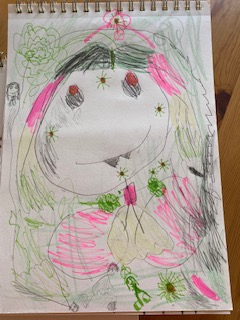
Four was a pretty chock-full year.

Fires—though those may seem like just another California season to her by now. Pandemic; staying home with Mommy, Daddy, and our new roommates, Auntie and Uncle for weeks on end.

Learning to ride a bike.

Pages upon pages of art, including a whole notebook almost exclusively dedicated to her “study” of “Hazel Vampire” (I blame Uncle and Auntie for this one).


Pandemic. More pandemic.

Continue reading “Turning Five by Sarah Frykenberg”

A Case for Context by Sara Frykenberg


I have a close family member who is staunchly Republican and frequently posts videos from the conservative platform PragerU or “Prager University.” Video topics include: why the Democratic Party is the “real” racist party (as though either party is innocent of racism), the “war on boys” and masculinity, and how feminists don’t care about Muslim women (as though some Muslim women aren’t also feminists), among other issues. You get the picture. It is a propaganda media source founded by radio talk show hosts which creates short videos on every topic there is, presenting the conservative viewpoint as the simple “God’s honest truth” about the issue.

I’ve seen some of these videos. They are as offensive as they are misleading. But one element that is particularly egregious to me is their complete disregard for larger context. Continue reading “A Case for Context by Sara Frykenberg”

Moments of Beauty by Sara Frykenberg

Last week a friend of mine started a post asking people to share something that they’ve enjoyed or appreciated since shelter-at-home orders began across the country and globe. This friend was in no way trying to minimize the very difficult situations that so many of us find ourselves facing during this pandemic. Rather, the list she elicited and generated helped to create, at least for me, a moment of hope or peace—a moment that I suspect many of us need right now.

Inspired by my friend (who has quite a talent for pointing out the potential for joy or happiness), I would like to add to her list here by sharing a couple of my “moments of beauty” in the hopes I can share this hope or peace. Continue reading “Moments of Beauty by Sara Frykenberg”

Staying Un-Frozen by Sara Frykenberg

It is February 14th, Valentines Day. So, today I want to explore my daughter’s love affair with Frozen; a story that I did not like, but that I learned to love by watching it through her eyes. A story which through her eyes, has taught me a lot about how to stay and be un-frozen.

I did not understand the phenomenon that was Disney’s Frozen in 2013. I did not like film’s premier song Let it Go, which you could hear e-v-e-r-y-w-h-e-r-e. The film wasn’t even about Elsa; the queen with magical powers who sings this song while reveling in the new-found freedom of her isolation. It’s about Elsa’s sister, Anna, and her quest to find Elsa. So really, I thought, the song was misleading. I also didn’t like the ‘loveable Olaf;’ and while switching up the “true love’s kiss” narrative was a positive change for Disney (Anna saves herself and Elsa with her love, instead of that of a man), I just didn’t get the widespread appeal. Continue reading “Staying Un-Frozen by Sara Frykenberg”

Teaching After the Getty Fire by Sara Frykenberg

This is the third year in a row that I will be writing about wildfires in California and their impact on me and my community.

This year, I don’t have any poetry.
This year, I’m not afraid.
This year, I’m angry. I am very angry. And again, I am awash in the (not so?) mundane concerns that surface in the wake of devastation. I am continually struck by this: the strangeness of the everyday next to the blackened hillside, the restricted access, and soot covered floors—the persistence and tremendous regularity, even normality of the everyday. Continue reading “Teaching After the Getty Fire by Sara Frykenberg”

Productive Confusion by Sara Frykenberg

My experience of productive confusion, alternatively, shuffles categories. It breaks apart. It is life giving chaos; but god/dess does it FEEL loud (even though it often requires quiet). If I’m not surfing the internet, while watching a show, while having a glass of wine, I might have to hear my own thoughts. I might notice that my internal loudness is also a symptom of the institutionalized trauma, violence and oppression that works to keep me externally quiet.

My head is a little bit too full lately. My classes begin in two weeks and I am determined to create an “Intro to Christian Ethics” class that offers my students at least an idea about hope that resonates with them, if not with me. Trauma is both a daily reality for far too many of us, and the headline or undercurrent of nearly every news report. Images from popular media play against my desires, my training in feminist analysis and ideas about power and empowerment in endless abundance. And I am mothering a joyful three-and-a-half-year-old whose need for liveliness both challenges and taxes me, pushing me and putting me face to face with my own hopes and doubts.

I feel pulled in so many directions, so I get confused about where to start, what to write, or what to do. I am awash in input, goals, and distractions.

Yet, I have also been challenged lately to see my confusion as a retreat from responsibility. Continue reading “Productive Confusion by Sara Frykenberg”

Avengers Vs. Sailor Moon Vs. … maybe… all that GOT *stuff

Spoilers ahead for Avengers: Endgame and Game of Thrones, so read at your own risk! Continue reading “Avengers Vs. Sailor Moon Vs. … maybe… all that GOT *stuff”

I’m [Not] Batman by Sara Frykenberg

A little tongue-in-cheek, somewhat punchy, somewhat angry reflection for your consideration. Thank you for reading.

Ever have trouble speaking your mind? I do. I do, particularly in situations where I was taught (in all sorts of ways, violent and nonviolent alike, religious, patriarchal) to be “a good girl.” The “good girl” training I received is so deeply ingrained in me that I often don’t realize when I’m doing it. I catch myself being agreeable with people when I want to be arguing. I use extra exclamation points in communications with my online classes to appear more likable, friendly or non-threatening. I also have a peculiar habit of, unconsciously, changing my clothes repeatedly until I ‘match’ someone around me, usually in color. I honestly don’t mean to do this, and only became aware of the habit in the last decade because my husband started pointing it out to me ALL THE TIME.

But I’m working on it. “Be authentic, Sara.” “Be yourself.” That’s got to be different than being good, right? I probe my habits and relationships for the tell-tale signs of this “good girl.” Continue reading “I’m [Not] Batman by Sara Frykenberg”