The Declaration of Independence: A Misogynistic Mash-up of Greek Philosophy and Roman Law

Stuart WordPress photoRegardless of political identity in America there seems to be an almost religious reverence for the Declaration of Independence (DI).  By far the most quoted sentence from it is the one that begins “We hold these truths to be self-evident, that all men are created equal.”  Though it is hardly ‘self-evident,’ the history behind the words in these two clauses betrays the fact that they constitute a misogynistic mash-up of Greek philosophy and Roman law.

First, the Greek philosophy in the first clause.  Precisely because of how often this portion of the DI is quoted (perhaps most memorably by Martin Luther King), the idea that there are ‘truths’ that are ‘self-evident’ may seem–self-evident.  From the perspective of the history of Greek philosophy, however, such an idea is as problematic as it is peculiar and for that very reason can reliably be traced back to one source: Plato.  The most likely direct source is the introductory section of an ancient Platonic commentary on Greek mathematical methodology.

Though relatively obscure today, it was a much admired work in the Renaissance and for a few centuries thereafter, influencing a wide range of disciplines, including law.  As a consequence of that influence law was conceptualized more geometrico (in a geometric manner), with legal documents drafted (as they often still are today) with a list of ‘defined’ terms first followed by the propositions to which they relate.  Similarly, judicial decisions still slavishly follow a quasi-mathematical methodology, ‘applying’ law to the ‘facts’ of the case, as if plugging numbers into an equation, with everything set out in a sequence of paragraphs identified by a combination of Roman numerals and arabic letters (‘as applied’ in Hobby Lobby (see the majority’s penultimate paragraph)). Continue reading “The Declaration of Independence: A Misogynistic Mash-up of Greek Philosophy and Roman Law”

A letter to feminists…from a 70-year-old white guy by Peter Wilkes

Peter Wilkes - CopyHello everyone —

I’m new at this, so be gentle…  I’m also aware that some might believe this letter to be “mansplaining” (a term I just learned).  I trust it won’t be.

First, I’m not a theologian, and definitely not an academic.  I’m just a guy, like any guy you might see on the street.

But I believe that feminism – defined as true and honest equality – is the only thing that’s going to save this messed-up world.  I’m also convinced the biggest obstacle to this happening is organized religion.  However, most importantly, I’m distressed that other guys don’t get this.  So, before I leave this life, I’m determined to do something about that.

I didn’t always think this way but, in my fifties, as I was kicking and screaming and going down for the third time, I reached for Merlin Stone’s book, When God was a Woman.  Only then did things start to make sense.  I’ve always been told I’m a late bloomer.  I never realized how late “late” would be.

But really, it’s just logical that early man watching a child grow inside the body of a woman – then seeing it emerge from that same body – must have found something amazing, wondrous, and worthy of great praise and adoration.  And also worship, for something like that to happen was, and always will be, a true miracle.  Continue reading “A letter to feminists…from a 70-year-old white guy by Peter Wilkes”

Feminist Bookstores and the Disappearance of Sacred Space by Marie Cartier

MarieCartierforKCETa-thumb-300x448-72405In my book Baby, You Are my Religion: Women, Gay Bars, and Theology Before Stonewall I talked about the importance of the gay women’s bar (and gay men’s bar) as sacred space for pre-Stonewall homosexuals—how the community space of the gay bar was the only public space for pre-Stonewall homosexuals and how it galvanized and concretized a community that had no other way of connecting. It was “home.”

I was so fortunate to do two readings and signings for People Called Women, the feminist bookstore from Toledo, Ohio — and Ohio’s only feminist bookstore — when they brought their “traveling bookstore” which goes to feminist events (they also have their mortar and brick store in Ohio J which I was thrilled to visit) to Michigan Womyn’s Music Festival last week. I was thrilled that we were able to sell out of all the copies of my book that People Called Women brought “to the land” (Michfest). I was thrilled that so many women showed up to our event, told stories about early bar life, cried, shared hugs and created community — and bought books. It felt radical and “old school” feminist. It felt like something I have missed – that connection with a feminist bookstore–for Los Angeles lost our women’s bookstore in 1999 —15 years ago.

people called women- front of store
Marie Cartier w/ Gina Mercurio, owner of People Called Women, Photo by: Megan Morris

For many of us who came of age post-Stonewall in the mid 70s, 80s and late 90s, the gay women’s bookstores—or rather feminist bookstores — were these sacred “home” spaces. They were our “alternate church,” as I so label the pre-Stonewall bars.

I “came out” as a lesbian and as a feminist — in 1979. One of the first places I visited was New Words Bookstore in Cambridge, MA. New Words really did feel like that—“new words,” like parting the curtain onto a brand new world where I had access to language that finally made sense—a new way of communicating—that is what feminism felt like — like being able to talk and be heard and understood for the very first time. Continue reading “Feminist Bookstores and the Disappearance of Sacred Space by Marie Cartier”

Good Muslim, Bad Muslim by amina wadud

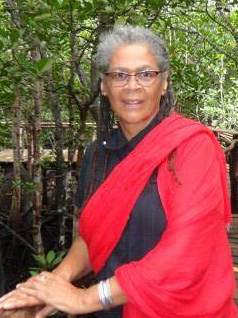
amina 2014 - cropped

No doubt about it, the news of late has been dismal, heart breaking, soul crunching. Pick a place or theme and see where you end up: Ebola in parts of Africa, Israel and Hamas; Ferguson, Missouri; Ukraine, U.S., and Russia; unaccompanied minors from the south crossing over into U.S. borders; the assault of the Islamic State of Iraq and Levant (ISIS) on Christians, Kurds, Yazidis, Shi’ahs and journalists. This list could (should) be augmented by many other conflicts and areas of strife which have been on-going for longer than the last several weeks.

I don’t know about you, but I draw my weary attention to the latest news each morning with knots in my stomach and a heavy weight on my shoulders. Meanwhile, even if I am not directing my attention to the news per se, the same events are all over social media and I confess I check into facebook and twitter each day even when I try to maintain a casual posture over usage and to keep upbeat attitude in how I engage (or ignore) the latest hash tag or hot button issues.

For weeks I have been thinking I should blog about an important lesson I have learned as best articulated in the book by Sharon Welch: A Feminist Ethic of Risk. In a world riddled with problems of proportions greater than can be solved by any one person, one group, one country or over one life time, how does one continue to be ethically engaged, avoid crippling despair and pointless cynicism, or just plain fall into apathy? Continue reading “Good Muslim, Bad Muslim by amina wadud”

Lessons Learned from the Atheist Alliance of America Convention by Andreea Nica

Andreea Nica, pentecostalismThe Atheist Alliance of America National Convention 2014 held earlier this month in Seattle, Washington granted me the opportunity to interview, converse with, and listen to renowned speakers, comedians, and influential figures in the atheist movement including the likes of David Fitzgerald, Dr. Steven Pinker, Dr. Rebecca Goldstein, Richard Haynes, and Dr. Richard Carrier.

This year’s convention drew in approximately 100 attendees throughout the weekend, according to Amy Monsky, Executive Director of Atheist Alliance of America (AAA). Monsky states that the AAA National Convention has several primary goals including: to bring atheists together; to hear great speakers; to network and socialize; and to raise awareness through education.

The family-friendly event was comprised of educational and activist-oriented sessions, debate, a comedy show, VIP non-prayer breakfast, film by Jeremiah Camara, “2014 Richard Dawkins Award” banquet, and a Sunday outing to Snoqualmie Falls and Chateau Ste. Michelle Winery.

Below is an overview of the sessions I attended, the conversations I had with presenters and experts, and the interviews I conducted. Continue reading “Lessons Learned from the Atheist Alliance of America Convention by Andreea Nica”

Anger is Not a Panacea: The “Next Stage” after Rage by Carol P. Christ

carol mitzi sarahIn a recent post Xochitl Alvizo cited Beverly Harrison’s much-loved essay “Anger as a Work of Love.” Harrison captured feelings that were in the air at the time of its writing several decades ago. Women were laying claim to the right to be angry at the silencing of our voices, the double standard, the media portrayal of women, income inequality, lack of access to good jobs, failure to prosecute rape and domestic violence, and a host of other injustices.

Most of all we were protesting the cultural stereotype that the “good woman” (understood to be white, Christian, and married or hoping to be) would not protest loudly or at all, would turn the other cheek, and would think about others rather than herself. (Jewish women and black women had to strive doubly hard to “live up” to this standard, as it was assumed that Jewish women were “overly assertive” and that black women were “too strong” and often “angry.”)

In this context Harrison’s essay and Mary Daly’s epithet “rage is not a stage” gave women—especially white women–permission to get in touch with our feelings of anger and to express them. We understood that “good women” had been hiding and repressing their feelings for centuries if not millennia with the result that the structures of injustice remained intact. Continue reading “Anger is Not a Panacea: The “Next Stage” after Rage by Carol P. Christ”

What Feminists of Color Taught Me In the Wake of the Michael Brown Shooting by Grace Yia-Hei Kao

Like many others, I’ve been following the aftermath of the recent shooting death of an 18-year old black teenager by a police officer in Ferguson, Missouri with a mixture of shock and horror. Mainstream news coverage and my Facebook newsfeed have been appropriately flooded with commentary about systemic racism, racial profiling, civil unrest, and the militarization of the police. As several African American thought leaders have noted, Brown’s death was not an aberration but “just the most recent example of police officers killing unarmed black men.” Continue reading “What Feminists of Color Taught Me In the Wake of the Michael Brown Shooting by Grace Yia-Hei Kao”

Systemic Violence and the Killing of Michael Brown by Xochitl Alvizo


Xochitl
Photo by Chris Pinkham

Oppression is systemic. Injustice is systemic. It pervades the whole – it seeps into everyday actions and becomes habits and patterns that function as default. As a result, the actions that fall within these patterns hardly need justifying. If anything, the questioning of them is what is put on the defensive. And those who stand against injustice must usually do so in the face of militarized policing, before vast forces that serve to preserve the status quo.

I can’t help but see the similarities between the everyday existence of young black men, of boys in this country, and that of women. The lack of safety in public places; the need to always be aware of one’s surroundings; the lack of trust in the intentions of another; living with the knowledge that people like you experience violence at much higher rates than others. It is a racist, violent, patriarchal world we live in. And, yes, it is also other things, good and beautiful things, but sometimes the hard reality of everyday life blocks out that light. Continue reading “Systemic Violence and the Killing of Michael Brown by Xochitl Alvizo”

Uppity Women Unite by Barbara Ardinger

Barbara ArdingerI have a poster on my wall: UPPITY WOMEN UNITE. In big, red, capital letters. I don’t remember where I got this poster, but I know I’ve had it since the late 70s or early 80s. I’m sure it comes from the raggedy late 60s, when second-wave feminism got up a head of steam and uppity women began getting our attention. That’s when Betty Friedan said being a proper 50s housewife was like having a mental illness. It’s when Gloria Steinem founded Ms. Magazine, which (oh, horrors!) did not give us recipes or home-making tips and did not tell us how to dress to lure our men into bed. It’s when Mary Daly started giving us a whole new, original take on the English language. Ahhh, yes, those were the good ol’ days. And the bad ol’ days, too, when the Equal Rights Amendment was not ratified.

“Uppity” can be a troublesome word. In the olden days, if someone called you uppity, it means you were inferior to them and weren’t staying in what they thought was your proper place. If you were a black person, for example, and if you didn’t step off the sidewalk when white men were coming, you were uppity. If you were a woman who wanted equal pay for doing the same work a man did, you were uppity. Those women in the 1980 movie, 9 to 5, were majorly uppity. And they won the battle.

Uppity women didn’t stay in the kitchen or the bedroom. They used—oh, horrors—the Pill. They marched to Take Back the Night. They got up on stage and played their own drums and guitars and didn’t sing like proper ladies should. They shouted. And they got into politics. Bella Abzug said that a woman’s place is in the House. Shirley Chisolm became the first black female member of congress in 1968 and in 1972 ran for president. (And I voted for her.)

B292_UppityWomenUnite_0

The English teacher in me wants to get in a word or two here. Look at the phrase “uppity women unite.” It might be a front page headline that says strong women who won’t stay on the bottom are getting together. Or maybe it’s a simple declarative sentence. But add punctuation and we get more punch. “Uppity women, unite.” Now the verb is imperative. We must unite. Let’s make it stronger: “Uppity women—unite!” Now it’s a command.

So, uppity sisters, and uppity brothers, too, you know how to multitask. Push the on button in your corpus callosum and let your imagination run while you read this. Let’s consider what the planet might look like if we had equal rights (and rites) in all things. Please understand that I’m not saying women should be the ones on top. I’m not talking about “power over,” but about what Starhawk calls “power with.” That’s shared power, which leads to shared magic.

Points of lightImagine yourself as one of a huge crowd of flying people joined as points of light above the earth. Float peacefully up there for a few minutes. Think about the power of people joined together, the energy of people working together. Now let’s get down to earth. Floaty energy is fun, but it doesn’t get much done. Imagine yourself as a member of a group with a goal. Touch down. Stand on the earth and consider the fact that everything on the planet is alive—not just people and animals and plants, but rocks, too. Even things we constructed have some life force. Embrace panentheism for a little while. Now here’s something to do: Find a church that doesn’t accept uppity women or uppity brothers. You’re united. As united, uppity people, go to that church and stand in a circle around it. Send friendly but firm energy into that church so that, even if a whole denomination or religion won’t change right now, that individual church might change. The next time you go to that church, radiate the same energy when you go inside.

You can also find a church that appreciates uppity folks. Send grateful energy to the church and all the people in it.

UPPITY WOMEN UNITE. If enough of us uppity women and our uppity brothers get together, we will eventually build up to a critical mass. A critical mass can lead to an explosion. I’d prefer to see a spiritual, peaceful explosion. What do you want to see?


Barbara Ardinger, Ph.D. (www.barbaraardinger.com), is a published author and freelance editor. Her newest book is Secret Lives, a novel about grandmothers who do magic.  Her earlier nonfiction books include the daybook Pagan Every Day, Finding New Goddesses (a pun-filled parody of goddess encyclopedias), and Goddess Meditations.  When she can get away from the computer, she goes to the theater as often as possible—she loves musical theater and movies in which people sing and dance. She is also an active CERT (Community Emergency Rescue Team) volunteer and a member (and occasional secretary pro-tem) of a neighborhood organization that focuses on code enforcement and safety for citizens. She has been an AIDS emotional support volunteer and a literacy volunteer. She is an active member of the neopagan community and is well known for the rituals she creates and leads.

Survivorship to Thrivorship in Sedna’s Ocean by Carolyn Lee Boyd

carolyn portrait

 These past three months I have learned the wonderful, important word “survivorship.” At the cancer center where I receive care, “survivorship” means life’s physical, emotional, mental, spiritual, economic, social, and political aspects affecting the quality and quantity of life after treatment.

“Survivorship” also perfectly describes what I have seen over and over working with older women, especially those who have made their lives masterpieces of this art. The deaths of loved ones, the loss of home and country, devastating illness and lifelong disability, violence from family and discrimination and hate from strangers – through it all they have found a strength and power that they have used to make their lives and that of others more meaningful and impactful. In fact, almost all older, and many younger, women I know have been transformed by their own kind of survivorship into someone beyond who she imagined she would ever be.

Survivorship also describes the courage, persistence, strength, wits, guts, intelligence, and wisdom of the global community of women necessary to overcome the trauma, violence, violation and repression of at least the past several thousand years. It is what has brought women through to where we are now.  Women’s spirituality as a force and a movement is also a heroine of survivorship. Through millennia of being repressed and dressed up in the garments of patriarchal practices to suit their needs, the traditions and spirit of the Female Divine have survived and we now see Her reclaiming Her place in our spiritual lives, theology, and world history.

Continue reading “Survivorship to Thrivorship in Sedna’s Ocean by Carolyn Lee Boyd”