Legacy of Carol P. Christ: Tree-Hugging Is About Trees and So Much More Than Trees

This was originally posted March 11, 2019

Not too long ago I heard someone deride members of a seminar who were building labyrinths in the olive groves of Greece as “a bunch of tree-huggers.”  I bristled! I probably first heard of the Chipko tree-hugging movement which is led by women in the 1970s and 1980s. Because I love nature, I naturally assumed hugging trees is a good thing. Originally, I had no idea that the tree-hugging movement was about much more than saving trees from being felled in the interests of short-term profit.

I did not know that the deeper purpose of the movement is to save a way of life based on forest-culture that is being threatened by the imposition of western ideas and practices promoted by colonialism and its successor, the green revolution. Nor did I know that the traditional forest-culture of India is the provenance of women: more than 4000 years of observing and experimenting created a “women’s knowledge” passed down from mother to daughter.

Continue reading “Legacy of Carol P. Christ: Tree-Hugging Is About Trees and So Much More Than Trees”
Legacy of Carol P. Christ: “Calling All Women” to Save the Earth, signed and shared by Carol P. Christ

This was originally posted on April 1, 2019

I contend therefore that we have allowed these chemicals to be used with little or no advanced investigation of their effect on soil, water, wildlife and man himself. Future generations are unlikely to condone our lack of prudent concern for the integrity of the natural world that supports all life. Rachel Carson, Silent Spring

Today we are faced with a challenge that calls for a shift in our thinking, so that humanity stops threatening its life-support system. We are called to assist the Earth to heal her wounds and in the process heal our own – indeed to embrace the whole of creation in all its diversity, beauty and wonder. Wangari Maathai

I want you to feel the fear I feel every day. And then I want you to act. Greta Thunberg

We are calling all women and our allies to come together to save the earth that sustains us all. Is it any wonder that from Rachel Carson to Wangari Maathai to the emerging young leader Greta Thunberg, women have been in the forefront of environmental movements for a century? As daughters, sisters, mothers, grandmothers, and aunts, we have long cared and advocated for the most vulnerable among us, the very young, the very old, the disabled, those who are the first to suffer the consequences of climate catastrophe and the many kinds of pollution that are poisoning the earth we share.

Continue reading “Legacy of Carol P. Christ: “Calling All Women” to Save the Earth, signed and shared by Carol P. Christ”

The Legacy of Carol P. Christ: “We Say the Silence Has Been Broken”

We treat the physical assault and the silencing after as two separate things, but they are the same, both bent on annihilation. Rebecca Solnit

When I was in my twenties and in therapy I had a recurrent dream in which a strange man was chasing me and caught up with me and started to strangle me and I could not scream. I was asked to act this dream out by my therapist, who told me that this time I would scream. I could not. She got up and came over and put her hands around my neck and started to squeeze. I still could not scream.

Two decades later I had a dream in which I was a baby and suffocating in my crib. I asked my current therapist if she thought someone had tried to suffocate me when I was an infant. Her answer was simple: “There is no need to think about this happening when you were an infant. You have been silenced all your life.”

When I was a child, my father used to punish us by taking off his belt, sitting down, asking us to pull down our pants and lie across his lap, and then lashing our bare bottoms with his belt. This was typical child-rearing practice in the 1950s and 1960s. Rita Nakashima Brock was the first to name it for me as child abuse. Nonetheless, when we got older, my brother and I preferred to be spanked, rather than to have our 25 cents a week allowance taken away from us. At least, we thought, being spanked was over in a minute, while losing your allowance was something you would suffer for a long time.

Continue reading “The Legacy of Carol P. Christ: “We Say the Silence Has Been Broken””

By Truth the Earth Endures by Carolyn Lee Boyd

Door to Truth, Sri Rangnath Swamy Temple, Pushkar

“By truth the Earth endures.” This Old Irish pronouncement quoted by Peter Berresford Ellis in  The Druids (p. 162) holds such hope. In this moment when the survival of humans and other living beings on our planet is uncertain, when we wonder how we can ensure a future we want our descendants to live in, this centuries-old statement tells us exactly what to do. Revere truth, speak truth, live truth, and the Earth will endure.

The “truth” by which the Earth endures is not simply the state of being factually correct, but, to the ancient Irish, as well as other cultures, also a mighty force that is an element of all that is good.  “…The old Irish word for Truth is also the basis for linguistic concepts of holiness, righteousness, faithfulness, for religion, and for, above all, for justice (p.169)” according to Ellis. What gives truth this immense authority is the power of the Word. Ellis tells us “Truth was the Word and the Word was sacred and divine and not to be profaned…’Truth is the foundation of speech and all words are founded upon Truth’” (p. 162).

Continue reading “By Truth the Earth Endures by Carolyn Lee Boyd”

From the Archives: We are Mauna Kea: The Continual Protest for Maintaining Sacred Land by Anjeanette LeBoeuf

Anjeanette

Moderator’s Note: The blog was originally posted November 21, 2015. The movement for the sacred land is still relevant and active.

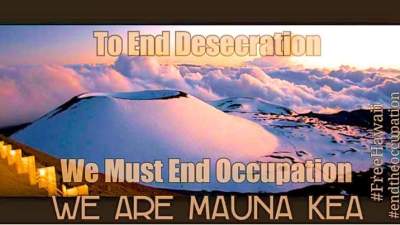
It seems like there is a perpetual debate over acquiring land for progress and growth versus the protection of land that has ties to religion, customs, and cultures. The history of America is littered with stories and events that deal with acquisition of land. The sake of growth, expansion, and progress takes precedence in the history of America. Our country’s geography is a road map of acquired land and the pushing aside sacrality.

Our country has treated sacred land in a variety of ways. Religious sites have found their way, at times, to the front lines of protest and change. Religions across the globe carry some sort of Mother Earth element. Hinduism has the goddess Pṛthivī, the Greeks worshiped Gaia and Hestia, and the Hopis called her Tuuwaqatsi. Papahānaumoku is Mother Earth to Hawaiians. She is the life-giving force and the ancestor to all human beings. Honoring the earth becomes honoring our mother.

FB_IMG_1446365637791
Continue reading “From the Archives: We are Mauna Kea: The Continual Protest for Maintaining Sacred Land by Anjeanette LeBoeuf”

We Are a Beautiful, Passionate, Inspiring, Never-Ending Story by Carolyn Lee Boyd

Your life is a beautiful, passionate, inspiring, never-ending story. It began with your ancestors long before your birth and will reverberate through untold future generations. It is infinitely complex, unique, and fascinating. Your story is deeply interconnected with other living and non-living beings. It is one among billions of individual stories that make up the wondrous, awe-inspiring story of our planet. 

Do you see yourself, other humans, all living beings, and Earth Herself in these words? Many of us may struggle to do so. As Janet Rudolph so eloquently noted in her recent post about Moses, we need to re-examine and change our foundational stories away from violence and towards spiritual regeneration. So, how can we create new stories about who we believe ourselves to be and how we respond to the world around us? Ursula Le Guin gives important clues in her book Steering the Craft: A 21st-Century Guide to Sailing the Sea of Story. In it she defines story as “a narrative of events (external or psychological) that moves through time or implies the passage of time and that involves change. I define plot as a form of story that uses action as its mode, usually in the form of conflict…(p. 122). “ Le Guin continues to say that this kind of plot “reflects a culture that inflates aggression and competition while cultivating ignorance of other behavioral options… (p. 123).”

Continue reading “We Are a Beautiful, Passionate, Inspiring, Never-Ending Story by Carolyn Lee Boyd”

Can I get an “Amen” up in here? by Laura Montoya 

I am a great evangelist. I used to evangelize in Pentecostal settings until I was 22. Then, I left my church to evangelize about feminist issues to every woman that crossed my path. Rhetoric is a gift I received when I was a kid and that I inherited from my grandpa and my dad. But during the COVID lockdowns, it was hard to socialize, and my evangelization skills turned toward making my friends and family join the privileged fan base of Ru Paul’s Drag Race. One by one, I convinced my sister, cousins, neighbors, and best friends to watch the reality show, and they did with astonishing devotion. Every week, two or three of us gather in someone’s living room wearing masks to watch episode after episode after episode. Our debates about the queens in the show could last all night long. Who had the best performance? Did you like their lip-synching? “That elimination was so fair/unfair!” 

Continue reading “Can I get an “Amen” up in here? by Laura Montoya “

The Legacy of Carol P. Christ: Sappho Chose Love Not War, What Will You Choose?

This was originally posted on November 12, 2012

We have been taught to speak of war and the heroes of war in hushed tones. We have been told that evil Helen’s choice was the cause of the Trojan war.  2600 years ago Sappho, known as the greatest lyric poet of ancient Greece, spoke truth to power and unmasked the lies told at the beginning of western tradition.

*

In a poem addressed to Anactoria, Sappho writes:

            Some say a cavalry corps
            some say infantry, some, again,
            will maintain that the swift oars
            of our fleet are the finest
            sight on dark earth …

Here, Sappho invokes the heroic tradition celebrated in the epic poems of Homer that shaped the values of ancient Greek culture and all the cultures that followed it, including our own.  This tradition tells us that to serve in a war and to be remembered as a hero is the highest goal to which a man can aspire.  Sappho does not agree:

             …but I say
             that whatever one loves, is.

Continue reading “The Legacy of Carol P. Christ: Sappho Chose Love Not War, What Will You Choose?”

Women Who Dig by Trina Moyles – Book Review by Carolyn Lee Boyd

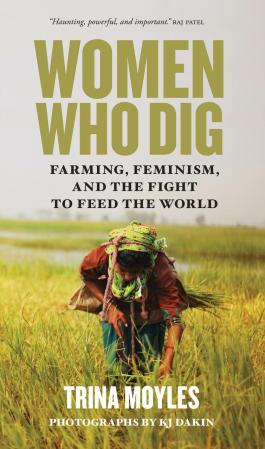
Here in the north, it is harvest time when the deep and ancient relationship between women and farming once again brings forth the food on which life depends. Women have been co-creating with the Earth to feed themselves and their families and communities for many  thousands of years. In fact, the world’s oldest agricultural tool may be a 300,000 year old stick possibly used by women to “harvest wild tubers for food and medicine” (p. xx) according to Women Who Dig: Farming, Feminism, and the Fight to Feed the World by Trina Moyles with photos by KJ Dakin. 

In her beautiful and enlightening book, Trina weaves together stories and stunning color photographs about the lives and work of women small farmers in Uganda, Guatemala, Nicaragua, the United States, Canada, India, the New Congo refugee settlement in Uganda, and Cuba. Together the profiles demonstrate that, despite sometimes overwhelming odds, women are feeding themselves, their families, and their communities through sustainable small farming practices that are good for both our nutrition and well being as well as the planet.

Continue reading “Women Who Dig by Trina Moyles – Book Review by Carolyn Lee Boyd”

From the Archives: Uppity Women Unite by Barbara Ardinger

This was originally posted on August 2, 2014

I have a poster on my wall: UPPITY WOMEN UNITE. In big, red, capital letters. I don’t remember where I got this poster, but I know I’ve had it since the late 70s or early 80s. I’m sure it comes from the raggedy late 60s, when second-wave feminism got up a head of steam and uppity women began getting our attention. That’s when Betty Friedan said being a proper 50s housewife was like having a mental illness. It’s when Gloria Steinem founded Ms. Magazine, which (oh, horrors!) did not give us recipes or home-making tips and did not tell us how to dress to lure our men into bed. It’s when Mary Daly started giving us a whole new, original take on the English language. Ahhh, yes, those were the good ol’ days. And the bad ol’ days, too, when the Equal Rights Amendment was not ratified.

“Uppity” can be a troublesome word. In the olden days, if someone called you uppity, it means you were inferior to them and weren’t staying in what they thought was your proper place. If you were a black person, for example, and if you didn’t step off the sidewalk when white men were coming, you were uppity. If you were a woman who wanted equal pay for doing the same work a man did, you were uppity. Those women in the 1980 movie, 9 to 5, were majorly uppity. And they won the battle.

Continue reading “From the Archives: Uppity Women Unite by Barbara Ardinger”