The other night I had a dream about a strange green hooded figure that was guarding a green gate underground. She wasn’t human; she had a hooked bird’s beak (like many of Marija Gimbutas’s goddess figures). Something about the strange face reminded me of an American Indian. This creature was not friendly but she was not hostile either. Just really intent upon making it clear that you did not pass through the gate without her permission. The word Root kept reverberating out loud in this place… Root Woman? Strange that she was also a bird. Anyway, thinking about bird women prompted the following poem and brief reflection on my relationship with one kind of bird…
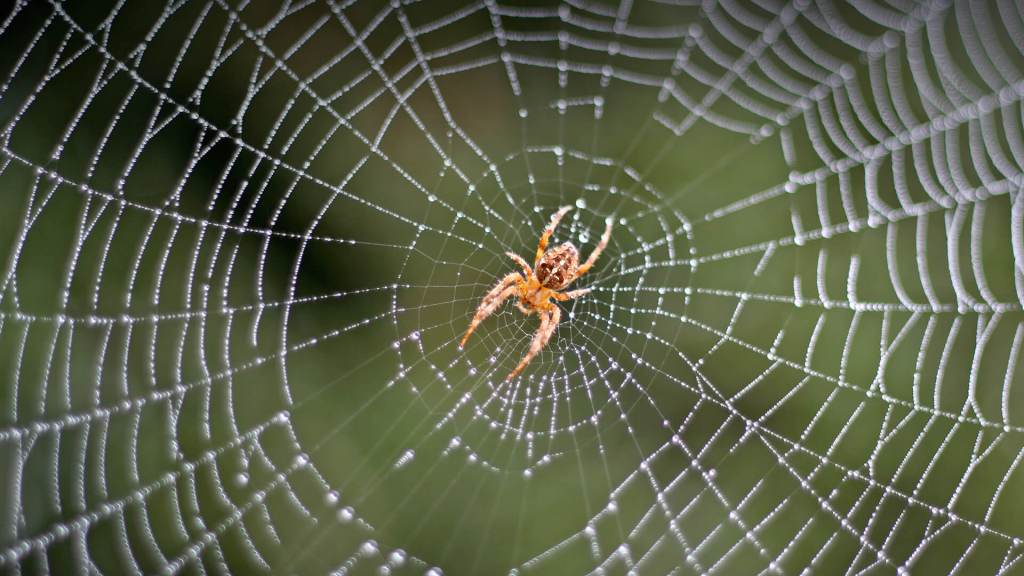
In addition to being viewed as a Creator Goddess and a Destiny Weaver, Spider is associated with many other aspects of life. Some of these aspects fall into what we would consider the light – the good – and others are dark dangers – the dark side of life.
Spider Wisdom by Judith Shaw
Patience, Resourcefulness/Protection, Good Fortune Though spiders have eight eyes they have very poor eyesight. Instead they have infinite patience, waiting quietly in their webs for prey.
Spider is credited with inspiring King Robert the Bruce of Scotland with its patience. A 14th century legend tells of a time when Bruce had suffered various military defeats against the English. While hiding in a cave he observed a spider trying and failing repeatedly to climb its silken thread. But it persevered and eventually reached its web. Bruce was inspired. He decided to persevere in his efforts, came out of hiding, and eventually won Scotland’s independence from England.
Spiders are important to our gardens. They eat more insects than both birds and bats.
Long ago people used spider webs to stop bleeding. Now science has discovered that spider webs contain Vitamin K – a coagulant which stops bleeding.
The Torah recounts a story of how Spider protected David, before he become King of Israel. As King Saul’s soldiers pursued him, David hid in a cave. A spider built a huge web across the cave entrance. The soldiers saw the cave but did not investigate, thinking that no one would crawl through a spider web to gain entrance.
Similarly a story from Islamic tradition depicts Mohammad hiding in a cave from pursuing soldiers. Here also a spider spun a web across the opening, protecting Mohammad.
A Hopi legend about Spider Grandmother tells how she protected a village by spinning a magical web over the whole village, which when doused with water gave protection from being burned down by its enemies.
Spider Woman of Dine (Navajo) mythology helps and protects her people. She helped them to destroy the monsters that roamed the land as they emerged from the third world into this world. She chose the top of Spider Rock in Canyon de Chelly – the Dine ancestral home – as her home. Children were warned that misbehaving would make Spider Woman angry. She would cast her web like a net, as some spiders do, to catch the naughty child, bring him up to her home and devour him. It was said that the top of Spider rock is white because of the bleached bones of those naughty children.
The Celts saw spider as a helper and believed that killing one would bring bad luck.
Spider appears frequently in Chinese legends as lucky beings, bringing happiness and wealth. Spider charms are worn for good luck.
Wisdom, Interconnection, Transformation A Hopi legend tells of Spider Woman helping Tiyo on his journey to the underworld. He begins with a visit to Spider Woman who gives him a serum to subdue his enemies. Then she accompanies him to the ‘Far-Far-Below River’ to offer advice during his trials. With her help Tiyo completes his journey successfully and returns to his people with greater wisdom and knowledge.
Egyptian Creator/Spider Goddess, Neith, often depicted veiled, wove this veil at creation to hide herself from humanity. As humans are not capable of understanding the fullness of divine mysteries the veil offers folds and strands that are thinner, allowing humans a glimpse at divine source and higher understanding.
African and some Native American stories portray Spider as a trickster god whose tales are part of a rich storytelling tradition which convey wisdom and moral lessons.
Spider symbolizes Maya (illusion) in Hindu Mythology. Vedic philosophy characterizes Spider as the weaver of the veil of illusion, hiding the ultimate truth of reality. In addition, Indra’s net, envisioned like a spiderweb with jewels at each vertex, illustrate the belief that all things are connected.
Though spiderwebs are stronger than steel, by weight they don’t usually last very long. Sometimes spiders destroy their own webs. Spider, with it eight (infinity symbol) legs and eyes symbolizes the infinite cycles of transformation as Spider continually creates, destroys and creates again, reflecting the essence of our natural world and its infinite cycles of birth, death and rebirth.
Dark Dangers – cunning, deception, intrigue, death Only a small number of spider species are dangerous to humans with venom that can cause localized pain to a person. Further, there are only about 25 spider species with venom that can cause serious illness in humans. And yet arachnophobia, the fear of spiders, is one of the most common fears worldwide.
Many folktales and myths warn of the dangers associated with Spider.
Athena, Greek Goddess of Wisdom and Handicraft was a skilled weaver. Arachne, a mortal and gifted weaver, got carried away with her talents and boasted that her work was better than that of Athena. Athena was furious and a contest was arranged between the two. Not only was Arachne’s weaving beautiful it also depicted the gods in a bad way. Athena destroyed Arachne’s work in a rage.
Arachne, ashamed to see what her arrogance had wrought, hung herself. Athena took pity on her – turning the rope into a web and Arachne into a spider. Through her death and transformation, Arachne was able to weave her beautiful tapestries for eternity.
Japanese mythology tells of the Spider Princess, Jorōgumo, who transformed into a beautiful woman and entraped men with her deception.
To Christians Spider symbolizes the Devil as the Devil prepares its trap for human souls like the spider prepares its web for prey.
When a spider is finished with its web many species roll it up and consume it.
In ancient Indian tradition Brahma, the creator of all things, was seen as a spider weaving the web that is our universe. Sacred text says that one day she will devour the web – our universe – and then weave another.
Divinatory Spider calls you to transform – to imagine your world anew. A time of creativity is at hand – a time of magic – a time to manifest your true destiny. Spider reminds you that with patience you can best reach your goal.
At the same time Spider calls you to recognize the dark side of life – the ways in which you or others might be deceptive, or engaged in intrigue.
Spider reminds you of the eternal cycles of life, death and rebirth.
Spider awakens your memory of the interconnection of all life, allowing you to integrate problem areas into a more wholistic perspective on life and reminding you of the system of interdependency in which we live.
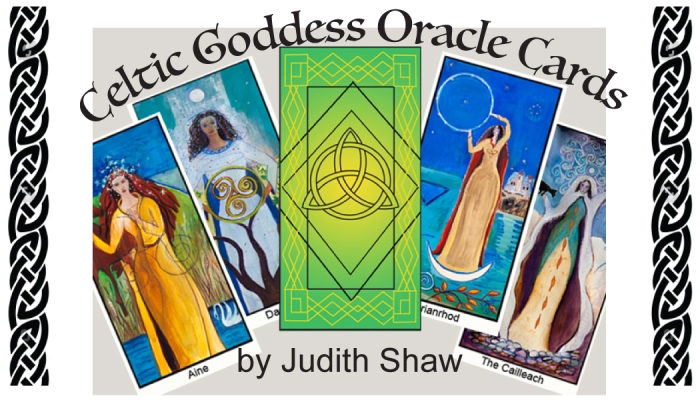
Judith’s deck of Celtic Goddess Oracle Cards is available now. You can order your deck from Judith’s website – click here. Experience the wisdom of the Celtic Goddesses!
Judith Shaw, a graduate of the San Francisco Art Institute, has been interested in myth, culture and mystical studies all her life. Not long after graduating from SFAI, while living in Greece, Judith began exploring the Goddess in her art. She continues to be inspired by the Goddess in all of Her manifestations. She is now working on her next deck of oracle cards – Animal Wisdom. Originally from New Orleans, Judith makes her home in New Mexico where she paints as much as time allows and sells real estate part-time. Give yourself the gift of one of Judith’s prints or paintings, priced from $25 – $3000.
Spider, the eternal weaver of webs, has symbolized creation since people first began storytelling. Cultures worldwide have associated Spider with the Creator Goddess, weaving – and through association with women as they were the weavers who spent endless hours creating the fabric to clothe their communities, and feminine power.
The third day dawns under a cloud. Mourning doves spread their wings across leaden skies. I am walking on air. Two restless nights – a huge truck in the yard – Blocked, my stomach lurches. I read Tributes in a daze. Fierce Little Flower Warrior Woman fights a torrent of waves. She is bridging raging waters forging a New Story.
“Weaving the Visions.” Oh, now I remember where it all began.
She hugged a tree. I plant a seed. Listening to rounds of “light and darkness” I let my body lead.
A serpentine path guides me back to Her Garden. Cradled by Ancestors Rooted in Body I shed another patriarchal skin.
The move to Portugal all but forced me to heal my relationship with time and productivity, to create a life that was sustainable and nurturing.
Hanging out in Obidos, the closest town to my village. Photo by Erika Mailman.
One year ago, I published my essay, The Grace of Letting Things End, about my bittersweet experience of leaving England in the wake of Brexit for a new life in Portugal.
One year later, my life in Portugal still feels radically new.
Time passes differently in Portugal. I set my intention, from the outset, to embrace this move as an opportunity to slow down and live a more authentic life.
My day-to-day life has irrevocably changed.
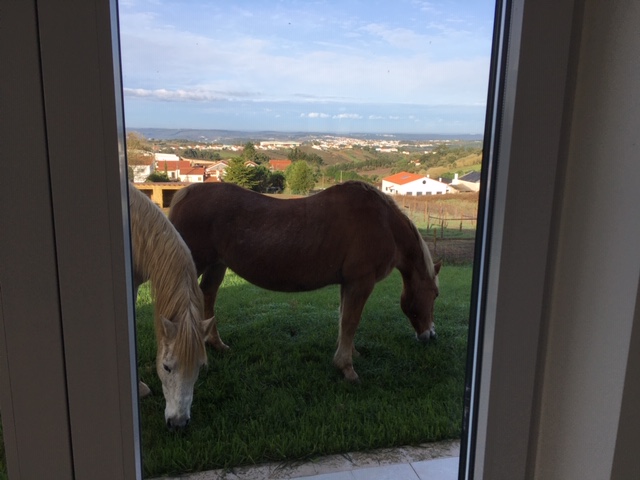
I’ve gone from being a livery yard customer in England, with all the drama and conflict this sometimes entailed, to becoming an independent small holder with two horses on my property to care for all by myself. Practically, this has translated into a lot more work, but also a lot more peace.
The ponies decided to help with the lawn mowing
I’ve also been devoting considerable time and energy into learning Portuguese. My husband and I have been taking classes once or twice a week for nearly a year now and are making slow but steady progress.
But the most deep-seated change has been to my whole relationship to work and life. In the UK, I led a very productivity-centered life, existing from deadline to deadline with barely any time to breathe in between. I often felt too busy and wrapped up in my projects to meet friends for lunch.
For years I have struggled to heal my dysfunctional relationship with time management, embracing lifehack after lifehack. I’ve all but abandoned social media. I’ve done my utmost to milk every single hour of the day in order to become more productive. This pattern led to disillusionment and epic burn out, something more and more women are facing, particularly those who balance the demands of their careers with childcare and other care-taking duties.
Even writers and artists can fall down the hole of the Cult of Productivity, taking the creative process, which is at its essence slow and organic, and trying to force it into an industrial process with regular, reliable yields that are judged on how well they can be monetized. Even the refuge of spirituality can be compromised if it’s just another task on a never-ending to-do list.
Thus, despite my official intention to slow down, I found myself trying doggedly to replicate my old hectic, tunnel-vision working schedule in Portugal only to discover that it just didn’t work here. I hit a brick wall. Because I couldn’t sustain the same level of busyness AND care for two horses AND learn a challenging new language AND keep my initial intention of slowing down and enjoying the life I moved here to experience.
Something had to give. The move to Portugal all but forced me to heal my relationship with time and productivity, to create a life that was sustainable and nurturing. No lifehack could help me anymore, because I’d already given up television. I don’t even watch Netflix.
We hear a lot about the Slow Living Movement, but actually slowing down involves so much more than decluttering your closet or posting pictures of photogenic hipsters in hammocks on Instagram.
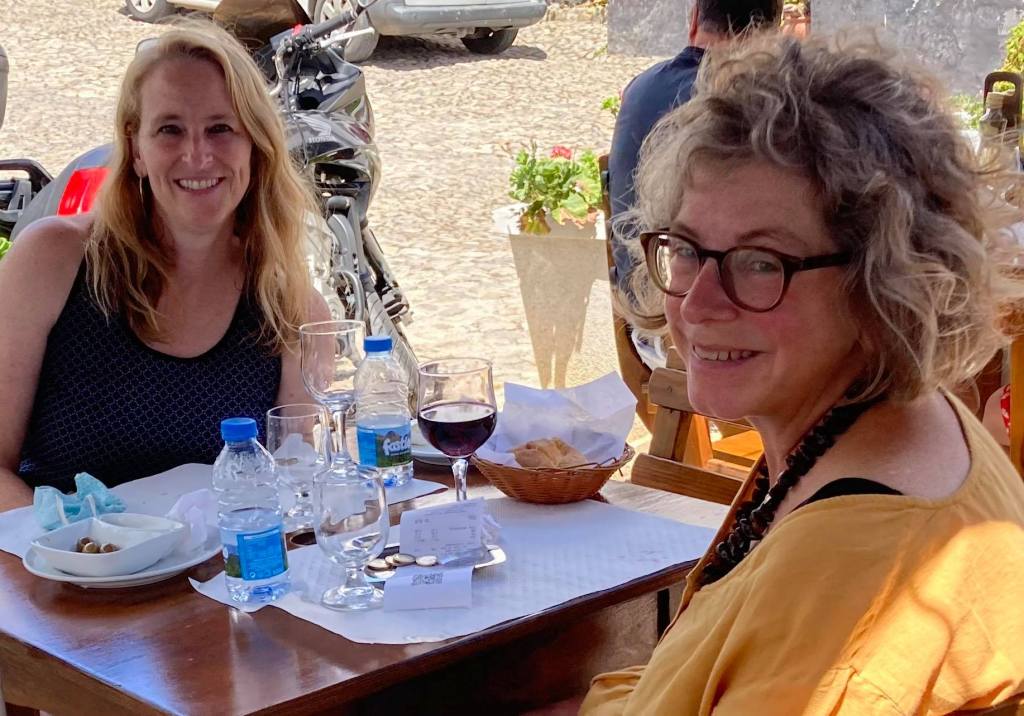
Moving to Portugal forced me to slow down. Because life is slow here. It’s no accident that the Slow Food Movement had its birth in Italy, another slow country in southern Europe. Food is also big in Portugal. In fact, I like to joke that LUNCH is the national religion. No matter how busy or important you think you are, the whole world stops for lunch. Shops close. People pour out of offices and go to restaurants for beautiful, affordable meals. Proper, cooked meals, mind you. Not a sandwich or salad to be inhaled at speed. To say you are too busy to meet your friends for lunch in Portugal would be sacrilege. Even in the height of the pandemic when all the restaurants were closed, people went home for lunch and ate with their families.
Converting my visiting writer friend Erika Mailman to the religion of LUNCH!
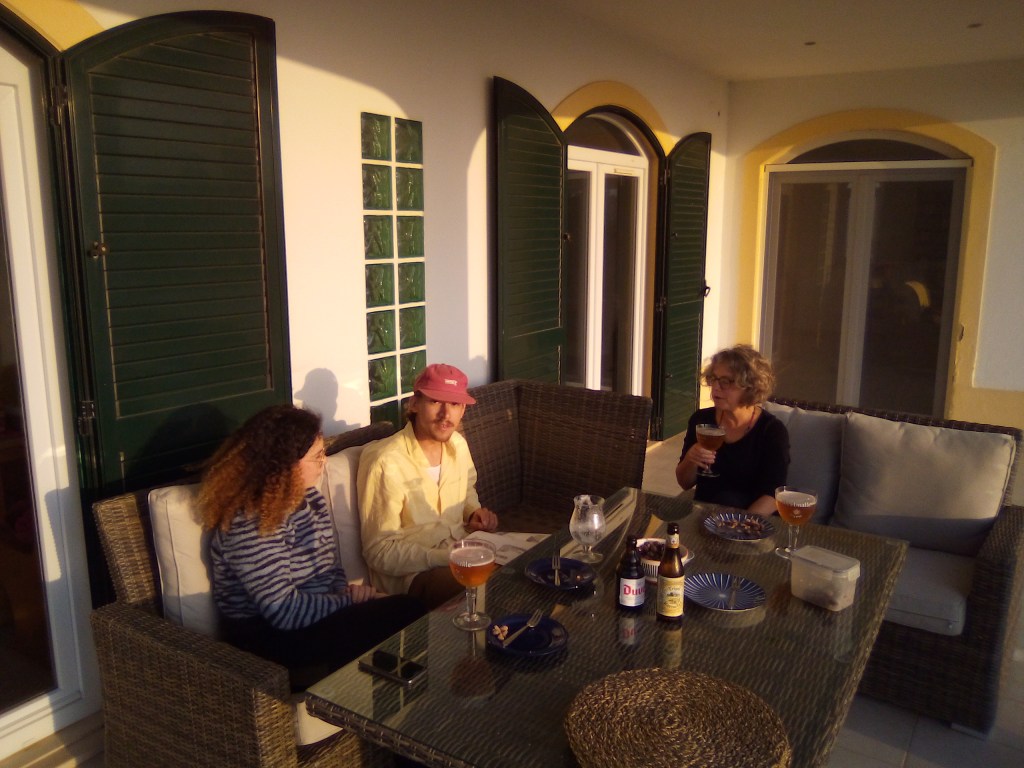
Any culture that prioritizes good food also prioritizes human relationships. My social life here is unlike anything I’ve experienced anywhere in the world. I’ve met wonderful Portuguese people, such as our local Priestess, Luiza Frazao, as well as new friends from the U.S., the U.K., Canada, Columbia, the Netherlands, Israel, Russia, Germany, Spain, Poland, Hong Kong, and Belgium. My husband and I have made so many friends in our village. We can walk to each other’s houses and invite each other for dinner or go on long walks together. The other foreigners who move to Portugal have made the conscious decision to make time for friendship, not just shove it into a twenty minute “let’s meet for coffee” slot. I haven’t had this much fun since I was a student.
Other things are slow here, too. The post office can be painfully slow. My New Yorker subscription has gone AWOL and I’ve resigned myself to reading the digital version. Plumbers and technicians come when they come. Just when you think they’ve forsaken you, they manifest at your door. But then again neighbors I’ve never met before also show up unexpectedly with gifts of apples for the horses. One day an old man pulled his tractor up in front of our house and presented me with two sapling banana trees.
What I’ve discovered is if I give up any notion of trying to control the clock or manage time, it becomes more expansive. When I’m with my horses or laughing with friends, time disappears and I’m living in an eternal now. The same is true when I’m deep in my writing flow or trying to speak my best Portuguese to thank my neighbor for the banana trees. In a rich and authentic life, there is time for everything.
Life Balance is a feminist issue, because too many women have been brainwashed by the Cult of Productivity for far too long and this has kept too many of us chained to a patriarchal machine that eats us up and spits us out when we’re too broken to go on doing anymore. Let’s rebel and meet our sisters for lunch!
Mary Sharratt is on a mission to write women back into history. Her acclaimed novel Illuminations, drawn from the dramatic life of Hildegard von Bingen, is published by Mariner.Her new novelRevelations, about the mystical pilgrim Margery Kempe and her friendship with Julian of Norwich, is now available wherever books and ebooks are sold. Visit her website.
At first glance the ancient belief that bees were birthed from dead bulls seems odd. But if we delve deeply into pre-historical artifacts we discover the mythopoetic roots of this idea.
This morning I met her by the barn sitting on a cedar fence
regarding me with one shimmering marbled eye, a little spiked crown on her head. A moment later two tiny balls of feathers exploded out of a tangled mass of blackberries below her. The fluff balls flew in between the cracks of the fence disappearing into what I knew must be a bird haven because I had recently piled a lot of brush back there. The fact that these nestlings could fly told me they were about two weeks old.
“Good morning,” I whispered as the mother continued to watch me. Behind the fence I heard a number of teeny voices peeping. Into the quiet space between the mother and I, arose the realization that this bird knew me well and had probably been watching me all spring. Normally when a human surprises a mother with chicks the adult puts on a show, taking immediate flight and then dragging a wing on the ground behaving as if it is broken. In this manner the adult desperately hopes to lure the predator away from her chicks. Even so, few nestlings make it to adulthood. The male doesn’t parent at all.
Bull, with its components of aggressiveness, stubbornness, virility, and ferocity, is emblematic of masculinity. But Bull is also associated with fertility, abundance, strength, and determination. Viewed by some cultures as a solar symbol – in the oldest myths, we find Bull connected to the moon.
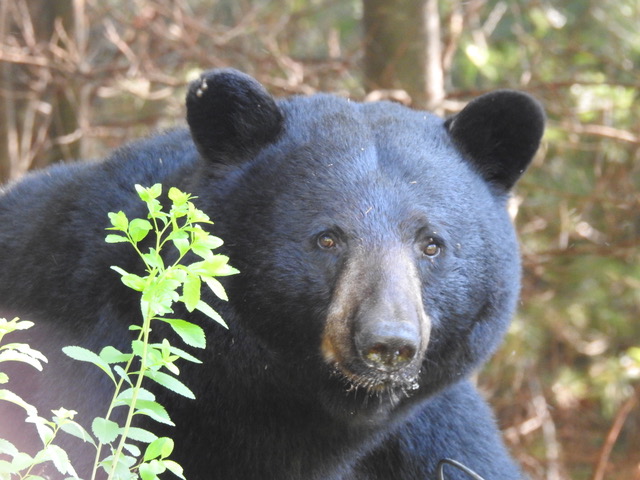
As an eco feminist I am deeply concerned with the loss of the animals I love. One of these is the Black bear whose visits are becoming more and more scarce as the forest around me disappears. The bear in this poem is unlike the bears I used to know in that he is terrified of me. When I first fell in love with bears it was because they embodied the soul and body of the Great Mother in a way that was meaningful to me. It is no accident that Black bears were honored as great healers by Indigenous peoples around the globe. The first images of them appeared on cave walls approximately 50,000 years ago.
Visionary Night
A furry shadow – ever dimming vision – did I imagine him? The woods are needled – Bare twigs stick out, pine spears behind Her. Mother Tree – She who sheltered his kin. He thinks rough elephantine arms will provide protection from his greatest threat – human supremacy. I cry out in desperation: “I am not one of them”. (this woman who loves bears)







 Feminism and Religion