Dancing for Forgiveness and Reconciliation – Part Two By Laura Shannon

In Part One of this article, I described dancing Jewish, Romani, and Armenian dances for forgiveness and reconciliation with groups in Germany and all over the world. I also offered danced rituals of remembrance at former concentration camps and other places scarred by the atrocities of war.
I went to camps including Dachau and Auschwitz, to genocide memorials and sites of massacre throughout Eastern Europe, in Australia, and the Americas. At first, my prayers were private: I brought flowers, lit candles, danced my grief, and spent time in meditation. I tried to visualise the prisoners in those places, sending them my deep sorrow and regret back through time. I wanted to let them know that they are remembered and mourned by people from their future. My prayers contained a fervent apology as well as a soul commitment to do my part in this lifetime to overcome prejudice and stand for peace.
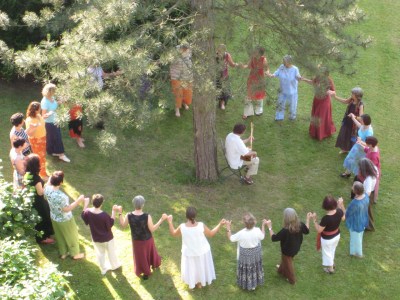
In time I invited others to dance with me for healing and peace. We danced at former camps in Germany, including Bad Gandersheim, a subcamp of Buchenwald, and on many occasions in Steyerberg, a former prison camp and forced-labour munitions factory which is now the site of an intentional community called Lebensgarten (‘Garden of Life’), a centre for permaculture, non-violent communication, and other ecologically and spiritually oriented ways of living.

Continue reading “Dancing for Forgiveness and Reconciliation – Part Two By Laura Shannon”

The Mask and the Mirror – Part 3 By Sara Wright

Artist Debra Fritts

One concrete way of accomplishing this change is to submerge ourselves in the rest of Nature and stay open to the appearance of animals, birds, plants, etc., and by paying close attention to images and words, nudges, synchronicities, dreams, and fantasies. Especially while caregiving, perhaps the most exhausting job of all. S/he provides us with a means to deal with the crisis of Covid 19 by staying in the present moment as much as we possibly can. Debra’s flowers/ four-leaf clovers, owls, stars, all speak to the importance of the presence of nature in different ways.

It is hard to miss the change of expression on Everywoman’s face. Held by the bear, her eyes are focused and there is a sense of peace that permeates the woman’s countenance. Clearly, Everywoman is able to be present to what is. This woman has once again found home.

To the right and below the moon there is a small leaf-like image that seems to be drifting. When I asked Debra what the image was she responded that the leaf was a simplified four-leaf clover. It symbolized the role that luck plays in the spread of an impersonal virus, but memories of being with her grandfather on Sunday afternoons searching for four-leaf clovers, and the way the two were connected with nature were also part of the reason she included this image. Once again we see the archetypal and the personal intersecting in Debra’s work. On an archetypal level, the impersonal presence of luck/trickster/fool determines viral outcomes, on a personal level this symbol attaches Debra to nature and her love for family.

Continue reading “The Mask and the Mirror – Part 3 By Sara Wright”

The Mask and the Mirror – Part 2 by Sara Wright


Artist Debra Fritts

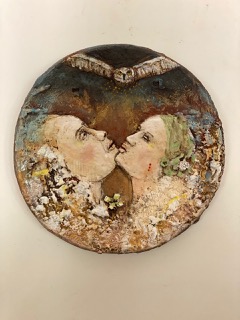
When I asked Debra about this circle she said “the circle around the eye is symbolic of the moon, a nightly ritual of seeing the moon.”  Curiously, women as ‘seers’ have an intimate relationship with the moon. Both eyes seem to be able to stare directly through the mask. The woman’s lips are parted; she is breathing but there is no sense that she is about to speak.

The length of the woman’s neck is accentuated by its distinct slate blue tones. This neck seems especially vulnerable – stretched perhaps to endurance. Suddenly it occurs to me that it is also a neck, like a chicken’s neck, that is ready for the chopping block. Has this woman lost her voice? Her ability to breathe? Is there a threat of being separated from her body? The suggestion of a body ends at the woman’s shoulders so we are left wondering…

Since our feelings and emotions reside in our bodies the suggestion here is that this woman may be without access to her body on an instinctual level. If so she is unable to protect herself. Blue is a color that is sometimes associated with death. In some Native traditions, like that of the Zuni and the Lakota Sioux blue is the color of the Underworld. Particularly touching is the pale four petaled flower to the lower right of the left half of the relief, a flower without a stem or root, or is this a wheel of some kind, one that is in motion – whirling – chaos? To my mind a number of aspects of this portrayal speak to the presence of death. Continue reading “The Mask and the Mirror – Part 2 by Sara Wright”

Cat – Mysterious and Magical by Judith Shaw

judith shaw photoCat moves elegantly through our lives with grace, independence and an unquenchable self-assurance. “My dog believes its human; my cat believes its god” is a saying reflected by the beliefs of our ancestors. Since Neolithic days cats have been associated with goddesses.

Cats, domesticated members and the smallest of the family Felidae in the Carnivora order, are a study in balance – between quiet calm and powerful action, independence and connection, the seen and unseen.

Continue reading “Cat – Mysterious and Magical by Judith Shaw”

Embroidery in the Time of Covid by Esther Nelson

In her recent essay on this “Feminism and Religion” site, Ivy Helman wrote:  “Over the past few months, I’ve been struggling to write posts.  This month is no different.  I am currently sitting with four different half-drafts on three semi-related topics, none of which I seem to be able to complete…I write.  I erase.  I rewrite.  I copy bits of one into another to save for some other time.  I’m left with one sentence….”

I think all writers have this experience—writing, erasing, and then rewriting over and over again.  Writing during the current pandemic seems more difficult than ever.  Perhaps it’s because our dealings with the outside world have been drastically curtailed.  Writers need a variety of social interactions and experiences to sort out, reflect upon, and then create into a work of art that appeals and connects with an audience.  At least I find this to be so. Continue reading “Embroidery in the Time of Covid by Esther Nelson”

The Quality of Mercy by Barbara Ardinger


The quality of mercy is not strained;
It droppeth as the gentle rain from heaven
Upon the place beneath. It is twice blest;
It blesseth him that gives and him that takes…

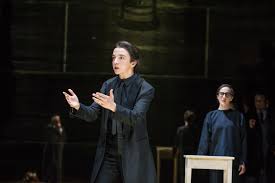
This speech (Act IV, scene 1) from The Merchant of Venice, given by Portia in disguise as a boy lawyer (and Bassanio doesn’t even recognize her!), may be one of Shakespeare’s most famous. In the play, as we know, Shylock, a Jewish moneylender, and Antonio, a merchant waiting for his ships to come in, make a bargain, one part of which is that if Antonio doesn’t pay on time, Shylock gets to collect one pound of his flesh. Antonio’s ships don’t come in, the case is taken before the Duke of Venice, and Portia appears in disguise to solve the legal issues. She goes immediately to Shylock and speaks this speech to him.

Portia, The Merchant of Venice Act IV, sc. 1, Royal Shakespeare Company production

Continue reading “The Quality of Mercy by Barbara Ardinger”

Subversive Sister Saints by Angela Yarber


As the American Embassy was bombed in 1999, I was hunkered in a Russian Orthodox Church, gazing at the brooding, whitewashed faces of icons, hands raised in endlessly frightening benediction. Hundreds of men met my eye, as I found myself asking, “Where are all the women?” In 2005, the sun peaked over the horizon on Mount Sanai as I entered the chapel at Saint Catherine’s Monastery, which houses the oldest collection of Christian orthodox icons in the world. As a sensory overload accosted my eyes, ears, and nose, I scanned the scene to find only two women crammed among all the icons; one was a nameless daughter sacrificed by her own father. Where were all the women? A few years later, I knelt at the Temple of 1,000 Buddhas in Thailand. Not a woman could be found. Where are all the women?

For over a decade, I’ve painted folk-feminist icons of revolutionary women from history and mythology, a subversively artistic attempt to answer my own question by painting the women who have been ignored, excluded, or strategically erased. From Pauli Murray to Sarasvati, Gloria Anzaldua to Papahanoumoku, this work continues to be a gift, joy, and a tremendous part of the mission of my non-profit, the Tehom Center, which empowers marginalized women by teaching about revolutionary women through art, writing, retreats, and academic courses. Continue reading “Subversive Sister Saints by Angela Yarber”

Moments of Beauty by Sara Frykenberg

Last week a friend of mine started a post asking people to share something that they’ve enjoyed or appreciated since shelter-at-home orders began across the country and globe. This friend was in no way trying to minimize the very difficult situations that so many of us find ourselves facing during this pandemic. Rather, the list she elicited and generated helped to create, at least for me, a moment of hope or peace—a moment that I suspect many of us need right now.

Inspired by my friend (who has quite a talent for pointing out the potential for joy or happiness), I would like to add to her list here by sharing a couple of my “moments of beauty” in the hopes I can share this hope or peace. Continue reading “Moments of Beauty by Sara Frykenberg”

Fragments of Beauty by Natalie Weaver


Can I empathize with your feeling,
your interest in this?
Be sound, my heart that feels
the beat of yours as my own.
I would like to be human one day.
Let my prayer be not please,
for, I fear I have been
an ungrateful guest,
sojourning pilgrim, refugee.
All this life, all will be,
a lesson in how to say
thank you.
These sides are not sharp antagonisms
that bring to points their points of view
but a pond’s surface under moonlight,
swirling like mercury, beneath which minnows,
fluid, do their works of harmonious disruption.
a city made of music
a city made of dreams
a city made of gardens
a city on a stream

oh, frontier Romana
who passes through the east
this is where my heart was cast
and carried out to deep

Darling, do you know me
Darling, do you see?
this is where I want you
where I long to be

how I yearn to see you
ruddied by the cool
Why were not you by me
then? then before I knew

yet, I trusted have you
trusted I could seek
now and wish to strew my ash
across the Blackest Sea

here to be uncluttered
here un’cumbered flesh
here our single soul to spread
and all the rest dispersed
I have come to you across the distance of years
That you might be redeemed in me
And know covenant by the measure of my love
I will comb your hair and bathe your soul
I will anoint you with my blood
I will mold and fire and decorate
The world beneath your feet
And I will dance until it is done
And broken into sleep
 

Natalie Kertes Weaver, Ph.D.is Chair and Professor of Religious Studies at Ursuline College in Pepper Pike, Ohio. Natalie’s academic books includeMarriage and Family: A Christian Theological Foundation (Anselm, 2009); Christian Thought and Practice: A Primer (Anselm, 2012); and The Theology of Suffering and Death: An Introduction for Caregivers (Routledge, 2013)Natalie’s most recent book is Made in the Image of God: Intersex and the Revisioning of Theological Anthropology (Wipf & Stock, 2014).  Natalie has also authored two art books: Interior Design: Rooms of a Half-Life and Baby’s First Latin.  Natalie’s areas of interest and expertise include: feminist theology; theology of suffering; theology of the family; religion and violence; and (inter)sex and theology.  Natalie is a married mother of two sons, Valentine and Nathan.  For pleasure, Natalie studies classical Hebrew, poetry, piano, and voice.

Trauma Healing through Communal Dance by Laura Shannon

The last few weeks have been difficult for me. I was already feeling raw from the treatment of refugees in Greece, the upheaval of impending Brexit in the UK, the fires devasting Australia and the Amazon, and so many other tragedies going on in the world. Then on Christmas Day I was thrown completely off balance by someone shouting abuse inches from my face, in a space where I had believed myself safe.
Someone restrained the woman and I made my escape, but the close-up image of her furious screaming face – eyes bulging, spittle flying, chin thrust up, chest thrust out – stayed with me long after the incident.
Like a car accident or other unexpected shock, this scene played back in my memory, night and day. I could not sleep, could not concentrate; I woke with nightmares, burst into frequent tears, suffered a string of migraines, and felt consumed with anxiety and fear.
In the following weeks I tried hard to overcome the trauma and to stop the flashbacks replaying continually in my mind, using all the resources available to me. However, I only really found a cure once I came back to Athens and went with my husband to a night of traditional dance with live music.

Continue reading “Trauma Healing through Communal Dance by Laura Shannon”