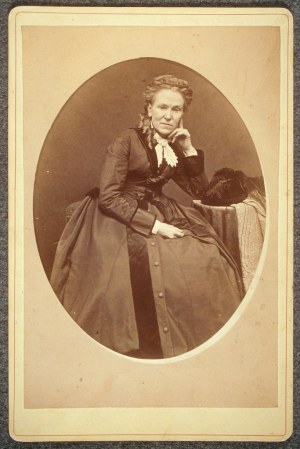
Matilda Joslyn Gage was an activist in the nineteenth century struggle for women’s rights equal to Susan B. Anthony, and a writer and theorist equal to Elizabeth Cady Stanton. That she is not remembered is due in large part to Susan B. Anthony’s efforts to write her out of history.
Matilda Joslyn Gage was also a scholar of women’s history unrivaled in her time. In Woman Church, and State, Gage argued that “the most grievous wrong ever inflicted upon women was in the Christian teaching that she was not created equal with man.” (page 1) From this it follows that feminists must never lose sight of the role Christian teachings have played and continue to play in the unequal treatment of women.
According to Gage, women’s position in church and state did not improve in the Christian era. To the contrary it declined! Gage proved this thesis in chapters titled: The Matriarchate, Celibacy, Canon Law, Marquette, Witchcraft, Wives, Polygamy, Woman and Work, and The Church of Today.
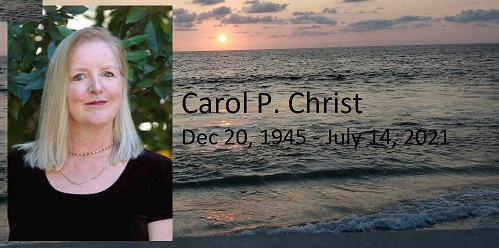
This post was originally published on July 2nd, 2012…like many of Carol’s other posts, it is eerily poignant for today.
Watching the last episode of the Australian series Brides of Christ in which Catherine leaves the sisterhood of the convent because of her disagreement with Humanae Vitae brought me right back to the Yale Roman Catholic chapel and the folk mass I attended regularly. In 1968 just after the publication of Humanae Vitae, priest and co-graduate student Bob Imbelli preached a sermon on the doctrine of conscience, arguing that though it was incumbent on Catholics to think carefully about the papal encyclical on birth control, it was also the responsibility of every Catholic to follow her or his conscience on the matter. In the episode, Sister Catherine encourages a Roman Catholic mother of six who has already self-induced more than one abortion to take the pill, but the woman decides she cannot go against the church’s teachings. Catherine allows an editorial against Humanae Vitae to be published in the school newspaper even though she knows it will probably lead to the expulsion of one of her favorite students.
I often find myself sitting in conservative Catholic spaces. My brother is a Roman Catholic priest in the Dominican order and I remain in support of his vocation. Every time, before a Mass officially starts, I’m overcome with a sense of: “You belong here…and you don’t.”
The part of me that has always felt at home in a Catholic setting is that love of the ritual and ceremony, the smell of the incense, the familiarity of the chants and songs. It was a Catholic priest, the late Fr. Ciaran O’Donnell, who taught me how to play the guitar and got me started with the healing practice of songwriting. When I sink into these associations, I feel connected to my Croatian ancestors and our Catholic faith. And there’s the other part of me—the queer feminist and an advocate for other queer and transgender people to live the fullest, most open expressions of themselves in all spaces of life, especially faith-based spaces. As a survivor of several forms of sexual assault and as a trauma specialist who has guided countless other survivors in their healing process over the years, I can’t sit in a Catholic Church and not feel uneasy about the legacy of abuse and silencing survivors within the church. Between my queer identity and dedication to supporting survivors, I feel that I don’t belong.
Quite a number of years ago I had a conversation with one of my professors, a feminist theologian, who posed the question “Why do I need a man to purify my baby with the waters of baptism? Is there something wrong or impure about the blood and water from a mother’s womb – my womb?” Before you jump and shout the words Sacrament or removal of original sin, this question bears merit in exploring, especially in today’s world where women are taking a serious beating religiously, politically, and socially. In today’s world, violations and rants are causing women to stand up and say STOP! This is MY Body. This outcry was provoked by chants of ethical slurs against women– Slut! Prostitute! Whore! The cry got even louder when the issue of religion and government was raised in the fight of healthcare coverage of contraception. The cry got even louder with the enactment of the laws in Virginia and Texas (and many other states to follow suit) that forces women to undergo transvaginal ultrasounds in early stage abortions. The mandatory insertion of a wand into a woman’s vagina (mandated by the government, mind you), is a violation and has women crying RAPE!
In her 1975 manifesto, “The Laugh of the Medusa,” French feminist Hélène Cixous urges women to write: “Writing is for you, you are for you; your body is yours, take it. . . . Women must write through their bodies, they must invent the impregnable language that will wreck partitions, classes, and rhetorics, regulations and codes . . .”
“The Laugh of the Medusa” remains a thrilling essay, challenging and inspiring women to “return to the body” and to language. “Woman must write woman,” Cixous insists, “for, with a few rare exceptions there has not yet been any writing that inscribes femininity.”
I am less concerned with the legitimacy or morality of public breast-feeding . . . rather I am asking what contributes to this strange binary of, on the one hand, social acceptability of near-porn-like images of breast used in advertising, i.e. Victoria Secret, while on the other hand, internal conflicts some feel when viewing a baby/child feeding at the breast?
Beyond the “war on women” initiated by the Republican party on women’s reproductive rights, the issue of women’s breast, or more specifically, the nursing breast, has been making itself know in the media. The recent Time magazine cover of Jamie Lynne Grumet breast-feeding her three-year-old son produced a flood of controversy centering on “attachment parenting,” which promotes, among other things, breast-feeding beyond infancy. Parent magazine recently profiled two military mothers breastfeeding in public while in uniform. For some, this perceived breach in social decorum is akin to urinating and defecating openly while wearing your uniform. Responding to the outcry, Air Force spokesperson Captain Rose Richeson states, “Airmen (sic) should be mindful of their dress and appearance and present a professional image at all times while in uniform.” In other words, it is suggested nursing military mothers pump and bottle-feed their babies when wearing their uniform in public spaces. And finally, Hadley Barrows of Minnesota was asked to leave the library by a security guard because her nursing in public was a form of “indecent exposure.” In this post I am less concerned with the legitimacy or morality of public nursing (although I have no issue with it), instead I am asking what contributes to this strange binary of, on the one hand, social acceptability of near-porn-like images of breast used in advertising, i.e. Victoria Secret, while on the other hand, internal conflicts some feel when viewing a baby/child feeding at the breast? Drawing from the work of Margaret Miles and her text, A Complex Delight: The Secularization of the Breast, 1350-1750, social attitudes and the public display of women’s breast can best be understood when the breast is viewed as a coded symbol that informs, through artistic representation, complex patterns of discourse.
Watching the last episode of the Australian series Brides of Christ in which Catherine leaves the sisterhood of the convent because of her disagreement with Humanae Vitae brought me right back to the Yale Roman Catholic chapel and the folk mass I attended regularly. In 1968 just after the publication of Humanae Vitae, priest and co-graduate student Bob Imbelli preached a sermon on the doctrine of conscience, arguing that though it was incumbent on Catholics to think carefully about the papal encyclical on birth control, it was also the responsibility of every Catholic to follow her or his conscience on the matter. In the episode, Sister Catherine encourages a Roman Catholic mother of six who has already self-induced more than one abortion to take the pill, but the woman decides she cannot go against the church’s teachings. Catherine allows an editorial against Humanae Vitae to be published in the school newspaper even though she knows it will probably lead to the expulsion of one of her favorite students.
While I celebrate the rise in status of Hildegard to official saint and soon to be Doctor of the Church, I cannot help but be suspicious of the Vatican’s motivations. One only has to take in the last two months behavior of the CDF, sanctioned by Pope Benedict, to see the real intentions of this papacy—the continued subjugation of all women to clerical authority.
The past month or so has been a very busy time for the Congregation for the Doctrine of Faith or CDF and their examination of women. First they (and this includes Pope Benedict XVI) decided American nuns are guilty of the sin of silence by not speaking out on abortion & homosexuality. Their “radical feminist” ideology of standing with the poor and disenfranchised, while good, is not good enough for the CDF. The firestorm of solidarity coming from both laity and religious surely caught the Vatican off guard. Right? Well, not quite. This past week the CDF began its investigation of the Girl Scouts for their purported association with the likes of Planned Parenthood and Oxfam. While both address the needs of the poor, it is the latter and its troubling advocacy for safe sex via condom use that initiated the inquiry. Keep in mine that in 2010 Pope Benedict retracted from his earlier position and bane on condoms, seeing instead their use as a “lesser evil” in the fight against HIV/AIDS. The CDF angst is that the message of condom use might be too much sex-talk for impressionable young women. And now the real conundrum, Pope Benedict officially declared Hildegard von Bingen a saint and will soon declare her the fourth female Doctor of the Church along with Catherine of Sienna, Theresa of Avila & Teresa of Lisieux. News articles credited the pope as feminist-friendly and minded by his endorsement of Hildegard. It is stated that Pope Benedict turned to the writings of the 12th century visionary with her sharp critique of clergy and the church during her own 12th century milieu as a contemporary diagnosis for the sins of its priest in the global sex scandal. So what is it that attracts Pope Benedict to Hildegard?
So it is a [female] generativity that .. is … giving life to social, cultural and economic structures that are inspired by values, ideas, principles and practices oriented to the common good …
The above statement from the Pontifical Council’s document on “Women’s Cultures: Equality and Difference” is a response to Pope Francis’s call for a discussion of “feminine genius” and its role in the Church. If in fact women are “oriented to the common good,” then this is the best reason I can think of to elect a woman pope. And if a women are in fact hard-wired to think about the good of all, wouldn’t a woman pope’s first act be to dissolve the hierarchy that elected her? Is this why the Vatican is so afraid of the power of women?
In Part 1 of this post, I described my first encounters with Rosalía’s music and visual arts, which are controversial for many, but I find them wonderful. I mentioned how she integrated God, mainly Catholic references and images, into a story of love and suffering in El Mal Querer. But I finished emphasizing my surprise when I listened to the album Motomami, since she managed to combine reggaeton (sexual-indecent music) and her views of God.
So, here is my attempt to describe Rosalía’s theology in Motomami. (Before I start, let me say: yes, I heard every song multiple times collecting references of God or the Christian tradition, so I hope you enjoy it.) Rosalía understands God as someone who controls our destinies amid grief and joy. In Como un G she says “It’s sad when you want something, but God has different plans for you” (“Qué pena cuando quieres algo pero Dios tiene otros planes pa’ ti”.) In Diablo, she says, “What God gives, God takes back” (Si Dios te lo da, te lo quitará), referring to her fans who first loved her but afterward became haters. God also protects us from an evil former partner when she says in Despecha‘ “May God forbid I go back to you” (“Que Dios me libre de Volver a tu la’o). God also is our help and supports our choices. Rosalía brings this concept talking about her identity as a woman, her freedom and autonomy in Saoko: “I know who I am, and I don’t forget where I’m going. I’m driving while God guides me. I am mine and I transform myself” (“Sé quién soy, y a dónde voy nunca se me olvida. Yo manejo, Dios me guía.)







 Feminism and Religion