Toward an Alternative Ecclesiology by Xochitl Alvizo 

I mentioned in a recent post that I would share a little more about my current research, as one of the aspects of my life I gained more clarity in during my recent process of regrounding was in the area of my research.

Two things stood out to me as I reflected on my work and scholarship: my concern for individual human dignity drives my work—it is an underlying thread in how I think and theologize. The second is that I want to make a major contribution to the theology of the church—I know I want to write a feminist ecclesiology. These two things are obviously related. I have witnessed enough of the ways that not only Christianity harms people, but how the church specifically is a conduit for the damages Christianity causes. At the same time, Christianity remains a living tradition, a shared story and language, and a community to which many are committed. So just as people are harmed by church, some are also nurtured and held by it. While it is true, then, that church indeed harms people and violates their dignity, often also justifying that violation on theological grounds, it need not do so and has other possibilities before it.

Thus, I want to contribute to a theology of church that is a grounded and liberating alternative to the problematic one to which people most often default or inherit. A queer, feminist, anti-racist, and decolonial ecclesiology.    

Continue reading “Toward an Alternative Ecclesiology by Xochitl Alvizo “

Spill that Tea: Catholic Nuns, Meghan Markle, and Theological Feminism by Anjeanette LeBoeuf

I wrote a piece in March 2021 regarding the British Royal Family and their horrendous treatment of the Duke and Duchess of Sussex, Prince Harry and Meghan Markle. On August 23, 2022, Meghan released her first podcast episode for her series titled “Archetypes”. The first episode had guest speaker, famed legendary tennis player Serena Williams. They talked about the misconceptions of ambition and the two-edged sword that women have to endure in society when striving to be their best in a male centric world. And for many of us within Religious and Theological spaces, the disparities that women, queer folk, and non-binary peoples have endured in society are also tied into the misconceptions and harmful archetypes found within religious spaces.

Continue reading “Spill that Tea: Catholic Nuns, Meghan Markle, and Theological Feminism by Anjeanette LeBoeuf”

Remembering Rosemary Part 2 by Janice L. Poss and Theresa A. Yugar

Editor’s Note: A more formal memorial to Catholic Feminist Theologian Rosemary Radford Ruether was posted here at Feminism and Religion at the time of her passing. Now we are delighted to share these memories of her by two scholars, Theresa A Yugar and Janice L. Poss, who knew her well, especially in her last months. Therese’s reflection is below and Janice’s will appear tomorrow. As Janice notes in her post, “More than any deep theological concept, doctrinal exegesis, or other hyper-scholarly thought, she taught me simply by being who she was – a woman – and she gave me the ultimate gift, the gift of herself.” Through these posts, Theresa and Janice pass on some of Rosemary’s wise and caring gifts to our FAR readers. Part 1 was posted yesterday. You can read it here.

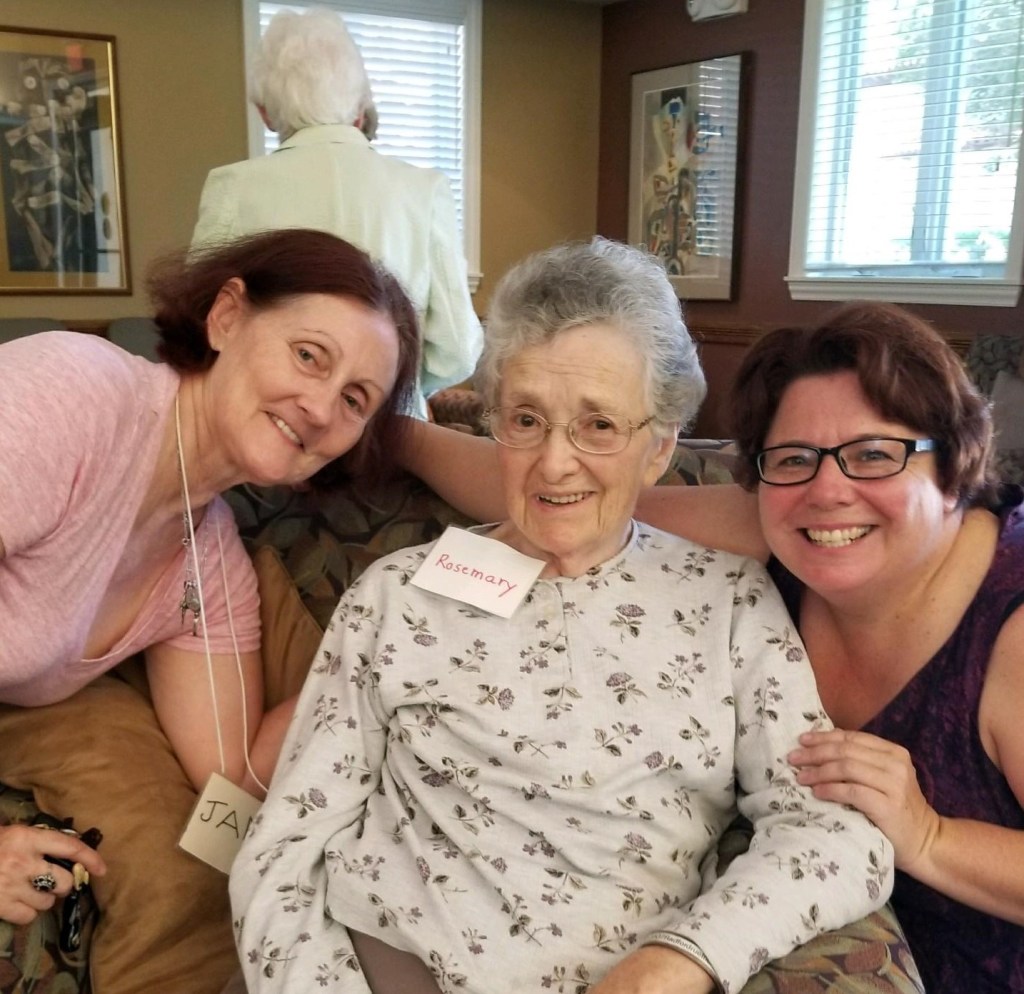
Janice, Theresa with Rosemary

Almost five years ago, Rosemary Radford Ruether suffered a devastating stroke that left her partially paralyzed and no longer able to speak or write, activities that were integral to her life as a writer, teacher, activist, and scholar. During her difficult last years Janice and I learned new ways of engaging her that were academically stimulating and fulfilling for her. We became advocates for her during her disability as she had been an advocate for us. Thus, out of pain grew blessings.

Janice and I dedicate and share with you these two short reflections that reflect our struggle to find our way without her. We know there will be many more reflections composed and shared by others whom she mentored, influenced and touched. Now—in the midst of our grief and sadness at her loss—we offer our personal memories of how she enriched our lives every day until she passed from our midst at 2pm, on Saturday, May 21, 2022.

Continue reading “Remembering Rosemary Part 2 by Janice L. Poss and Theresa A. Yugar”

Remembering Rosemary Part 1 by Janice L. Poss and Theresa A. Yugar

Editor’s Note: A more formal memorial to Catholic Feminist Theologian Rosemary Radford Ruether was posted here at Feminism and Religion at the time of her passing. Now we are delighted to share these memories of her by two scholars, Theresa A Yugar and Janice L. Poss, who knew her well, especially in her last months. Therese’s reflection was posted yesterday and Janice’s is below. As Janice notes in her post, “More than any deep theological concept, doctrinal exegesis, or other hyper-scholarly thought, she taught me simply by being who she was – a woman – and she gave me the ultimate gift, the gift of herself.” Through these posts, Theresa and Janice pass on some of Rosemary’s wise and caring gifts to our FAR readers.

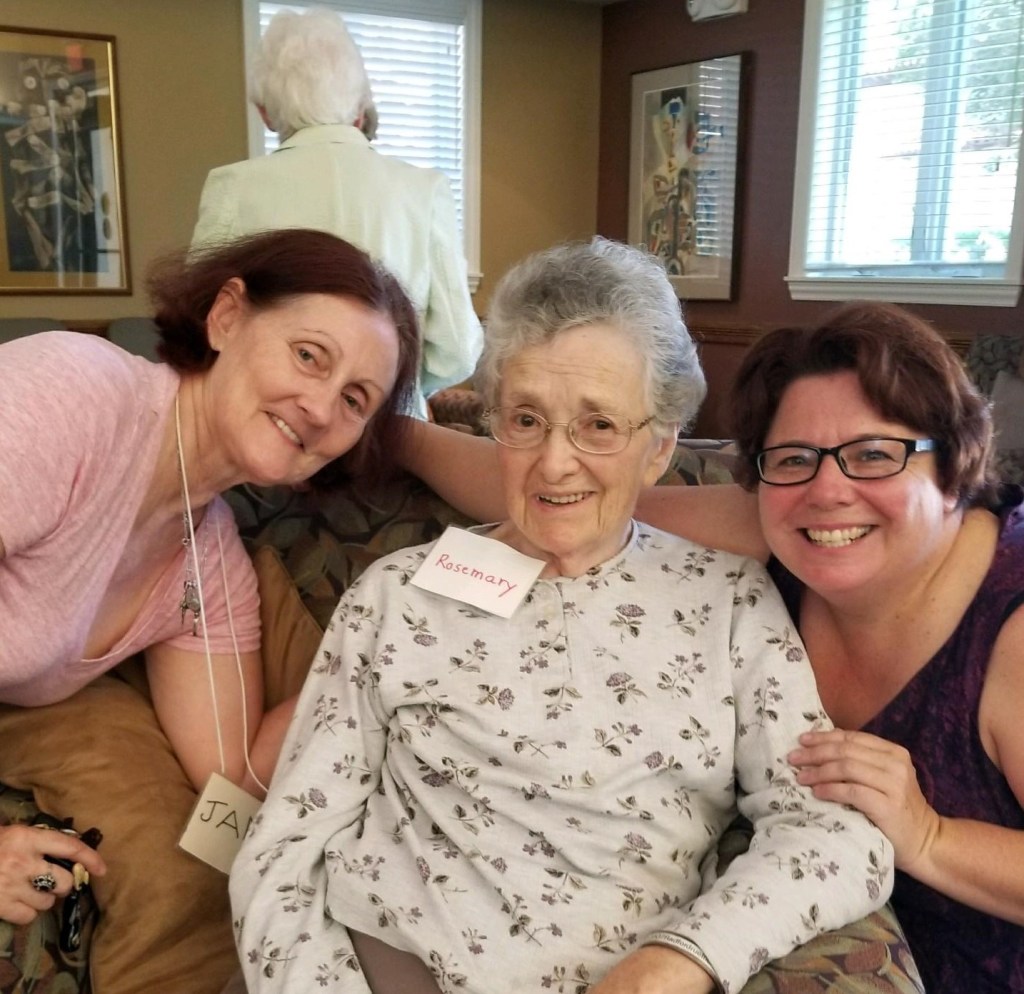
Janice L. Poss, Rosemary and Theresa A. Yuger

She’s gone, but not forgotten. She is there, presence felt. The Spirit, as they say, works in mysterious ways. I knew about Rosemary for several years after attending two presentations  on feminist topics that she gave at Loyola Marymount University in 2005 and 2008. In 2006, I also recall hearing about her while organizing the first Roman Catholic Women Priests (RCWP) Mass in Los Angeles. Once I entered Claremont Graduate University as a Ph.D. student I heard quite a bit about her because my colleague and friend, Theresa Yugar, mentored me through orientation until she graduated. Occasionally I would see Theresa and Rosemary at Pilgrim Place when I attended Women Church Services. Although Rosemary was still teaching one class a semester, I could never attend because I was working full-time.

Continue reading “Remembering Rosemary Part 1 by Janice L. Poss and Theresa A. Yugar”

From the Archives: Rape is Not a Political Platform – Rape is a Violent Crime! By Michele Stopera Freyhauf

Moderator’s note: This marvelous FAR site has been running for 10 years and has had more than 3,600 posts in that time. There are so many treasures that have been posted in this decade. They tend to get lost in the archives. We are beginning this column so that we can revisit some of these gems. Today’s blogpost was originally posted August 23, 2012. You can visit it here to see the original comments.

Just when you think you have heard it all, here we go again – another politician with “open mouth-insert foot” syndrome.  Discussing his zero-tolerance policy for abortion, Missouri Representative Todd Akin made the following statement last Sunday about pregnancies that result from rape:

“from what I understand from doctors, that’s really rare.  If it’s a legitimate rape, the female body has ways to try to shut that whole thing down.  But let’s assume that maybe that didn’t work or something.  I think there should be some punishment, but the punishment ought to be on the rapist and not attacking the child.”

Continue reading “From the Archives: Rape is Not a Political Platform – Rape is a Violent Crime! By Michele Stopera Freyhauf”

From the Archives: Brigid, Archetype of Inspiration and Activation by Stephanie Anderson Ladd

Moderator’s note: This marvelous FAR site has been running for 10 years and has had more than 3,600 posts in that time. There are so many treasures that have been posted in this decade that they tend to get lost in the archives. We are beginning this column so that we can all revisit some of these gems. Today’s blogpost was originally posted February 1, 2014. You can visit it here to see the original comments.

Brigid, Goddess of the Fire, greets us on Brigid’s Day, February 1. She is a Celtic sun goddess whose light burns brightly, illuminating the darkness of the land, of a heavy heart, and the dark night of our soul. With her shining light to guide us, we are lifted out of the Underworld darkness where we tend to descend in Winter, to the light of the World above, teeming with life as Spring begins to unfold her wet wings.

Brigid is a beloved goddess throughout the British Isles, particularly Ireland, where she is seen as the Mother of the Land and Her people. As a feminine archetype, she activates our solar, active nature. Much like the sun rising from below the Earth’s horizon, she urges us to come out of hiding and shine our light on the world. This may be done in a quiet manner, such as sitting by the hearthfire and doing needlework, finding inspiration by a walk in nature and writing a poem, moving about the kitchen making soup, getting busy with an art or craft project, or in big ways by taking on new roles as healers, artists, and leaders and calling others to join us.

Continue reading “From the Archives: Brigid, Archetype of Inspiration and Activation by Stephanie Anderson Ladd”

Poem: In These United States- The Court Supreme By Marie Cartier

We have nine justices usually but one of our most beloved, and notorious,
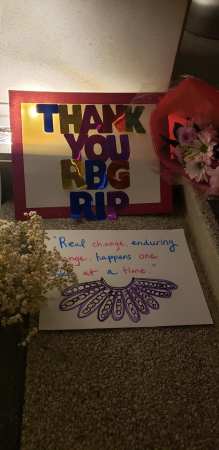
Ruth Bader Ginsberg, RBG, has gone to the Summerland, across

the Rainbow Bridge, to the afterlife—wherever that is for her, she’s

gone there. May her memory be a blessing. May her memory be a revolution.

And we are left with eight, five conservatives and

three liberals. RBG was liberal. Our current Pennsylvania Avenue occupant has already

nominated someone to replace RBG. This someone believes that god

speaks to the wife through her husband, the wife is submissive to the husband in all things,

she must submit in all things to her husband.

Sigh. As someone joked, this someone is walking through and slamming shut,

all the doors that RBG kicked open.

This nominated replacement believes that a woman has no choice in the matter of pregnancy,

and being gay is (once again) a sin in the eyes of the law, as well as her church.

This RBG replacement is Catholic, I guess.

I’m Catholic, too.

Maybe you’ve seen that meme on social media?

“I’m Christian. Oh…classic Jesus or Republican Jesus?”

That’s a joke: Ha. Ha.

Continue reading “Poem: In These United States- The Court Supreme By Marie Cartier”

Judaism or Christianity: Which Tradition Is More Open to Feminist Change? by Carol P. Christ

Jill Hammer’s recent post on midrash surrounding the Biblical figure of Eve (Hava in Hebrew) sparked me to muse again about the fact that, despite its patriarchal roots and overlay, Judaism is a much more flexible tradition than Christianity and, therefore, much more open to feminist change.

Part of this is due to the fact that Judaism is midrashic while Christianity has been and remains a doctrinal tradition. Midrash is a form of Biblical interpretation that includes retelling the story to fill in the blanks and to answer contemporary questions left unanswered in the original text. Jews consider the Torah (the 5 books of Moses) to be the “Word of God” though opinions vary as to what this means. In the rabbinical tradition, the Torah is interpreted through the Talmud which is an extensive collection of discussions and disputes that draw on Biblical texts in relation to contemporary (to the rabbis) questions. Midrash included in the Mishnah (a collection of teachings that preceded the Talmud) and the Talmud are considered part of the “oral Torah.” which is also “the Word of God.”

The Talmud is considered to be authoritative, but it includes conflicting interpretations that were never resolved into a single definitive view. Though different Jewish groups have declared certain views to be normative, other groups have disagreed. There is no central authority (such as a Pope or council) to resolve these disputes. Though some Jewish groups disagree strongly with the beliefs or practices of others, in Judaism as a whole an attitude of “live and let live” leads to inclusion rather than exclusion. Indeed. The Talmud records that in the midst of a particularly vehement dispute between two rabbis, a voice intervened, stating: “These and these are the words of the Living God.” (Quoted by Judith Plaskow in Goddess and God in the World.) Continue reading “Judaism or Christianity: Which Tradition Is More Open to Feminist Change? by Carol P. Christ”

A Sword Will Pierce Your Own Soul by Mary Jane Miller

On Holy Ground is a collection of icons for this age of climate change. The collection of iconography opens with an image of Mary of Swords inspired by the number seven. This sacred number is associated with intuition, mysticism, inner wisdom, and a deep inward knowing. The ancient church speaks of seven deadly sins and seven holy attributes, and seven sacraments. The composition places the planet Earth beside Mary as she bows her head having been told, “ a sword will pierce Your own Soul ”
Mary of Sorrows or in this case, Mary the softener of Evil Hearts tilts her head lovingly towards our planet Earth. Seven swords pierce her heart; indicating the fullness and boundless sorrow, pain and “sickness of heart” that would have been experienced by Mary the Mother of Jesus at His crucifixion.
Muslims pilgrims circle the Kaaba in Mecca sevens times, and Egyptians had seven gods.

Continue reading “A Sword Will Pierce Your Own Soul by Mary Jane Miller”

The Feast of Santo Tomas by Sara Wright

This morning I went up to the village plaza in Abiquiu to watch the dancers parade around the church with their saint who is also honored at this village festival held every year at the end of November.

This is one of the two Native American festivals that is honored each year by the genizaros who are mixed Spanish and American Indian people who embrace and practice the Catholicism that was once forced upon them.

This eclectic community is made up of descendants of Native American slaves. Those captured in warfare were brought here, converted to Catholicism, taught Spanish and held in servitude by New Mexican families. The young women and female children endured the usual atrocities perpetuated on captive females including rape at the hands of their captors. Some New Mexican male genizaros gained their freedom by serving as soldiers to defend frontier villages like Abiquiu from Indian raids. By the late 1700s, genizaros comprised one-third of the population of New Mexico. Ultimately these non – tribal peoples were assimilated into New Mexican culture.

The dances are beautiful to witness with the smallest female children dressed in predominantly white regalia some wearing a rainbow of ribbons, the young girls were dressed in red and white and had red circles of war paint inscribed on their cheeks, some of the older women also wore red, many carried turkey or eagle feathers in their hands. Most wore face paint.

Continue reading “The Feast of Santo Tomas by Sara Wright”