Would You Rather Just Not Be? by Esther Nelson

When I was in my late teens, my mother became friendly with Beth, a woman she occasionally worked with on the post-partum unit of the local hospital.  Beth had two children a little younger than I, however, when our moms got together outside of the workplace, we (the kids) sometimes found ourselves thrust together.  

I don’t recall how the conversation began on this particular day, but Beth’s children were complaining (within earshot of their mother) about life.  They were sour on the experience. “You’re born and then you die.” They didn’t seem to have much enthusiasm for the possibilities available to them before death.  Their mother asked them, “Would you rather just not be?” Their answer, an unequivocal “YES,” surprised me. It resonated with my own feeling at the time—one that I had not dared articulate. Continue reading “Would You Rather Just Not Be? by Esther Nelson”

Mother – Daughter Betrayal by Sara Wright

(1)

Today is my mother’s birthday and although she has been dead for more than a decade I still think of her almost every day. At the time of her death I had not seen her for twelve years. Not by choice. After my father’s sudden demise my mother chose my children, her two adult grandsons to be her protectors, and dismissed me from her life, permanently.

When she died, my mother divided her assets evenly between my children and me, forcing her only daughter to live beneath the poverty level for the remainder of her life.

The final betrayal.

At the time of her death I was teaching Women’s Studies at the University.

Continue reading “Mother – Daughter Betrayal by Sara Wright”

To Light a Flaming Pumpkin: The Inexact Art of Family Ritual, by Molly Remer

Our bounty is inIMG_7695
creativity
friendship
community
the myriad small adventures
of everyday.
We tell of magic
and moonrise
and listening to the pulse
of the earth beneath our feet.

Ah, October. Fall has settled into the trees and air. Last year on Samhain (Halloween), as the sun was setting and the full moon was rising, my family stood together in the dim light on our back deck, lit a fire in a hollowed out pumpkin and offered handfuls of herbs into the flames as we celebrated our blessings, our harvests, and our bounty, as a family and as individuals. As we spoke aloud our blessings and our bounty, our words got deeper, broader, and more authentic. My twelve year old son stepped forward to say how thankful he is that he gets to live with his best friend, his fifteen year old brother, and they embraced over the flaming pumpkin. My fifteen year old son offered his thanks for a family that has “cool IMG_7387rituals like this” and my four year son offered his blessings for the “energy we feel together.” My seven year old daughter offered her gratitude for pandas and for toys.
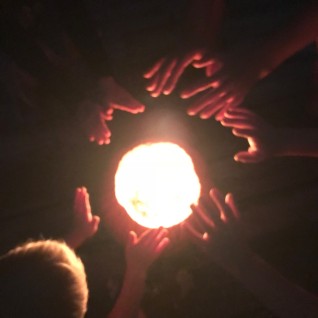
The next week, we returned the seeds to the pumpkin and released it to the outdoors to grow next year.

Seventeen years ago, I held my first Winter Solstice ritual. I wrote my wish for a baby onto a small piece of paper and rolled it up into a “seed” of my dreams that I planted within a special wooden box. On the autumn equinox the following year, I gave birth to my first child, a son who now stands inches above me, but who joins hands with his family each month to sing “Dance in the Circle of Moonlight” together on the back deck under the full moon.

After having this first baby, it became increasingly important to me that we celebrate holidays and traditions that reflect our spiritual values and worldview rather than the packaged version of the holidays offered by society, or the religious observances of dominant faiths that do not match our own. While we have celebrated the wheel of the year together in a variety of ways in what has now been sixteen years of parenting and twenty-one years of marriage, it wasn’t really until last year that I felt I finally, truly hit my stride in planning fulfilling, nourishing family rituals. Perhaps it is because I am no longer trying to juggle nursing a baby or changing a diaper while simultaneously also guiding a ceremony. Perhaps it is because I’ve loosened up and accepted the myriad imperfections possible within a multi-age celebration. Perhaps it is because when one of the children wanders off during circle or interrupts me while I’m talking, I accept it as part of the flow, and continue our work without breaking my stride. Perhaps it is because I now laugh too when someone makes a joke during my careful ritual, and continue to roll with it, instead of feeling like it is disrespectful. Perhaps it is because I consider a 15-20 minutes family ritual perfectly sufficient instead of trying to plan for a full-fledged, retreat-style “program” of activities. Perhaps it is because we’ve joined hands in family circle in so many ways and for so many years that we all now trust that I’m not giving up on doing this together.

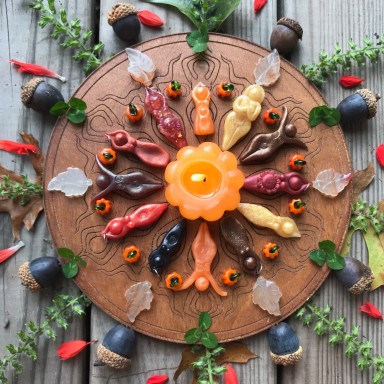
In the course of the year we’ve anointed one another’s foreheads with fragrant oils while standing in the freezing water of a freshwater stream. We’ve felt the raindrops kiss our faces and the rays of the sun peek in and out of the clouds as we celebrated the summer solstice by releasing wildflowers into the river. We’ve howled at the moon together, built a green man face from leaves, stones, and sticks in the field, created flower mandalas, thrown pinches of cornmeal into the woods as a symbolic sacrifice, soaked our feet in warm water laced with rose petals and then massaged one another’s feet with lotion, walked through a spiral of candlelight, and offered handfuls of herbs into a flaming pumpkin.

As we notice the changing seasons and honor the call of nature within our lives through ceremony, celebration, and song, we make visible the interconnected dance of life. We reaffirm our commitment, our relatedness, to each other and to the natural environment around us. We communicate with and are in relationship to that larger force of life and spirit that we call Goddess. And, we bring our spiritual beliefs into our bodies, hands, minds, and hearts in an ever-spinning Wheel of celebration, attention, observation, enjoyment, communion, and love.

 “We can think of ritual as the container we weave in which we can be carried away by magic and ecstasy.”

—Starhawk and Valentine, The Twelve Wild Swans

For your own flaming pumpkin ritual, choose a large, round pumpkin, cut off the top 42311806_2188101348068742_1038582461505732608_oand hollow it out. Keep the seeds to plant with the remnants of your fire later. You may start the fire with paper and a lighter and then keep adding herbs to keep it burning, or you may stoke it by putting some alcohol in the bottom of the pumpkin to begin with. Alcohol burns cool and can create a longer lasting, less smoky flaming pumpkin. Offer your autumn bounty into the pumpkin with herbs sprinkles/handfuls—these can be spontaneous spoken aloud declarations of your harvest, your celebrations, your gratitude, etc. What are you thankful for?
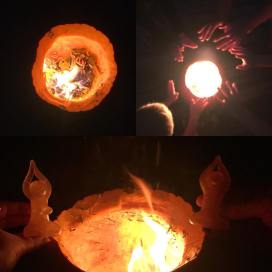
  • Optional: offer any sacrifices/releasing on slips of paper into the flames
  • Optional: Sing “Hallowed Evening” chant (by my kids and me)

Hallowed evening
Hallowed night
We dance in the shadows
We offer our light.

Additional Articles:

The Sound of Silence: a mother’s day reflection 2019 by Sara Wright

Here in the high desert it has been raining off and on for the last few days. A giant puddle sits in the driveway and all the trees range in color from subtle shades of sage to emerald. Fringed Chamisa, spun gold and salmon wildflowers are bent low but stems are luminescent. Seedlings are sprouting in unlikely places.

I can’t think of a better mother’s day present for the desert than these ongoing cloud-bursts that are nourishing the earth with water and minerals from the sky. I am profoundly grateful for this year’s spring greening.

The earth is experiencing a sense of renewal. I wish I could say the same for me with respect to mothering and mother’s day. I cross this cyclic threshold with the same feelings of dread and grief that overpower me each year. Neither of my children acknowledge me as the mother who once loved them so fiercely, but oh so imperfectly in her own confusion and despair.

I was such a young wife, barely twenty when I became pregnant with my first child. Two years later I was a mother of two sons. Within five years I was divorced and on my own.

Although I tried to repair the damage as soon as I was able, neither child was willing to join me. I desperately suggested counseling – many times. As adolescents and young adults both Chris and later David, responded with chilling silence and apparent indifference to every frantic attempt I made to bridge the gap.

Continue reading “The Sound of Silence: a mother’s day reflection 2019 by Sara Wright”

Raising (Dis)respectful Sons by Esther Nelson

I recently spoke with a female relative (I’ll call her Sylvia), the mother of two teenage sons.  The eldest just completed his first year of college.  During our conversation, Sylvia mentioned she was not looking forward to him coming home for the summer, saying that “something” happens to sons as they grow older.  She called him a “troll.”  I looked up the word online.

“In Internet slang, a troll is a person who starts quarrels or upsets people on the Internet to distract and sow discord by posting inflammatory and digressive, extraneous, or off-topic messages in an online community (such as a newsgroup, forum, chat room, or blog) with the intent of provoking readers into displaying emotional responses and normalizing tangential discussion, whether for the troll’s amusement or a specific gain” (Wikipedia). Continue reading “Raising (Dis)respectful Sons by Esther Nelson”

Why Pro-Life Stops at Birth: Who Really Supports Life and Why by Winifred Nathan

The patriarchal Catholic Church claims to be pro-Life.  But is it pro-Life?  Or is it pro-Birth?  A Catholic Benedictine sister outed the pro-Life movement. Her position: the pro-life crowd shows little if any ongoing interest in life after birth.  They’re pro-birth, but not pro-life.  Legislators who enact laws to restrict a woman’s right to an abortion, but then stand firm against funding  programs that assist the mother and her baby once the child is born are not pro-life.   Too often the goal of anti-abortion advocates is for the fetus to make it to birth. Birth is the important value, life not so much.

I propose the starting point for deciphering this puzzle is to look at our desire as human beings for immortality.  We want to defy death believing that there is a spiritual continuation of who we are after our bodies shut down.  We want death to be a new beginning.

A great deal of effort goes into seeking  an answer to the question what comes next.  A question we presently lack the capacity to answer. We honestly do not know what if anything happens following death.

Continue reading “Why Pro-Life Stops at Birth: Who Really Supports Life and Why by Winifred Nathan”

Re-reading Mary Shelley’s FRANKENSTEIN by Joyce Zonana

And so is born the “monster” most people associate with the name Frankenstein–a lone and lonely terrorist who lashes out against a world that has no place for him. One by one, he strangles all the people his “maker” holds dear: his brother William, his best friend Clerval, and his cousin/bride Elizabeth. Yet the novel invites us to have compassion for the creature, even while it condemns the society that makes him as he is. Victor, raised by a devoted mother and tenderly loved by a doting cousin, should have known better. As should we.

jz-headshotA few weeks ago, a former colleague invited me to visit one of his classes, to discuss Mary Wollstonecraft Shelley’s 1818 novel Frankenstein; or, The Modern Prometheus and the essay I’d published about it almost thirty years ago, “‘They Will Prove the Truth of My Tale: Safie’s Letters as the Feminist Core of Mary Shelley’s Frankenstein.”  To prepare for that visit, I’ve spent the past few days re-reading the book, and I’m overwhelmed anew by the beauty of Shelley’s language, the brilliance of her plot, and the profoundness of her themes. The book moves me even more today than when I first read it.

Continue reading “Re-reading Mary Shelley’s FRANKENSTEIN by Joyce Zonana”

The Race-ing of Innocence: Calling All Feminists to Converse by Marcia Mount Shoop

mms headshot 2015Well over 100,000 people and counting have read a blog post called “Nothing But the Truth: A Word to White America After the Recent Unpleasantness in Washington DC” that I wrote. Going on 400 commenters have weighed in on my website.  I have not been able to keep up with replying to all the comments, but I have read them all. And a few cluster around the topic of childhood innocence and the role of adults in nurturing/protecting/informing children around the realities of things like racism, sexism, and the ugly layers of American history.

This exploration of the nature of childhood and our culture’s role in nurturing what we value about childhood calls out for feminist reflection.  So, I put this out to the FAR community of conversation for discussion.

Some of the comments that interest me the most are those who gave the young men from Covington Catholic a pass because they are “just kids.” And they felt media and others were being too hard on them to expect them to understand what was going on in front of the Lincoln Memorial when competing narratives about our country converged.

Continue reading “The Race-ing of Innocence: Calling All Feminists to Converse by Marcia Mount Shoop”

Help, My Daughter Got a Bunch of Princess Stuff for Christmas! by Trelawney Grenfell-Muir

Every year, I see multiple pleas from concerned mothers (rarely fathers, because (straight) fathers rarely take on emotional labor of child rearing) wondering what to do about the pile of pink plastic that just came into their home. It’s such a scary pile. It whispers, “come here, little girl… let go of your individuality, your power, your freedom. Join me in the glamour and popularity of gendered subordinate dehumanized servitude… everybody’s doing it… first one’s free….” Mothers (well, the ones who pay attention) look at that pile and see a desolate road ahead of princess girls who grow into teens that think they need to look like pornified sex kittens, who grow into young adults that think it’s ok for men to treat them like sex objects, and on into a bleak dystopian future of internalized misogyny.

I can’t promise that I’ve come up with a magic formula to prevent all that. After all, our girls are met with a barrage, a deluge, of toxic messages luring them down that path in every movie, TV show, magazine, billboard, and media around them. Even female meteorologists can’t just wear suits or have short hair or look plump. And none of my strategies will work if family members are modeling that females should try to please the “male gaze.” So I am not offering a magic bullet. All the same, here is how I handled the Pink Plastic Menace – as usual, a joint effort with my sister Tallessyn Grenfell-Lee.

Continue reading “Help, My Daughter Got a Bunch of Princess Stuff for Christmas! by Trelawney Grenfell-Muir”

A Precious Gift by Natalie Weaver

This has been another hard month.  I don’t feel it to be hard.  I just know objectively that it is.  The typical challenge of balancing my work with the children’s needs and the management of a household has been intensified by the onset of a serious medical condition in my family.  I now enter that phase of elder care, which I understand is more or less bound to bankrupt the average household.  I have become the much-begrudged adult child, compelled to make decisions for other people’s lives and regarded in the fog of suspicion. My intentions are now under scrutiny; my time is usurped; my efforts are thankless.  I’m not complaining really.  I am just describing.

In the midst of things, I have managed to take my older son to the seeming ends of the earth to visit potential high schools.  I am managing a Destination Imagination team for my fourth grade son’s class.  I am teaching six courses, and my home is relatively clean.  I am running a weekly lecture series, I volunteered at the Church this month, and no one has missed any meals.  I even managed to sew a blanket for a friend’s new baby. There are many more serious family, medical, and economic issues that underlie my day-to-day, but along with everyone else, and perhaps a little more so than some others, I just accept that I am amazingly over-extended.

Continue reading “A Precious Gift by Natalie Weaver”