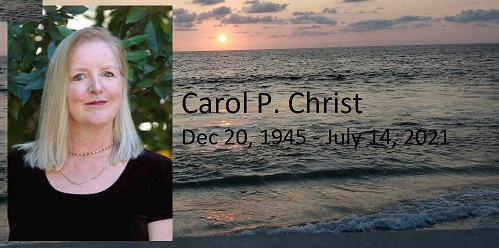
Legacy of Carol P. Christ: Of Human Life*

This post was originally published on July 2nd, 2012like many of Carol’s other posts, it is eerily poignant for today.

Watching the last episode of the Australian series Brides of Christ in which Catherine leaves the sisterhood of the convent because of her disagreement with Humanae Vitae brought me right back to the Yale Roman Catholic chapel and the folk mass I attended regularly.  In 1968 just after the publication of Humanae Vitae, priest and co-graduate student Bob Imbelli preached a sermon on the doctrine of conscience, arguing that though it was incumbent on Catholics to think carefully about the papal encyclical on birth control, it was also the responsibility of every Catholic to follow her or his conscience on the matter.  In the episode, Sister Catherine encourages a Roman Catholic mother of six who has already self-induced more than one abortion to take the pill, but the woman decides she cannot go against the church’s teachings.  Catherine allows an editorial against Humanae Vitae to be published in the school newspaper even though she knows it will probably lead to the expulsion of one of her favorite students.

Continue reading “Legacy of Carol P. Christ: Of Human Life*”

From the Archives: Is Baptism a Male Birthing Ritual? By Michele Stopera Freyhauf

This was originally posted on March 22, 2012

Quite a number of years ago I had a conversation with one of my professors, a feminist theologian, who posed the question “Why do I need a man to purify my baby with the waters of baptism?  Is there something wrong or impure about the blood and water from a mother’s womb – my womb?”  Before you jump and shout the words Sacrament or removal of original sin, this question bears merit in exploring, especially in today’s world where women are taking a serious beating religiously, politically, and socially.  In today’s world, violations and rants are causing women to stand up and say STOP!  This is MY Body.  This outcry was provoked by chants of ethical slurs against women– Slut! Prostitute! Whore!  The cry got even louder when the issue of religion and government was raised in the fight of healthcare coverage of contraception. The cry got even louder with the enactment of the laws in Virginia and Texas (and many other states to follow suit) that forces women to undergo transvaginal ultrasounds in early stage abortions.  The mandatory insertion of a wand into a woman’s vagina (mandated by the government, mind you), is a violation and has women crying RAPE!

Continue reading “From the Archives: Is Baptism a Male Birthing Ritual? By Michele Stopera Freyhauf”

Legacy of Carol P. Christ: Of Human Life*

This was originally posted on December 30, 2011

Watching the last episode of the Australian series Brides of Christ in which Catherine leaves the sisterhood of the convent because of her disagreement with Humanae Vitae brought me right back to the Yale Roman Catholic chapel and the folk mass I attended regularly.  In 1968 just after the publication of Humanae Vitae, priest and co-graduate student Bob Imbelli preached a sermon on the doctrine of conscience, arguing that though it was incumbent on Catholics to think carefully about the papal encyclical on birth control, it was also the responsibility of every Catholic to follow her or his conscience on the matter.  In the episode, Sister Catherine encourages a Roman Catholic mother of six who has already self-induced more than one abortion to take the pill, but the woman decides she cannot go against the church’s teachings.  Catherine allows an editorial against Humanae Vitae to be published in the school newspaper even though she knows it will probably lead to the expulsion of one of her favorite students.

Continue reading “Legacy of Carol P. Christ: Of Human Life*”

Rethinking Church from the Ground Up by Xochitl Alvizo

In the last post about rethinking church communally, I ended with reference to the fact that those who do not identify with an organized religion – nearly 70% of the religiously unaffiliated – think that churches “focus too much on rules,” “are too concerned with money and power,” and “are too involved in politics.”

I found this to be the case also among participants of “Emerging Church” congregations, which I researched for my dissertation. Many participants of the congregations I visited had previous negative and damaging experiences of church – experiences that caused them to become unaffiliated from church and Christianity all together. But, when discovering or happening upon an “emerging” congregation, some were pleasantly surprised by the experience of an open, welcoming, and justice-oriented community of faith that was creative in form and ritual, and egalitarian in leadership.

Continue reading “Rethinking Church from the Ground Up by Xochitl Alvizo”

Rethinking Church Communally and Creatively by Xochitl Alvizo

I spend a curious amount of time discussing, studying, and writing about polity – the structures and procedures of congregational/denominational governance (my previous post about communion reflects one kind of polity). Amid theological and sociological research about the decline, revival, or re-emergence of Christianity and the church, my research specifically focused on how emerging congregations organized and structured their decision-making processes. As a “body” – ecclesial, social, political – what are the new and creative ways that congregations structure and organize their collective living and relating?

Continue reading “Rethinking Church Communally and Creatively by Xochitl Alvizo”

SpiritualiTEA with Chasity Podcast, Episode 3 by Chasity Jones

An excerpt from SpiritualiTEA with Chasity Podcast Episode 3: Why are we afraid of Divination??? What is divination?

Divination is from Latin divinare “to foresee, to be inspired by a god”. (Goleman, David. The Varieties of the Meditative Experience. London: Rider, 1975.)

“DIVINATION IS A SACRAMENT!!” – Chastity S. Jones

This is beautiful to me because it reminds me of how when the prophets would begin to prophesy in the bible or even the explosive forward movement of the spread of the gospel- driven by the Holy Spirit, as well as those who documented the gospel are all described as being inspired by God. 

The most popular form of divination right now is tarot cards but we will discuss how there are many other forms- including forms that are acceptable in the church RIGHT NOW.

There are many bible verses cursing those who divine but I want to reiterate that one bible verse cannot be a comprehensive ethic or set of ethics, especially when there are other verses that contradict that verse.

Continue reading “SpiritualiTEA with Chasity Podcast, Episode 3 by Chasity Jones”

From the Archives: Rape is Not a Political Platform – Rape is a Violent Crime! By Michele Stopera Freyhauf

Moderator’s note: This marvelous FAR site has been running for 10 years and has had more than 3,600 posts in that time. There are so many treasures that have been posted in this decade. They tend to get lost in the archives. We are beginning this column so that we can revisit some of these gems. Today’s blogpost was originally posted August 23, 2012. You can visit it here to see the original comments.

Just when you think you have heard it all, here we go again – another politician with “open mouth-insert foot” syndrome.  Discussing his zero-tolerance policy for abortion, Missouri Representative Todd Akin made the following statement last Sunday about pregnancies that result from rape:

“from what I understand from doctors, that’s really rare.  If it’s a legitimate rape, the female body has ways to try to shut that whole thing down.  But let’s assume that maybe that didn’t work or something.  I think there should be some punishment, but the punishment ought to be on the rapist and not attacking the child.”

Continue reading “From the Archives: Rape is Not a Political Platform – Rape is a Violent Crime! By Michele Stopera Freyhauf”

Musings on The Crown by Janet MaiKa’i Rudolph


Even though I was a late-comer to the Netflix series The Crown, when I did watch it, I was riveted. Lots of thoughts ran through my mind at this picture of royalty. The concept of royalty in human history is vast and multi-faceted, however in this blogpost I am only pulling on a few threads that tugged at me as I watched this show.

I laughed as people greeted the Queen and said, “your highness.” Does that make the rest of us lownesses? And where did all this pomp come from anyway? And why is the British monarch the head of the Church of England which is a bible-based Christian religion?

Monarchy, religion and war have always seemed so connected in our culture. Indeed, during the coronation of Queen Elizabeth, she was handed “the sword of state” as if she would actually be using it. (I looked it up, true to the ceremony). Continue reading “Musings on The Crown by Janet MaiKa’i Rudolph”

Judaism or Christianity: Which Tradition Is More Open to Feminist Change? by Carol P. Christ

Jill Hammer’s recent post on midrash surrounding the Biblical figure of Eve (Hava in Hebrew) sparked me to muse again about the fact that, despite its patriarchal roots and overlay, Judaism is a much more flexible tradition than Christianity and, therefore, much more open to feminist change.

Part of this is due to the fact that Judaism is midrashic while Christianity has been and remains a doctrinal tradition. Midrash is a form of Biblical interpretation that includes retelling the story to fill in the blanks and to answer contemporary questions left unanswered in the original text. Jews consider the Torah (the 5 books of Moses) to be the “Word of God” though opinions vary as to what this means. In the rabbinical tradition, the Torah is interpreted through the Talmud which is an extensive collection of discussions and disputes that draw on Biblical texts in relation to contemporary (to the rabbis) questions. Midrash included in the Mishnah (a collection of teachings that preceded the Talmud) and the Talmud are considered part of the “oral Torah.” which is also “the Word of God.”

The Talmud is considered to be authoritative, but it includes conflicting interpretations that were never resolved into a single definitive view. Though different Jewish groups have declared certain views to be normative, other groups have disagreed. There is no central authority (such as a Pope or council) to resolve these disputes. Though some Jewish groups disagree strongly with the beliefs or practices of others, in Judaism as a whole an attitude of “live and let live” leads to inclusion rather than exclusion. Indeed. The Talmud records that in the midst of a particularly vehement dispute between two rabbis, a voice intervened, stating: “These and these are the words of the Living God.” (Quoted by Judith Plaskow in Goddess and God in the World.) Continue reading “Judaism or Christianity: Which Tradition Is More Open to Feminist Change? by Carol P. Christ”

A Theological Conversation by Natalie Weaver and Valentine

My son asked me to discuss with him the theological problem of the dual natures, i.e., the divine and human natures, coexisting in the person of Jesus.  He asked me to begin by assuming the premises that 1) Jesus was a real, historical person and 2) that Jesus was both human and divine.  The question then became, “Did Jesus know he was God?”

Of course, as a theologian, I was delighted to have this conversation with my son.  It was fascinating to see how his mind worked, to hear him evaluate the strengths and weaknesses of high and low Christologies, to hear how he resolved the question himself, and to have an opportunity to share my own thoughts with a genuinely engaged, truly curious, and attentively listening dialogue partner in the person of my teenage son.  Not too shabby a victory for any parent!

As we talked, he continued to provide context for the question, which began as a classroom debate in his high school theology seminar.  Apparently, the students were tasked with taking some element from their in-class discussion, evaluating it, and then applying it practically by a twofold retrospective reflection in which the students were 1) to identify a specific situation in their life that could have gone better and 2) to share how their insight drawn from class would have made all the difference.  Now, my son expressed a bit of frustration with this assignment because he would have preferred to discuss how today’s insights might help him in the future, rather than to dwell in the past.  As his wheels turned, I left him alone to puzzle out his assignment, with the promise that I eagerly would return in an hour to see what he produced, accompanied by my own essay on the same task.

Continue reading “A Theological Conversation by Natalie Weaver and Valentine”