Generosity and Community: the Alternative Worldview of Women’s Ritual Dance, Part 1 by Laura Shannon

My life’s work with traditional women’s circle dances of Eastern Europe and the Near East has been a natural interweaving of feminism, activism and Goddess spirituality. In more than thirty years of experience, my students and I have gained valuable insight into their potential as tools for healing and transformation.

These simple and ancient dances connect us with women’s ritual practices from the past which are rooted in a Goddess-reverent paradigm honouring the earth, the body and the female face of the divine. In the present day, the practice of mindfully dancing traditional circle dances which embody this worldview can help us imagine and create a more equitable society in the future.

Continue reading “Generosity and Community: the Alternative Worldview of Women’s Ritual Dance, Part 1 by Laura Shannon”

Women’s Ritual Dances and the Nine Touchstones of Goddess Spirituality – Part Four by Laura Shannon

In Rebirth of the Goddess, Carol P Christ offered Nine Touchstones of Goddess Spirituality as an alternative to the Ten Commandments. The Nine Touchstones are intended to inform all our relationships, whether personal, communal, social, or political.[1] In this four-part blog (here are parts 1-3 Part 1, Part 2, Part 3) I am exploring ways in which these Nine Touchstones are inherently embodied in traditional women’s ritual dances of the Balkans, which has been my spiritual practice for over thirty years.

Carol’s Fourth Touchstone is: ‘Speak the truth about conflict, pain, and suffering.’ Many women’s dance songs which allow the women to speak and sing their grief and pain. When we bring that pain into the healing container of the circle, sharing simple steps, Dancers in the circle simultaneously give and receive support for their own and others’ sorrow. Ultimately, the sense of community  and solidarity in the circle transforms our grief so that the burden becomes manageable. Many historical songs, too, tell stories of women being abducted or abused, and how they fought back or got away – or not – so that they are remembered and honoured by future generations.

Continue reading “Women’s Ritual Dances and the Nine Touchstones of Goddess Spirituality – Part Four by Laura Shannon”

Women’s Ritual Dances and the Nine Touchstones of Goddess Spirituality-Part Three by Laura Shannon

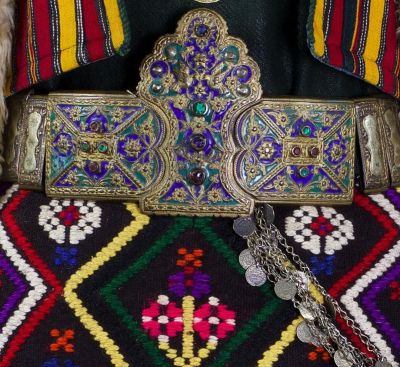
Women’s apron from Pentalofos, Greek Thrace

In Rebirth of the Goddess, Carol P Christ offered Nine Touchstones of Goddess Spirituality as an alternative to the Ten Commandments. The Nine Touchstones are intended to inform all our relationships, whether personal, communal, social, or political.[1] In this series of blogs I am exploring ways in which these Nine Touchstones are embodied in the traditional women’s ritual dances of the Balkans, which I have studied as a spiritual practice for more than thirty years.

Carol P Christ’s Second Touchstone is: ‘Walk in love and beauty.’ As she says, ‘love and beauty are the great gifts of bounteous earth’.[2] Dancing women of the Balkans walk in love and beauty each time they put on their festive dress to dance together in the courtyard or the village square. Their ceremonial costumes are created from the bounty of the earth – just a couple of generations ago, this was literally the case, as the women tended the sheep, prepared and spun the wool, wove, sewed, embroidered and ornamented their garments with the work of their own hands. Even now, the cloth they buy is purchased with money they have earned from working and harvesting the land.

Continue reading “Women’s Ritual Dances and the Nine Touchstones of Goddess Spirituality-Part Three by Laura Shannon”

Women’s Ritual Dances and the Nine Touchstones of Goddess Spirituality-Part Two by Laura Shannon

In the first part of this article, I looked at how Carol P Christ’s Nine Touchstones of Goddess Spirituality from Rebirth of the Goddess are related to traditional women’s ritual dances of the Balkans. After more than thirty years of researching and teaching these dances and the way that they pass on information in encoded symbolic ways, I have come to see them as an educational system, a women’s mystery school.[1] The main message which the dances convey is an ethic of community, partnership, mutual support, and other life-enhancing values aligned with the Nine Touchstones, which can be directly experienced in the dance.

We know from the research of Marija Gimbutas that these values were central to the Old European civilizations which honoured the Goddess, while Yosef Garfinkel and Elizabeth Wayland Barber show that circle dances have their roots in these same early Neolithic cultures of Eastern Europe and the Near East. This leads me to suggest that Balkan women’s circle dances surviving today may have their origin in early egalitarian matriarchal cultures of Neolithic Europe. The Nine Touchstones of Goddess Spirituality provide an perfect template through which to explore the ethics of women’s ritual dances.

Continue reading “Women’s Ritual Dances and the Nine Touchstones of Goddess Spirituality-Part Two by Laura Shannon”

Women’s Ritual Dances and the Nine Touchstones of Goddess Spirituality-Part One by by Laura Shannon

In Rebirth of the Goddess, feminist theologian Carol P Christ offered a list of ‘Nine Touchstones of Goddess Spirituality’.[1] She revisited the Nine Touchstones in an interview with Karen Tate on Voices of the Sacred Feminine titled ‘Gratitude and Sharing: Principles of Goddess Spirituality‘, and in an inspiring series of blogs on this site recently exploring each touchstone in depth.

In her incisive analysis of the ethics of Goddess religion, Christ argues that Goddess spirituality can offer the ‘ethical guidance that we need to combat the forces of evil in our world’, and that this ethic is not imposed from a set of rational principles nor from a transcendent God known through the prophetic traditions of the Bible, as suggested by Rosemary Radford Ruether.[2] Rather, the ethics of Goddess spirituality are discerned through intuition and reflection on the world of which human beings are a part.[3]

Continue reading “Women’s Ritual Dances and the Nine Touchstones of Goddess Spirituality-Part One by by Laura Shannon”

The Cosmic Dance (Part Two) by Laura Shannon

Part One of this post looked at connections between the cosmic dance and the Goddess Hera. To read it, click here.
Pythagoras was the first to call the universe by the Greek term kósmos, referring to the order, beauty and tranquility which are inherent in natural and universal geometric form and proportion. He described the cosmos as a single living being in which all things are related, including music, beauty, movement, and justice – much as the world was understood in the Neolithic Goddess cultures of Old Europe, of which more later.

The word kósmos (κόσμος) gives us the word kósmima (κόσμημα), jewellery – silver and gold like the moon and sun, with glinting gems like the stars and planets – as well as the word kosmitiká (κοσμητικά), cosmetics. These adornments were used by priestesses in classical Greece, not to emphasise their individual beauty, but rather to identify them in their public role as instruments of cosmic beauty, harmony, and order. This is the same role which dancers take on today when they don traditional costume to dance on ritual occasions such as Epiphany or Easter. Continue reading “The Cosmic Dance (Part Two) by Laura Shannon”

The Cosmic Dance and the Goddess Hera (Part One) by Laura Shannon

Summer is here, and even with the terrible troubles going on in our world, I hope that some of us are managing to take time out and enjoy pleasant evenings outside under the stars. Gazing up at the heavens, we see the same starscape our ancestors saw, thousands of years ago.
In the worldwide Sacred Circle Dance network of which I am part, many dances have been created or choreographed which work with the energies of the sun and the moon. The power these heavenly bodies have in the human world is obvious, but many people do not realise the importance which the stars and planets also had to ceremonial practice in the ancient world. The architecture of Greek temples in antiquity was oriented to the rising of specific constellations and other astronomical phenomena, which also alerted people in far-off locations that the time was drawing near for celebrations or ceremonies in particular places. Continue reading “The Cosmic Dance and the Goddess Hera (Part One) by Laura Shannon”

With Our Tears, Let Compassion Flow: Remembering the Armenian Genocide by Laura Shannon

Today, April 24, is the worldwide day of remembrance for the Armenian genocide of 1915. On this day three years ago, marking the centenary of the genocide, I wrote about dance as an expression of solidarity with the Armenians people, and with all victims of genocide throughout history and throughout the world. You can find that piece here.
Now as then, I am encouraging my students to dance Armenian dances with their groups this week, or even simply to light a candle, listen to Armenian music (some recommendations are listed at the end of this post), with an open heart. How better to heal the wounds of history than with such tiny and intimate acts of compassion?
The root of the word ‘compassion’ essentially means ‘to suffer with’, and I think that one of the gifts of our own suffering might be that we can begin to have sympathy for those who have suffered like us.
Through compassion, our own heartbreak helps our hearts to be broken open. Although suffering can cause us to feel terribly isolated and utterly alone, at the same time, our pain opens our hearts in sympathy for the pain that others feel. To paraphrase Tibetan Buddhist teacher Chogyam Trungpa, this enables us to ‘reach out to help others… to discover a greater universe and a fuller and fuller broken heart. This is not something to feel bad about; it is a cause for rejoicing.’

Continue reading “With Our Tears, Let Compassion Flow: Remembering the Armenian Genocide by Laura Shannon”

Claiming the Power to Choose Our Lovers and Partners by Carol P. Christ

My dear friend Carol Lee Sanchez once told me that the women of the Laguna Pueblo– whose culture is an egalitarian matriarchy–taught her that women must choose their men, not wait for the men to choose them.* This was a new idea for me, and though I was attracted to it, I found it difficult to assimilate. The reason I did not understand what Carol Lee was teaching me was that I was still operating out of a patriarchal binary: either the man was in control, or the woman must be.

Like many otherwise independent women, I have often reverted to a kind of passivity in love affairs. As a girl, I was taught to wait for the man to choose me. As a feminist I knew better, but I didn’t know how to change this cultural pattern, especially when most of the men I knew still expected –even if only unconsciously– to be in charge. In addition, having learned that a man who wants an independent feminist woman is hard to find, I often gave up on ever finding a man. Not actively looking, I would be pleasantly surprised when a man took an interest in me. Then, all too often, I would give myself to him, hoping that he was the right one. Continue reading “Claiming the Power to Choose Our Lovers and Partners by Carol P. Christ”

Another Gay Bar Closes – Paradise Lost by Marie Cartier

It’s where I went when I wanted to be around other gay people when John Kerry debated George Bush in 2004 for the presidency. I had just moved to Long Beach from Los Angeles and I was still figuring out the city. I didn’t have access to the debate on my TV at home, and I needed to see it. The bartender turned it on for me and we all gathered around and watched. By we all, I mean the gay men and lesbians who frequented that corner café and bar.

I remember laughing so hard that day when someone in the bar said what I still love as a quote, “John Kerry: Bring complete sentences back to the White House.”

Later when I met my girlfriend, who would become my wife, we were living a few blocks apart and in the middle of those few blocks was The Paradise Café. We didn’t have access to the lesbian TV series smash The L-Word. We often went to the Paradise and guilted them into turning it on. We’d sit at the bar with French fries, which to this day I think are the best fries in Long Beach, and watch The L-Word, chiding a lot of gay men around us that they needed to watch to and catch up on this “amazing show!!”

It was where I went, where tons of us went after gay marriage was declared legal in California. I went in with a friend of mine, Carolyn Weathers, who is the cover girl on my book, Baby, You Are My Religion: Women, Gay Bars, and Theology Before Stonewall (BYAMR).

Continue reading “Another Gay Bar Closes – Paradise Lost by Marie Cartier”