To be transparent, these last four weeks have unintentionally flown by and have been filled with great pain, sorrow, depression, loss, and grief to be honest. I can feel my own spirit at the beginning of a long healing process and have a feeling that these words kept between you and I will be a tremendous part of my healing. Healing in itself is an essential aspect of Womanism and how I found my way to it. I have been privileged to develop spiritual practices that encourage and assist with healing in emotional, physical, mental, and wisdom ways!
Today, I acknowledge the Africana Womanism (Clenora Hudson-Weems) characteristic of strength. I must admit I have a strained relationship with the word as a Black woman. I was raised by strong women to be strong in an environment in which we will always have to strong. As a result, being soft is interpreted as weak. I mourn that Black women rarely find spaces in which they can turn off their survival mode- fight or flight nervous system responses and relax while being soft. It is so foreign. At this point in my life softness is so inconvenient and also something that I don’t even know how to maintain consistently.
I have been re-reading Rebirth of the Goddess reflecting upon my own journey over these past 40 years, remembering how her image appeared to me as a bird goddess the day I first worked with river clay… When I discovered that some of the images I sculpted of bird goddesses mirrored those in Marijia Gimbutas’s The Language of the Goddess I entered an unknown realm. All I understood at the time was that I was being called by some unknown force. I had no idea that this power existed not only without, but within, and that someday I would be able to name both Nature and my Body as the source of that power. And come to understand that they are One.
This post is dedicated to Carol P. Christ. I knew her first as my professor and then my friend for over 15 years. May her memory be a blessing.
This week’s Torah portion is Shofetim (also spelled Shoftim), or Deutoronomy 16:18-21:9. I have written about this parshah before. In that post from August of 2018, I reflect on how the patriarchal elements of the portion should not detract from its larger concern for justice, compassion, and peace. Yet, there is more to the parshah. In fact, I have recently begun exploring Judaism’s connection to all things magical, and interestingly enough, this parshah fits right into my recent inquiries. Let me share with you some of what I have learned as it relates to this parshah.
Where Shofetim and magic meet is idolatry. There are three instances in Shofetim where idolatry is condemned, punished by stoning to death. All three of these prohibitions involve polytheism, either directly worshiping other deities or participating in practices associated with the worship of those deities. What are they?
Early in the morning of July 15, 2021, I was sitting amid the chaos of boxes in my new home which I had just closed on a week earlier. I had woken at 5 am to a leak in the new roof and was feeling very tired and somewhat dazed by all the work to be done. Then I got a text with the news that Carol Christ had passed away the previous day. It took a few minutes for that reality to sink in past my state of overwhelm and exhaustion and then the tears and the memories flooded through me.
Carol and I became friends in 1987 when we both had begun living on the Greek island, Lesvos, in the village of Molyvos. At that time Carol was mainly using her Greek name, so for many years I called her Karolina. As the months wore on we discovered our mutual interests – in Goddess, in social justice, in living a life more connected to nature and in the desires of younger women to kick up their heels and have some fun. We became constant “parea” (company) for each other.
Dedicated to Carol Christ, 1945-2021, who taught so many of us how to love the Goddess
She is called “Nude Woman” and currently lives in her natural museum house in Vienna. Nude woman. She is art, but she is not in an art museum. And there are questions: why was she originally painted red? Why are her breasts so large? Why is her stomach so large? Why does she fit in a human hand? What was her purpose? Was it to entice men, or to comfort women? Historians disagree. Is her hair woven? Or is it a hat? Why does she have no eyes? No feet? Why is she there?
This essay is dedicated to the memory of Carol P. Christ, scholar of the Goddess, who has brought so much wisdom and liberation to our world, and whom I deeply admired. May her memory be a blessing.
The call of the Divine Mother has compelled me for most of my life. I have scoured kabbalistic works for visions of God/dess as Mother, Womb, Protectress, Home of Being. I’ve gone on treasure hunts through museums to find paintings of the Annunciation and statues of birthing goddesses. I’ve written poems to the Mother Goddess of my imagination. Experiencing Deity as creatrix and nurturer moves me. But when I had a daughter of my own, becoming the Mother in an immediate sense proved to be more difficult than revering Her from afar. I couldn’t fully internalize that I had stepped into the sacred role of parent, even after I became one. I know this is true because of my dreams.
Not long after my daughter was born more than a decade ago, I began to have disturbing dreams. In the first of these dreams, I dropped my infant daughter by mistake into water that had flooded the area around my home. She disappeared without a trace into the deep water. I begged for help finding her, but no one would help me. Soon I realized she must be dead. I woke up terrified and sobbing. In another dream, I realized no one was watching my daughter and she must have fallen into the nearby lake. In a third dream, a huge flood came into my house and carried her away.
While planting and constructing my indoor container garden, I thought about how my ancestors put seeds into their children’s hair so that in case they were taken away to live and die in chains, they would at least be able to sustain themselves with a piece of the motherland. Rice, okra, yams, watermelon, and so MANY more crops that would go on to make white slaveholding Americans so rich (passing their wealth to their descendants and zero reparations for the descendants of enslaved Africans), that they were willing to fight a war to sustain their evil practices of owning human beings as chattel (Check out High on the Hog Netflix documentary which was adapted from a book by Dr. Jessica B. Harris). Enslaved Africans brought these foods to the new world, a direct result of slavery.
As I wash my daughter’s hair (which for Black women and girls is a PROCESS!!), as I moisturize her hair, and as I braid my hair, I am thankful that no one has a right to my child and that I do not need to fear her enslavement. Instead, I manifest her revolutionary future to carry the torch of our ancestors. A Torch and a commitment to elevate our community and move the community forward. I leave it up to her to choose how she will carry that torch forward!
After thirteen years filled with marital strife, I recently moved out. For financial and logistical reasons, we are staying married, focusing on our two children and have put into place a ‘3-3-3’ schedule.
Three days, our daughters are with me. Three days, they are with him. And three days, we are all together at our old home.
I believe that it is a great transitionary plan as it is making the adjustment for our daughters easier, but it is not always the easiest on me.
I call him my Dos Equis as yes, he is husband number two. Perhaps I am a slow learner, but I believe I have been ‘on path’.
Dos Equis wanted us to all go on vacation together, and so we recently drove to Destin, Florida. He feels that our relationship is ‘normal’ and that I have perniciously turned off some essential switch withholding my wifely duties and my support for him.
But it is not normal.
Although I would suppose that far too many of you can relate.
One of the key factors to me that differentiates feminist spiritual paths from many dominant religious traditions and frameworks is the recognition and acknowledgement of the body as a source of wisdom, a source of pleasure, a source of learning, and a source of knowing. Not viewed as unclean, dirty, or as something to be mistrusted or transcended, we can return to our bodies again and again, dropping down into our bellies, bones, and blood, returning to center, and returning home to ourselves. Those who embark into thealogy quickly realize that it is a spirituality better lived than analyzed. My own experience of my goddess-oriented path is an intensely embodied one. I am here on this earth, in this body, my feet on the ground, my eyes on the sky, listening, feeling, and sensing. This, to me, is sacredness in motion, this is the Goddess right in front of me, she is witnessed in the very fact that my pulse beats in my wrist and that my eyes alight on those three crows coasting lightly into the treetops.
Sara Avant Stover, writing in the Book of SHE says: “Our bodies aren’t indentured servants here to labor for us until we take our dying breath. They are sacred chalices . . . . Our bodies always tell the truth and hold the information we need to thrive” (p. 43).
And, one of my favorite quotes of all comes from Camille Maurine in Meditations Secrets for Women who writes: “Your body is your own. This may seem obvious. But to inhabit your physical self fully, with no apology, is a true act of power.
At one time, I would have focused my attention primarily on women and encouraging women to trust their bodies, to listen to their bodies, and to honor their bodies. I’ve come to see that a goddess-centered approach to ethics, values, and embodied spiritual experience includes all people who have a body. In my heart of hearts I would like all people to value their bodies, honor their bodies, trust their bodies, and listen to their bodies. I think if this was true, the fundamental way in which we relate to, treat, and care for one another would change and the feminist values of cooperation, compassion, and empathy would come to form the foundation of society. Every single one of us begins life within someone else’s body. We enter the world through someone’s body. And, we have a body that interacts with other bodies for our entire lives. This is altogether simple, obvious, and profound. Our bodies are our seats of reality, of being human, of being present in the world. A life firmly rooted in concept of the body as sacred, no longer allows room for violation of or harm to others.
Carol Christ writes in Rebirth of the Goddess: “The rituals and symbols of Goddess religion…[bring] experience and deep feeling to consciousness so that they can shape our lives; helping us broaden and deepen our understanding of our interdependence to include all beings and all people; binding us to others and shaping communities in which concern for the earth and all people can be embodied.”
When I talk to other people about self-trust and building self-trust, I often encourage them to check in with their bodies for a physical response to a decision, idea, choice, or happening. Where does it land in your body? What do you feel inside when you think about making this decision or taking this action? Does your body respond with a “yes” or a “no” when you think about this idea? For me, the sensation comes in my chest, around my heart—a lightening or expansion or a contraction or heaviness. This is not what all people will experience, perhaps you feel the answer in your belly, in your head, around your jaw. Perhaps you feel it as a color, sensation of warmth or coolness, or as a “rightness of being.”
I must also acknowledge that many people have experienced some form of physical trauma or abuse in their lives and that these experiences can complicate our relationships with our bodies, our sense of intuition, and our trust in ourselves. If your body has been a site of violation, it may be more difficult or complex to connect to this body-based sense of “knowing” or intuition that I reference and I do not wish to oversimplify what can be a complex and multilayered personal experience of embodiment.
If you mentally walk through your body, what do you see?
What is your body as home like for you? How re-sourced is it?
What needs attention within you?
Do you have a sense of your inner and outer ground?
What do you feel in your belly, right now?
I have been leading a process this year called #30DaysofGoddess and one of the things I suggest on some of the days is to offer a “body prayer.” Since people have asked for additional guidance with what that means, I sat on my yoga mat one morning and let a body prayer emerge. After I moved through the motions, I typed it out and I offer it to you now (as well as prayercard version of it). May it nourish you.
A Body Blessing: Fold your hands in front of your heart, feel your palms warm and your pulse beat. Kiss your fingertips. Raise your hands and cradle your face with love and then, move one hand to the top of your head and one to your heart. Pause. Cross your arms over your chest, one hand on each shoulder and sway back and forth gently. Kiss your palms and lay them upon your belly. Run your hands down your legs. Wiggle your toes. Fold your hands in prayer pose and bring them back to your heart-level. Breathe deeply and then open your hands. Gaze into them. Envision the day’s potential nestled there. What do you see in your own cupped palms? Kiss your fingertips again and whisper what it is you need to hear. Say: thank you.
Note: I do have a companion video about the body as home here.
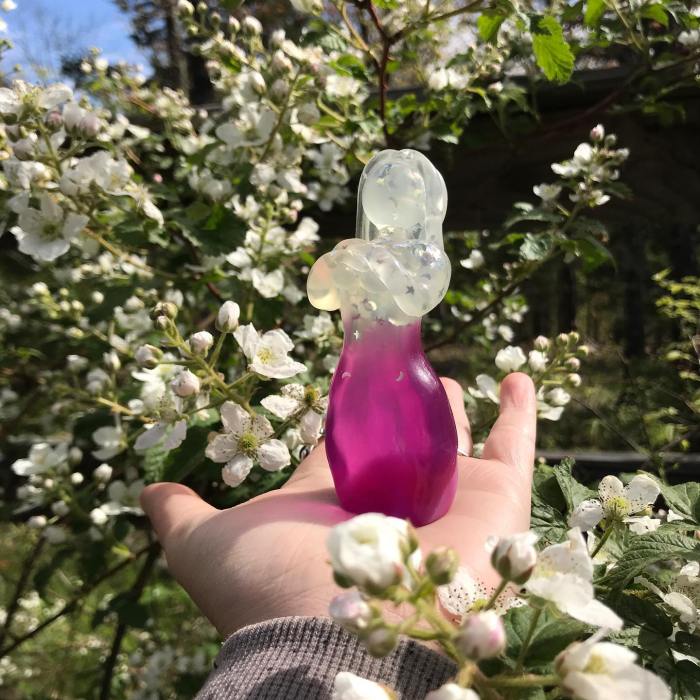
Molly Remer’s new book Walking with Persephone is now available for pre-order from Womancraft Publishing. Her prayerbook, Whole and Holy: a Goddess Devotional was published in November. Molly has been gathering the community to circle, sing, celebrate, and share since 2008. She plans and facilitates women’s circles, seasonal retreats and rituals, mother-daughter circles, family ceremonies, and red tent circles in rural Missouri. She is a priestess who holds MSW, M.Div, and D.Min degrees and wrote her dissertation about contemporary priestessing in the U.S. Molly and her husband Mark co-create Story Goddesses, original goddess sculptures, ceremony kits, mini goddesses, and more at Brigid’s Grove. Molly is the author of Womanrunes, Earthprayer, Sunlight on Cedar, the Goddess Devotional, She Lives Her Poems, and The Red Tent Resource Kit and she writes about thealogy, nature, practical priestessing, and the goddess at Patreon,Brigid’s Grove, Feminism and Religion, and Sage Woman Magazine.
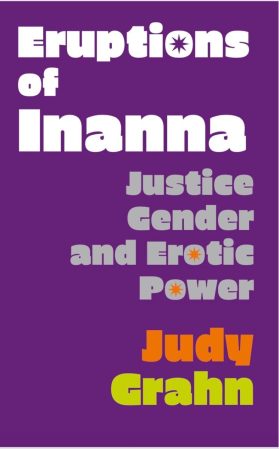
Any new book by Judy Grahn is cause for celebration. For decades, Grahn has been a lyrical and passionate poet, author, mythographer, and cultural theorist whose work features both goddess wisdom and contemporary culture centering on women and queer people. Nightboat Books has just published her newest book, Eruptions of Inanna: Justice, Gender, and Erotic Power, which offers ancient yet fresh world views with which to approach such issues as injustice, sexuality and gender, climate change, and more just when we need it most.
In Eruptions of Inanna, she brings what she calls her “poet’s eye” to eight stories featuring the Sumerian goddess Inanna as well as religious practices of those devoted to her. She explores how these have directly influenced our world and, in her words, can continue to “feed our needs and help us take better care of each other and our world.” According to Grahn, Inanna “is a combination of human, creature, erotic and other energetic forces, and civilization. She also inherited very old powers that grew out of women’s rituals” (55). Her essence engenders sovereignty and self-worth, especially in women and queer people. She is a goddess of love, espousing passion and the joy of eroticism as integral to both life and society. She practices an expansive justice that creates positive outcomes in response to horrific acts. She creates a civilization of the arts, beautiful and useful crafts, abundance, and a jubilant communal life. She demands respect for nature and ecological sustainability.






 Feminism and Religion