I moved to the mountains to move mountains, to find peace in the hidden crevices of an endangered planet. We pull out her hair, clumps at a time, self-harming her* in a myriad of new ways. Wildfires burn up our forests, floods destroy precious lowlands. Loggers strip the possibility of new life from the soil. Our childhood stories become our adult lives: The Giving Tree who gave it all. . . . The land doesn’t break; just dips and hides in private caves. I moved to the mountains so that the predators of my past wouldn’t find me. Their spirits crawl out from unvisited graves.
They slip past the disappearing forests of canopied evergreens that once shaded and protected Ki’s children. [Ki is short for Kin – more on what this word means in Part 3.]
you whistled my name four notes chilled prickly skin needling truth we are forever bound you bird woman owl tree wounding wounding wounding we weep grief grief grief too deep half a million dead gunned down by Explosive Will I make no apology Return atrocity to those whose behaviors will one day destroy them too. What we do to nature we do to ourselves.
Context for Poem:
Yesterday I wrote an essay about the barred owl killings beginning with a personal story about my relationship with barred owls. I have known about this Federal Fish and Wildlife Organization’s proposal since 2023.
Hope is the thing with feathers . . . Emily Dickinson
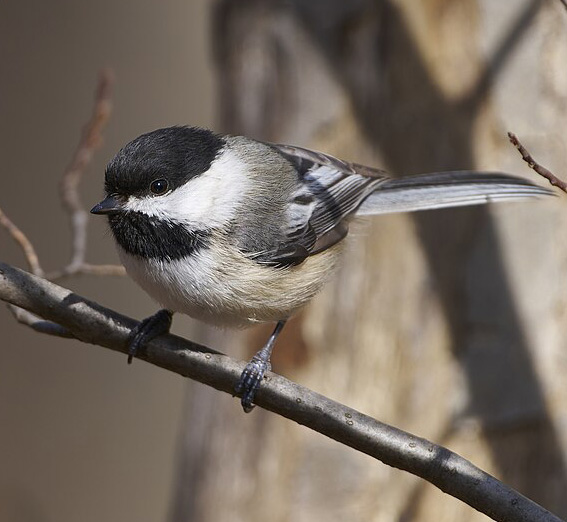
Chickadee
I awoke this morning to bird song, and for a moment I was lifted beyond the despair that has caught me in its grip — despair for the country, for the earth, for loved ones whose lives are increasingly tossed into the chaos, for the future The disappearance of persons into labyrinths of prisons in this country, Guantanamo, and the tortuous CECOT prison complex in El Salvador has broken what was left of my spirit. Then this morning I heard a report that the State Department has changed what it considers to be human rights abuses in order to align with recent Executive Orders, deleting critiques of such practices as retaining political prisoners without due process of law, restrictions on free and fair elections, violence against LGBTQ persons, threats against people with disabilities, restrictions on political participation, coercive medical or psychological practices, and extensive gender-based violence. Ostensibly these changes are to lift restrictions on sanctions toward other countries, but I fear they portend clearing the way for such abuses in the US as well.
My heart is heavy in ways I have not previously known, so I am grateful for that brief moment of delight in the early morning. Later in the day, I found myself wondering whether those who suffered and died in concentration camps, whose despair certainly was beyond comparison with my own, found any solace in the sight and sound of birds who flew freely over the walls of the camps in ways they could not. The daughter of survivors of Auschwitz, Toby Saltzman, recalled that her mother, who often suffered bouts of despair over the Holocaust, found her spirits lifted by the songs of birds. When Toby later visited Auschwitz, she was greeted by flocks of birds. Upon her return, she reflected, “I left Auschwitz feeling a surge of triumph that my parents survived, and gratitude to the birds that gave my mother spiritual sustenance and hope.” We are sorely in need of such sustenance in these times.
Women and trees belong together; our relationships with them stretches back to antiquity. They have been our protectors, guiding us through grief and difficult times. They offer us gifts of beauty, fruits, and nuts, are receivers of prayers, sometimes speaking through prophecy. Sometimes healing springs appear at their feet. And always they are wisdom keepers, these Trees of Life. It is not surprising that women’s ceremonies were and are often enacted in the forest under a canopy of trees.
Weeping white tears
Emergence magazine recently posed three questions that I want to share because I think they might help raise awareness for women who love trees and the relatively small minority of other people who are attempting to deal with what is happening to the rest of nature during this political crisis and time of earth destruction.
Some folks who are not Indigenous still love and care for the land as a beloved friend, relative and teacher and it is to these people, both women and men, that I offer up these questions because I think they may help to keep us grounded in a painful but potentially creative way. Queries like these attach us to a larger long-term perspective that allows for a ‘both and’ approach to the future. The last question invites the reader to take personal action. Feeling that reciprocal connection between an individual and some aspect of the land s/he is attached to is a key that opens a door to deeper engagement with the rest of nature.
The Torah portion for March 29, 2025 was Pekudei. Quite often this parshah is read with Vayakhel. In fact, I have written about the double parshah Vayakhel-Pekudei before, but focused on only Vayakhel. Now, it is Pekudei’s turn.
Like parshot Vayakhel and Terumah as well as other parts of the book of Exodus, Pekudei focuses on haMishkan, the Tent of Meeting or Tabernacle. We read about calculations concerning the costs of the constructions, instructions for the high priest’s garb, ritual washing of hands and feet, when to construct and when to deconstruct the traveling tent, and the divine presence as cloud and fire. In Pekudei, we have no mention of women and no mention of any Israelite men barring the religious elite: Moses, Aaron, and Aaron’s sons. Therefore, in this commentary, I want to discuss contradictions in the text that speak to (1) a consistent divine presence that seems to argue against animal sacrifices and (2) the ways in which the natural world and Israelite religion went hand-in-hand.
This was originally posted on January 19. 2020. An ‘Update Note’ has been added at the end of the post.
Elizabeth Cunningham
When I was a child in the 1950s we often played cowboys and Indians. There is a photograph of my brother and me in no doubt inauthentic costume complete with feathered headdress. In kindergarten I named myself Morning Star. (I just googled and see that I must have gotten the name from the 50s television series Brave Eagle, the first with an indigenous main character. Morning Star is the female lead.)
When I was a teenager, my aunt came across a privately printed book The Gentleman on the Plains about second sons of English aristocracy hunting buffalo in western Iowa. My great grandfather accompanied them as their clergyman. I wish I could find that book now to see how this enterprise was presented. In my adolescent mind these “gentlemen” looked like the local foxhunters in full regalia. On opening morning of foxhunt season an Episcopal clergyman (like my father) was on hand in ecclesiastical dress to bless the hunt and then invited to a boozy breakfast.
The Torah portion for March 1, 2025 is Terumah, consisting of Exodus 25:1-27:19. Terumah in Hebrew means contribution, and the parshah begins with the deity requesting donations from the willing hearts of men (yes, only men) of precious metals and stones as well as dyes, linens, wools, and skins. Terumah then provides the instructions for how to build the Tent of Meeting and all of its components. In this post, I want to focus on four aspects of the post from the perspective of ecofeminism and feminism: beauty; the misuse of nature, the concept of home, and the indwelling or immanence of the divine.
January’s twilight hours draw me into her pale embrace stalactites and frozen streams whisper that winter’s skin is thin even with months to go flowing water is muted under seeded snow underground roots pulse with light sleeping forest boughs wake in wild winds crack and moan rest in peace at dawn bears sleep fox and weasel seek slivers of open water I walk in slow motion to stay upright at the edge of a meandering serpentine stream listening for the scent of just one hemlock singing feeling the tangles of gray and green Indoors standing at the window I ask how many forested eyes are meeting my own?
Awakening to an image cattails in the marsh? When I drive by curled brown rushes crush stiffened seed swords a few gray puffs rising under sail dull brown capsules cracked by winter cold opalescent ice crystals mirror solid gray sheets stretch across the horizon Why then cattails in my dreams?
Two days later Lynx strides by the window self-possessed, tufted ears erect fine points, feathery furred paws sliding over frozen snow striped buff and coal rounding the corner a sinewy vision of serpentine grace purpose unveiled she picks up the trail avian hieroglyphics lead her on my wild turkeys freeze perch high in the trees a forest of eyes peer down through evergreen boughs