The Door by John Erickson

Faith is something we get from each other, and sometimes in the most magical of circumstances, faith becomes embodied by the person you love the most.

I have a Ph.D. in American Religious History but I’ve never been much of a religious person.  It’s been one of the conundrums of my life but nevertheless, I found religion and its role in influencing, for good and bad, the lived experiences of the LGBTQ community something worth exploring.

I’ve been struggling with writing this post ever since I graduated and officially became “Dr. John.” In preparing for my defense, the Chair of my Dissertation Committee requested that at the start of the defense, he wanted me to introduce my project, its overall scope, and most importantly why I wrote it.

Why did I write it?  How does one answer why they chose to devote 8 years of their life to a single subject in search of an original idea?  While some would sit and grapple with this question, I knew what the answer was all along because it always was (and always will be) about my maternal grandmother, Gladys Hritsko.

I wanted to know what made me different.  Throughout my dissertation, I interviewed people who, much like myself, grew up in similar small towns, attended the same conservative church services, and heard the same damning things that I did about my sexuality being preached from the pulpit. Many of my subjects were deeply hurt by religion and it set some of them up for years of searching and painful memories and experiences that both forced them to leave their religious and faith-based communities they grew up in or, in the worst case, being kicked out by their family as a result of their religion.

Continue reading “The Door by John Erickson”

The Caves Beneath My Roots or Psychological Spelunking by Darla Graves Palmer

I’ve spent much of the past four years – since returning to the state of my birth after more than forty years’ intentional absence – trying to understand and make peace with a particular slice of southern culture that I avoided most of my adult life. Part of that process was a deep dive into my family roots which led me to also consider the caverns further below those roots. If landscape contributes to shaping our human nature, what might that mean for my family?

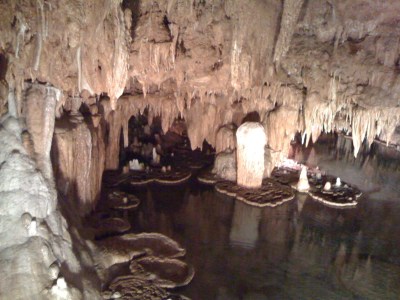
Here in the Missouri Ozarks, my roots extend a hundred and fifty years deep; my ancestors on both sides of my family are buried in the karst of the Ozark Plateau, and their bones have leached into the thousands of caves that honeycomb the area, mixing with the limestone and other minerals through the abundance of flowing water. I grew up being cautioned to watch out for sinkholes, often a sign that there was a cave system below.

Continue reading “The Caves Beneath My Roots or Psychological Spelunking by Darla Graves Palmer”

Mother – Daughter Betrayal by Sara Wright

(1)

Today is my mother’s birthday and although she has been dead for more than a decade I still think of her almost every day. At the time of her death I had not seen her for twelve years. Not by choice. After my father’s sudden demise my mother chose my children, her two adult grandsons to be her protectors, and dismissed me from her life, permanently.

When she died, my mother divided her assets evenly between my children and me, forcing her only daughter to live beneath the poverty level for the remainder of her life.

The final betrayal.

At the time of her death I was teaching Women’s Studies at the University.

Continue reading “Mother – Daughter Betrayal by Sara Wright”

Mother of All Fears by Trelawney Grenfell-Muir

This time of year, the general public tends to pay more attention than usual to witches. Much of it is lighthearted – halloween costumes and memes about where to park your broom. Some of it is spiritual – adherents of the modern religions of Wicca and neopaganism discussing symbolic and supernatural beliefs. And some of it is historical – analyzing the witch trials of past centuries and wondering how they apply, ethically, to modern day intolerance and violence.

Within all these discussions, usually unnamed and unexamined, is the framing metaquestion: what should we fear? And what should we do about that which we fear?

Historic witch trials (from a time when witches were believed to be evil agents of Satan) reveals how we humans always try to externalize badness and goodness, so we can exterminate badness and excuse ourselves for our lack of goodness. So we have heroes and villains, neither of them very human, but rather idols and symbols of our fears. I honestly think the patriarchy’s fear of females is as strong as it ever was. When the most popular videos on the most popular internet porn sites are of ****TRIGGER WARNING RAPE, INCEST**** raping a stepsister, or doctors raping a teenage girl in the hospital for cancer, or of border agents raping a pregnant young refugee, and these sites are visited by 98% of the men in our society, what does that say about us as a species? Or a culture? As Tallessyn Grenfell-Lee says, “Scary, scary vaginas!

Continue reading “Mother of All Fears by Trelawney Grenfell-Muir”

To Light a Flaming Pumpkin: The Inexact Art of Family Ritual, by Molly Remer

Our bounty is inIMG_7695
creativity
friendship
community
the myriad small adventures
of everyday.
We tell of magic
and moonrise
and listening to the pulse
of the earth beneath our feet.

Ah, October. Fall has settled into the trees and air. Last year on Samhain (Halloween), as the sun was setting and the full moon was rising, my family stood together in the dim light on our back deck, lit a fire in a hollowed out pumpkin and offered handfuls of herbs into the flames as we celebrated our blessings, our harvests, and our bounty, as a family and as individuals. As we spoke aloud our blessings and our bounty, our words got deeper, broader, and more authentic. My twelve year old son stepped forward to say how thankful he is that he gets to live with his best friend, his fifteen year old brother, and they embraced over the flaming pumpkin. My fifteen year old son offered his thanks for a family that has “cool IMG_7387rituals like this” and my four year son offered his blessings for the “energy we feel together.” My seven year old daughter offered her gratitude for pandas and for toys.
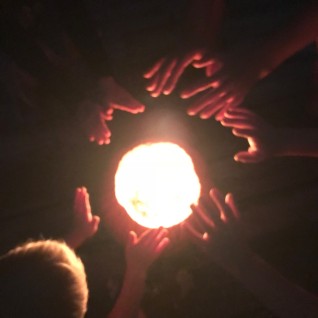
The next week, we returned the seeds to the pumpkin and released it to the outdoors to grow next year.

Seventeen years ago, I held my first Winter Solstice ritual. I wrote my wish for a baby onto a small piece of paper and rolled it up into a “seed” of my dreams that I planted within a special wooden box. On the autumn equinox the following year, I gave birth to my first child, a son who now stands inches above me, but who joins hands with his family each month to sing “Dance in the Circle of Moonlight” together on the back deck under the full moon.

After having this first baby, it became increasingly important to me that we celebrate holidays and traditions that reflect our spiritual values and worldview rather than the packaged version of the holidays offered by society, or the religious observances of dominant faiths that do not match our own. While we have celebrated the wheel of the year together in a variety of ways in what has now been sixteen years of parenting and twenty-one years of marriage, it wasn’t really until last year that I felt I finally, truly hit my stride in planning fulfilling, nourishing family rituals. Perhaps it is because I am no longer trying to juggle nursing a baby or changing a diaper while simultaneously also guiding a ceremony. Perhaps it is because I’ve loosened up and accepted the myriad imperfections possible within a multi-age celebration. Perhaps it is because when one of the children wanders off during circle or interrupts me while I’m talking, I accept it as part of the flow, and continue our work without breaking my stride. Perhaps it is because I now laugh too when someone makes a joke during my careful ritual, and continue to roll with it, instead of feeling like it is disrespectful. Perhaps it is because I consider a 15-20 minutes family ritual perfectly sufficient instead of trying to plan for a full-fledged, retreat-style “program” of activities. Perhaps it is because we’ve joined hands in family circle in so many ways and for so many years that we all now trust that I’m not giving up on doing this together.

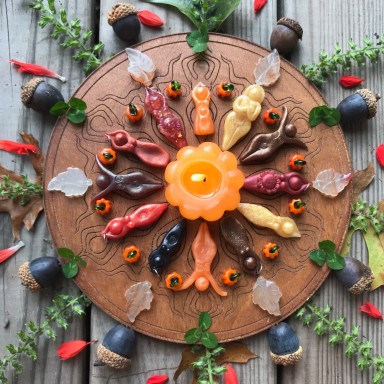
In the course of the year we’ve anointed one another’s foreheads with fragrant oils while standing in the freezing water of a freshwater stream. We’ve felt the raindrops kiss our faces and the rays of the sun peek in and out of the clouds as we celebrated the summer solstice by releasing wildflowers into the river. We’ve howled at the moon together, built a green man face from leaves, stones, and sticks in the field, created flower mandalas, thrown pinches of cornmeal into the woods as a symbolic sacrifice, soaked our feet in warm water laced with rose petals and then massaged one another’s feet with lotion, walked through a spiral of candlelight, and offered handfuls of herbs into a flaming pumpkin.

As we notice the changing seasons and honor the call of nature within our lives through ceremony, celebration, and song, we make visible the interconnected dance of life. We reaffirm our commitment, our relatedness, to each other and to the natural environment around us. We communicate with and are in relationship to that larger force of life and spirit that we call Goddess. And, we bring our spiritual beliefs into our bodies, hands, minds, and hearts in an ever-spinning Wheel of celebration, attention, observation, enjoyment, communion, and love.

 “We can think of ritual as the container we weave in which we can be carried away by magic and ecstasy.”

—Starhawk and Valentine, The Twelve Wild Swans

For your own flaming pumpkin ritual, choose a large, round pumpkin, cut off the top 42311806_2188101348068742_1038582461505732608_oand hollow it out. Keep the seeds to plant with the remnants of your fire later. You may start the fire with paper and a lighter and then keep adding herbs to keep it burning, or you may stoke it by putting some alcohol in the bottom of the pumpkin to begin with. Alcohol burns cool and can create a longer lasting, less smoky flaming pumpkin. Offer your autumn bounty into the pumpkin with herbs sprinkles/handfuls—these can be spontaneous spoken aloud declarations of your harvest, your celebrations, your gratitude, etc. What are you thankful for?
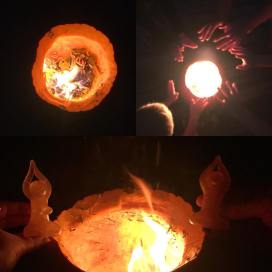
  • Optional: offer any sacrifices/releasing on slips of paper into the flames
  • Optional: Sing “Hallowed Evening” chant (by my kids and me)

Hallowed evening
Hallowed night
We dance in the shadows
We offer our light.

Additional Articles:

I’m That Trump Voter You Hate by Trelawney Grenfell-Muir

There are people in my family who believe Christianity to be so inherently oppressive and harmful, that anyone who identifies as Christian is culpable for all of the harm done by all imperial colonization by Christian empires and nations, all harm done to Native Americans, to LGBTQ people, most slavery, racism, genocide, ecocide, and basically almost every problem the world has had for 2000 years.

Theirs is not an unusual view. I encounter this view regularly here in the Northeast US, though most people assign the blame to religion in general. For parts of my family, Christianity is the true evil because it was so popular, and thus the religion most commonly tied to violent and oppressive political leaders and structures.

I also encounter this attitude from feminists, quite frequently. According to many feminists, I am everything that is anti-feminist and misogynist… precisely, solely because I am Christian.

Continue reading “I’m That Trump Voter You Hate by Trelawney Grenfell-Muir”

The Truth About Humans by Natalie Weaver

I have greatly enjoyed an odd little book I read over the summer.  It is Lucy Cooke’s The Truth About Animals (Basic Books, 2018). Cooke takes us through a journey of animal behavior, chronicling the curious narratives that naturalists, philosophers, theologians, and other high-thinking professionals impose on animals to render their behaviors meaningful, moral, and relevant.  Cooke shows us how tempting it has been historically for people to seek and discover confirmation of human values in all those other pairs so happily coupled on Noah’s Ark.

It has often been an important tool for feminists, as with other sets of thinkers, to make these connections as well.  And, as one familiar with the classical charges that women are more inherently corporeal than their spiritual-intellectual male counterparts, and that therefore women are more animal than the more accurately “human” form that their male counterparts represent, I understand the feminist investment in nature.  I appreciate that it involves a sort of ownership and redefinition of the slur; an acceptance of space and place as limited and essentially animal; an awareness of environmental sustainability; a deep sense of connection to the continuum of creaturely being that is the giant ecology of our planet.

Continue reading “The Truth About Humans by Natalie Weaver”

Don’t Think About That – a poem of motherhood in this wounded world by Trelawney Grenfell-Muir

Get the kids out the door to swim
Sunscreen, lots of sunscreen
Summer’s worse every damned year
Deadly heat waves are killing people as our civilization begins to crumble

Don’t think about that, gotta remember to fill water bottles
Pack a snack
Settle the dogs in their crates
Cages like those refugee children who keep dying in concentration camps

Don’t think about that, gotta get everyone herded into the car

Continue reading “Don’t Think About That – a poem of motherhood in this wounded world by Trelawney Grenfell-Muir”

Temple Magdalen by Elizabeth Cunningham

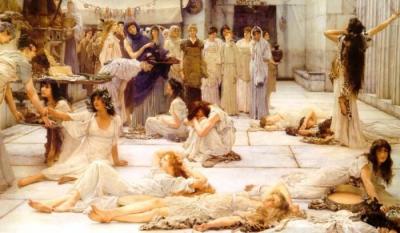
The Women of Amphissa, 1887, by Lawrence Alma-Tadema

Since I began writing for FAR in July 2012, I have written about Mary Magdalen, or excerpted a passage from one of my novels, near or on her July 22 Feast Day. For why I made the controversial choice to depict her as a prostitute, see last year’s post. The below excerpt is from The Passion of Mary Magdalen. I made this selection in remembrance of all the refugees in the world today. In this passage, Judith, a Jewish widow whose family was driven from the land by tax collectors, returns to the place where Maeve (my fictional Celtic Magdalen) and her friends have recently founded a Temple to Isis on the outskirts of Magdala. Maeve has just invited Judith to join them. (Edited for brevity.)

She stared at me, her eyes full of anger and longing.

“I will not be a slave and a whore where I was once a wife, the one who made the challah bread, who said the Sabbath prayers over it. This was our place, my husband’s and mine. We brought the best we had to the temple, the finest oil and wine, the unblemished kid—”

“Goats? You kept goats? You know how to make cheese?”

She sat quietly for a moment before she answered. “How can I live here with you?” she wondered. “I don’t understand.”

Continue reading “Temple Magdalen by Elizabeth Cunningham”

What If Jesus Is Dead (And It’s A Good Thing)? by Tallessyn Zawn Grenfell-Lee

Bear with me.

I know that most Christians accept some version of the idea that Jesus, the person, died, and then ‘rose from the dead’ in a supernatural, miraculous way – probably the most common definition of what Christians celebrate at Easter. I grew up in progressive Christian churches, where I, too, was taught this idea, which I found fascinating and inspiring. Many people (both Christians and others) still find it healing and inspirational; and I want to state clearly that I think that’s well and good.

Okay.

What I would like to suggest, however, is that this approach may miss the main point of Easter, of resurrection, and of these narratives. Here goes.

Continue reading “What If Jesus Is Dead (And It’s A Good Thing)? by Tallessyn Zawn Grenfell-Lee”