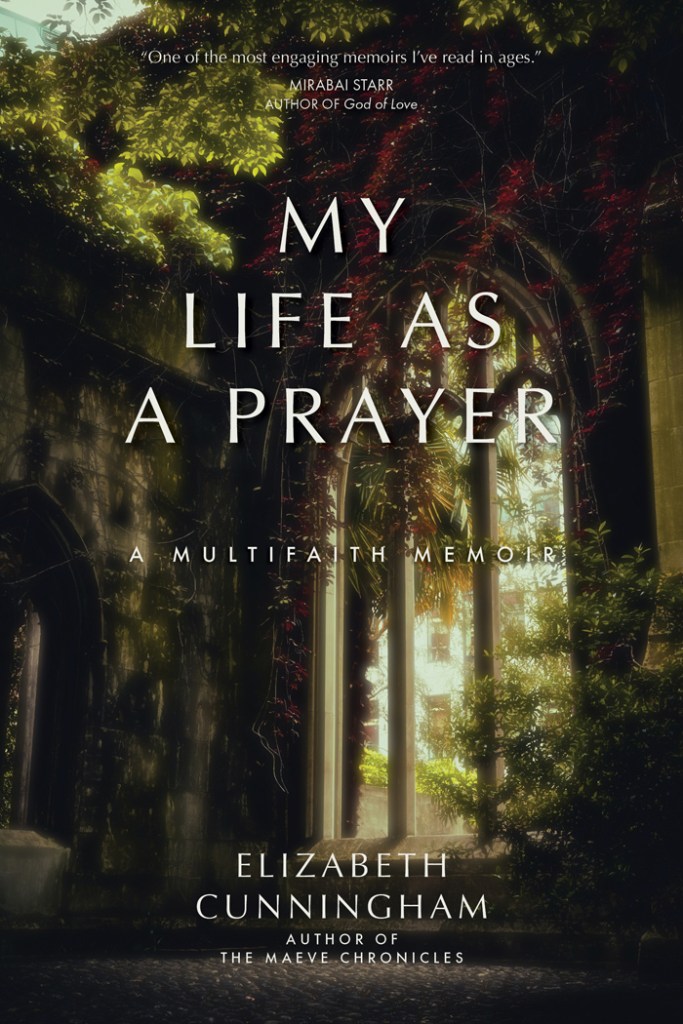
My Life as a Prayer by Elizabeth Cunningham, book review by Janet Maika’i Rudolph

Our own FAR sister, Elizabeth Cunningham has written her marvelous memoir which came out yesterday. It is titled My Life as a Prayer with the subtitle, A Multifaith Memoir. For those of you who may not know Elizabeth, she wrote regularly for FAR for many years. She is the author the The Wild Mother and the award-winning Maeve Chronicles. Her Chronicles envision the Celtic Mary Magdalen named Maeve. Throughout the four books of the Chronicles, Maeve is filled with vivacious energy and her own life of spirit. The books are Magdalen Rising, The Passion of Mary Magdalen, Bright Dark Madonna and Red-Robed Priestess (which in full disclosure is one of my favorite series of all time.)

In My Life as a Prayer, Elizabeth’s writing is lush and poetic, clever and clarifying, multilayered and depthful.  I hope I can convey all those elements in this short blogpost?

Continue reading “My Life as a Prayer by Elizabeth Cunningham, book review by Janet Maika’i Rudolph”
Crete as the cradle of a culture of peace – Part Two by Laura Shannon

Part One of this article spoke of our collective yearning for peace, and the difficulty of imagining a peaceful world when we are taught to believe that “patriarchy and with it war and domination are universal and inevitable.” (Carol Christ, 2015)

But this is a myth. The peaceful civilisation of Bronze Age Crete lasted two thousand years with no sign of violence, slavery, or war. Most likely matriarchal, matrifocal, and matrilineal, ancient Crete embodied the final flowering of Old Europe. Art and archaeology reveal a life-loving people who honoured the earth, the Goddess, and nature, particularly mountains, caves, and trees. Key values and symbols of this culture of peace survive today in Cretan women’s dances and folk arts including pottery, textiles, baskets, and bread.

Continue reading “Crete as the cradle of a culture of peace – Part Two by Laura Shannon”

I Am Kaleidoscope by Janet Maika’i Rudolph

Art work designed by Jaysen Waller – http://www.jaysenwaller.com/

FAR was founded in June 2011 by four women, Xochitl Alvizo, Cynthia Garrity-Bond, Caroline Kline, and Gina Messina.  They are and have been revolutionary thinkers in the world of feminism. Below is a portion of what they write on our “About” page

There is no single definition of feminism and this is a place of many voices. Important work in women’s studies in religion continues as more attention is paid to the intersection between gender, race, culture, and sexual identity, within feminism and religion.” They go on to say: “We establish this blog in the hope that feminist scholars of religion — and all who are interested in these issues — will use this forum to share their ideas, insights, and experiences, so that this community of thinkers will be nurtured as we explore diverse and new directions.”

Continue reading “I Am Kaleidoscope by Janet Maika’i Rudolph”

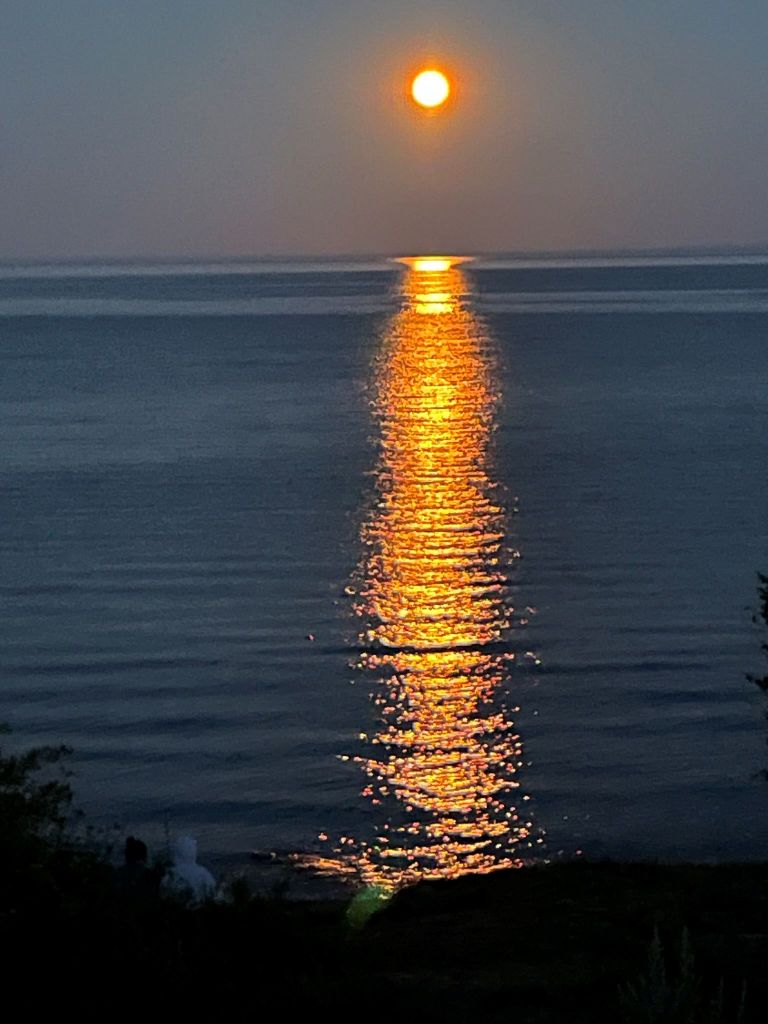
Moon Worshippers by Beth Bartlett

You’d have thought it was the 4th of July the way people were gathering on the shore of the great lake, Gitchee Gumee – some with coolers and lawn chairs, kids and dogs in tow, each claiming their spot — waiting for the viewing as if waiting for the fireworks.  But what we awaited was far more spectacular – the “once in a very blue moon,”[i]  the second full moon in a calendar month, but also a “super moon” – so named because at this time when it is closest to the earth in its orbit it appears larger than usual. Super moons happen a few times a year and blue moons happen every two to three years, but super blue moons are rare. This one was probably the last in my lifetime since the next one will occur fourteen years from now in 2037.

My husband, dog, and our son’s dog, aptly named Luna, made our way to the lake, finding our spot on the ancient rocks, joining the other moon gazers. A feeling of community celebration arose with the moon as we strangers to each other together watched the first light of rising moon with shared anticipation and appreciation. The “blue moon” in fact appeared red as it came up through the hazy atmosphere, but as it rose higher in the sky, just as in the lyrics to the song, “Blue Moon,” the moon turned to gold, casting its golden glow across the waters.  As it rose, it seemed to grow even larger, rounder, brighter.

Continue reading “Moon Worshippers by Beth Bartlett”

The Blue Beetle: “¡No contaban con mi astucia!” by Yara González-Justiniano

Literally, you did not count on my astuteness. Or in other words, you underestimated my intelligence. It is the perpetual trick of arrogance that white supremacy and classism plays on racially and ethnically minoritized people and the joke/yoke these people carry. It is the most frequent microaggression I experience in academia in the supposed –– disque–– compliment of “you are so articulate!”

Source: Yahoo News

El Chapulín Colorado (The Red Grasshopper) is a Mexican comedic superhero character created by artist Roberto Gómez Bolaños, better known as Chespirito (little Shakespeare), in the 1970s. Whenever Chapulín untangles a mess, whether on purpose or by chance, he says “¡No contaban con mi astucia!” The movie Blue Beetle, which pays homage to this beloved character across Latin America and Latinx people is ––entre otras cosas–– exactly that, astute! Puerto Rican director, Angel Manuel Soto, and Mexican writer, Gareth Dunnet-Alcocer, take the DC comic book story of Jaime Reyes’s Blue Beetle (2006) and transform it into a film that, more than responds to a Latino superhero gap, it takes representation, impact, and issues of capitalism seriously. The truck, the heart-shaped shield, the tools, and the crickets playing in the background of the outdoor scenes ––to name a few–– are an extension of the characters’ parallelisms and the possibilities of what it means to have higher numbers of representation in mass media-produced films with integrity and astucia. ¡Awiwi!

Continue reading “The Blue Beetle: “¡No contaban con mi astucia!” by Yara González-Justiniano”

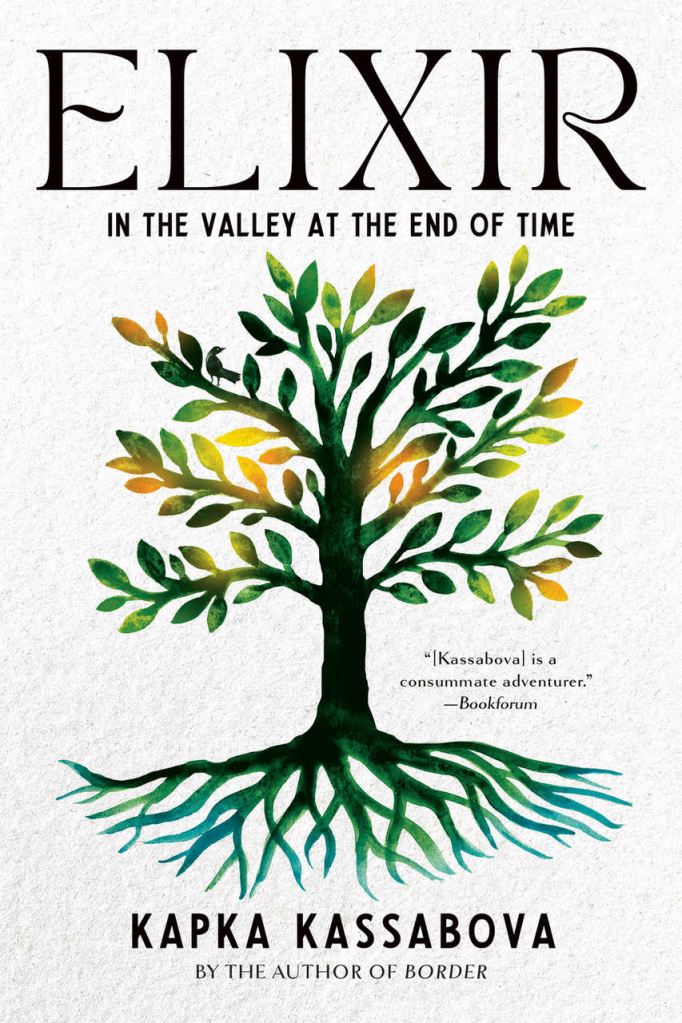
Elixir: In the Valley at the End of Time by Kapka Kassabova, Book review by Laura Shannon

Kapka Kassabova is an award-winning author of poetry, fiction and nonfiction, born in Bulgaria and now living in the Scottish Highlands. Her newest work of narrative nonfiction, Elixir, soars with the luminous prose and unflinching honesty we have come to expect from this brilliantly gifted writer.

Elixir is an extraordinary, profoundly moving book. The moment I finished reading it, I began again from the beginning, pausing only to order multiple copies for friends. Like Robin Wall Kimmerer in Braiding Sweetgrass, Kassabova effortlessly integrates science and the sacred, addressing historical, ecological, and personal trauma with clarity, compassion, and hope. Elixir combines memoir, travel, history, ethnography, botany, philosophy, spirituality, eco-psychology, traditional Chinese medicine, and even alchemy, in a subtle, sophisticated exploration which defies categorisation.

Continue reading “Elixir: In the Valley at the End of Time by Kapka Kassabova, Book review by Laura Shannon”

Inanna’s Sisters, by Molly M. Remer

Sometimes I feel like my own Ninshubur. 
I set up a lamentation in the street. 
I call my own name,
beat the drum 
to lead myself back home,
prepare the temple
for my own arrival. 
I will not give up on myself,
will not abandon my own wholeness,
I refuse to sacrifice my Self. 
I will not stay in the underworld forever. 
We all need people in our lives who will say:
No, this will not do. 
I’m coming after you. 
I will help you to crawl back up, 
back out, back through. 
I will reach out to you. 
I will boost you up.
I will rise with you into becoming. 
You will not stay behind defeated 
and alone so long as I,
your Ninshubur,
draw breath.
I will beat the drum for you. 
I will call your name. 
You are not alone. 
Come back to me.
I see your power 
and your strength. 
I hear your longing. 
Return, 
return,
return.

I first met Inanna in the firelit darkness of a midwifery retreat in central Missouri. Toddler son at my breast, I watched, spellbound, as the charismatic, dark-haired midwife recounted the tale of Inanna’s descent into the underworld, through the seven gates we traveled, to the seat of our own wounding and our own medicine.

Continue reading “Inanna’s Sisters, by Molly M. Remer”

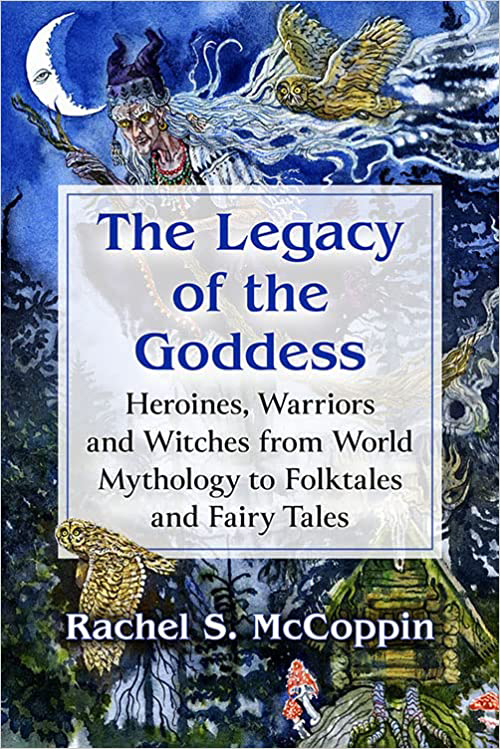
The Legacy of the Goddess: Heroines, Warriors and Witches from World Mythology to Folktales and Fairy Tales by Rachel McCoppin

Part 2, Part 1 was posted yesterday

Chapter 4, “Monstrous Females and Ghost Women,” “traces the many female characters within folktales and fairy tales who appear as monstrous, materializing in the forms of giantesses, succubi, mermaids, rusalki, etc. Just as in many ancient myths, even though these monstrous women appear in folktales and fairy tales as hindrances to the quest of the hero, they ultimately serve to educate male heroes about the true meaning of their quest, which again often aligns with concepts associated with mythic goddesses. The many ghost women who appear in folktales and fairy tales around the world are also discussed in this chapter, as they often serve as agents to teach male heroes about how they, particularly as females, have been wronged by males or by patriarchal systems, and thus have been thwarted from completing their own heroic quests” (McCoppin, p. 9).

Though most myths around the world display male heroes partaking on heroic quests, and seldom focus on heroines who participate in their own heroic journeys, this is not at all the case with folktales and fairy tales, as hundreds of folktales and fairy tales portray strong, independent female heroines who indeed partake on their own heroic quests. Therefore, the second half of Legacy of the Goddess focuses on the formidable heroines found in many folktales and fairy tales from around the globe.

Continue reading “The Legacy of the Goddess: Heroines, Warriors and Witches from World Mythology to Folktales and Fairy Tales by Rachel McCoppin”

The Legacy of the Goddess: Heroines, Warriors and Witches from World Mythology to Folktales and Fairy Tales by Rachel McCoppin

This is part 1 of a two part posing. Part 2 will be posted tomorrow.

In this blog post, I would like to take the opportunity to discuss my new book, entitled: The Legacy of the Goddess: Heroines, Warriors and Witches from World Mythology to Folktales and Fairy Tales. This book argues that hundreds of folktales and fairy tales from around the world have preserved elements related to goddess worship from the sacred myths of many ancient civilizations.

Powerful goddesses were worshipped in most global cultures for centuries, until, in many regions, episodes of diffusion, conquest, colonialism, etc. caused the worship of these goddesses to be revised, lessened, or in some cases eliminated. To “preserve at least part of the reverence of goddesses, as well as the memory of the powerful religious and social roles women once held as representatives of goddesses”, hundreds of folktales and fairy tales were created, “told, and retold, most often by women storytellers” to impart goddess ideology (McCoppin, 2023, p. 5). Thus, many folktales and fairy tales portray myriad examples of powerful female characters who portray important messages connected to the goddesses and sacred women of ancient mythology.

Continue reading “The Legacy of the Goddess: Heroines, Warriors and Witches from World Mythology to Folktales and Fairy Tales by Rachel McCoppin”

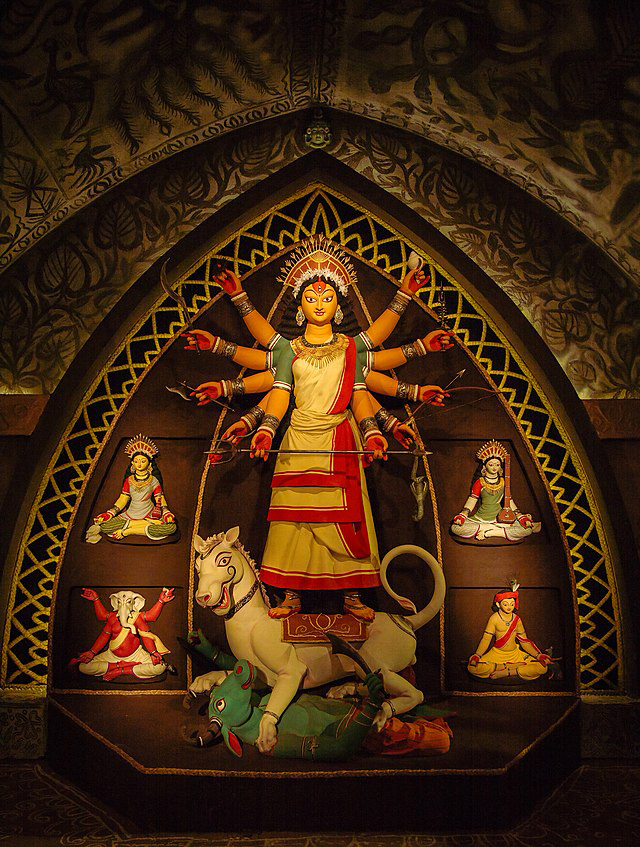
Durga Rising: Feminism as Fierce Compassion By Beth Bartlett

In her FAR post earlier this year,[i] “Why Feminism Needs the Fierce Goddesses,” Susan Foster argues that a “flagging” feminist movement needs the revitalizing energy of the “fierce goddesses” of ancient times to challenge the patriarchal forces that seem to be on the rise as increasingly we find women’s lives and freedoms constrained. She writes, “the dark goddesses of ancient times have been submerged in our psyches, but they serve as a repository of fierce energy, of female rage against injustice.”  She continues, “It’s important and healthy for us as women to reclaim our anger, using it to protect ourselves and fight for our rights in systems that are oppressive.”

Reading this, I immediately thought of Beverly Wildung Harrison’s, “The Power of Anger in the Work of Love,” and China Galland’s, The Bond Between Women: A Journey to Fierce Compassion. Anger as the work of love; fierce compassion.  In this time of mass shootings, insurrection, the ongoing assault on women, LGBTQ, and BIPOC peoples, when rage seems so easily fueled by hate, envy, and greed, it is the rage based in love and compassion that is most needed.  This is the rage of the fierce dark goddesses who are moved to act against injustice, the rage of the feminism I love. With its source in love and compassion, it is a rage that rebels in the best sense of the word – that at once refuses injustice and affirms dignity and respect, that speaks truth to power, that is grounded in solidarity and friendship, and values the immanence of the earth, the water, the body, and the divine spark in all beings.[ii] 

Continue reading “Durga Rising: Feminism as Fierce Compassion By Beth Bartlett”