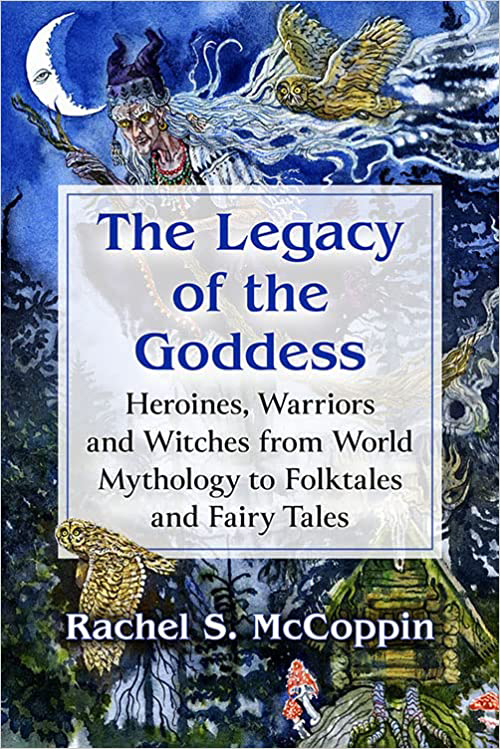
The Legacy of the Goddess: Heroines, Warriors and Witches from World Mythology to Folktales and Fairy Tales by Rachel McCoppin

Part 2, Part 1 was posted yesterday

Chapter 4, “Monstrous Females and Ghost Women,” “traces the many female characters within folktales and fairy tales who appear as monstrous, materializing in the forms of giantesses, succubi, mermaids, rusalki, etc. Just as in many ancient myths, even though these monstrous women appear in folktales and fairy tales as hindrances to the quest of the hero, they ultimately serve to educate male heroes about the true meaning of their quest, which again often aligns with concepts associated with mythic goddesses. The many ghost women who appear in folktales and fairy tales around the world are also discussed in this chapter, as they often serve as agents to teach male heroes about how they, particularly as females, have been wronged by males or by patriarchal systems, and thus have been thwarted from completing their own heroic quests” (McCoppin, p. 9).

Though most myths around the world display male heroes partaking on heroic quests, and seldom focus on heroines who participate in their own heroic journeys, this is not at all the case with folktales and fairy tales, as hundreds of folktales and fairy tales portray strong, independent female heroines who indeed partake on their own heroic quests. Therefore, the second half of Legacy of the Goddess focuses on the formidable heroines found in many folktales and fairy tales from around the globe.

Continue reading “The Legacy of the Goddess: Heroines, Warriors and Witches from World Mythology to Folktales and Fairy Tales by Rachel McCoppin”

The Legacy of the Goddess: Heroines, Warriors and Witches from World Mythology to Folktales and Fairy Tales by Rachel McCoppin

This is part 1 of a two part posing. Part 2 will be posted tomorrow.

In this blog post, I would like to take the opportunity to discuss my new book, entitled: The Legacy of the Goddess: Heroines, Warriors and Witches from World Mythology to Folktales and Fairy Tales. This book argues that hundreds of folktales and fairy tales from around the world have preserved elements related to goddess worship from the sacred myths of many ancient civilizations.

Powerful goddesses were worshipped in most global cultures for centuries, until, in many regions, episodes of diffusion, conquest, colonialism, etc. caused the worship of these goddesses to be revised, lessened, or in some cases eliminated. To “preserve at least part of the reverence of goddesses, as well as the memory of the powerful religious and social roles women once held as representatives of goddesses”, hundreds of folktales and fairy tales were created, “told, and retold, most often by women storytellers” to impart goddess ideology (McCoppin, 2023, p. 5). Thus, many folktales and fairy tales portray myriad examples of powerful female characters who portray important messages connected to the goddesses and sacred women of ancient mythology.

Continue reading “The Legacy of the Goddess: Heroines, Warriors and Witches from World Mythology to Folktales and Fairy Tales by Rachel McCoppin”

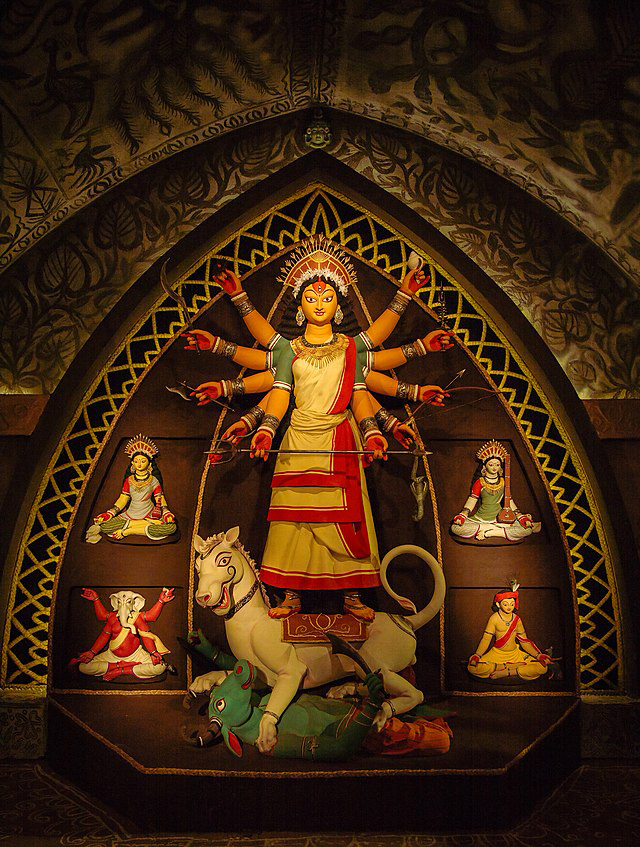
Durga Rising: Feminism as Fierce Compassion By Beth Bartlett

In her FAR post earlier this year,[i] “Why Feminism Needs the Fierce Goddesses,” Susan Foster argues that a “flagging” feminist movement needs the revitalizing energy of the “fierce goddesses” of ancient times to challenge the patriarchal forces that seem to be on the rise as increasingly we find women’s lives and freedoms constrained. She writes, “the dark goddesses of ancient times have been submerged in our psyches, but they serve as a repository of fierce energy, of female rage against injustice.”  She continues, “It’s important and healthy for us as women to reclaim our anger, using it to protect ourselves and fight for our rights in systems that are oppressive.”

Reading this, I immediately thought of Beverly Wildung Harrison’s, “The Power of Anger in the Work of Love,” and China Galland’s, The Bond Between Women: A Journey to Fierce Compassion. Anger as the work of love; fierce compassion.  In this time of mass shootings, insurrection, the ongoing assault on women, LGBTQ, and BIPOC peoples, when rage seems so easily fueled by hate, envy, and greed, it is the rage based in love and compassion that is most needed.  This is the rage of the fierce dark goddesses who are moved to act against injustice, the rage of the feminism I love. With its source in love and compassion, it is a rage that rebels in the best sense of the word – that at once refuses injustice and affirms dignity and respect, that speaks truth to power, that is grounded in solidarity and friendship, and values the immanence of the earth, the water, the body, and the divine spark in all beings.[ii] 

Continue reading “Durga Rising: Feminism as Fierce Compassion By Beth Bartlett”

The Return of the Goddess to Our Human Consciousness by Caryn MacGrandle

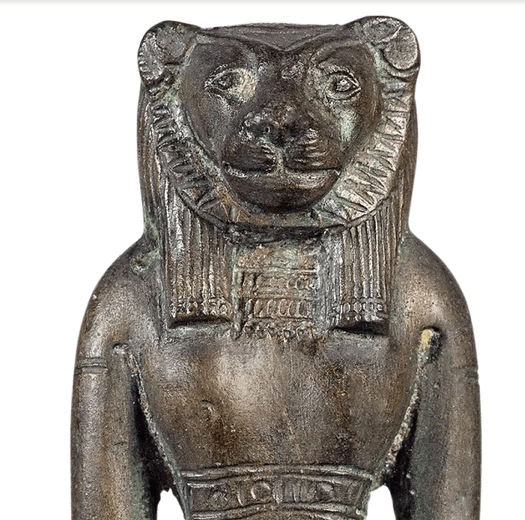
One of the over 700 granodiorite statues made of the Goddess Sekhmet almost 3500 years ago, “the Lady of the Place of the Beginning of Time.” 

Molly Remer of Brigid’s Grove, a fellow contributor here at Feminism and Religion recently wrote on the Mother Well section of the divine feminine app: “I feel like Inanna & Enheduanna are all around in recent months!”

Yes. I do as well.

A year or two ago, I read a book by Lauren Sleeman entitled ‘Behold’.  The premise of the book has remained with me:  a telling of the Goddesses, in particular Lilith, the Great Mother and Crone of the Cosmos, and Hekate, Goddess of the Dark Moon and the Mysteries of Life, who have been silently watching and waiting these past few thousand years to return to our human consciousness. 

Continue reading “The Return of the Goddess to Our Human Consciousness by Caryn MacGrandle”

Legacy of Carol P. Christ: Walk in Love and Beauty: A Touchstone for Healing

This was originally posted on July 9, 2018

Nurture life.

Walk in love and beauty.

Trust the knowledge that comes through the body.

Speak the truth about conflict, pain, and suffering.

Take only what you need.

Think about the consequences of your actions for seven generations.

Approach the taking of life with great restraint.

Practice great generosity.

Repair the web

In Rebirth of the Goddess, I offered Nine Touchstones of Goddess Spirituality as an alternative to the Ten Commandments. The Nine Touchstones are intended to inform all our relationships, whether personal, communal, social, or political.

Continue reading “Legacy of Carol P. Christ: Walk in Love and Beauty: A Touchstone for Healing”

To Stand in the Presence of the Ancients! – Enheduanna, Part 2 by Janet Maika’i Rudolph

Yesterday I wrote about the priestess/scribe Enheduanna and her warrior/king father Sargon. I posited their connection to the codification of patriarchy. They did not invent it, as war and the diminution of women had been happening in some circles. I do wonder, however, if they furthered it along to a point of no return.

Another king of the time, Urukagina from circa 2350 bce[1] codified laws under the guise of reformation.  Some of his reforms were progressive in that they sought to protect the poorer classes against aristocracy and the priesthood.  But they also were clear to let women “know their place.” Here are the translated words from his laws:

“If a woman to a male has spoken . . .[bad] words(?) which exceed (her rank?), onto the teeth of that woman a baked brick shall be smashed, and that brick will be hung at the main gate.”

Continue reading “To Stand in the Presence of the Ancients! – Enheduanna, Part 2 by Janet Maika’i Rudolph”

To Stand in the Presence of the Ancients! – Enheduanna, Part 1 by Janet Maika’i Rudolph

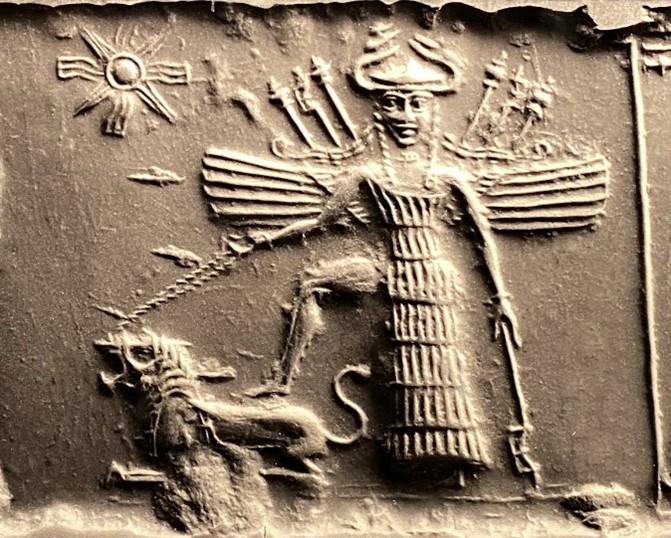
Ishtar controlling a lion ca 2334-2154 BCE

To be in the presence of antiquities is powerful. They carry an energy which is palpable.  I found this to be true at the recent exhibit at the Morgan Library in Manhattan that ran from October 14, 2022 through February 19, 2023. 

Enheduanna is a fascinating woman who lived in the lands of Mesopotamia circa the 23rd century BCE. She was a priestess who was also a writer and chronicler of her times. She named herself in her writings making her the first known author of any written works in history. She was so influential that for centuries after her death, scribes learned their craft in scribal schools by reading and copying out her work. Scholars have referred to her as the Sumerian Shakespeare[1]

Her main temple was in Ur, the very city that hundreds of years later gave rise to the biblical priestess Sarah and her husband, Abraham. We can only image how much they had been influenced by her.

Continue reading “To Stand in the Presence of the Ancients! – Enheduanna, Part 1 by Janet Maika’i Rudolph”

Divinely Feminine Events to Change the World by Caryn MacGrandle

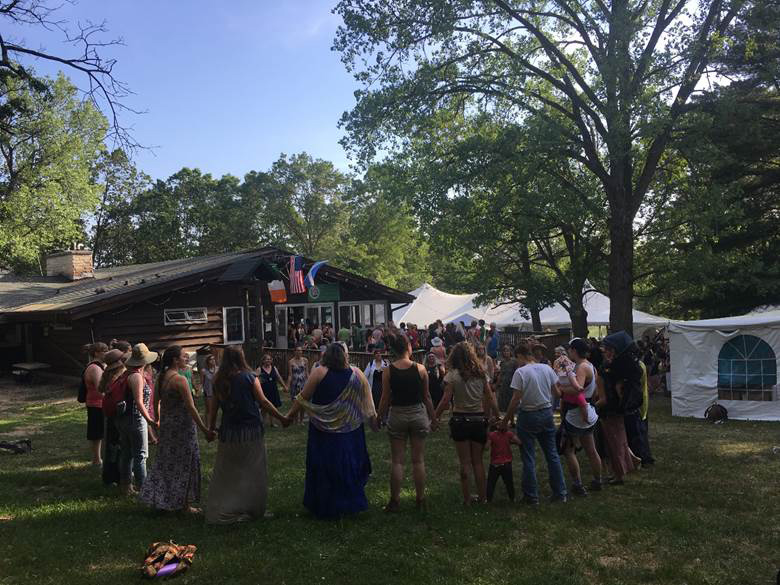
Morning Circle at Midwest Herbal Conference in 2017

In the bathroom at 4am in the morning, I hear the birds start to sing.  Instantly, I am transported back to my tent at Midwest Herbal Conference in Wisconsin to the excitement of starting a new day with the feeling of being in nature with fellow conmadres, amazed at the knowledge and wisdom the women around me hold.  Watching them go into the forest, bend down to see a plant, put it in their mouths and eat it.

Continue reading “Divinely Feminine Events to Change the World by Caryn MacGrandle”

The Vows We Make, by Molly Remer

I make a vow of self-sovereignty,
a declaration of wholeness,
a promise to myself that I will keep:
I vow to listen to my heart,
to claim my power and my voice.
I vow to live my own magic,
to step into the center of my own life
and live from there.
I vow to live a life
that includes space for me,
to stand up for what I need,
to listen to my longings,
to honor my inner call,
to do my own work with trust.
I vow to never abandon myself.
I vow to inhabit my own wholeness
in all ways.

In February, I signed up for a Vow of Faithfulness class with WomanSpirit Reclamation. Guided by Patricia Lynn Reilly (of “Imagine a Woman” and A God Who Looks Like Me fame) and Monette Chilson, the class was based on Patricia’s book, I Promise Myself: making a commitment to yourself and your dreams. Structured as a seven week online women’s circle, the class took us on a deep dive into vow-making, culminating in a vow ceremony in which we made a public (to the class that is) declaration of our own vows to ourselves. As the class unfolded, I found myself reviewing past vows as well as sensing new vows bumping up against my consciousness, whispering to be heard.

Continue reading “The Vows We Make, by Molly Remer”

Hope Is Giving Birth in the Face of the Dragon by Beth Bartlett

Syrian Baby

The image of the baby born under the rubble of the earthquake in Syria has been haunting me. So has the image in my mind of her mother, giving birth to her baby while trapped after the building, where she, her husband, and their children were sleeping, collapsed.  The baby’s uncle, when digging through the debris hoping to reach his brother and family, found the baby alive, her umbilical cord still attached to her mother. When he cut the cord, the baby let out a cry.  Tragically, her mother had died after giving birth, as had her father and siblings.

Continue reading “Hope Is Giving Birth in the Face of the Dragon by Beth Bartlett”