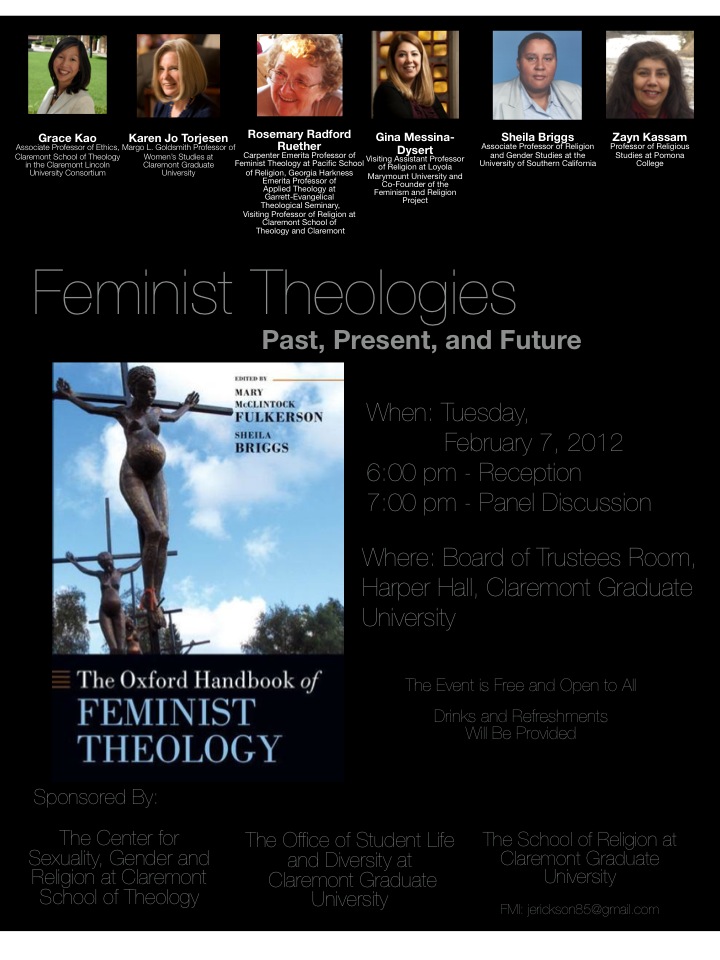
On February 7, 2012, a panel discussion focused on the past, present, and future of feminist theologies took place at Claremont Graduate University to celebrate the release of TheOxford Handbook on Feminist Theology. The panel was organized by John Erickson, moderated by Grace Kao, and featured Karen Torjesen, Rosemary Radford Ruether, Gina Messina-Dysert, Zayne Kassam, and Sheila Briggs as presenters. What resulted was a terrific discussion about women, religion, and feminist theologies. Many were in attendance and participated in the panel; for those who were unable to attend, here is a video of the presentations from that evening. We look forward to you sharing your thoughts and comments about the past, present, and future of feminist theologies.
Category: Feminist Theology
REMEMBERING MERLIN STONE, 1931-2011 by Carol P. Christ
“In the beginning…God was a woman. Do you remember?” Feminst foremother and author of these words Merlin Stone died in Feburary last year.
I can still remember reading the hardback copy of When God Was a Woman while lying on the bed in my bedroom overlooking the river in New York City early in 1977. The fact that I remember this viscerally underscores the impact that When God Was a Woman had on my mind and my body. Stone’s words had the quality of revelation: “In the beginning…God was a woman. Do you remember?” As I type this phrase more than thirty-five years after first reading it, my body again reacts with chills of recognition of a knowledge that was stolen from me, a knowledge that I remembered in my body, a knowledge that re-membered my body. My copy of When God was a Woman is copiously underlined in red and blue ink, testimony to many readings.
Though I could then and can now criticize details in the book, the amassing of information and the comprehensive perspective When God Was a Woman provided was news to me when I first read it. Despite having earned a Ph.D. in Religious Studies from Yale, I did not “know” that Goddesses were worshipped at the very dawn of religion. I had not heard of the theories of Indo-European invasions of warlike patriarchal peoples into areas already settled by peaceful matrilineal, matrifocal cultures in Europe and India. I had written my undergraduate thesis on the prophets, studying their words in the original Hebrew, but I did not understand that their constant references to the Hebrew people “whoring” after “idols” and worshipping “on every high hill and under every green tree” referred to the fact that many of the Hebrew people were choosing to worship Goddesses in sacred places in nature. Nor did I understand that the Genesis story which I had studied and taught took the sacred symbols of Goddess religion– the snake, the tree and the fruit of the tree, the female body—and turned them upside down. Continue reading “REMEMBERING MERLIN STONE, 1931-2011 by Carol P. Christ”
Bareed Mista3jil: Negotiating Gender, Sexuality, and Religion in Lebanon by Amy Levin
It’s not often (enough) that I (have the time to) come across non-academic books that articulate and reflect some of the most complex intersections between religion, gender, and sexuality. Those that do are commonly produced in the Western hemisphere, often representing the voices of Euro-American cultures and religious traditions. That is why I want to give voice to Bareed Mista3jil, a book, or collection of “41 true (and personal) stories from lesbians, bisexuals, queer and questioning women, and transgender persons from all over Lebanon.” Bareed Mista3jil was published in 2009 by the organization Meem, a community of lesbian, bisexual, queer women and transgender persons (including male-to-female and female-to-male) in addition to women questioning their sexual orientation or gender identity in Lebanon. The purpose of the book is to give voice to those in Lebanon with non-conforming sexualities and identities in order to give hope to this under-represented, often silenced population. Here is a description from Meem on the origin of the book: Continue reading “Bareed Mista3jil: Negotiating Gender, Sexuality, and Religion in Lebanon by Amy Levin”
Feminism and the Emerging Church By Xochitl Alvizo
What is emerging in the emerging church will not be faithful, liberative, or just if it continues to perpetuate the erasure of women’s herstory.
There has been on ongoing conversation among Christian identified people for about 20-30 years now. It originally started in the U.K. and Australia before making its impact in the U.S. It has its roots in evangelical Christianity but has since extended more broadly to Christians of all stripes including Catholic ones. This conversation is often referred to as the Emerging Church, the emerging church movement, or, as preferred by many, the Emerging Conversation. Phyllis Tickle has written a book, The Great Emergence, suggesting that this movement represents a much larger historical transformation of Christianity that occurs about every 500 years prompting a kind of house cleaning and rummage sale of the church. Continue reading “Feminism and the Emerging Church By Xochitl Alvizo”
Practice What You Preach by Corinna Guerrero
The underlying principle that links a feminist critique to every other critical lens since the rise of feminist discourse is the “hermeneutic of suspicion.” Essentially, a hermeneutic of suspicion identifies the disconnect between rhetoric and a lived reality. The lived lives of women are different than the pontifications espoused directly and indirectly by the traditionally patriarchal social, political, cultural, religious, and educational structures in which individuals participate.
I like to think that I live my life bucking these structures whenever possible because the roles a woman plays in her own life should: 1) be determined by her; and 2) if she negotiates more “traditional practices” (e.g. marriage, motherhood, etc.) then these practices do not limit her to traditionalist practices (e.g. staying at home, spousal servitude, etc.). Granted, I used the two most generic examples of traditional and traditionalist practices, but the point is still valid. When I go to holidays with my extended family there are very few questions or comments about my PhD program, but many comments about the fact that I do not make a plate of food for my husband. Continue reading “Practice What You Preach by Corinna Guerrero”
Feminist Theologies: Past, Present, and Future by Gina Messina-Dysert
I had the great honor to be a part of the Feminist Theologies: Past, Present, and Future panel on February 7, 2012 to celebrate The Oxford Handbook of Feminist Theology. I presented with some feminist foremothers who have had a tremendous impact on me and my feminist ideals. To say it was a wonderful experience would be a complete understatement.
Below is the talk I shared at the conference. It focuses on my personal experience with feminist theology, the Feminism and Religion project, and how digital print will shape the future of feminist theology. A very special thanks to John Erickson for organizing this important event.
It is truly a pleasure to be here today to celebrate the publication of The Oxford Handbook of Feminist Theology. Certainly a foundational text that will be instrumental in moving the field of feminist theology forward by connecting feminists from different cultural and geographical backgrounds to discuss women and religion in a globalized world. Continue reading “Feminist Theologies: Past, Present, and Future by Gina Messina-Dysert”
Feminism and Religion: Where Do Nontheists Fit? By Bridget Ludwa
What is a woman to do when she no longer finds any type of theism relevant to her, but as a human being still needs community, ritual and sense of the sacred that theistic religion inherently provides? The most vocal representatives of atheists are men, such as the voices of Richard Dawkins, Sam Harris, and the late Christopher Hitchens. I’m happy to have these voices, because they’re brilliant and well-spoken, but where are the women? My partner shares the same belief system as I do, but he does not feel the same need for community as I do. Is it gender? What ratio of women to men do you observe when you look at who is spending their time and energy making sure your local Catholic Church functions? In questioning if women are more spiritual than men, Caroline Kline observed that women outnumber men in religious observance. For the sake of argument, let’s accept for a moment that women are more inclined than men to seek community, ritual and a sense of the sacred. What is a nontheist woman to do?
I wanted to go through some articles posted on here before diving into this question, maybe I would find a satisfying answer and that would be the end of it. Carol Christ consistently poses the divine gender question, and admittedly I’ve been very drawn to a feminine manifestation of the divine. The idea of Mother resonates with me more than Father (a father whom many believe could only “save” humanity via human sacrifice). Part of my rejection of theism does indeed stem from this issue of gender. For many who find traditional theistic concepts unnerving, Christ’s reevaluation of the divine is gratifying and empowering. As empowering as this reevaluation is, however, the concept of any deity, male or female, still did not settle with me. Continue reading “Feminism and Religion: Where Do Nontheists Fit? By Bridget Ludwa”
The Harlot Shall Be Burned with Fire: Biblical Literalism in The Girl with the Dragon Tattoo by Sarah Sentilles
Against my better judgment, this past weekend I went to see The Girl with the Dragon Tattoo, directed by David Fincher who’s best known for Fight Club and The Social Network. I didn’t like the book; it unsettled me that a novel filled with sexual violence against women—a novel that seems to take pleasure in the violence, to offer it up for readers to consume—became such a sensation. But I’m a sucker for a trailer and a good soundtrack, and I was curious, so I bought a ticket.
The plot revolves around a missing girl and the serial killer believed to have murdered her who uses the Bible like a handbook. He takes passages from Leviticus—21:9 for example: The daughter of any priest, if she profanes herself by playing the harlot, she profanes her father. She shall be burned with fire—and enacts them on women’s bodies. On Jewish women’s bodies.
Please click here to continue reading this article at Religion Dispatches.
Sarah Sentilles is a scholar of religion, an award-winning speaker, and the author of three books including A Church of Her Own: What Happens When a Woman Takes the Pulpit (Harcourt, 2008) and Breaking Up with God (HarperOne, 2011). She earned a bachelor’s degree from Yale and a master’s of divinity and a doctorate in theology from Harvard, where she was awarded the Billings Preaching Prize and was the managing editor of the Journal of Feminist Studies in Religion. At the core of her scholarship, writing, and activism is a commitment to investigating the roles religious language, images, and practices play in oppression, violence, social transformation, and justice movements. She is currently at work on a novel and an edited volume that investigates the intersections of torture and Christianity.
A Next Wave of Scholarship By Kwok Pui Lan
I came to the United States in 1984 to begin my doctoral studies at Harvard Divinity School. It was an exciting time to do feminist theology and religious studies. Womanist ethics just began to emerge, as Dr. Katie Geneva Cannon has just completed a dissertation on the subject at Union Theological Seminary in 1983. I count it as a blessing that she was teaching at the Episcopal Divinity School, just on the other side of the Cambridge Common.
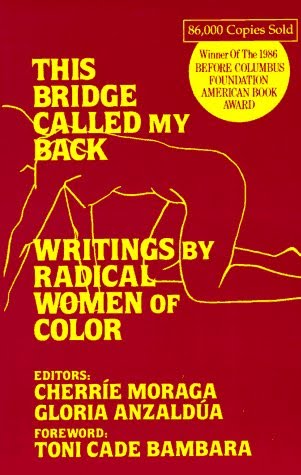
The mid-1980s saw the paradigm shifts in feminist studies in religion, as womanist, mujerista/Latina, Asian and Asian American women began to articulate their own theological understanding. If Womanspirit Rising (1979) was a reference text for our field, which contained essays by white women, we had the first reader by radical women of color, This Bridge Called Our Back(1981).
We began to discuss multiple oppressions and multiple identities, and the need to integrate race, class, and gender into our analyses. We challenged white women who have universalized their middle-class, white experience as if women were all the same. Continue reading “A Next Wave of Scholarship By Kwok Pui Lan”
My Body Tells A Story: Embracing my Scars and Imperfections By Michele Stopera Freyhauf
As we approach New Years Eve, there is an emphasis on losing weight, getting in shape, etc. in the coming Year. We make resolutions to better ourselves and reflect on the year that passed us by. With the impending New Year, there is also a realization that we become a year older, which for some means more grey hair, wrinkles, or other marks that appear on our body. It is safe to say that we live in a world that is obsessed with body image and the search to find the fountain of youth. In fact, TV is plagued with reality shows that perpetuate this obsession. Keeping up with the Kardashians displays such a problem. People who watch this show watch Kris Jenner’s facelift to her struggle with body image despite the fact that she gave birth to six healthy children and is 56 years young. There are also shows that show people obsessed, even addicted to plastic surgery – they are trying to attain perfection, attempting to reverse the aging process, and remove the scars of their lives. Continue reading “My Body Tells A Story: Embracing my Scars and Imperfections By Michele Stopera Freyhauf”