Loving Harry Potter By Xochitl Alvizo

I went to the movies with a group of friends last Friday to watch the final Harry Potter movie, Harry Potter and the Deathly Hallows Part II. It was a great movie, fun and action-filled, and the energy of opening night only made it better. Afterward we all went out to eat and exchanged notes on our favorite scenes – talking about every little detail. At one point, one of my friends commented on the strong role women have in the Harry Potter movies/books. She said the story is carried by the women – that if it wasn’t for them Harry Potter would not exist. She made specific mention of Harry’s mom as having sacrificed her life for him. Lily dies so Harry can live.

This of course is when my brain comes to a screeching halt.

Women sacrificing their lives for others – I become suspicious and my defenses go up. Sacrifice = suffering. Suffering must not be glorified. Sacrifice must not be sacralized. I see red flags everywhere. Wait, though; haven’t those of us who are Christian-identified heard the opposite affirmed a million times? Jesus suffered and died – was sacrificed – for our sins. Further, Christians’ most sacred ritual, communion, includes reference to Jesus’ broken body and spilt blood. So, isn’t that what people do for love, sacrifice, as Harry’s mom did?

No. I don’t think that’s actually what people (or God) do for love. Continue reading “Loving Harry Potter By Xochitl Alvizo”

“She stood up straight and began praising God”: Luke 13: 10-13 By Theresa A. Yugar

The following is a guest post written by Theresa A. Yugar, Ph.D. Candidate in women studies in religion at Claremont Graduate University.

The gospel story of the crippled woman healed by Jesus of her ailment in the Gospel of St. Luke epitomizes for me the values of a Feminist Liberation theological perspective. For women, Feminist Theology as a discipline has enabled us to claim our dignity and rights as women and “stand up straight” as this woman in the gospel does. In the context of a larger church tradition which has not always affirmed women, Jesus models in his ministry both compassion and respect for the wellbeing of women. For eighteen years, this nameless woman, carried “a spirit that had crippled her,” so much that “she was bent over and was quite unable to stand up straight,” (13:11).  Not only does Jesus heal her of her infirmities, but he also defends her dignity as a “daughter of Abraham.”

On a very intimate level I identify with this nameless woman who approached Jesus humbly seeking healing and liberation from the physical ailments that bound her. In my own life I have also experienced the same sense of bondage that this woman in the gospel is healed of. Like many women, I grew up struggling to affirm the dignity I had as a human being. Even though the church I love and grew up in stated that they value both men and women equally, in practice this was not the case. For me and the un-named woman, the relevance of this gospel in relation to Feminist Theology touches on the core of Jesus’ ministry, which was the liberation of all people from the oppressive structures that burdened them.  Continue reading ““She stood up straight and began praising God”: Luke 13: 10-13 By Theresa A. Yugar”

This is What a Catholic Looks Like By Kate Conmy

The following is a guest post written by Kate Conmy, MA, Membership Coordinator for the Women’s Ordination Conference.  Kate celebrates spiritual activism, feminism, and human rights.  She currently works as the Membership Coordinator for the Women’s Ordination Conference and lives in Washington, DC.  She can be contacted at Kconmy@womensordination.org.

In my last semester as a Religion student at Mount Holyoke College I sat in my Feminist Theology seminar with only one question for our guest speaker: “Why are you still a Catholic?” A question I rarely dared to ask myself as I spent most of my studies concentrating on Buddhism, traveling abroad to Dharamsala, India, interning with the Buddhist Peace Fellowship in Berkeley, even learning Tibetan; by most observable assessments I had swapped the pew I grew up in for a zafu.  But Mary Hunt reminded me in such a simple and smart way that Catholicism is about community building and justice seeking. She said: “This is what a Catholic looks like. We have a responsibility to speak this language.”

In that moment I realized I had been resisting something that has always belonged to me. Raised in a Jesuit-educated Catholic family in Upstate, New York I felt less confirmed within the church, and more convinced that we were celebrating a god that was too small. One of the great mysteries for me growing up in a church-going family was the personal and religious reconciliation the Catholics I knew negotiated, sometimes weekly to make sense of their faith.  The dissonance between what was practiced during Mass, and what Catholicism meant at the dinner table seemed an exhausting spiritual dance of ambivalence.  It wasn’t until I began to identify as a feminist theologian that my spiritual worlds converged in a moment of satori: ambivalence is a virtue!  The sisters and daughters of Mary Daly gave me permission to re-claim my Catholicism with all of my questions as an extraordinary action of faith.  Ambivalence means courageously engaging the sacred to foster critique, conversation and innovation in the pursuit of knowing God. Just as Carter Heyward writes, “To love God is to un-do evil,” I so strongly believe that God must manifest as an expression of creative justice whereby inclusivity, “right-relation,” and the elimination of discrimination are central on the path toward a higher liberation. I graduated feeling empowered by women, activists, and radicals who claimed their faith and the responsibility to speak a language beyond the binary in order to celebrate the wisdom of all human and divine goodness.  Continue reading “This is What a Catholic Looks Like By Kate Conmy”

Qu(e)erying Our Lady By Xochitl Alvizo

I love art. I especially love certain women’s art – women such as Frida Kahlo, Cathy Ashworth, Sudie Rakusin, and Alma Lopez. To me, their art is a reflection of women’s strength, creativity, and beauty. Frida Kahlo, for example, expressed so many aspects of herself and her experience through her art. In it one can glimpse her passionate love for Diego Rivera, her continuous physical pain, her search for meaning, and the unending hopefulness she maintained throughout it all. Frida Kahlo’s art, like her person, was vibrant and full of life, colorful and yet broken. She expressed the wide spectrum of her experience not in words only but in color and images, texture, paint and print. As she put it, “I paint my own reality” – her own reality is what she knew and it is what she painted.

I rely on art to do what academics often cannot do well – what I cannot do well – which is to communicate the truths that rattle our being down to its deep core in ways that connect with others. There have been times in my academic life when I have encountered new insights that changed my life forever. Moments of being shaken and awakened at my very core by a truth that until then had eluded me. But such moments can be hard to share with others because they can be hard to translate to words, even if such moments have come to me by words. Learning about feminist theology and being shaken by the truths it spoke to me is one such encounter – and it was indeed an academic one that is often hard for me to put into words and explain to others. On the other hand, encountering Alma Lopez’s artwork was also a core rattling moment, but one which I can more easily share.

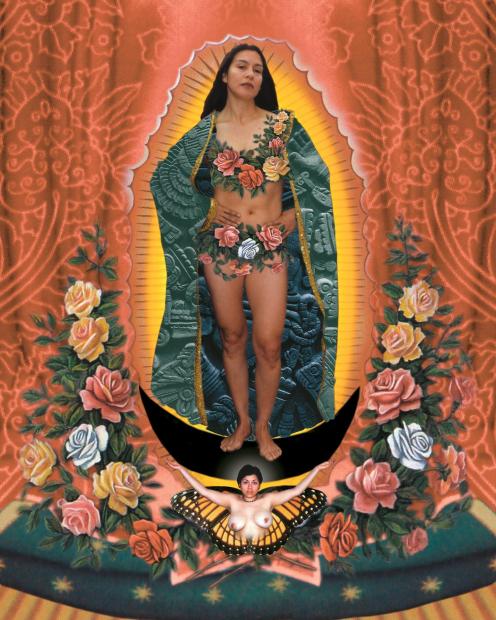
Our Lady - Lopez
“Our Lady” by Alma Lopez (1999)

Alma Lopez’s Our Lady is a digital art piece in which Our Lady of Guadalupe is depicted (embodied, really) in a more obviously female form than is traditionally expected. For this, every time her piece is on exhibit, Lopez receives a barrage of protest and harassment – as does the sponsoring institution. Accusations of obscenity, profanity, and blasphemy come her way.  But, why?

When I see Lopez’s Our Lady, I do not see blasphemy or obscenity, I see a celebration of the female and the sacred. I see the beauty of God’s queer incarnation – and I remember – I remember that the word became flesh and made her home among us. From the womb of a woman’s body, her life-giving body, the divine took human shape. Boundaries of sacred and profane forever blurred.

Alma Lopez, like Frida Kahlo, paints her own reality; she says this piece is a reflection of her relationship with Our Lady of Guadalupe, a divine image that has been part of her life since she was very young.  But I also think she reveals something more than just her personal relationship with Our Lady… Continue reading “Qu(e)erying Our Lady By Xochitl Alvizo”

The Chispa* Carrier: Rosemary Radford Ruether By Renny Golden

The following is a guest post written by Renny Golden, Professor Emerita, Northeastern Illinois University.

The Chispa* Carrier: Rosemary Radford Ruether by Renny Golden

What kind of voice is breaking silence, and what kind of silence is being broken? Adrienne Rich

She came to prison with hidden keys. The way forward,

she said, is behind us. With only a spoon of history she

gutted a tunnel that ran below the plazas of Prince after Prince.

We sat waiting behind bars: mouldy histories, slop theologies

in mush bowls shoved under cell doors. Eat this or starve.

We prayed for deliverance we could not name.

We imagined her walking through deserts, our prophet

searching the sand for bones, pouring through ancient scripts,

gospels, archeologies, the dank stacks of basement libraries,

reliquaries with their throb of real blood, archives.

We rattled the bars with questions: Can she pick locks? Continue reading “The Chispa* Carrier: Rosemary Radford Ruether By Renny Golden”

Feminism, Ontology and the Priesthood of all Believers

At a surprisingly early age, perhaps nine or ten, I became the author of my own spiritual narrative, meaning, I took it upon myself to initiate and pursue the deep mystery of my faith.  Weekly Mass was an event, not an obligation, and something to which I attended without my family. The singleness of my worship at such a young age drew stares and whispers from those families who had arrived in tact. And while I was not unaware of their curiosity, I found it easier to lose myself in the absolute wonder of my environment. This was the world to which I belonged.  I was at once home and alive in a devotion filled with sacramentals, those objects of religious piety that created a force field of God’s protection around me. 

While the mystery of God’s love enveloped and graced my adolescence, a slow and creeping suspicion began to take hold of my faith. Because of my “girlishness,” I was barred as an alter server, and I began to absorb my otherness. I worried about my difference, and began to question the fairness of God. Telegraphic messages of inferiority caused me great confusion. The implicit reality that as female I was ontologically challenged, slowly sifted its way into my psyche and I would argue, my soul as well.

As a budding young feminist, what I found within the teachings of the church, either implicit or explicitly, did not coincide with what I felt to be the inner me.  On the cusp of adulthood, the collision between self and Church [read as God] was inevitable. The catechetical formation of my youth, of coming forth equally male and female in the image and likeness of God seemed like a childish myth and certainly not the reality of the andocentric church to which I was now departing.

Fast forward twenty years, and I cautiously found myself back in the Catholic Church, only this time in the arms of feminist theologians. I was hooked.  Their writings informed my life choices, directing me towards my current doctoral pursuit.  Yet I have found the academic arena is able to shield and protect me from the pain I continue to feel within the institutional church. To demonstrate the interweaving of the challenges and nourishment I experience as a Catholic I addressed above, I would like to share with you the following story. Continue reading “Feminism, Ontology and the Priesthood of all Believers”

What Feeds Your Soul? By Cathy Dundas-Reyes

The following is a guest from Cathy Dundas-Reyes, Ph.D.

I have finished coursework in Leadership Studies, but feel like I could use another three years to read all the additional leadership literature out there. I took comps two weeks ago and now get to wait…for the results. I had prepared my mind before I headed back for my test. I knew it would be hard to switch gears – having nothing to really study anymore. But it has been harder than I thought.

For a few days, I was restless and irritated. I tried to study for lit review but was not productive. All I felt was exhausted. I napped everyday and still wanted to sleep at night. I realized I could use the time to minister to my own soul. My feminine soul to be more specific.

I had a glimpse of her in my mind. She was a runner in a race and was worn out. She had kept up for the race, but she was done. Her head was down and she needed to rest. She was toned and in good shape – she had been a faithful companion. But now she needed something from me. Could I just sit and listen? When was the last time I did something that fed my soul?

What feeds your soul? I thought about lots of things that feed my feminine soul. A visit to the Getty museum, exploring the coast for unexpected beauty, a massage, dancing…chocolate ice cream. So that is what I will do…while I wait.

Interestingly, I had another image of my feminine soul almost a year ago. She was a slave, in chains, at the mercy of the task master. She was malnourished, neglected and in torment. I was struck by the contrast of the two images. Now, she may be tired, but she is powerful and strong. She grew from a slave to a powerful running partner. Lady Wisdom says “I am understanding, power is mine” (Prov 8:14). Find out what feeds your feminine soul – find that deep understanding and power. I would love to hear your comments about what you discover.

For more about the feminine soul – see Janet Davis’ book, The Feminine Soul: Surprising Ways the Bible Speaks to Women (2006).

Mary Daly: Radical Elemental Feminist and Sinner By Gina Messina-Dysert

While some argue that Mary Daly was too radical, I have been greatly influenced by her contributions to the field of feminism and religion.  I can still remember the first time I read a piece of her work.  It was during my undergraduate career at Cleveland State University in a course entitled “Women and Religion.”  I was immediately impacted and wanted to know more about this bold, strong and courageous woman, and although I had already considered myself a feminist, it was in that moment I recognized the existence of patriarchy in religion.  Shortly thereafter I applied to a graduate program in religious studies and became better acquainted with Daly’s work and the intersection of feminism and religion.

While I must admit that I am troubled by some of Daly’s claims and disagree with some of her contentions, I have also been significantly influenced by her foundational work in feminist theology, her demand for women’s liberation and Spinning of new tales and new ideas.  Daly called for women to have the courage to be, to experience a new fall out of patriarchal systems and into a new being that allows women to discover their capabilities, the dynamic power women possess within themselves.

According to Mary E. Hunt, co-founder and co-director of the Women’s Alliance for Theology, Ethics and Ritual (WATER), “Her contributions to feminist theology, philosophy, and theory were many, unique, and if I may say so, world-changing. She created intellectual space; she set the bar high. Even those who disagreed with her are in her debt for the challenges she offered…She always advised women to throw our lives as far as they would go. I can say without fear of exaggeration that she lived that way herself.”[1]

While I never had the opportunity to meet Mary Daly, I have no doubt been inspired by her brilliance, courage, wit, and spirit.  My feminist and theological views have been shaped through her influence. I have been able to spiral into freedom and rename and reclaim my own experiences; I have found my own creative power.  Thank you for having the courage to sin big Mary Daly.

“There are and will be those who think I have gone overboard. Let them rest assured that this assessment is correct, probably beyond their wildest imagination, and that I will continue to do so.” – Mary Daly

Between Mother Mary and Mother God: It’s a Mystery!

“It’s a mystery!” was the repeated response my mother gave to me whenever I asked her theological questions that fell outside the realm of the Catholic Baltimore Catechism.  To be fair, my questions were usually a bit precocious for a young child, but who are we kidding, I was a rather strange and overly religious kid.  My idea of a good time was kneeling before our three-foot statue of the Virgin Mary as our family recited our Lenten rosary.  And while my brothers were contorting themselves into positions that would qualify for Cirque de Soleil, I was piously straight and focused.  Mary was my pathway to the big three, The Father, The Son and The Holy Ghost.  And while I knew I was suppose to desire the Three-in-One, they did not hold the same sway over me as the Mary who stood atop the world while crushing Satan in the form of a snake. My love for Jesus was more a sense of obligation for the unfair rap he had to endure while on earth, the Great Sacrifice for the sin of Adam and Eve.  My image of God as a not-so-nice-Father-to-his-only-Son sealed itself into my consciousness early on.  “Why,” I would ask my mother, “if God is love would he insist on such a bloody and painful sacrifice for a sin that honestly does not seem so bad.” You guessed it, “It’s a mystery!”  was her response.

But I have since come to learn that it’s not a mystery, but rather a matter of shifting the theological lens from an abusive Father to a God who has been totally misrepresented.  A God who is both unnameable and pronounceable.  Who offers us the mystery of God’s self in every single seen and unseen element of the earth and cosmos.  But still, that does not always work for me.  I need more.  In times of heartache or sorrow I need an image with skin and bones and a heart that is larger than my pain. I need a Creator God that will rock me back and forth, soothing my fears and yes, even caressing my face with cool breaths that remind me I will survive this latest insult to life.  In these times I know what God is not. I know God is not a rock, or a wispy tuft of air.  God is not the mighty King on high able to judge my enemies.  Nor is God a warrior who kicks ass over the unrighteous.  God is my Mother.  Maybe this is why Mary has always worked for me.  Maybe she never really was the mediator between Them and me, she is Them.  Theologically I may be on shaky ground, but the mystery between Mary as Mother and Mother God is one I know, not one I can defend. And it is one that continues to sustain and let me know that I am never too old to be held in the Mother’s embrace.

Female Language and Imagery of the Divine By Gina Messina-Dysert

According to Rita Gross, “If we do not mean that God is male when we use masculine pronouns and imagery, then why should there be any objections to using female imagery and pronouns as well?” What an important question. I was raised using only male language when talking about God and while I am embarrassed to admit it, spent my childhood through my early college years believing that God was a man. As studying religion and theology has shaped my life, I decided that gender neutral language when talking about God was the most appropriate way to approach the problem of God-talk and sexism, and thus utilized the term“divine” to talk about God. It made sense to me. But then I began reading Gross, as well as Carol Christ and Elizabeth Johnson, and other feminist scholars who argued that we must use female language to talk about God in order to have positive female imagery of the divine. Right now we are inundated with male language, we must balance that out.

And so, I decided that I must use female language to refer to God. To be honest, I feel comforted by talking about the divine as woman, as mother. In order to further develop my own imagery of God as woman, I wrote a prayer that I wanted to share. It was a great spiritual exercise for me to describe the qualities I feel the divine possesses and it allowed me to experience a closer connection to Divine Mother.

Prayer to Divine Mother

Great Divine Mother

Who is Immanent in All Things

Spiraling Life into Being

And Communicating through Nature

She Who is Compassionate and Merciful

Nurturing our Spirit

Her Benevolence felt Strongly

And Encountered through Humanity

She Who is Guardian

Cradling us with Affection

Her Protection Sensed

And Her Love a Source of Haven

She Who is Sustainer

Nourishing our Lives

She Who is Vivifier

Cultivating our Hearts

Great Divine Mother

Guide Me to Have Faith in Your Wisdom

To Share Your Gentle Compassion

And to be Sincere in Spirit and Heart