MATILDA JOSLYN GAGE: IN HER NAME, AMERICAN WOMAN WRITER AND ACTIVIST (1826-1898), part 2 by Maria Dintino

part 1 appeared yesterday

Leila Brammer in her book Excluded from Suffrage History: Matilda Joslyn Gage, Nineteenth-Century American Feminist, explains the long-term impact of the dismissal of Gage:

“The loss of Matlida Joslyn Gage from the history of the woman suffrage movement and her ideas from the intellectual history of feminism speaks to the influence of exclusionary processes in social movements as well as their unfortunate consequences…we must remember that Joslyn Gage was intricately involved in the movement, wrote in newspapers and magazines, and published a book, but all these activities and her significant feminist thought had to be re-created and rediscovered nearly a century later”(120).

Continue reading “MATILDA JOSLYN GAGE: IN HER NAME, AMERICAN WOMAN WRITER AND ACTIVIST (1826-1898), part 2 by Maria Dintino”

MATILDA JOSLYN GAGE: IN HER NAME, AMERICAN WOMAN WRITER AND ACTIVIST (1826-1898), part 1 by Maria Dintino

Moderator’s Note: We are pleased to announce that we have formed a co-operation with The Nasty Women Writers Project, a site dedicated to highlighting and amplifying the voices and visions of powerful women. The site was founded by sisters Theresa and Maria Dintino. To quote Theresa, “by doing this work we are expanding our own writer’s web for nourishment and support.” This was originally posted on their site on January 5, 2021. You can see more of their posts here. 

A few weeks back, I came upon a term I had not heard before, the ‘Matilda Effect’. It’s defined as: a bias against acknowledging the achievements of those women scientists whose work is attributed to their male colleagues (Wikipedia). This term was coined by science historian Margaret W. Rossiter in 1993, in her essay The Matthew Matilda Effect in Science.

The Matthew Effect, labeled in 1948 and credited to Robert K Merton, and later to Harriet Zuckerman as well, refers to the way that: eminent scientists will often get more credit than a comparatively unknown researcher, even if their work is similar; it also means that credit will usually be given to researchers who are already famous (Wikipedia).

Continue reading “MATILDA JOSLYN GAGE: IN HER NAME, AMERICAN WOMAN WRITER AND ACTIVIST (1826-1898), part 1 by Maria Dintino”

Gift From the Beyond, part 2 by Sara Wright

Part 1 was posted yesterday

Trillium Rock

My friend Lise sent me some words on the eve of Davey’s birthday (unbeknown to me until the 6th) that reminded me of how often I spoke to him during those months.

The reason I pray to the dead is I trust their timing. They have all the time in the world, after all, and they also see the big picture and the long story. I pray to the dead because, I admit, how little I know, how little I can understand, and how vast the mystery is of the soul.

Let me circle myself with the living who can hold both, with the dead who can hold it all. We are entangled souls…. We are all praying together, with the flowers, the trees, with all that is.” (I substitute talk for pray because that is what I do)

Continue reading “Gift From the Beyond, part 2 by Sara Wright”

Gift From the Beyond, part 1 by Sara Wright

The words came unbidden “go outdoors”. It was dark but I felt my way to the door. I always listen when Nature calls.

Trillime

I had just re -membered that Davey’s birthday was the next day. ‘Happy birthday Beloved’. My little brother would have been 75. I calculated the years with difficulty imagining what it would have been like if he had lived…

Dead at 21 from a self – inflicted gunshot wound, part of me died with my Gemini Twin. I failed him at the end, turning into a parent who was incapable of being emotionally present to listen to a young boy on the verge of adulthood at a time of desperate need. Instead, I parroted my parents’ script, not having developed one of my own…

”You have everything to live for,” I screamed when Davey tried to tell me that he was tired of living.

I no longer blame myself for my inadequacy, but regrets linger on just the same.

It would be eleven years before I was able to begin grieving. Catapulted out of my body at the time of my brother’s death I felt nothing for years as I self- medicated with alcohol and a dreary round of boyfriends while being unable to be emotionally present for my own young children. To feel one must inhabit a body but mine was overflowing with anguish and abandonment. Too dangerous to go there. Isolated and alone, I huddled in my house in silent torment, an absentee mother following the parental script with children of my own.

Continue reading “Gift From the Beyond, part 1 by Sara Wright”

Bible Believing Church Sign by Michelle Bodle

A dear colleague is retiring from ministry this year. As I often do at times of celebration, I think about the most meaningful conversations, questions, and impact that person has offered my life. As I was thinking of this colleague in particular, what came to mind was a statement that made to him that sparked a conversation that has been ongoing between us for almost a decade: “That church is not for me.”

            My friend talked about driving his motorcycle down a well-traveled highway and seeing church after church. If you know churches, you know that church signs can be anywhere from enjoyable to problematic. Some church signs try to convey witty messages, but they often miss the mark. Other times, a church speaks of its beliefs or current sermon series, using insider churchy language that does not hit with those whom the sign may be trying to reach in the first place. But church signs do exist for a purpose – to catch the eyes of travelers, which was undoubtedly the case with my colleague. 

            “I was driving down this road, and the sign that caught my attention said, ‘Bible Believing Church,’ and I’ve been thinking about that repeatedly,” he stated. I replied that I didn’t need to think about that sign; I knew exactly what it was trying to convey—that I was not welcome there. 

Continue reading “Bible Believing Church Sign by Michelle Bodle”

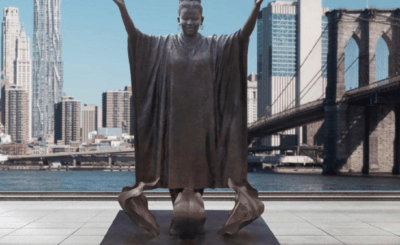
Sojourner Truth: Part Two: The Speech and the Sojourner Truth Legacy Plaza by Beth Bartlett

Part one was posted yesterday.

Most of us are quite familiar with Sojourner Truth’s “Ain’t I a Woman?” speech as recorded by Frances Gage several years later, with its powerful “ain’t I a woman” refrain.  However, the actual speech as transcribed at the time by Marius Robinson, while similar in content, does not contain the refrain. Rather, Truth simply states that she is “a woman’s rights” woman.[i]  It is unlikely that she spoke in the southern dialect Gage used in her transcription, since Truth grew up knowing only Dutch, eventually learning English as spoken in New York, and probably spoke with a Dutch accent. Much of the content in the Gage version was fabricated – such as the statement that she bore thirteen children, when she only had five children, though she did cry out in a mother’s grief when she learned that her only son, Peter, had been illegally sold south to Alabama.[ii]

Continue reading “Sojourner Truth: Part Two: The Speech and the Sojourner Truth Legacy Plaza by Beth Bartlett”

Sojourner Truth: Part One: Her Life by Beth Bartlett

On May 29th, 1851, a striking, 6’ tall, African American woman rose to speak at the Women’s Rights Convention being held in Akron, Ohio. There Sojourner Truth gave her famous “Ain’t I a Woman Speech.” 

Originally named Isabella, and known as “Bell,” Truth was born into slavery in 1797, the second youngest of James (“Bomefree” – Dutch for “tree”) and Elizabeth (“Mau-mau Bett”) who were enslaved by a wealthy Dutch man, Johannes Hardenbergh, Jr., who had a large estate in Ulster County, New York, which was inherited by his son, Charles, when Truth was just an infant. Upon the death of Charles, at the young age of nine, she was sold at auction to John Nealy, where she “suffered ‘terribly-terribly’ with the cold”[i] and beatings. In her own words, “He whipped her till the flesh was deeply lacerated, and the blood streamed from her wounds – and the scars remain to the present day.”[ii] She prayed for deliverance, and soon after was sold to a fisherman and tavern owner, Martinus Schriver, where she led “a wild, out-of-door kind of life,” carrying fish, hoeing corn, foraging roots and herbs for beer.  Only a year later she was sold again to John J. Dumont, where she lived out the remainder of her enslavement until her emancipation by the State of New York in 1828. She described her life there as “a long series of trials” which she did not detail “from motives of delicacy,  . . . or because the relation of them might inflict undeserved pain on some now living”[iii] whom she regarded with esteem. Knowing the conditions of enslaved women, we can deduce what those trials entailed. Despite her affections for a man on a neighboring estate, who was beaten to death for visiting her when she was sick, she was forced to marry a much older man, Thomas, also enslaved by Dumont, with whom she bore five children. Because Dumont reneged on his promise to free her, she walked away with her infant daughter in 1827 and was taken in by the Van Wegener family where she lived for the next year. 

Continue reading “Sojourner Truth: Part One: Her Life by Beth Bartlett”

Why I Wrote Queering the American Dream by Rev. Dr. Angela Yarber

Like most authors, I had grand plans for Queering the American Dream. Heeding the wisdom of the venerable black, queer writer, Pauli Murray—“One person plus one typewriter constitutes a movement”—I committed, not simply to writing and publishing a book, but creating a movement. With my modern-day typewriter (laptop) in hand, I dreamed of readers throwing off the shackles of an ill-suited dream, galvanizing retreats, coaching to help other marginalized creatives queer their own iterations of the so-called American dream.

I tried learning about book marketing and pitching companion essays and creating a launch team and all those things small-time authors without expensive publicists on retainer do. I tried so hard.

Continue reading “Why I Wrote Queering the American Dream by Rev. Dr. Angela Yarber”

Desperately Seeking Persephone by Janet Rudolph, Book Review by Carolyn Lee Boyd, Part Two

In Part One of this review (posted yesterday), we learned how Janet descended into the Underworld, like Inanna and Persephone, after child abuse and rape, and how she began a decades-long journey back to our own world, healed and empowered. To learn more about her return from the Underworld and how she became the shaman and author she is today, I invite you to join the journey in Part Two as we continue to explore “Signposts” that marked her ascent.

Signpost #3. Be aware, be free, be focused, be here, be loved, be strong, be healed.

Janet’s teachers at the Mystery School had brought together shamanic traditions from throughout then world. Among them was Huna, or Hawaiian Adventure Shamanism as practiced by Serge Kahili King. A summary of Huna is shown in a mantra: Be aware, be free, be focused, be here, be loved, be strong, be healed (114) and “focus on the gifts that come to us through adversity” (116). 

Continue reading “Desperately Seeking Persephone by Janet Rudolph, Book Review by Carolyn Lee Boyd, Part Two”

Mayflower Crowning by Sara Wright

I sit under the snowy crabapple as fragile flower petals drift one by one to the ground, covering my hair in white butterflies, soon to become the first mulch of the year. Our Lady is always nourishing new life…

 The hum of a thousand bees is deafening – bumblebees – glorious golden rotund bodies swarming from one tree to another with so many relatives – everyone seeking sweet nectar.

The scent is beyond description – intoxicating – a poignant perfume lasting only a few days and keeping me rooted to my bench every single morning to soak in the sweetness under impossible heat. Heavily polluted air is thick and metallic but here I inhale a plethora of fragrances so intense they drown out poisoned air.

Continue reading “Mayflower Crowning by Sara Wright”