“Tricolor Mary: Encountering Three Faces of the Divine Feminine” by Simone Grace Seol

simone-graceI always felt curiously distant from the figure of Mary. I always sensed that there is so much there and yet, I could never connect to it emotionally.

The foil to Eve, vessel of Love, suffering mother. I wanted to love her, I wanted to feel her, I wanted to feel drawn to the mystery of Marian devotion. But I felt alienated by the vision of the feminine that she seemed to project: the pure, immaculate, virginal, submissive, obedient, quietly suffering.

Most days, I feel like the opposite of every single one of those qualities.

It’s exactly the kind of feminine archetype I don’t really relate to — the kind of person about whom people say, “oh, she’s really nice” as if yielding compliance and non-offensiveness are her primary attributes. The kind of woman who fades into the background, whose worth lies only in her utility to the patriarchal narrative. Continue reading ““Tricolor Mary: Encountering Three Faces of the Divine Feminine” by Simone Grace Seol”

The Fringe is Our Stronghold by Oxana Poberejnaia

oxanaRecently I have come across several stories of women’s fringe spiritual movements or practices. This made me think about the role of outsiders’ or minority views in religions and society.

Patriarchy pushes women and their issues to the margins of society and religion. It seems that there women sometimes invent their own spiritual practices. These allow women to stand their own ground in religious matters, to preserve self-respect and to keep the hope of the highest spiritual attainment.

Quite often these beliefs and practices seem shocking in their bizarreness and their stubbornness not to accept orthodox norms.

Continue reading “The Fringe is Our Stronghold by Oxana Poberejnaia”

La Virgen de Guadalupe: New Feminist Portrayals by Jose Duran

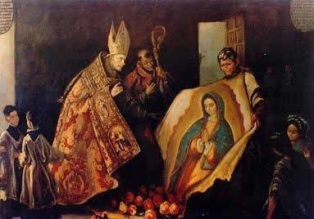
Jose DuranShe appeared on a hill on December 9, 1531. She spoke to Juan Diego in his native tongue of Nahuatl; the language of the Aztecas. She asked for a church to be built at that very site in honor of her, the Virgin Mary. Juan Diego took the request to the local priest, but his story was not believed. On December 12, following further instructions from La Virgen, Juan Diego was able to find and pick roses not native to Mexico. He rolled them up in his tilma and returned to the priest. When he unrolled his tilma to present the roses, there on the tilma was the image of La Virgen de Guadalupe; she was as dark as the natives themselves.

Natives across Mexico and throughout the Americas endured the brutal realities of conquest, and experienced the relegation to second class citizens during the colonial period in Mexico. In particular, native women experienced oppression two-fold. This is evident in the fact that native men had privileges and opportunities within the public sphere of society which were denied to women, such as holding particular types of public service positions.

So how is it that millions of natives across the continent converted to Catholicism, the religion used by their oppressors to justify the horrors and atrocities inflicted upon them? The appearance of La Virgen to Juan Diego. She is seen as the blending of the Indigenous and European cultures. A Huffington Post article, Everything You Need to Know About la-virgen-de-guadalupe-tilma-de-juan-diegoLa Virgen de Guadalupe, explains, “Her image has been used throughout Mexican history, not only as a religious icon but also as a sign of patriotism.” Indeed, she has appeared as a symbol even in the most pivotal of moments, such as the fight for Mexican independence and the Mexican Revolution. The authors of the study The Evolving Genre of ‘Our Lady of Guadalupe’: A Feminist Analysis, also note that she has become “. . .the ideal model for womanhood and motherhood.”  Continue reading “La Virgen de Guadalupe: New Feminist Portrayals by Jose Duran”

Painting Marys, Welcoming Refugees by Angela Yarber

angelaThis holiday season, in the midst of our ever-repeating mass shootings and debates about the welcoming of Syrian refugees, I have seen a meme, a pithy quote, a bumper sticker time and time again amidst my fellow liberals:

“If only we had a seasonally appropriate story about Middle Eastern people seeking refuge being turned away by the heartless.”

Similarly, many have posted pictures of nativity scenes with a tongue-in-cheek quip, “I’m so glad people are placing these lawn ornaments in their yards to indicate that they welcome refugees into their homes.”

Myriad articles have been published encouraging Christians to remember our calling to welcome the refugee, and as an ordained clergywoman, I affirm these thoughts. I believe it is our responsibility, as Christians and particularly as feminist Christians, to welcome the marginalized, the oppressed, the refugee. I am also a strong believer in the separation of church and state, a distinctive imperative both to my Baptist tradition and to my home country of the United States. So, in many ways, it doesn’t really matter politically that my faith tradition teaches me to welcome the refugee because my country is not a Christian nation, but it does matter that the primary symbol of my country—the Statue of Liberty—proclaims boldly and without apology: “Give me your tired, your poor, Your huddled masses yearning to breathe free, The wretched refuse of your teeming shore. Send these, the homeless, tempest-tossed to me, I lift my lamp beside the golden door!” Continue reading “Painting Marys, Welcoming Refugees by Angela Yarber”

The Case of Mary’s Decency by Xochitl Alvizo

Incarnation, Goddess spirituality, Xochitl Alvizo, god became flesh

This post builds on yesterday’s post on Marcella Althaus-Reid’s indecent theology.

In her book, From Feminist Theology to Indecent Theology, Marcella Althaus-Reid states that liberation theology has two dominant characteristics: the familiar ‘preferential option for the poor,’ with its suspicion of class structures and the influence these have on faith and church teachings to perpetuate and preserve its unjust systems of oppression and domination; and  for its praxis of transformation of said unjust systems (FFTIT, 11). Marcella Althaus-Reid credits liberation theology for “systematically and structurally using the concept of ideological formation in order to unveil class economic interests embedded in theology” (FFTIT, 11).

To build on this, Althaus-Reid uses the concepts of ‘decency’ and ‘indecency’ to challenge theology’s obsession to regulate and control “sexual performances, roles and behavioral patterns of people…through a sexually based patriarchal hierarchy based in a particular androcentric understanding of life according to predetermined identities” – in other words, heterosexism. Indecent theology, then, aims to strip away theology’s false claim to sexual neutrality and its obsession to control, and instead aims to develop a theology free from the heterosexism that confines it (FFTIT, 83). One key place in theology she seeks to indecent (she used the word as a verb) is the “legend of Mary” (IT, 40).

Continue reading “The Case of Mary’s Decency by Xochitl Alvizo”

Hail Mary: The Rosary and Why I Keep Praying by Marie Cartier

MarieCartierforKCETa-thumb-300x448-72405My mother-in-law is currently in hospice and expected to cross over any time now. My wife is with her. Those two sentences alone—since I am a woman writing this blog—signify historic/herstoric change. I am a woman and I am writing about my mother in law and I am writing that my wife is with her. We are in a sea change regarding gay marriage. I will be allowed bereavement to go with my wife, when the time comes, for the services.

What has not changed in my life is my dependence on traditional prayer. Although I am a witch/Wiccan, have done all kinds of meditation from Transcendental Meditation, and Buddhist chanting, to visualization, spell work, and New Age affirmation—when push comes to shove as they say, I get out the Rosary.

Why? Continue reading “Hail Mary: The Rosary and Why I Keep Praying by Marie Cartier”

Women for a Franciscan World by Dawn Morais Webster

Dawn Morais Webster, the Pope off to his summer palace, Castel Gandolfo. He tells the world he will now become just a “humble pilgrim.”Women: Architects and Engineers of a Franciscan World

This New Year’s Eve I find myself attending Mass at St. Austin’s Church in Austin, Texas. A long way from Hawaii and en route to Argentina which gave us Pope Francis. This Mass is also a celebration of the Solemnity of Mary, Mother of God.

This crossing of many currents is perhaps as eloquent a statement as any on where women have traditionally found themselves in the church—up on a pedestal or totally in service to others. Both exalted and silenced. Tradition has not served women in the church as well as women have themselves served the church and the community through many ministries. The male leaders of the church have been happy to raise their eyes heavenward and sing the praises of Mary and the many female saints while consigning the women around them to positions of pure service, if not servitude. Continue reading “Women for a Franciscan World by Dawn Morais Webster”

Coming Together to Honor the Mother by Carol P. Christ

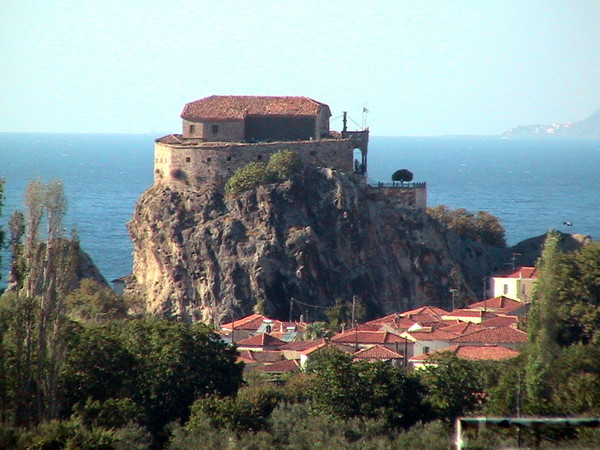
petra churchcarol-christFrom the evening of the 14th through the day and night of the 15th of August, thousands of pilgrims ascended the Holy Rock of Petra to honor the Panagia—She Who Is All Holy. 

There is “something really beautiful”* in being among them.

Six of us set out from Molivos at 7:30 on the 14th to meet in the square of Petra to ascend to the church.  Petra was already full of so many pilgrims that police had forbidden traffic in the main square and were directing cars into a nearly full parking lot in a field.  When we got out of the car, the two others who came with me and I had a perfect view of the steady stream of pilgrims climbing the rock, which was already lit up in the twilight.

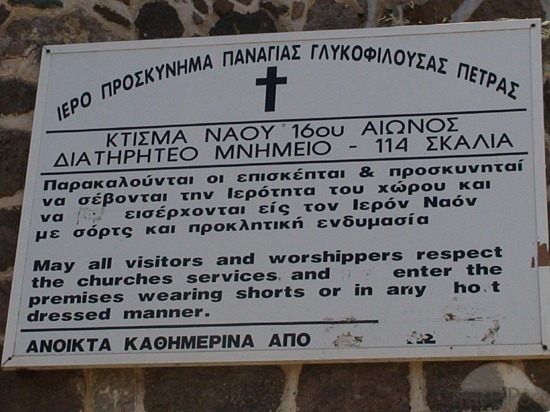
When we found the others, I said that we would climb to the church on the top of the rock where we would light candles and approach the icon of the Panagia to silently pray or express a wish for the coming year.   The others followed me through the square into the winding streets lined with stalls and gypsy beggars to the bottom of the rock.  While we waited for our turn, we saw the sign advising pilgrims of proper dress (read carefully).

instructions-before-getting-in-the-church-petra

Continue reading “Coming Together to Honor the Mother by Carol P. Christ”

Hidden Meanings in the Rituals of the Assumption by Carol P. Christ

carol-christ“[T]he Old European sacred images and symbols were never totally uprooted; these persistent features in human history were too deeply implanted in the psyche.  They could have disappeared only with the total extermination of the female population.” Marija Gimbutas, The Language of the Goddess, 318.

August 15 is known to Greek Christians as the date of the Koimisi, “Falling Asleep” or Dormition of the Panagia, She Who Is All Holy.  December 25 is a minor holiday in the Orthodox tradition, while Easter and August 15 are major festivals.  The mysteries of Easter and August 15 concern the relation of life and death.  In Orthodox theology, both Easter and August 15 teach that death is overcome:  Jesus dies and is resurrected; Mary falls asleep and is assumed into heaven.  These mysteries contain the promise that death is not the final end of human life.  Yet this may not be the meaning of the rituals for many of those who participate in them.

In Christus Victor, Gustaf Aulen argued that Eastern (Orthodox) and Western (Catholic and Protestant) traditions understood salvation differently.  The Western Church focuses on salvation from sin, while the Eastern Church focuses on transcending death.  This contrast is not absolute, as for the Western Church sin is the cause of death and when sin is overcome, immortal life is restored.  While Orthodoxy has strong ascetic and monastic traditions, it does not teach ordinary Christians to focus on sexual purity and impurity as Western traditions have done.  Nor is there a strong emphasis on transforming collective sin in movements for social justice.  Significantly, though Roman Catholics and others consistently refer to the “Virgin Mary,” Orthodox Christians prefer “Panagia,” She Who Is All Holy.

In Greece the ordinary rhythms of life are disrupted at Easter and in August.  During lent, many women (and some men) fast, while in August women named Mary and Panagiota–as well as others who wish to honor or petition the Panagia–wear black for two weeks.
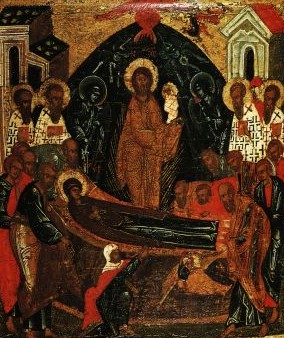
Assumption1Throughout the first 2 weeks of August, Greek Christians focus on the death of the Panagia.  According to theology, her Son appears after her death and “assumes” her into heaven.  The Orthodox icon depicts Mary surrounded by the Apostles, while Jesus holds the assumed body of Mary depicted as an infant wrapped in swadling clothes.

When she first saw this icon, my friend Naomi Goldenberg commented that it is an example of the widespread attempt on the part of men to appropriate the power to give birth.  The icon reverses the symbolism of the nativity where the baby wrapped in swadling clothes is held in the hands of his mother.  Christian baptism described as re-birth through the Father, Son, and Holy Spirit is another version of “male birth.” Continue reading “Hidden Meanings in the Rituals of the Assumption by Carol P. Christ”

Painting Guadalupe and Mary by Angela Yarber

As we feminists struggle to elevate Mary and Guadalupe, we sometimes forget that speaking of birth and gestation is not always empowering or even essential to womanhood. 

It is early morning on the Hill of Tepeyak on December 9, 1531 when a wondering peasant named Juan Diego first caught a glimpse of her presence.  Diego sees a vision of a teenage girl surrounded by light; the young girl asks that a church be built on the hill in her honor.  After hearing her speak and seeing the light emanating from her presence, Diego recognizes her as the Virgin Mary.  He rushes to the Spanish archbishop who insists on a sign as proof of Diego’s vision.  The young girl instructs Diego to gather flowers from the top of the hill, even though it is past their growing season.  Upon climbing to the top of the Hill of Tepeyak, Diego discovers Castilian roses—a beautiful flower otherwise unheard of in Mexico—which the glowing young woman arranges in his cloak.  When Diego returns to the archbishop, he opens his cloak to reveal the miraculous flowers and they fall to floor; in their place was an image imprinted on the fabric of his cloak.  It was the image of Our Lady of Guadalupe.

Guadalupe is one of Mexico’s most popular religious and cultural images and her icon, now on display at the Basilica of Our Lady of Guadalupe, is one of the most visited Marian shrines in the entire world.  On December 12, countless Christians—particularly Catholics—celebrate her feast day.  Her feast day occurs within the four week celebration of Advent, which is the period of waiting, expectancy, and gestation before the birth of Jesus at Christmas. Continue reading “Painting Guadalupe and Mary by Angela Yarber”