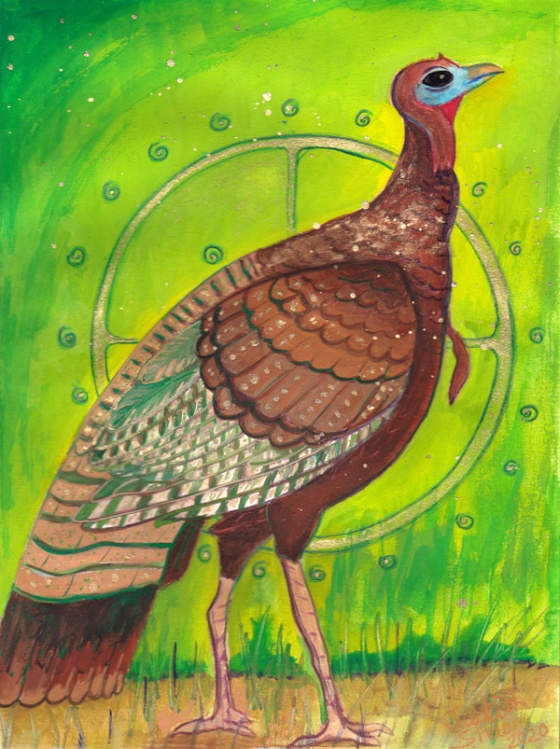
From the Archives: Turkey – Abundance, Gratitude and Connection to Mother Earth by Judith Shaw

This was originally posted on October 25, 2020

In the United States turkeys are equated with Thanksgiving. But there is so much more to Turkey – a gentle creature who forms strong attachments. Reputed to be dumb, Turkey is in fact quite intelligent and curious, with the ability to solve problems. Turkeys have an excellent understanding of the details of their location which makes them so successful at feeding themselves. They also love to play and to cluck along with music.

wild-Turkey-with-fanned-tail
photo by Tony Castro

Turkeys, indigenous to North America, evolved over 20 million years ago and share a common ancestor with grouse, pheasants and other fowl. Two species of wild turkey exist today – the wild turkey of eastern and central North America of which there are 5 sub-species and the ocellated wild turkey of the Yucatan.

Yet why is turkey named turkey? Strangely enough it was a mistake. English colonial settlers thought turkeys were a type of guinea fowl which England imported from Turkey – thus the name. The Spanish word for turkey is guajolote which is derived from the Nahuatl (Aztec) name huexolotl.

Continue reading “From the Archives: Turkey – Abundance, Gratitude and Connection to Mother Earth by Judith Shaw”

Deer – Inspiration For Liminal Times by Judith Shaw

We have just passed another marker in the cycle of the seasons –  Fall Equinox – the second moment in the circle of the year in which day and night are of equal length. It is a time to begin our quiet reflections on the growth experienced during the previous periods of the year; a time when a greater understanding of balance is sought; a time when our hearts are filled with appreciation for the bounty offered by Mother Earth while at the same time feeling trepidation about the approaching winter.

Continue reading “Deer – Inspiration For Liminal Times by Judith Shaw”

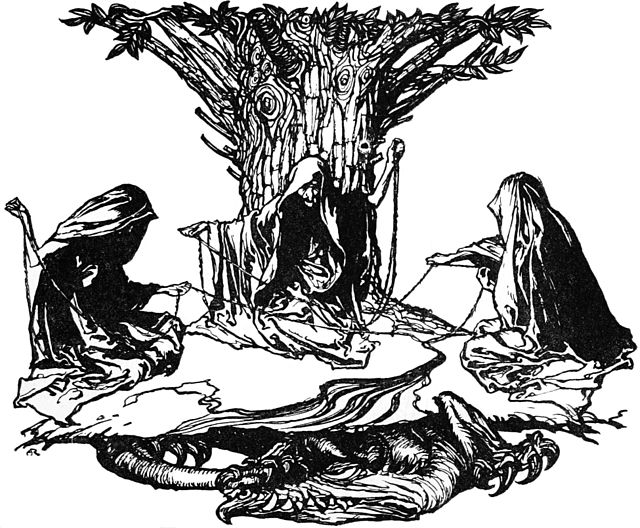
The Norns, Spiritual Mystery and Me, Part 1 by Janet Maika’i Rudolph

In 2020, I began writing my biography because some weird things were happening in my life including some which were time-bending. To help make sense of it, I wrote up “conversations” with the mythical characters of Persephone, Inanna and the Norns of the Norse. Throughout my bio, I speak to the Norns as an out loud meditation on the nature of time, fate and energy.

The three Norn sisters are Urd, Verdandi and Skuld. Their names come from Old Norse which is not a spoken language. The actual translation of their names is open to speculation. In general, here are their common meanings.

  • Urd – past
  • Verdandi – happening or present
  • Skuld – future or debt.

By mythological tradition, they show up at a child’s birth and then weave their “fateful” decisions about that child’s life into a tapestry. They are considered more powerful and fearsome than the gods because even the gods are ruled by the hands of fate (or Norns in this case). They were also treated as oracles where kings and warriors went to consult them much as was done in Delphi Greece.[1]

Continue reading “The Norns, Spiritual Mystery and Me, Part 1 by Janet Maika’i Rudolph”

The Legacy of Carol P. Christ: Was Ariadne the Most Graceful Bull-leaper of All? Deconstructing and Re-visioning Greek Mythology

This was originally posted on March 3, 2014

Sometimes we think of Greek myth as a pre-patriarchal or less patriarchal alternative to the stories of the Bible. After all, Goddesses appear in Greek myths while they are nearly absent from the Bible. Right?

So far so good, but when we look more closely we can see that Greek myth enshrines patriarchal ideology just as surely as the Bible does. We are so dazzled by the stories told by the Greeks that we designate them “the origin” of culture. We also have been taught that Greek myths contain “eternal archetypes” of the psyche. I hope the brief “deconstruction” of the myth of Ariadne which follows will begin to “deconstruct” these views as well.

bull leaping ring before 2000 bc phourni

Ariadne is a pre-Greek word. The “ne” ending is not found in Greek. As the name is attributed to a princess in Greek myth, we might speculate that Ariadne could have been one of the names of the Goddess in ancient Crete. But in Greek myth Ariadne is cast in a drama in which she is a decidedly unattractive heroine.

Continue reading “The Legacy of Carol P. Christ: Was Ariadne the Most Graceful Bull-leaper of All? Deconstructing and Re-visioning Greek Mythology”

Whale – Lord of the Sea by Judith Shaw – Part 2

Whale, a bridge between the spirit world and the physical world, breathes air but dives deep into the sea, reminding us to embrace duality while seeking balance and our highest truth.

Continue reading “Whale – Lord of the Sea by Judith Shaw – Part 2”

Whale – Lord of the Sea by Judith Shaw – Part 1


In the deep waters of Earth’s soul, Whale – Lord of the Sea – lives long, dives deep and emerges within a cascade of sea foam to greet the day . Considered divine beings by some cultures and demons by others, this enigmatic being inspires both awe and fear in the human heart.

Continue reading “Whale – Lord of the Sea by Judith Shaw – Part 1”

Sheep – Gentle Wisdom by Judith Shaw

Sheep – soft-footed, fluffy creatures – graze and amble along with frolicking lambs by their sides. Know worldwide as docile and friendly, sheep – in particular the female ewes and their lambs – have come to symbolize innocence, gentleness and peacefulness. The symbolism of rams takes on a slightly different, more masculine tone and will be looked at separately. 

Continue reading “Sheep – Gentle Wisdom by Judith Shaw”

Eden, Eve and a Tale of Seeds by Janet Maika’i Rudolph

Last month I wrote about the Garden of Eden. You can read it here:

In that post, I described how Eden is essentially a garden of treasures. What are those treasures? I believe that they are seeds, the most prolific and creative element for spreading life here on Earth. Below is my own fantastical story about the Garden and how the seeds came to reside there.

Sinuous and serpentine, Hawwah, Hayyat, Eve emerged from Apsû, carrying within her seeds, fertilized eggs, and all the fruitfulness and abundance therein. 

Continue reading “Eden, Eve and a Tale of Seeds by Janet Maika’i Rudolph”

From the Archives: Buddhist Misogyny Revisited – Part I by Barbara McHugh

Recently, I wrote a novel about the Buddha’s wife disguising herself as a man to join his religious community. When I showed the manuscript to a Buddhist friend, whose knowledge and practice I respect greatly, he expressed apprehension that it violated the basic myth of Buddhism. I assumed he meant that my storyline of gender deception strays too far from the versions of the Buddha’s life as recorded in the traditional canon, which adherents regard as the Buddha’s inviolable teachings. The last thing I wanted to do was to misrepresent these teachings.

What does it mean “to violate a myth”?  If I had portrayed the Buddha as a psycho-killer or wife-beater, I could appreciate this charge, but I had presented an enlightened Buddha whose values were in alignment with standard scripture and the mores of his day. The change I made was to tell the story from a woman’s point of view, and to do so, I modified some of the traditional legends and created new material to make my choices plausible. Predictably, my modifications came up against many of the stories’ misogynistic elements.

For instance, in the canon, the Buddha initially refuses to admit women to the monastic order.  Eventually his attendant Ananda persuades him, but then the Buddha adds 104 extra rules for nuns, eight of which (the Garudammas) clearly put women in an inferior position.  One rule states: “A nun who has been ordained even for a hundred years must greet respectfully, rise up from her seat, salute with joined palms, do proper homage to a monk ordained but that day.” The Buddha also told Ananda that thanks to the admission of women, the Dharma (the teachings and practices of Buddhism) would die out after only 500 years.

Continue reading “From the Archives: Buddhist Misogyny Revisited – Part I by Barbara McHugh”

Hawk – A Soaring Visionary by Judith Shaw

Hawk, beautiful and deadly, soars high in the air –  circling and circling –  its piercing eyes focused below. Spotting Hawk, one is amazed by its elegance and power while feeling a strange and ancient connection to this magnificent bird. Yet it strikes fear in the hearts of small animals.  

Continue reading “Hawk – A Soaring Visionary by Judith Shaw”