Fun With Bumper Stickers By Barbara Ardinger

I was driving through one of the more conservative corners of Orange County, California, a couple weeks ago and went past a very pretty brick church with a tall, proud steeple and signs in the front yard giving times of worship services. I have no idea what kind of church it was, but as I went past, a car pulled out of the driveway and began following me. It’s a public street, I said to myself. Looks like a tony neighborhood. No need to worry about being followed. So I neither sped up nor slowed down. At the red light, the car behind me pulled up beside me and the driver, a young man, looked at me. As soon as the light changed, he sped ahead, changed lanes, then slowed down just a little. As I pulled up behind him at the next red light, a hand came out of the driver’s window. A finger was aggressively elevated.

Good grief! How had I insulted this driver? The guy made a right turn, I stewed and fussed a couple of miles…and then it dawned. My bumper stickers. I have four on my car. PROTECT OUR MOTHER EARTH—SHE’S THE ONLYONE WE’VEGOT. THANK GODDESS. BRIGHT BLESSINGS. And my current political bumper sticker: IMPEACH THE SUPREME COURT. (This last, of course, is a comment on the Citizens United decision, which many people think is doing incalculable damage to the political process.) For years, my friends have been telling me that at any gathering, they can always tell I’m there by the bumper stickers on my car. Continue reading “Fun With Bumper Stickers By Barbara Ardinger”

Process Thought: Feminist Friendly Metaphysics by Xochitl Alvizo

To be is necessarily to be in process and engagement with the lure of creative advance (that is, with God). In this sense, God is the poet of the world continually luring the world toward its full be-coming.

“It all goes back to one’s metaphysics.” That is what my TA said in the first theology class I took during my masters program. We were discussing our theological statements in class – a statement that outlines our individual understanding of God, humanity, sin, etc. – presenting them to one another for feedback and discussion.  As we argued  and discussed (“How can you possibly believe that?”) our TA made the case that our theological statements and the varying differences among them were largely determined by our particular metaphysics – that is, they are determined by whatever we hold to be the nature of existence.  That is to say, if science studies the physical world, metaphysics is the result of asking questions about the underlying reality of that physical world – about the nature of the physical world and by extension all of existence. As one can imagine, not all metaphysics are created equal, but all of them are theories with enormous implications. Continue reading “Process Thought: Feminist Friendly Metaphysics by Xochitl Alvizo”

A Love Letter to My Body by Amanda Kieffer

My body, my love, how terribly I’ve missed you.  Do you remember the night we wept? The night I touched you for the first time since . . . I can’t remember when. I asked your forgiveness a hundred times. I had to make up for all the nights I spent ignoring you and asking forgiveness from that ridiculous Man in the sky.  I thought you were His.  I thought He was angry because I wanted to know your secrets and your secret places.  I was ashamed of myself and I was ashamed of you . . . of your sensual motions . . . of your dark spaces . . . where only men, well, only one man is supposed to go.  I am forbidden. So they say. If I explore your depths in secret it’s a sin and the Man in the sky will be angry, perhaps for Himself, perhaps for that one man on whose territory I am trespassing.  Never speak of such a transgression!  Everyone will be shocked, embarrassed, horrified. Well . . . Continue reading “A Love Letter to My Body by Amanda Kieffer”

Imaging God by Tiffany Steinwert

There are some words a mother never wants to hear. For me, those words came one evening as I tucked my 3 year old son, G, in to bed. We had just finished reading  God’s Dream, a children’s book by Bishop Desmond Tutu, and were discussing what God might want us to do. The conversation went something like this:

G:           “I think God wants me to share.”

Me:        “I think so too.  God likes sharing.”

G: “        “Yeah, He likes it when I share.”

SCREEEEECH!!! Insert here the sound of the needle suddenly scratching and falling off the record.

He?

Where did G get that? With two theologians as parents, G’s religious world has been carefully and intentionally constructed since birth. Nowhere ever did we refer to God as “He.”

Perhaps it was just a slip of the tongue, a mistaken pronoun, an unintentional lapse. God/dess knows I pride myself on my child’s gender fluidity. I take his vacillating male and female pronouns as a sign of early queer, gender non-conformity. Though, I suspect others might interpret that as part of normal verbal development. You choose.

Whether intentional or unintentional, I decided to nip this in the bud once and for all. Continue reading “Imaging God by Tiffany Steinwert”

That Which Is Sacred by Max Dashu

We are going through a huge cultural shift toward restoring the female to her full radiance. However you want to define that, it is rising now, through us.

That which is Sacred, what should we call it? We’ve been told to name it he, him, his. That it was blasphemy to do otherwise, to say she, even as they desecrated the Divine with comparisons to mortal overlords, those cruel masters, despoliators, persecutors. No. Reconsider. That fearful address to an authoritarian punisher takes us far from true reverence. Rather revere the roots of Being, manifesting in all Nature around us, within us. The profound silence, and the Deep calling to the Deep.

Deeply I go down into myself. My god is Dark and like a webbing

made of a hundred roots that drink in silence. ― Rainer Maria Rilke

There are myriad emanations of the indescribable Source, but Goddess women call it she, as medicine to what they have forbidden in us, to us. That Shakti, the effulgence that pours through all living beings, including the rocks. The Shekhinah, the ever-flowing waters of Nummo, of Anahid. The Tao that is “the mother of whatever exists under the sky, upon whom myriads of beings depend for their birth and existence,” as the Dao De Jing says.

“The Universe is the Goddess. She is not separate from it, She did not create it and then let it be. She is what is, what was, and what will be.”1 So the Kemetic people praised Neith, Mother of the Neteru, on her great temple at Sa in the Nile Delta. Inscribed magnificats exalt her in some of the greatest spiritual literature of the world:

Neith, Mother of the Neteru


Greater is her name than of all gods and goddesses

The primordial One, eldest of the primeval gods

She who made that which is

She who created that which exists…

Who gave birth to Ra,

Who brought forth in primeval time herself,

Never having been created.

But not all wisdom is written. Continue reading “That Which Is Sacred by Max Dashu”

A MEDITATION ON A MIDRASH: “ABRAHAM’S DAUGHTER” BY ARCADE FIRE by Sara Frykenberg

The wages of the sin of sacrificing our children is their death, whether the sacrifice is to some supposed higher order, to absolute obedience or to appear to be the “good Christians” we are “supposed to be”…

Maybe its because I enjoyed the books more, or because of my sister’s all too expectation-garnering reviews or even, because I’d seen this theme before, in an amazing yet gruesome Japanese movie, Battle Royal, I left the theater unsatisfied after watching The Hunger Games. I did however, LOVE the song that played at the end of the movie, which I downloaded before we left the theater.  I listened to it in the car on the way home.  I listened to it the next day, the day after that and for days after that… I listened and listened, and I found surprise, power, anger, sorrow and a channel for grieving that I had needed in the Midrash “Abraham’s Daughter” by Arcade Fire. 

Abraham took Isaac’s hand and led him to the lonesome hill

While his daughter hid and watched, she dare not breathe

She was so still.

I discovered the practice and potential power of Midrash from my teachers in graduate school.  The idea of an “extra-biblical” story that might help to expound upon Biblical passages that are all too often unexplained or unsatisfactory to (my) feminist consciousness was very appealing to me—and it is still appealing to me.  But I have to admit that the feminist Midrash I read in my classes seemed too positive and did not resonate with me.  The pieces were too much like a tender hug or a mother hen covering my wounds with her wings.  I wanted to hear a story of Bible that could help me make sense of the violence I’d discovered in my childhood religion.  I needed a story of Bible that honored my violent struggle to counter the abuse within it and within me.

Like Isaac, I was too intimate with my abuser: unable to avoid walking hand and hand with him when pushed to do so.  Asked to create a prayer or Midrash for a class once, I wrote about the way I would turn the radio in my car up when I started to hear ‘God’ speak to me.  I didn’t know how to listen and tune out the abusive maxims that played over and over again in my head (maxims that surfaced every time I even thought about the divine).  Continue reading “A MEDITATION ON A MIDRASH: “ABRAHAM’S DAUGHTER” BY ARCADE FIRE by Sara Frykenberg”

Magic Names by Barbara Ardinger

Many modern pagans adopt magical names. I think I’ve found one for myself. It’s a good motto, and even saying it aloud reminds me of the daily blessings of the Goddess to her children. The Latin name I’d choose is Beata elle. “Blessed is she.” 

When I attended a pagan studies conference recently to read from Secret Lives (and sign and sell a few copies), I listened very carefully to another presenter who spoke about magical names. When we go through an initiation, he said, we receive a new name. It’s a custom that is familiar to people through the ages and around the world. The presenter spoke about why people adopted magical names during the 19th-century European occult revival and why pagans still take magical names. And he set me to thinking. When you earn your Ph.D., you don’t get a new name. The Ph.D. is indeed an initiatory experience. Ask anyone who’s done it. You go through multitudinous ordeals both physical and intellectual. You face judges, speak what you’ve learned, and finally attain gnosis. But all you get for all your work and suffering are those nifty letters to put after your name. But I digress. Continue reading “Magic Names by Barbara Ardinger”

Is Baptism a Male Birthing Ritual? By Michele Stopera Freyhauf

Quite a number of years ago I had a conversation with one of my professors, a feminist theologian, who posed the question “Why do I need a man to purify my baby with the waters of baptism?  Is there something wrong or impure about the blood and water from a mother’s womb – my womb?”  Before you jump and shout the words Sacrament or removal of original sin, this question bears merit in exploring, especially in today’s world where women are taking a serious beating religiously, politically, and socially.  In today’s world, violations and rants are causing women to stand up and say STOP!  This is MY Body.  This outcry was provoked by chants of ethical slurs against women– Slut! Prostitute! Whore!  The cry got even louder when the issue of religion and government was raised in the fight of healthcare coverage of contraception. The cry got even louder with the enactment of the laws in Virginia and Texas (and many other states to follow suit) that forces women to undergo transvaginal ultrasounds in early stage abortions.  The mandatory insertion of a wand into a woman’s vagina (mandated by the government, mind you), is a violation and has women crying RAPE!

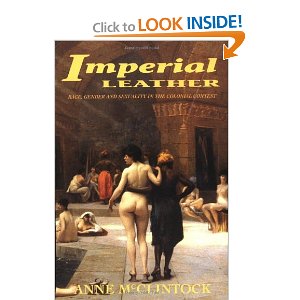
The memory of this conversation did not re-appear by chance, it was prompted by a book I read for my History of Sexuality Class – Imperial Leather: Race, Gender, and Sexuality in the Colonial Context by Anne McClintock who addresses the notion of baptism through origins, property, and power.  So many things are currently being taken away from women and reading McClintock’s assertion regarding male baptism is perplexing.  She believes that male baptism or baptism by a man takes women’s role in child bearing and diminishes it.  These are the same men who historically treated and regarded women as vessels.  She further asserts that this act is a proactive removal of creative agency with respect to a woman’s ability to have the power to name.  That is, the last name of the child belongs to the husband.  A point that supports the notion that patrimony marks the denial of women.  Anyone doing genealogy encounters a perplexing struggle to identify mothers because their names are essentially erased from memory and rarely attached to a child’s name. Continue reading “Is Baptism a Male Birthing Ritual? By Michele Stopera Freyhauf”

The Dark Night of a Theological Education By Cynthia Garrity-Bond

Yesterday I decided I would attend Sunday Mass.  I have been involved in some fairly weighty theological conversations with my friend, bringing to the surface awareness that I am restless and in a state of holy longing for the Absolute One. I do not usually attend conventional Mass. The exclusive language of the liturgy is like a cacophony of painful sounds, each one more abusive than the next.  But this morning I thought it would be different because I was different.  The hole in my heart was larger, more pronounced and in need for that which I could not name.

I should say that my academic studies have lifted me far from a loving encounter with Jesus or for that matter, any part of Christian orthodoxy, which is why my decision to attend mass is confusing.  In fact, through my initiation into theology as a discipline, I have become a paradox to myself.  On the one hand, I am informed on enough theological matters that I might be able to swoop a Jeopardy category of say, “Anything having to do with Christianity.”  But when it comes to articulating my beliefs with regard to such doctrines as the Virgin birth, divinity, miracles, prayer or, (gasp) the validity of the Bible, I’m stalled. Even more than that, I’m inclined to suspend most confessional statements about the Divine because, in spite of my education and degrees, I do not know what I think I should know. Continue reading “The Dark Night of a Theological Education By Cynthia Garrity-Bond”

Do White Feminists Have Ancestors? By Carol P. Christ

Carol P. Christ is a founding mother in the study of women and religion, feminist theology, women’s spirituality, and the Goddess movement.  She teaches in the Women’s Spirituality program at CIIS and through Ariadne Institute offers Goddess Pilgrimages to Crete. Her books include She Who Changes and Rebirth of the Goddess and the widely used anthologies Womanspirit Rising and Weaving the Visions.

Some years ago when I was speaking on ecofeminism, womanist theologian Karen Baker-Fletcher posed a question that went something like this:  What I am missing in your presentation is reference to ancestors.  For black women, this issue is critical.

Baker-Fletcher’s question provoked a process of thinking that continues to this day.  For example, I began to notice that when black women spoke at the American Academy of Religion, they often began by thanking their foremothers Delores Williams and Katie Cannon for beginning the womanist dialogue.  It is far rarer to hear a white woman thank Valerie Saiving, Mary Daly, Rosemary Radford Ruether, or Marija Gimbutas before her talk.

To the contrary, many white women take great pains to distance themselves from feminist foresisters.  I once heard a white woman Biblical scholar tell women students to do work on women in the Bible or other areas of religion without using the word feminist or placing their work in a female or feminist train of thought– if they wanted to get it published.  She was very proud that she had used this method and succeeded.  In other words, she was following in the footsteps of Mary Daly, Phyllis Trible, and Elisabeth Schüssler Fiorenza but acting as if she had invented the study of women and the Bible herself.  The reason for this, she freely admitted, was that male scholars who held power in her field would not respect her work if she used the “f” word. Continue reading “Do White Feminists Have Ancestors? By Carol P. Christ”