No One Is Safe from the Parodist (Part 1) by Barbara Ardinger

Now, with only a minimum purchase, you can save your loved ones—your friends—your neighbors—your business associates—from eternities of suffering and torment. Our new Multi-Level Marketing company guarantees Eternal Salvation for you and your entire downline.

Some days, it’s just not safe to let me watch MSNBC. I think politics is both scary and fun, and the current field of Republican candidates is majorly scary. Well, I did vote Republican once. This was in 1976, when I’d just finished my Ph.D. at Southern Illinois University atCarbondale. I voted for Jim Thompson, one of the governors ofIllinoiswho did not go to jail. But I digress. I’ve decided to help the current Republicans with their advertising. I reached into my three-ring binder again for another souvenir of my days writing for multi-level marketing and found an early version of this ad. Religious issues and identities seem to playing a big part in the campaigns. In November, be sure to vote for the candidate of your choice.  Continue reading “No One Is Safe from the Parodist (Part 1) by Barbara Ardinger”

The Rhetoric of Freedom of Religion in the Debate about Contraception Coverage By Elise M. Edwards

Does freedom of religion include the right to impose your religious views on your employees?  Should freedom of religion exempt you from financially contributing to a medical benefit for your employees that you consider sinful?

According to an Associated Baptist Press article, Richard Land, president of the Southern Baptist Convention Ethics and Religious Liberty Commission, “called a new rule [by the Obama Administration] requiring insurance plans to cover birth control — including those paid for by religious employers that believe artificial birth control is a sin — a ‘horrible decision’ that poses a problem not just for faiths that object to birth control” in the January 28 broadcast of Richard Land Live.  Land believes that this policy infringes on religious freedom.  (Note that the health care policy  does exempt houses of worship and religious organizations that employ primarily those of the same faith, but not organizations like hospitals and colleges that employ and serve people of all faiths, or no faith. An article by Religion News Service, posted here, also on a Baptist media outlet, explains the policy in more depth.) Continue reading “The Rhetoric of Freedom of Religion in the Debate about Contraception Coverage By Elise M. Edwards”

Do We Need More “Ministerial Exceptions”? by Kile B. Jones

In a recent unanimous and precedent-setting Supreme Court ruling, a “ministerial exception” was given to Hosanna-Tabor Evangelical Lutheran Church and School regarding employment discrimination.  Cheryl Perich, a “called teacher” at Hosanna-Tabor, was fired after issues surrounding her narcolepsy developed.  As is well known in the United States, innumerable federal, state, and local laws exist to protect employees from discrimination based on race, sex, age, disability, and so forth.  Title VII of the Civil Rights Act (1964) prohibits employment discrimination based on race, color, sex, religion, or national origin.  In the Americans with Disabilities Act (ADA, signed in 1990), employers are also held liable for discrimination based on an employees’ disability.  The “ministerial exception” excludes religious institutions and ministers from the ADA.  It is important to note that the ADA protects employees hired by private companies as well as public ones.

In the slip opinion, the Supreme Court argues that, “The Establishment and Free Exercise Clauses of the First Amendment bar suits brought on behalf of ministers against their churches, claiming termination in violation of employment discrimination laws.”  The opinion sites other cases where it was ruled that religious institutions are their own arbiters of employment and termination and cannot be compelled by the State to comply with certain national laws (see Watson v. Jones, Kedroff v. Saint Nicholas Cathedral of Russian Orthodox Church in North America, and Serbian Eastern Orthodox Diocese for United States and Canada v. Milivojevich).  Justice Alito concurs by saying, “The “ministerial” exception gives concrete protection to the free “expression and dissemination of any religious doctrine.”  The Constitution leaves it to the collective conscience of each religious group to determine for itself who is qualified to serve as a teacher or messenger of its faith.” Continue reading “Do We Need More “Ministerial Exceptions”? by Kile B. Jones”

On Being a Gay Male Theologian During the War on Women by Dirk von der Horst

For some time, a prominent strand of gay and feminist theory and theology has taken it almost as axiomatic that gay men, lesbians, and straight women have a common stake in dismantling patriarchy.  While I have always understood my own work as a gay theologian in terms of that common struggle, recent developments point to a significant challenge to keeping that bond intact in the larger sphere of political activism.

At the end of last year, National Public Radio deemed 2011 an extraordinary year for gay rights.    Buzzfeed listed 40 reasons why it was the best year for gays ever, beginning with a Gallup poll showing that for the first time a majority of Americans supported same-sex marriage.  The list also included the repeal of Don’t Ask Don’t Tell and several firsts for openly gay elected officials.  Even the world of professional sports is becoming more accepting: in a recent tweet, Ravens’ linebacker Brendon Ayanbadejo equated support for same-sex marriage with playing in a Super Bowl when asked about his life’s greatest accomplishments.

Simultaneously, we saw a steady legislative assault on women’s reproductive freedom.   Continue reading “On Being a Gay Male Theologian During the War on Women by Dirk von der Horst”

The Land of the (Not Quite) Free: Women and Religion Behind Bars by Amy Levin

The sun was setting on an early Friday evening in October 2008 as I pulled into the parking lot of the Iowa Correctional Institute for Women, a maximum level security prison housing nearly 700 inmates. Though the serene drive on Iowa’s main highway lasted a mere 40 minutes from Grinnell to Mitchellville, my co-teacher and I felt worlds away from our tiny utopian bubble of books and booze. As we gathered our teaching materials for a course we designed called “Feminist Playwriting,” we made sure not to bring in any contraband, one of the many precautions given during our orientation for students participating in Grinnell Liberal Arts in Prison, a program created in 2003 that allows students to design liberal arts courses in either a men or women’s Iowa prison. My experience interacting with an incredible roomful of women, some who would suffer behind bars for the rest of their lives, was needless to say a life changing experience. That semester ignited a fire in me for prison rights, which recently has manifested in a concern for the nexus of religion and prison. Continue reading “The Land of the (Not Quite) Free: Women and Religion Behind Bars by Amy Levin”

Son of Man: An Updated Gospel Story of Jesus Set in South Africa by Michele Stopera Freyhauf

January 12, 2012

Son of Man is an updated story of the life of Jesus set in the fictional State of Judea that is modern day South Africa – complete with warlords and child soldiers.    It could easily be mistaken for modern day Rwanda or Darfur with its modern issues and political overtonesRoger Ebert stated, “The secret of the movie is that it doesn’t strain to draw parallels with current world events – because it doesn’t have to.”  The director draws parallels between the gospels and 21st century Africa.  According to Dartford-May, “we wanted to look at the Gospels as if they were written by spin doctors and to strip that away and look at the truth.”  The director “captures the rhythms of African life in both rural settings and sprawling townships.”  “Feather-clad young angels offer an eerie echo and reminder of Africa’s lost generations.”

The movie also sticks with what Eric Snider calls “Traditional African trial music, dance, and costumes” as a type of worship or or allusion to Jesus’ godhood.  Judea is in flux; warlords and corruption take center stage.  Poverty, violence, and oppression affect the all of the people.  The key idea is that Jesus is a freedom fighter – one that fights injustice and oppression.  The director does not emphasize “Jesus’ divinity so much as his leadership, good sense and compassion.”  Jesus is not violent and his followers, most of whom were former child soldiers, are encouraged to respond non-violently, which goes against their upbringing and training. Continue reading “Son of Man: An Updated Gospel Story of Jesus Set in South Africa by Michele Stopera Freyhauf”

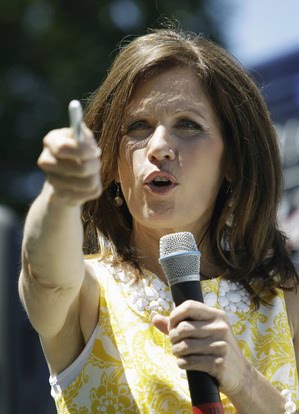
Michele Bachman is a Woman: Using the Gender Card in Iowa By John Erickson

I have been flirting with the idea of writing a blog post about Michele Bachmann for a while.  When this post goes live, Republicans in Iowa will fire the long awaited starting pistol of the 2012 Republican Presidential Nomination Race.  Among the citizens of Iowa and the Presidential hopefuls, one individual, Representative Bachmann, is hoping and more importantly in her case, praying for a miracle.

In the recent weeks, some frontrunners have surfaced: Mitt Romney, the former Massachusetts Governor and if I dare say, devout Mormon, Ron Paul, a United States Congressman from Texas’ 14th District, and Rick Santorum, a former United States Senator from Pennsylvania and fervent Catholic.  However, although the troupe is the typical political line up (all white, privileged, religious, heterosexual family men), Michele Bachmann is hoping to capitalize on the major factor that sets her a part from the pack: her gender.

Continue reading “Michele Bachman is a Woman: Using the Gender Card in Iowa By John Erickson”

A Church With No Walls By Sheila E. McGinn, Ph.D.

Last year about this time, I spent a month in Malaysia, at the invitation of Alpha Omega International College, a school in Petaling Jaya, a suburb of Kuala Lumpur. I was rather surprised at the initial invitation, since AOIC is sponsored by the Assemblies of God and I myself am a feminist Roman Catholic. To put it mildly, the two denominations tend not to be “on the same page” on various aspects of the Christian tradition, so I wanted to ensure that the college administrators knew what they would be getting if I were to come. Happily, the AOIC president who had proffered the invitation confirmed that indeed they did want me to come for the guest lectureship, so the beginning of October saw me making my way almost exactly to the opposite side of the globe, to run my New Testament ethics seminar at the college and to spend time learning from Malaysian Christian and Muslim leaders about interreligious dialogue and inter-ethnic relationships in their country.

Malaysian hospitality was faultless—generous, thoughtful, inviting—and everyone made time to tell me about their cross-cultural experiences and their concerns for the religious climate in Malaysia. I continually was impressed by the sincere convictions of these religious leaders and their constituencies, and by the political and cultural difficulties they faced in any kind of collaborative endeavor or even attempts at dialogue. Wherever I looked, will or nil, boundary issues continued to arise. Although other ethnic groups had the right to choose their religious affiliation, the Malay ethnic group was legally defined as Muslim. Within the Christian tradition, certain denominations traditionally were connected with one ethnic group or another. Continue reading “A Church With No Walls By Sheila E. McGinn, Ph.D.”

Well-Behaved Women Seldom Make History, But Obedient Ones are Rewarded in Heaven: An Examination of the Re-Invention of the Bengali Tradition of Sati By Michele Stopera Freyhauf

Well-Behaved Women Seldom Make History is a book authored by Laurel Thatcher Ulrich.  This has become a well-known phrase used by most feminists to imply a meaning of disobedience or stance against the patriarchal structure of society.  Often in error, the credit of the invention of this phrase is attributed Eleanor Roosevelt and Marilyn Monroe.  Their image, and especially the image of Monroe, will often appear with the slogan on merchandise as a means of marketing and raising revenue.  Ironically, reinvention or reuse is prevalent in history when it comes to tradition or ritual for the same reason – monetary gain.  This practice is common and the benefit of reinventing or reinterpreting an old tradition is an automatic connection to the past giving continuity, which, according to Eric Hobsbaum, instills strong “binding social practice,” (p. 10) including loyalty and duty in the members of the group.  This is especially effective in manipulating the poor and uneducated who usually display strict obedience and blind acceptance of tradition. The Bengali reinvented tradition of satî is an example of this. Continue reading “Well-Behaved Women Seldom Make History, But Obedient Ones are Rewarded in Heaven: An Examination of the Re-Invention of the Bengali Tradition of Sati By Michele Stopera Freyhauf”

Conversation on Leadership Continues…By Xochitl Alvizo

In a recent post on leadership I proposed that facilitating open dialogue is a central aspect of leadership. That if we are to move into new horizons – that is, feminist horizons of mutual communal empowerment and liberation – we must be willing to both risk and dialogue, and a leader is one who helps facilitate those practices.

Dialogue and the practice of making room for one another’s voices and contributions do not come easily to us however. Humans have a tendency to stifle and squelch one another especially if we sense that our privileges and comforts, our truths and our convictions, are being challenged or threatened. And so the breakdown in dialogue can result in the literal prevention of change and possibility – the possibility and actuality of entering into a more divine reality and way of relating. A leader then must be someone who can recognize and be aware of change-stifling powers, be willing to name and resist them, and help facilitate the creation of a literal time/place space for open participation and dialogue. This new open space has the potential and literally becomes the womb from which something new may be birthed…it is a fluid, messy, mysterious place, and not one necessarily easy to exists within, but absolutely necessary if seek to contribute toward a more just and beautiful existence. Open dialogue is a necessary part of helping create this new womb space where differences (of perspective, voices, people) can come together to interact and spark with one another in order to morph and change and thus birth something new together. Continue reading “Conversation on Leadership Continues…By Xochitl Alvizo”