A Place for Everyone at the Table by Carolyn Lee Boyd

carolynlboydWinter’s bone-chilling, relentless cold makes it the most treacherous season in the north when you don’t have a warm place to sleep or enough to eat. Poverty may look different in the city and the country, in various countries and continents, but it can be devastating to body, mind, and soul anywhere.

When I lived in New York City, no day went by that I wasn’t aware that people near me were hungry and homeless. When I moved to a more rural community, I found that, while small groups of volunteers ran food pantries and emergency assistance programs, many in my generally well-off town did not know that they had neighbors who were in need. While contributing to organizations that assist people around the globe is essential, clearly we must also consider what we, as human beings and especially as feminists with a focus on religion and spirituality, must do to support those who live within a few miles of us. Continue reading “A Place for Everyone at the Table by Carolyn Lee Boyd”

Mother Hubbard Speaks Her Mind by Barbara Ardinger

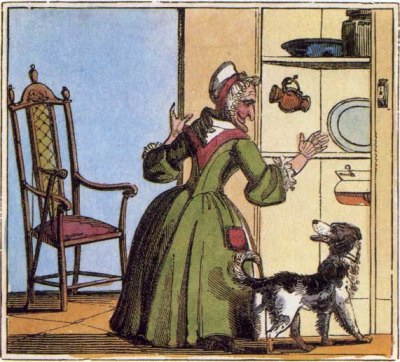
Old Mother Hubbard
Went to the cupboard
To get her poor dog a bone;
But when she came there
The cupboard was bare,
And so the poor dog had none.

hubbard-01

From her lips to our ears.

Ya wanna know why my cupboard’s bare? It’s because we’re poor! Well, not all the time. Mr. Hubbard gets a good job from time to time, and then him n me an the kids an the animals have enough to eat. But those jobs never last long enough. And ya wanna know why? It ain’t just the economy (which is, yeah, pretty stupid). It’s on accounta we don’t quite look like everybody else ’round here. On accounta we don’t speak the “normal” language at home. We obviously came from someplace else. An’ the folks ’round here are so worried about themselves they don’t care about us. Some of ’em don’t like us at all. (And, I ask you, where’s the folks who look like me in the schools n the gov’mint an on the police force?)

Now we don’t live way out in the sticks like my friend Mrs. Shoe does with all her children. We live in the outskirts of this big city, and we can grow a lot of our own food. Lotsa times, though, we march into the big city and look around for more food. There’s lotsa food that got thrown away, perfectly good food goin’ to waste every day. That’s how I get bones for the old dog an good stuff for the cats, too. An, of course, for the kids an the hubby n me. An for the homeless folks who show up from time to time. Share ’n’ share alike, that’s my motto. We do what we can for who we can.

And we don’t share the “normal” religion of the folks in the big city. Most of them never heard of the Mother Goddess. Or any goddess at all, for that matter. No, they’re all enthralled by that greedy Mammon or by those other old bearded guys who stand up on top o’ that metaphorical mountain and yell down at their favorite men about invadin’ some foreign land r other. An ya know what? When the folks in the city are havin their prayers and we happen to be there, we stand quiet-like and bow our heads (politeness counts, doncha know) and wait till they’re done before we walk away and go lookin’ for more good thrown-away food ’n’ other stuff to take home with us. But would they stand respectful-like if we started prayin’ in the city to our Mother Goddess? (That’s what they call a rhetorical question. Don’t need no answer.)

Continue reading “Mother Hubbard Speaks Her Mind by Barbara Ardinger”

The Greek Crisis: Grandparents on the Table? by Laura Shannon

Laura Shannon In a previous article, I have described the devastating consequences of five years of austerity in Greece: soaring poverty, hunger, unemployment, infant mortality, pensioner deaths, malnourishment, sickness, and suicide.

Unemployment has exploded to over 25%, nearly 60% for young people. In contrast to other European nations, Greece provides virtually no unemployment benefits , and national healthcare is only available to those with a job.

The resulting humanitarian catastrophe, ruthlessly and knowingly imposed by Greece’s creditors, the IMF, EU and ECB, is unequaled by anything in European history in peacetime. People have only managed to survive thanks to the intrinsic values of Greek culture and civilisation: generosity, hospitality, connection, positivity, sustainability and mutual support.

These are the values which brought me to live in Greece; they are also the values of the traditional circle dances I have spent my life researching. And they are directly descended from the values of Old European culture as articulated by Marija Gimbutas, Carol P. Christ, and Riane Eisler.

When the economic crisis first struck in 2008, worsening every year since, I saw firsthand how deeply these values are embedded in Greek society.

Here, networks of families, neighbours and friends help one another, even when everyone is desperately struggling; this is how Greeks have managed to survive the terrible effects of the man-made ‘crisis’ until now. As family members have lost jobs, homes, businesses and prospects, often crucial support for the whole family is provided solely by one grandparent’s meager pension.

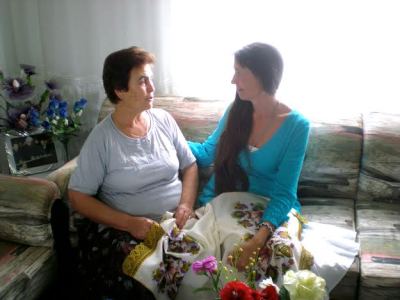
 Laura and Magdalina, in northern Greece. In the course of my research, I have been welcomed in countless homes by Greek rural women. Many families may be materially poor by contemporary standards, but are rich in values of community, hospitality and sustainability. Here Magdalina is showing me samples of her peerless embroidery (featuring ancient Goddess motifs, for those who have eyes to see).
Laura and Magdalina, in northern Greece. In the course of my research, I have been welcomed in countless homes by Greek rural women. Many families may be materially poor by contemporary standards, but are rich in values of community, hospitality and sustainability. Here Magdalina is showing me samples of her peerless embroidery (featuring ancient Goddess motifs, for those who have eyes to see).

This picture of grandparents helping support their children and grandchildren throughout their lives is quite alien to western and northern Europeans, and yet it is firmly at the heart of Greek society. Elders are almost universally cared for within the family; old-age homes are extremely few. Like the sacred hospitality offered to guests and strangers since ancient times, elder care is considered a sacred responsibility, and elders themselves are universally treated with great respect.

This respect for elders is at the heart of the Greek resistance to further cuts to pensions. For the same reason, Greece does not wish to consider raising VAT (sales tax) on medicines and electricity bills, two further measures on which the lenders continue to insist, which will of course hit these vulnerable elderly the hardest. Continue reading “The Greek Crisis: Grandparents on the Table? by Laura Shannon”

Love Facing by Safa Plenty

aqua and red

This piece titled, ‘Love Facing’ is a meditation on the intergenerational dynamics of family violence and our need to move beyond labels in order to understand the complexities of American violence. It begins with a narrative critic of spanking as a corrective measure and its propensity to escalate into other forms of violence. The poem continues with reflection on how male privilege and power impact the disempowerment of women and girls. It signals forgiveness as a possible means of understanding intergenerational trauma and stress, however.  The piece advocates an understanding of male privilege and dynamics of power and control, as a means of empowering women and children, affected by family violence. Furthermore, it examines our societies failure to raise healthy men and boys, who are comfortable openly expressing their emotions. In the end, the poem signals our human need for unconditional love, respect, and honor and need for religious and spiritual practice imbued with compassion, mercy, and kindness, or feminine attributes of the Divine.

“When the power of love overcomes the love of power, the world will know peace.” ― Jimi Hendrix

Continue reading “Love Facing by Safa Plenty”

Who’s Got the Money by amina wadud

amina 2014 - croppedAfter doing my usual pre-travel research (expected weather, electrical plug usage and currency exchange rates) I tried to amply prepare for a continuous trip between India and Switzerland on one ticket: not too many clothes in my suitcase, but enough for the climate disparity. At the time I checked in, that disparity was something like 90 to 60 degrees (F) respectively. I opted for cotton clothes with layers and sandals with or without socks. As it turned out, India got hotter (nearly 100F) and Switzerland got colder (45F) with biting rain and winds. So I spent a LOT of my down time in my hotel room.

I had stuff to read, casual and work related and managed to keep myself busy. On occasion, I would turn on the TV. All the stations in Fribourg were in French or German with one exception: the financial news channel. I could only take that news for so long. My last day in Fribourg, there was a break in the news and instead they played back-to-back episodes of some program about the “super rich”. It turned out to be more distressing than the news. You’d expect people with so much money to have one thing you might wistfully dream about. But nope, I really have no interest in private planes or huge yachts with custom fitted gold faucets, or Ferraris and Lamborghinis. Yes, I would like to live near the beach, but a small bungalow would do me just as well—no need for the 25,000 square feet vacation home they were showcasing. Continue reading “Who’s Got the Money by amina wadud”

The Feminization of Poverty: The Impact on Migrant Mothers in the U.S. by Michele Stopera Freyhauf

Freyhauf, Durham, United Nations, Feminism and Religion, John Carroll, UrsulineI had the honor of speaking at the United Nations during the Commission for the Status of Women this past March about the Feminization of Poverty and the Impact on Migrant Mothers.  Below is the text of my speech delivered.  By posting my speech, it is my hope to use social media to help draw attention to this problem and use our resources to find solutions.

Over the last thirty years, rich countries have grown much richer, and poor countries have become, in absolute and relative terms, poorer. Global inequality in wages are striking and poor countries are turning to the IMF or World Bank for loans, which require “so-called” structural adjustments of devaluing currency, cuts in support for “noncompetitive industries,” and the reduction of public services such as healthcare and food subsidies, which has provided disastrous results for the poor, especially women and children.

The feminization of poverty not only means that more of the world’s poverty is born by women, thanks in large part to globalization of the world economy, but includes a denial of access to fundamental human rights, including health, education, nutritious food, property, representation, etc. Feminized poverty encompasses more than matters of individual suffering – it ensnares a vicious cycle of poverty that impacts their entire family.

Feminization of poverty has no singular cause. The United Nations Development Fund for Women identified 4 key dimensions that indicated a heightened rate of poverty for women:

First is called “the temporal dimension,” which means that women are often the primary caretakers of children and household duties. Women who live in developing nations may also have agricultural or physical responsibilities. With these demands, less time is available to devote to paid employment causing them to earn a smaller income even though they effectively do more work than their male counterparts.

Second is “the valuation dimension” which is defined as unpaid labor that women perform to take care of family members and other household chores. Work that is considered “less than” because formal education or training is not required.

Third, is “The employment segmentation dimension.” Women are natural caretakers and thus corralled into “women’s work”, such as teaching, working with textiles, or domestic servitude that includes caring for children or the elderly.

Finally, “the spatial dimension.” When employment is non-existent or difficult to find, women may have to migrate to other areas to find work temporarily. If a woman has children, she may refuse to take the job and stay to care her family. However, Some opt to leave their families behind, to secure what they consider a better life – a means of support – but this choice often comes a great cost. Continue reading “The Feminization of Poverty: The Impact on Migrant Mothers in the U.S. by Michele Stopera Freyhauf”

To Your Poor Health by amina wadud

amina 2014 - cropped

This week I had started my blog in commemoration of Black History Month.  Alas it has sat in my computer unfinished as the deadline is well past for my bi-monthly post.  So here is why.

As I was listening to NPR one day, a man was describing the “types” of thinking developed as a consequence of the types of intellectual and physical exposure.  “Higher” thought (I hate that assessment of it, but it’s his word) he equated with things like knowledge of Shakespeare.  “Other” thought went with the days before (or current places and peoples without) access to some of our own human intellectual ventures (like Shakespeare’s plays).  What I, the abstract thinker (of course, I’m a theologian…) took away from this was that maybe I had ventured well into the realm of so-called higher thinking and as such had LOST touch with some basic thought for survival.

So I had a medical emergency. I have a hiatus hernia.  It was diagnosed just before I went to India, and medication prescribed.  I filled that prescription for over a year at my local pharmacy for about $10-$12 per 100 pills.  India is in a patents war with the US over medicine production, because they refuse to play into the over-costly game that is our US norm.  When my supply ran low I went to get a new prescription filled at my now local pharmacy.  They asked for over $300 for a 3-month supply!  Even if I only got one month it would be $169. I opted to do without altogether.  I figured my dietary adjustments, no citrus, no mint, no tomatoes no night time eating would be enough to suffice. Continue reading “To Your Poor Health by amina wadud”