All That She Carried by Tiya Miles: Recovering the Untold Stories of Black Women in America, part 2 by Theresa Dintino

Part 1, appeared yesterday.

There are many women named Rose in the ledgers of unfree people in Charleston around 1850. The defining feature to find the Rose mentioned on this sack is that her daughter is named Ashley, not a common name for Black female children of the time. Miles finally locates a Rose and an Ashley in the inventory of Milberry Place Plantation, a country estate of a man named Robert Martin. When Martin died, his estate was liquidated and thus the mention of the sale of Ashley. 

“Ashley is listed among one hundred unfree people in the inventory of Martin’s enslaved property taken in the year 1853. Her attributed value of $300, in comparison to that of other women listed at $500 and $600 in the cotton boom decade of the 1850’s, suggests that she may have been a younger or relatively unskilled worker”(69).

Things were bad enough for unfree people but the disruption that came like a tsunami through their lives when an enslaver died and his property was sold was a fear most carried and trembled at the thought of. Unfree families were always being torn apart in the time that slavery was legal and allowed in this country, but when estates were being divided up, it became particularly excruciating and this is what came to pass for Rose and Ashley. 

Continue reading “All That She Carried by Tiya Miles: Recovering the Untold Stories of Black Women in America, part 2 by Theresa Dintino”

All That She Carried by Tiya Miles: Recovering the Untold Stories of Black Women in America, part 1 by Theresa Dintino

Moderator’s Note: This piece is in co-operation with The Nasty Women Writers Project, a site dedicated to highlighting and amplifying the voices and visions of powerful women. The site was founded by sisters Theresa and Maria Dintino. To quote Theresa, “by doing this work we are expanding our own writer’s web for nourishment and support.” This was originally posted on their site on November 30, 2021. You can see more of their posts here. 

First she was told about a grain sack dating from around 1851 that had these words  embroidered on it:

My great grandmother Rose
mother of Ashley gave her this sack when
she was sold at age 9 in South Carolina
it held a tattered dress 3 handfulls of
pecans a braid of Roses hair. Told her
It be filled with my LOVE always
she never saw her again
Ashley is my grandmother
Ruth Middleton
1921

Continue reading “All That She Carried by Tiya Miles: Recovering the Untold Stories of Black Women in America, part 1 by Theresa Dintino”

On the Good and the Bad of Behar by Ivy Helman

The Torah portion for May 21, 2022 is Behar (Leviticus 25:1 – 26:2).  In it, the Israelites receive instructions for sh’mita and yovel – two types of sabbatical years.  These years attempt to set up right relations between the community, the inhabitants of the land, and the land itself.  From an ecofeminist perspective, not all is as idyllic as the Torah wishes it to seem.   

Behar begins with sh’mitah, a sabbatical year that takes place every seventh year.  During sh’mitah, the land must lay fallow.  Both humans and animals can eat from what the land will naturally grow.  

Continue reading “On the Good and the Bad of Behar by Ivy Helman”

Listening to the Noise: The Connections between Milada Horáková, Anti-Semitism, and the Black Lives Matter Movement by Ivy Helman.

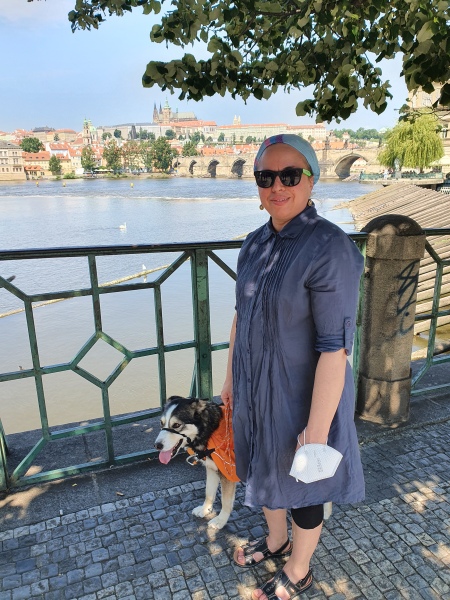
20200627_112934This month more than most, I feel like I have so much to say that I don’t really know where to begin.  It doesn’t help that next door they are remodelling an apartment and, outside my window, there is a crew drilling up the sidewalk and another roofing the house across the street.  The noise and its echoing are overwhelming on Prague’s narrow streets.  

Perhaps the best place to start is with a similarly loud occurrence.  On June 27th, Prague commemorated the 70th anniversary of the execution of Milada Horáková using the city-wide intercom system.  Minute-long excerpts from her trial and execution were broadcast throughout the day.  Horáková, the only woman to be executed during the Communist regime in Czechoslovakia, was a long-time proponent of democracy and  women’s rights.  In the field of women’s rights,  she focused on the status of women and children, spending considerable effort on women in the workplace and reconciling their work with family responsibilities.  She was also an outspoken critic of the Nazi Regime, having spent time as a political prisoner in Terezin.  When the war ended, she joined parliament, but resigned right after the communist take-over.  After continuing to speak out against the Communists,  she was arrested in September of 1949 and charged with attempting to overthrown the government.  She along with 12 others were interrogated and tried.  Four of them, including Horáková were sentenced to death.  She was publicly hanged on the 27th of June 1950.  Eighteen long years later, she was posthumously exonerated, and in 2000, the Czech Republic unveiled a commemorative tombstone for her in the National Cemetery at Vyšehrad Castle.  In 2017, a film was made about her life and legacy. Continue reading “Listening to the Noise: The Connections between Milada Horáková, Anti-Semitism, and the Black Lives Matter Movement by Ivy Helman.”

Telling Stories by Natalie Weaver

Human beings tell stories. This may sound like a simple truth.  To folklorists, literature professors, and people who work in media and in government, I would sound like a rather simple-minded child to be arriving so late in life at this obvious fact.  We tell stories.  And, just as the phrase “telling a story” might connote, our stories are not always true to life.   Our stories are descriptors and meaning-making efforts, largely rooted in our grappling with self and group identity.

Take, for example, the story of human life as exceptional in the animal kingdom.   As a child I would try to answer for myself the question of what made human beings distinct from other animals, since I had learned somewhere along the way that we were and are exceptional.  I considered the stock answer “reason,” which seemed to me sufficient to explain how human beings did everything, from the writing of language to the building of skyscrapers. As a student of theology, I enlarged upon the rational faculty to see it as the divine in the human, operating as the co-creative element with which human beings gain structural manipulation over our environments.  We make things after our image, just as God made us after God’s.   Continue reading “Telling Stories by Natalie Weaver”

A Servant of God or a Lover of Life? by Carol P. Christ

Carol Molivos by Andrea Sarris 2Thus through an enormous network of mythological narrative, every aspect of culture is cloaked in the relationship of ruler and ruled, creator and created. . . . [Sumerian] legend endows the Sumerian ruler-gods with creative power; their subjects are recreated as servants. . . . [This new narrative was] deployed with the purpose of conditioning the mind anew.(20, italics added)

This provocative statement is found in a chapter titled “The First Major Sexual Rupture” in a collation of the writings titled Liberating Life: The Women’s Revolution by imprisoned Kurdish leader Abdullah Ocalan (pronounced Oh-cha-lan). According to Ocalan, who clearly had been reading authors like James Mellaart, Marija Gimbutas, and Heidi Goettner-Abendroth, the values of the societies that preceded Sumer in the Near East were entirely different. Continue reading “A Servant of God or a Lover of Life? by Carol P. Christ”

Human Trafficking by Valentina Khan

Valentina KhanRecently I saw SOLD, a movie based on human trafficking taking place in Nepal and India. Within the first thirty minutes of the movie I was cringing, holding my hands, shrinking into my chair. Naively, I begged the question how families could sell their innocent children to strangers, even if they are fed the lies of working for pay? I am a mother of two children, who are my heart and soul. Deep inside I feel that if we as a family were in desperate times, I would rather sell myself than my children, or I would escape with them, and if we die, we die together. Yes. So extreme. But I can’t fathom letting my children go. Not for any amount of money, no matter how dire times were. I wouldn’t be able to live not knowing where they were, what they were doing, and with who. Just writing this or thinking about it, churns my stomach inside out.

I feel bad to make such statements and appear as if I am passing judgment on these mothers and fathers, who are living in desperate conditions, not knowing what else to do but to sell their flesh and blood to this multi-billion dollar industry. Many are not even aware and might truly believe that their children will go off to earn money for the family. As I write this I have a more informed position, because human trafficking is not a problem concentrated in a certain area of the world, this is a world wide epidemic with mostly women and children being bought and sold not just far away but here in my backyard, Los Angeles, California. Continue reading “Human Trafficking by Valentina Khan”

Songs for the Soul by Elise M. Edwards

Elise EdwardsDuring the Christian season of Lent, many Christians focus on spiritual practices or disciplines that bring them closer to God. This year, I did not really engage in this type of reflection until the end of Lent. I have been wrapping up my first year teaching college students full-time, I’ve been focused on several writing projects, and I’ve been traveling. I did not intentionally think about spiritual practices until I participated in a silent retreat before Holy Week and traveled first to spend the holiday with my family and then again to mourn and remember the life of my aunt.  I reflected on them when I most needed them.

Continue reading “Songs for the Soul by Elise M. Edwards”

The Feminization of Poverty: The Impact on Migrant Mothers in the U.S. by Michele Stopera Freyhauf

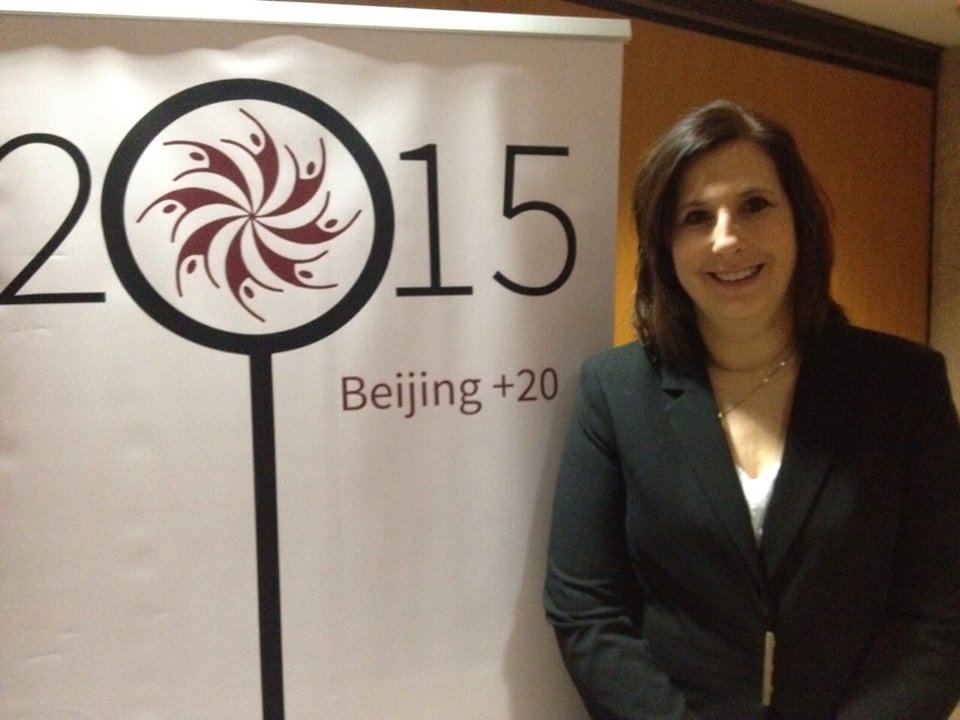
Freyhauf, Durham, United Nations, Feminism and Religion, John Carroll, UrsulineI had the honor of speaking at the United Nations during the Commission for the Status of Women this past March about the Feminization of Poverty and the Impact on Migrant Mothers.  Below is the text of my speech delivered.  By posting my speech, it is my hope to use social media to help draw attention to this problem and use our resources to find solutions.

Over the last thirty years, rich countries have grown much richer, and poor countries have become, in absolute and relative terms, poorer. Global inequality in wages are striking and poor countries are turning to the IMF or World Bank for loans, which require “so-called” structural adjustments of devaluing currency, cuts in support for “noncompetitive industries,” and the reduction of public services such as healthcare and food subsidies, which has provided disastrous results for the poor, especially women and children.

The feminization of poverty not only means that more of the world’s poverty is born by women, thanks in large part to globalization of the world economy, but includes a denial of access to fundamental human rights, including health, education, nutritious food, property, representation, etc. Feminized poverty encompasses more than matters of individual suffering – it ensnares a vicious cycle of poverty that impacts their entire family.

Feminization of poverty has no singular cause. The United Nations Development Fund for Women identified 4 key dimensions that indicated a heightened rate of poverty for women:

First is called “the temporal dimension,” which means that women are often the primary caretakers of children and household duties. Women who live in developing nations may also have agricultural or physical responsibilities. With these demands, less time is available to devote to paid employment causing them to earn a smaller income even though they effectively do more work than their male counterparts.

Second is “the valuation dimension” which is defined as unpaid labor that women perform to take care of family members and other household chores. Work that is considered “less than” because formal education or training is not required.

Third, is “The employment segmentation dimension.” Women are natural caretakers and thus corralled into “women’s work”, such as teaching, working with textiles, or domestic servitude that includes caring for children or the elderly.

Finally, “the spatial dimension.” When employment is non-existent or difficult to find, women may have to migrate to other areas to find work temporarily. If a woman has children, she may refuse to take the job and stay to care her family. However, Some opt to leave their families behind, to secure what they consider a better life – a means of support – but this choice often comes a great cost. Continue reading “The Feminization of Poverty: The Impact on Migrant Mothers in the U.S. by Michele Stopera Freyhauf”

Pesach, Patriachy and the Unfinished Work of Liberation.

headshot2Pesach, or Passover, begins tomorrow at sunset. It has always seemed strange to me that a festival centered on liberation begins with a focus on housework and cleanliness to the point where one is almost a slave to the process of chametz (leavened food) removal.  Not only that, but the spiritual interpretation of what the chametz represents adds to this conundrum.

The Rabbis of the Talmud teach us that chametz represents egotism and arrogance. The divine instruction to eat only unleavened bread for the festival of Pesach is a call to cultivate humility because they believe that our inflated sense of self-worth causes harm to other human beings as we value ourselves and our lives more than them. As we remove the chametz from our homes, we are also supposed to be removing the self-centeredness, arrogance and egotism within ourselves. Cultivating humility redirects our attention to all those parts of our lives that have suffered by being too self-centered, including our relationship with the Holy One. Continue reading “Pesach, Patriachy and the Unfinished Work of Liberation.”