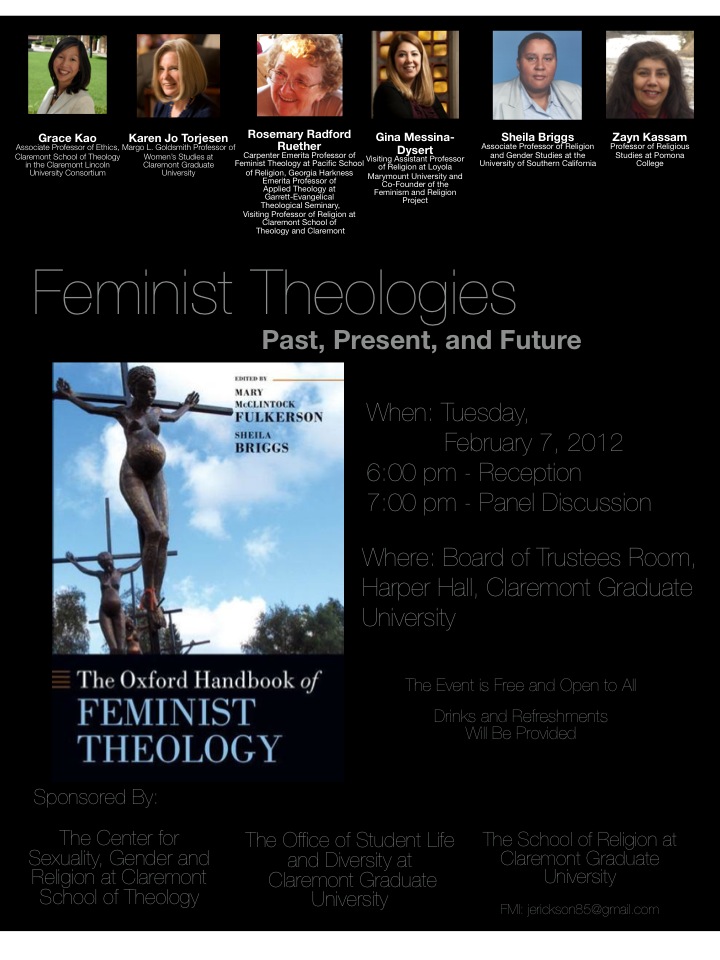
On February 7, 2012, a panel discussion focused on the past, present, and future of feminist theologies took place at Claremont Graduate University to celebrate the release of TheOxford Handbook on Feminist Theology. The panel was organized by John Erickson, moderated by Grace Kao, and featured Karen Torjesen, Rosemary Radford Ruether, Gina Messina-Dysert, Zayne Kassam, and Sheila Briggs as presenters. What resulted was a terrific discussion about women, religion, and feminist theologies. Many were in attendance and participated in the panel; for those who were unable to attend, here is a video of the presentations from that evening. We look forward to you sharing your thoughts and comments about the past, present, and future of feminist theologies.
Category: Women and Community
Bareed Mista3jil: Negotiating Gender, Sexuality, and Religion in Lebanon by Amy Levin
It’s not often (enough) that I (have the time to) come across non-academic books that articulate and reflect some of the most complex intersections between religion, gender, and sexuality. Those that do are commonly produced in the Western hemisphere, often representing the voices of Euro-American cultures and religious traditions. That is why I want to give voice to Bareed Mista3jil, a book, or collection of “41 true (and personal) stories from lesbians, bisexuals, queer and questioning women, and transgender persons from all over Lebanon.” Bareed Mista3jil was published in 2009 by the organization Meem, a community of lesbian, bisexual, queer women and transgender persons (including male-to-female and female-to-male) in addition to women questioning their sexual orientation or gender identity in Lebanon. The purpose of the book is to give voice to those in Lebanon with non-conforming sexualities and identities in order to give hope to this under-represented, often silenced population. Here is a description from Meem on the origin of the book: Continue reading “Bareed Mista3jil: Negotiating Gender, Sexuality, and Religion in Lebanon by Amy Levin”
Son of Man: An Updated Gospel Story of Jesus Set in South Africa by Michele Stopera Freyhauf
January 12, 2012
Son of Man is an updated story of the life of Jesus set in the fictional State of Judea that is modern day South Africa – complete with warlords and child soldiers. It could easily be mistaken for modern day Rwanda or Darfur with its modern issues and political overtones. Roger Ebert stated, “The secret of the movie is that it doesn’t strain to draw parallels with current world events – because it doesn’t have to.” The director draws parallels between the gospels and 21st century Africa. According to Dartford-May, “we wanted to look at the Gospels as if they were written by spin doctors and to strip that away and look at the truth.” The director “captures the rhythms of African life in both rural settings and sprawling townships.” “Feather-clad young angels offer an eerie echo and reminder of Africa’s lost generations.”
The movie also sticks with what Eric Snider calls “Traditional African trial music, dance, and costumes” as a type of worship or or allusion to Jesus’ godhood. Judea is in flux; warlords and corruption take center stage. Poverty, violence, and oppression affect the all of the people. The key idea is that Jesus is a freedom fighter – one that fights injustice and oppression. The director does not emphasize “Jesus’ divinity so much as his leadership, good sense and compassion.” Jesus is not violent and his followers, most of whom were former child soldiers, are encouraged to respond non-violently, which goes against their upbringing and training. Continue reading “Son of Man: An Updated Gospel Story of Jesus Set in South Africa by Michele Stopera Freyhauf”
CELEBRATING THE BEGINNING OF THE AQUARIAN AGE by Sara Frykenberg, Ph.D.
Looking back, it’s interesting to think of myself as a young woman learning in a time of transition from the Piscean Age to the Aquarian Age. According to Yogi Bhajan, the man known for brining Kundalini Yoga to the West, 11/11/91 marked the beginning of the last part of the Piscean age and on 11/11/11 the Age of Aquarius officially began. So, welcome all to the Age of Aquarius! This change of course, entails a significant paradigm shift that is supposed to affect our attitudes, consciousness and all of our relationships. The beginning of the Aquarian age, like the end of the Mayan calendar and other overlapping prophesies of change, tends to inspire our apocalyptic imagination. We may anticipate a breaking of our world. I tend to imagine the pressure of the Aquarian transition like an event horizon of a black hole: a movement through extreme gravity that feels crushing and inescapable. However, recently I’ve been struck by how the seeds of this new age, have been blossoming in my own experience and in the world around me.
According to my Kundalini teachers, the attitude of the Piscean age can be summed up as, “I believe.” The attitude of the Aquarian Age is, “I know.”
As a child I desperately wanted to believe enough. My evangelical Christian upbringing taught me that all I needed to do was believe that as God, Jesus Christ died for me and saved me from my sins. If I did this, then I could go to heaven with my family. Plus, Jesus would take me with him when he came back—that is, I wouldn’t have to go to hell or suffer the trials and tribulations of the apocalypse… this last part really stuck with me.
I thought I believed. I wanted to believe. I did “all the right things,” to somehow prove or provoke the kind of unquestioning belief I thought was necessary to be a “real” Christian. But, the fact of the matter was I doubted. As a little child (and I’ll admit, into my teens) I was sometimes struck with a sudden and horrifying fear that my family had been raptured and Jesus had left me behind. I would literally panic until I found someone; but I’d also hide this fear because I didn’t want anyone to think that I didn’t believe enough.
I now know this extreme fear of god and His (sic) wrath was a part of my abusive relationship to what I thought was god. I also know that our doubts can lead us towards renewed life. I know that it is not my beliefs that make me valuable: wholeness is inherent in our connection to “a larger creative existence.” We express this wholeness and our value, “with each committed action.”[i] Continue reading “CELEBRATING THE BEGINNING OF THE AQUARIAN AGE by Sara Frykenberg, Ph.D.”
Pushing Boundaries: Learning to be a Reformer By Jared Vázquez
When I consider the role of women in the social reforms of the late 19th century and early 20th century, I am struck by the boldness of those women in a society that is often essentialized as a quintessential model of patriarchy where all the women were too busy swooning under the pressure of corsets into the hands of handsome gentleman callers. But if we take the time to read closely about what activist women did during the late 19th century I believe that it becomes apparent that they developed much of the model by which we not only operate but also judge social reform; those reforming women set the standard by which we measure change. The reforming women of the 19th and 20th centuries altered the landscape of theU.S.in the way that they challenged the status quo of acceptability for the roles that women could play, both in the home and in public, and in the way that they challenged normative gender roles. In these we not only see the impact that was affected on their own societies, but also the legacy that has guided and continues to guide women and men who work for social reform today.
The women of that era challenged gender roles in various ways, in both public and less public ways. Utopian orders, for instance, that began to form in the mid 19th century were not only founded by women, like the Shakers, but were also directed by them and women enjoyed equal status with men in all affairs. The Salvation Army is another group in which women reinterpreted ‘womanly’ behavior in order to advance what they saw as their call to mission and evangelizing and took to the streets, going into areas that were “unsuitable” for women. The reforming women of the second half of the 19th century were boldly questioning and challenging the notions of social ordering that dictated the ways in which women were “allowed” to behave. Reading the contemporary responses of non-Protestant faiths in the ways that they sought to “properly feminize” their own female membership gives clues to the level to which the challenge on gender roles had reached. Continue reading “Pushing Boundaries: Learning to be a Reformer By Jared Vázquez”
Feminist Music By Gina Messina-Dysert
Last week Caroline Kline shared the article “Feminist Films” and discussed the Bechdel Test as a way to identify whether or not a film is feminist. It left me wondering – can we identify music as feminist in the same way? Music generally does not offer dialogue between two women. But there are instances where we find two women singing together about feminist issues like the 80’s classic “Sisters are Doin’ it for Themselves.” There are also women singing about or to women, like Juliana Hatfield’s “My Sister.” And there is music that acknowledges women’s struggles as women like Ani Difranco’s “I’m No Heroine,” No Doubt’s “I’m Just a Girl,” and Pink’s “Stupid Girls”. But is this the only way to identify feminist music? Continue reading “Feminist Music By Gina Messina-Dysert”
The Paradoxical Perception of Midwifery in American Culture By Stacia Guzzo
This past Sunday night, midwife Robin Lim was named CNN Hero of the Year at a formal award ceremony in Los Angeles, California. The award, which was given after eleven weeks of public voting on CNN.com, came with $250,000 to support Lim’s quest to provide quality prenatal, labor, birth, and postpartum care for the poor and underserved in Indonesia. She accepted the award amidst a standing ovation, and closed her words of acceptance by simply saying: “Every mother counts. And health care is a human right.”
The recognition of Lim—or Ibu (“Mother”) Robin, as she is called by those whom she serves— is well-deserved. An American woman, Lim provides midwifery care at the Bumi Sehat clinics which she helped to establish. Each year, she helps thousands of Indonesian women get care and attention during their pregnancies and the births of their children. She began her work in 1994, seeing pregnant women and children under five for free out of her home. As her reputation spread, supporters of Lim, along with local business and community leaders, helped to advance her cause. Today, the village-based Bumi Sehat clinics are located in both Bali and Aceh. They provide free prenatal and birthing care as well as breastfeeding support to any woman who needs it, regardless of her ability to afford it. Ibu Robin’s words to CNN reflect that her commitment to her cause is an altruistic one: “”Every baby’s first breath on Earth could be one of peace and love. Every mother should be healthy and strong. Every birth could be safe and loving.” Continue reading “The Paradoxical Perception of Midwifery in American Culture By Stacia Guzzo”
Enduring the Trials of Graduate School: From Conception to Labor Pains and Birth By Michele Stopera Freyhauf
Going back to school at 30-something to complete a B.A. in a completely different field (from accounting to Religious Studies and Theology) was an interesting endeavor. After many years of legal and business writing as well as crunching numbers, learning how to write academically, including formatting citations and using new technology was quite an undertaking that has proven to be rewarding. All the searchable databases in the library no longer included card catalogues and microfiche. This was amazing! No more correction ribbon and electric typewriters (am I showing my age yet?!) Going to college in 1985 is different then going back to college in 2006.
The transition did not stop with technology and formatting papers. With each class and each instructor, a new transition was introduced on my way to the finish line. It was a very large transition and more difficult when you sit in classes with students your own children’s ages. Add to that the reintroduction of the grammar game; in-text citations or footnote citations, semi-colons or dashes, commas or no comma, etc. With the help of great mentors and patient professors, I prevailed and moved on to my next task (I mean transition) – Graduate School. New professors, new demands, different writing styles, scholarly growing pains in abundance. The research and writing intensified (which is an understatement). Then there is the addition of critical reviews, peer reviews, and multiple presentations. Each professor with his or her own format and requirement. Each with their own style of subjectivity or, if you are lucky, a specific grading protocol with tangible prompts or goals. It is a world of unexpected twists, but, in my opinion, better than undergraduate work. Continue reading “Enduring the Trials of Graduate School: From Conception to Labor Pains and Birth By Michele Stopera Freyhauf”
Forty Years and Counting: Women and Religion in the Academy By Carol P. Christ
Carol P. Christ is a founding mother in the study of women and religion, feminist theology, women’s spirituality, and the Goddess movement. She teaches in the Women’s Spirituality program at CIIS and through Ariadne Institute offers Goddess Pilgrimages to Crete. Her books include She Who Changes and Rebirth of the Goddess and the widely used anthologies Womanspirit Rising and Weaving the Visions.
The receipt of an invitation to the Fortieth Anniversary Celebration of the Women’s Caucus in the American Academy of Religion and the Society for Biblical Literature this week, takes me back to the summer of 1971. At the first meeting of Women Theologians at Alverno College (which was followed up at Grailville in succeeding years), I proposed that we form a feminist caucus in the field of religion, as had already been done by feminists in several other fields.
Since I was one of the few women at Alverno who had attended the annual meetings in the field of religion, I was delegated to call Harry Buck, then director of the AAR, to ask for space on the program. Harry, who continued to support the work of women in the field through lecture series at Wilson College and the magazine Anima which he founded, offered not only space at the meetings, but a print-out of the names and addresses of all of the members of the AAR who were not obviously male. I invited all of them to come to a feminist meeting at the AAR in Atlanta. It is hard to imagine now, but before 1971, the women who attended the AAR in any given year could probably have been counted on one hand. Continue reading “Forty Years and Counting: Women and Religion in the Academy By Carol P. Christ”
Rosemary Radford Ruether’s Women and Redemption: A Theological History By Gina Messina-Dysert
Women and Redemption : A Theological History. 2nd ed. By Rosemary Radford Ruether.Minneapolis: Fortress Press. 2011.

Having been critically impacted by the work of Rosemary Radford Ruether, I was anxious for the release of the second edition of her crucial book, Women and Redemption: A Theological History. Redesigned with illustrative material, research questions, and suggested reading for further research, as well as the addition of a new chapter exploring recent developments in feminist theology, this text does not disappoint.
With this newest edition, Ruether acknowledges the ongoing journey in the field of feminist theology and emerging issues faced by women in religion and society. Examining the Christian claim of an inclusive and universal redemption in Christ, she traces paradigm shifts in understandings of gender over the last two millennia. Ruether offers an historical exploration of women and redemption in the first five chapters followed by a global survey of contemporary feminist theologies in the final four chapters, which includes a concluding section that gives attention to “Fourth World” feminisms and post-colonialism in an effort to “bring this volume up to date” (xvii). Continue reading “Rosemary Radford Ruether’s Women and Redemption: A Theological History By Gina Messina-Dysert”