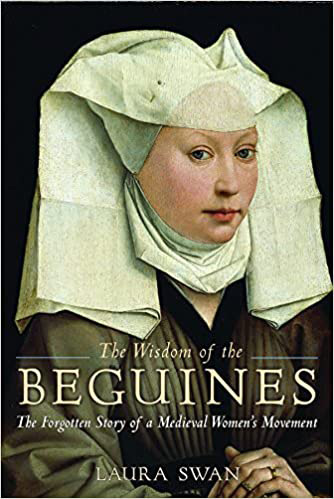
The Wisdom of the Beguines: The Forgotten Story of a Medieval Women’s Movement by Laura Swan, part 2 by Theresa C. Dintino 

Part 1 was posted yesterday

Praying people out of purgatory

Beguines excelled at this. By the Middle Ages, the belief in many Christian circles was that one did not go directly to heaven but to a sort of “holding place” after death to be cleansed of their sins before being allowed into heaven. Eventually “the medieval church also taught that people could pray for the souls in purgatory and that their prayers would effectively aid those souls in their transition from purgatory to heaven”(108).

It’s important to note that these women were esteemed by the communities they lived in as spiritually gifted, able to intercede with God on their own without permission from the church, clergy or men. This is radical for the time.

“Beguines, as we have seen, were understood to have extraordinary spiritual powers. People believed that having a beguine intercede before God on their behalf was an assurance that their petition was heard by God—and perhaps in no instance more than for “those poor souls in purgatory.” And beguines believed that they did indeed exercise the authority to release countless souls from purgatory. Many of the stories included in the vitae of beguines grapple with the fate of the deceased in purgatory (or hell)”(109).

Continue reading “The Wisdom of the Beguines: The Forgotten Story of a Medieval Women’s Movement by Laura Swan, part 2 by Theresa C. Dintino “

The Wisdom of the Beguines: The Forgotten Story of a Medieval Women’s Movement by Laura Swan, part 1 by Theresa C. Dintino 

Moderator’s Note: This piece is in co-operation with The Nasty Women Writers Project, a site dedicated to highlighting and amplifying the voices and visions of powerful women. The site was founded by sisters Theresa and Maria Dintino. To quote Theresa, “by doing this work we are expanding our own writer’s web for nourishment and support.” This was originally posted on their site on July 5, 2022. You can see more of their posts here. 

Around 1200 AD in Europe, communities of women often called beguines began to form. These women were not nuns, they were devout and devoted to the tenets of Christianity but did not belong to any church. They were independent communities of women who often created their own industry, trade or other means to produce income. They were self-sufficient and generally concerned with helping the poor, especially women. They lived in convents. This was the origin of that word.

“These women were essentially self-defined, in opposition to the many attempts to control and define them. They lived by themselves or together in so-called beguinages, which could be single houses for as few as a handful of beguines or, as in Brugge, walled-in rows of houses enclosing a central court with a chapel where over a thousand beguines might live—a village of women within a medieval town or city”(2).

Continue reading “The Wisdom of the Beguines: The Forgotten Story of a Medieval Women’s Movement by Laura Swan, part 1 by Theresa C. Dintino “

How Will Catholics Vote?

Will Catholics be “salt” and “light” in the 2024 election? Cardinal Dolan fails to show the way.

Dawn Morais Webster, the Pope off to his summer palace, Castel Gandolfo. He tells the world he will now become just a “humble pilgrim.”

Donald Trump’s parade of vulgarity, racism, misogyny and grift is always on display. He is proud of it. His outrageous lies are his version of “truth,” or as his running mate JD Vance would say, they come “from the heart.” It’s easy to condemn Donald Trump but the more urgent question is how will our vote stack up against our professed values, and for believers, how does it square with our faith?

I am deeply ashamed that Catholics were enablers of Trump’s rise to power. And that Catholics, by a slim but crucial margin, still support Trump over Kamala Harris in seven battleground states, according to a National Catholic Reporter survey of self-identified Catholics.

Continue reading “How Will Catholics Vote?”

Sing Anyway by Dr. Jamie Marich

I often find myself sitting in conservative Catholic spaces. My brother is a Roman Catholic priest in the Dominican order and I remain in support of his vocation. Every time, before a Mass officially starts, I’m overcome with a sense of: “You belong here…and you don’t.”

The part of me that has always felt at home in a Catholic setting is that love of the ritual and ceremony, the smell of the incense, the familiarity of the chants and songs. It was a Catholic priest, the late Fr. Ciaran O’Donnell, who taught me how to play the guitar and got me started with the healing practice of songwriting. When I sink into these associations, I feel connected to my Croatian ancestors and our Catholic faith. And there’s the other part of me—the queer feminist and an advocate for other queer and transgender people to live the fullest, most open expressions of themselves in all spaces of life, especially faith-based spaces. As a survivor of several forms of sexual assault and as a trauma specialist who has guided countless other survivors in their healing process over the years, I can’t sit in a Catholic Church and not feel uneasy about the legacy of abuse and silencing survivors within the church. Between my queer identity and dedication to supporting survivors, I feel that I don’t belong.

Continue reading “Sing Anyway by Dr. Jamie Marich”

Bible Believing Church Sign by Michelle Bodle

A dear colleague is retiring from ministry this year. As I often do at times of celebration, I think about the most meaningful conversations, questions, and impact that person has offered my life. As I was thinking of this colleague in particular, what came to mind was a statement that made to him that sparked a conversation that has been ongoing between us for almost a decade: “That church is not for me.”

            My friend talked about driving his motorcycle down a well-traveled highway and seeing church after church. If you know churches, you know that church signs can be anywhere from enjoyable to problematic. Some church signs try to convey witty messages, but they often miss the mark. Other times, a church speaks of its beliefs or current sermon series, using insider churchy language that does not hit with those whom the sign may be trying to reach in the first place. But church signs do exist for a purpose – to catch the eyes of travelers, which was undoubtedly the case with my colleague. 

            “I was driving down this road, and the sign that caught my attention said, ‘Bible Believing Church,’ and I’ve been thinking about that repeatedly,” he stated. I replied that I didn’t need to think about that sign; I knew exactly what it was trying to convey—that I was not welcome there. 

Continue reading “Bible Believing Church Sign by Michelle Bodle”

Can Feminist Christians Hasten the Advent of Reproductive Liberation? by Elizabeth M. Freese, PhD

Wikimedia Commons, Servite Church in Hungary

The collision of the 2023 Christian liturgical season of Advent with American reproductive politics has been jarring. Feminist religious critique and transformative activism are imperative.

With the Texas Supreme Court decision on a dire abortion case, alongside increasing criminalization of women having miscarriages, we are witnessing the principle of patriarchal dominance of female reproductive capacity and the denigration of women’s full, equal personhood pushed to the extreme. In part, this barbarity is perpetuated by Christianity. Even though this tradition often challenges social systems of injustice, and it does not actually support their hollow theology of “life at conception,” misogynist oppressors have plenty of Christian religiosity to stand on.

Continue reading “Can Feminist Christians Hasten the Advent of Reproductive Liberation? by Elizabeth M. Freese, PhD”

What “Can” Women Do? – An Excerpt from Nice Churchy Patriarchy by Liz Cooledge Jenkins

In an essay called Sister, You Can Be Anything God Desires You to Be,[1] Kara Triboulet recalls a discussion in her theology class at her Christian college. When the professor opened up the floor and invited students to express their views on women in leadership, these are some of the things her classmates said:

“I believe women can be in leadership, just not as pastors.”

“Allowing women to teach other women and children isn’t limiting. At least they have a place to serve.”

“Women can be directors, but not pastors.”

“The Bible is very clear . . . women can’t teach or lead men because men were created first. It’s just the way God ordained it, and we all just need to accept that.”

Continue reading “What “Can” Women Do? – An Excerpt from Nice Churchy Patriarchy by Liz Cooledge Jenkins”

Legacy of Carol P. Christ: Has the Vatican Discovered that Women Should Be Running the World?

This was originally posted on February 9, 2015

So it is a [female] generativity that .. is … giving life to social, cultural and economic structures that are inspired by values, ideas, principles and practices oriented to the common good …

carol p. christ photo michael bakas

The above statement from the Pontifical Council’s document on “Women’s Cultures: Equality and Difference” is a response to Pope Francis’s call for a discussion of “feminine genius” and its role in the Church. If in fact women are  “oriented to the common good,” then this is the best reason I can think of to elect a woman pope. And if a women are in fact hard-wired to think about the good of all, wouldn’t a woman pope’s first act be to dissolve the hierarchy that elected her? Is this why the Vatican is so afraid of the power of women?

Continue reading “Legacy of Carol P. Christ: Has the Vatican Discovered that Women Should Be Running the World?”

Re-imagining the Ritual of Communion by Xochitl Alvizo

I remember the words so clearly: “I know what it’s like to have my body broken, I know what it’s like to have my blood spilt. I won’t celebrate anyone else’s broken body or spilt blood, and I don’t want anyone doing that on my behalf.” Sitting in the pew next to me, my friend spoke her truth in a soft and tentative, but somehow still firm, voice. She then slumped in her seat and folded up her legs, hugging them against her body. While everyone else got up to take communion, I stayed in place beside her.

There was a period of time in my life when I was not willing to participate in communion. My friend’s words stayed with me, transforming the communion table from one of hospitality to one of violence. “Celebrating” communion didn’t feel celebratory anymore. I chose not to take communion for several years. I let my friend’s words guide and deepen my reflection on the practice of communion—especially in light of the trauma suffered by all too many bodies.

Continue reading “Re-imagining the Ritual of Communion by Xochitl Alvizo”

From the Archives:“Vaginas are Everywhere!”: The Power of the Female Reproductive System by John Erickson

Moderator’s note: This marvelous FAR site has been running for 10 years and has had more than 3,600 posts in that time. There are so many treasures that have been posted in this decade that they tend to get lost in the archives. We are beginning this column so that we can all revisit some of these gems. Today’s blogpost was originally posted June 19, 2012. You can visit it to see the original comments here.

I have a beautiful picture of vagina hanging on my wall.  However, for the longest time it was in the back of my closet, with a plastic bag covering it.  I wasn’t ashamed of it but my ex-boyfriend, like most gay men, refused to have it on the wall where he could see it.  He is now long gone; the vagina is now out and proud.

I bid on the picture one fall during a showing of the Vagina Monologues at Claremont School of Theology.  One of my best friends was in the show and I had always loved its powerful message.  I walked out of the theatre, waiting for my friend, and there it was: the picture of the vagina.  I found myself caught up in its beauty.  Its gaze had mesmerized me.  The outlying layers of red, the contours of its shape, they all began to mold into a figure before my eyes.  While I have never thought of myself as a religious person, I realized that at that moment I was no longer looking the old photo but rather I was staring at the outline of the Virgin Mary.  At that moment, I realized that I had to have the picture.

Continue reading “From the Archives:“Vaginas are Everywhere!”: The Power of the Female Reproductive System by John Erickson”