Painting Herstory: Our Lady of Silver Lake by Angela Yarber

angelaIt has become my new routine during the first phase of my queer little family’s year-long journey. After completing my chores, I run along the trails surrounding Silver Lake and once I’m thoroughly drenched in sweat, I grab a book and push our enormous 15-foot canoe into the frigid waters of the little lake we’re calling home for three months. With a smile that has yet to wipe off my face, I paddle fiercely. I’m typically the only person on the lake.

It’s a steep mile hike from the trailhead, and we’re the only ones “living” here for the summer, so my giant green canoe ripples the silvery waters in solitude. Once I find the right spot, I stuff my life vest behind my head and cozy down into the belly of the canoe, book in hand, goofy grin still spread across my flushed face. In the warmth of the sun, I read. In the belly of the canoe, I drift into the history of the lake, the unwritten annals lapping alongside my rocking boat, the portions on record filling the book in my sun-warmed hands.

The author who wrote the history of Silver Lake, William Powers, hiked up with several autographed copies in his rucksack several days after our arrival. He’s a nice man who wrote a nice book. There’s nothing like reading about the history of a place while in the place. Hear me say this clearly: there’s nothing wrong with the nice book this nice man wrote. The stories of Frank Chandler feeling a call from God to build a place for religious camp meetings along Silver Lake’s shores are fascinating, an interesting part of the history of camp meetings that filled the Awakenings throughout the United States. But as I read about Frank Chandler and the various men who the logged roads hikers now hike and built the buildings that haven’t existed for years due to fire, I couldn’t help but notice who was missing. Continue reading “Painting Herstory: Our Lady of Silver Lake by Angela Yarber”

Holy Women Icons on Tour: A Motley Crew of Unlikely Saints Hits the Road by Angela Yarber

angelaSeveral months ago I introduced one of my newest Holy Women Icons with a folk feminist twist, the intrepid traveler and passionate nomad, Freya Stark. In writing about her fearless journeys to far-flung places women only dreamed of visiting in the early 1900s, I also shared that my wife, toddler, and I have decided to follow her fierce lead into the seemingly unknown. In less than one month, our journey will begin as we spend an entire year volunteer traveling throughout the United States. We have sold our home. We finish teaching summer courses at the end of the month. And in Freya’s courageous words, we have decided that “it is the beckoning that counts, not the clicking latch behind you.” The beckoning is calling us to live more gently with the earth, do more justice, and to create a more peace-filled world. And we have the privilege of radically altering our lives to follow this beckoning.
This time next month, we’ll be settled into our little pop-up camper in the Green Mountain National Forest of Vermont where we’re volunteering for three months. In the fall, we’ll do the same in the southernmost part of the Shenandoah Valley. December will find our trusty camper—aptly named “Freya Stark”—chugging east to west across the southern parts of the United States, parking in the San Francisco Bay Area so that we can fly to Hawaii to volunteer on an organic farm and lead yoga retreats for the first three months of 2016. Continue reading “Holy Women Icons on Tour: A Motley Crew of Unlikely Saints Hits the Road by Angela Yarber”

Thoughts on Nuns and Sisters and Perpetual Indulgence by Marie Cartier

helen prejean
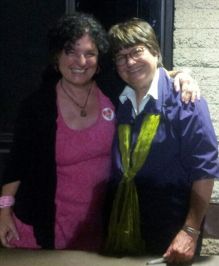
Marie and Sister Helen Prejean

The word “nun” can conjure images from traditional to irreverent in terms of gender. The gender of those who call themselves nuns can range from feminine to masculine, from a woman who looks like a woman dressed as a woman, a contemporary sister or “nun,” who does not wear the traditional black habit, but contemporary female clothing and perhaps a short veil or “wimple” and a cross around her neck; to a man dressed as nun in extremely sexual female garb, a “drag queen” nun; to the traditionally dressed nun, whose habit is a full-length black gown, and full veil covering everything but her face and hands, who means to conceal gender and become something else – a “nun.”

The physical space of “nun” then has opened the realm of gender for women, and recently men, since the creation of the category “nun” was established with the first order of female religious. Cloistered orders of women began in the fifth century, with the more liberated orders of “sisters” forming in the sixteenth century. The Encyclopedia of Catholicism lists approximately twelve Roman Catholic religious orders of sisters, or as they are commonly called, “nuns.” However, this terminology should be amended to allow for the difference between “sisters”- non-cloistered orders, and “nuns”- cloistered orders. Most traditionally the word nun officially refers to Roman Catholic nuns – those who take solemn vows of chastity, poverty and obedience, and live cloistered lives of silence, and prayerful meditation. Choir nuns, such as that of the famous convent headed by Hildegard de Bingen, (1098-1179), German nun, mystic and composer, chant the Liturgy of the Hours daily – consisting of a set order of readings and prayers, including Morning, Evening, Daytime and Night Prayers. Continue reading “Thoughts on Nuns and Sisters and Perpetual Indulgence by Marie Cartier”

This Be My Altar by Lori Tiron-Pandit

LTP Feb2015My grandmother took me to church often when I was a child. It was not my favorite activity. The village church, surrounded by the graveyard, was cold and gloomy, and the priest demanded too much undue reverence, I thought. As a consequence, I used to spend whole days devising plans of sudden sickness and disappearance acts before church time.


One summer, I must have been around seven or eight, my grandmother told me that we would be going to a monastery in a neighboring village, and there was nothing I could do or say to get out of it. I felt betrayed by fate and bereft of hope.

When we reached the Vladimiresti Monastery, I found myself in front of a tall fence of thick, whitewashed walls, over which trailed heavy clematis and morning glory vines. It was a beautiful day, with a perfectly clear sky and balmy weather, and that first image of the monastery was so perfect that it seemed almost fake, like a movie set. Continue reading “This Be My Altar by Lori Tiron-Pandit”

Painting Lottie Moon, Redeeming Lottie Moon by Angela Yarber

angelaI never imagined I’d paint her. Though I was not raised in church, I have vivid memories of worshiping in Southern Baptist Churches, churches where women’s voices were not permitted behind the pulpit, churches where women could never dream of ordination, churches that damned LGBTQ folks to hell with a pound of a fiery fist on a well-worn bible perched atop an angry pulpit. Canonize a Southern Baptist woman into the sainthood of Holy Women Icons? No, thank you.

Though I am an ordained Baptist minister myself, it’s important to remember that there is a vast spectrum of belief and practice when it comes to the Baptist church. Because our polity is non-hierarchical and we are anti-creedal, one cannot easily say, “All Baptists believe ______ or all Baptists practice _______.” Whether you are as conservative as the Southern Baptist Convention or as liberal as the Association of Welcoming and Affirming Baptists, we all share some core Baptist distinctives: the separation of church and state, believer’s baptism, the autonomy of the local church, freedom of conscious, and the priesthood of all believers. Learning of these distinctives as a young feminist searching for a faith to call my own, I was immediately drawn to the core Baptist tradition. They reject hierarchy. All are supposed to be equal. It is up to the individual conscious to determine what one believes. And it is up to the individual church to determine how that particular community of faith will practice those beliefs. It is feminist to its core. Southern Baptists feel otherwise, which is why they refrain for ordaining women and claim that they should be submissive to their husbands.

Continue reading “Painting Lottie Moon, Redeeming Lottie Moon by Angela Yarber”

Stop. Drop. And Pray. by Valentina Khan

543296_10151140607043082_1192980077_n

The other night, it was close to 11:00 pm and I was finally enjoying my own little ‘midnight’ snack and a healthy dose of reality TV when I got a phone call from a cousin I haven’t heard from in quite some time. He is in the East Coast and it seemed too late for a leisure phone call from him. So I answered in a panic, yet, all he wanted was to say “hi” and to talk a little bit about the obligation of a Muslim to pray the five daily prayers. OK, this is odd, I thought, but I guess I could entertain this topic for a few minutes. Might be better for me than the junk TV I was winding down to anyway.

We chatted for a few minutes and he started to get very heated about the requirement of the five daily prayers.  To back up a little, let me paint a quick picture of this eccentric cousin of mine. He is smart.  A New Yorker.  Middle-aged. He has studied at prestigious universities, has traveled the world, and even delved into religion so much so that he used to give sermons on Fridays, the holy day of the week for congregational prayer in the Muslim tradition. His main question for me, “Do you really believe in the flying white horse story?” Continue reading “Stop. Drop. And Pray. by Valentina Khan”

The Nuns Jumped Over the Wall by Dawn Morais Webster

Dawn Morais Webster, the Pope off to his summer palace, Castel Gandolfo. He tells the world he will now become just a “humble pilgrim.”

One of the most prized dishes in Chinese cuisine is called “The Monk Jumped Over the Wall.” The name comes from the folk belief that the monk was unable to resist the aroma of this delicious dish and jumped the wall in search of it.

Reading Jo Piazza’s If Nuns Ruled The World: Ten Sisters on a Mission, it is clear that these nuns, and others like them, have been drawn by people’s needs, to jump the walls of patriarchy and prejudice.

And there’s no putting them back behind those walls.

Just ask media maven, Sr. Maureen Fiedler: “After all, Jesus was a feminist, and we claim to follow him.”

One nun, though, has accepted being put behind bars for literally breaking through the fences around the nuclear facility in Oak Ridge,Tennessee. Sr. Megan Rice is unfazed by clerical disapproval.

“I don’t believe in excommunication,” she says, “because I don’t see the institutional Church as the real Church.” Continue reading “The Nuns Jumped Over the Wall by Dawn Morais Webster”

Lessons Learned from the Atheist Alliance of America Convention by Andreea Nica

Andreea Nica, pentecostalismThe Atheist Alliance of America National Convention 2014 held earlier this month in Seattle, Washington granted me the opportunity to interview, converse with, and listen to renowned speakers, comedians, and influential figures in the atheist movement including the likes of David Fitzgerald, Dr. Steven Pinker, Dr. Rebecca Goldstein, Richard Haynes, and Dr. Richard Carrier.

This year’s convention drew in approximately 100 attendees throughout the weekend, according to Amy Monsky, Executive Director of Atheist Alliance of America (AAA). Monsky states that the AAA National Convention has several primary goals including: to bring atheists together; to hear great speakers; to network and socialize; and to raise awareness through education.

The family-friendly event was comprised of educational and activist-oriented sessions, debate, a comedy show, VIP non-prayer breakfast, film by Jeremiah Camara, “2014 Richard Dawkins Award” banquet, and a Sunday outing to Snoqualmie Falls and Chateau Ste. Michelle Winery.

Below is an overview of the sessions I attended, the conversations I had with presenters and experts, and the interviews I conducted. Continue reading “Lessons Learned from the Atheist Alliance of America Convention by Andreea Nica”

Women are like countries: both need to fight hard for independence by Oxana Poberejnaia

oxanaRita M. Gross in her book Buddhism After Patriarchy presents portraits of prominent women from Buddhist history. Some stories are extraordinary for the brutal details they contain. For example, Yeshe Tsogyel was raped, kidnapped and beaten by her suitors to the point that her back was a bloody pulp. She subsequently escaped to meditate in a cave.

In a patriarchal society, religious fervour is not recommended for women. Submission and obedience – yes. The life of an ascetic, a wanderer or a hermit – no. A son is relatively free to pursue religious activities (especially if he is one of the younger children and the issue of inheritance is sorted out). However, all daughters are better off tucked into a marriage. Supporting your husband and sons on their spiritual path – yes. Independent striving away from family life – no. Continue reading “Women are like countries: both need to fight hard for independence by Oxana Poberejnaia”

Five Years of Untamed Spirituality and Challenging Feminism by Vanessa Rivera de la Fuente

Vanessa Rivera de la Fuente. Path to IslamIn Chilean tradition, the number five has an important meaning regarding the understanding of life. At 5, a person starts school and  life in society. At 15, we celebrate the entrance into the young adulthood. At 25, it is expected you have finished college. Age 30 is a good age to get married and by age 35 you’ve probably bought your first house. At 40, it is the perfect time to make an evaluation of your life … At 65, you leave behind all duties and enjoy the rest of the path. Each one of this milestones comes with a celebration or ritual that gathers your family and/or closest friends.

A few days ago, I entered my 5th year of Islam as my spiritual path. Following the tradition, I want to make an honest assessment of my first period as a Muslim- naming the Good, the Bad and the Ugly- but also expressing my Hopes, in the sincere feeling that the best is yet to come. Continue reading “Five Years of Untamed Spirituality and Challenging Feminism by Vanessa Rivera de la Fuente”