From the Archives: A Chorus of Need: I Need an Abortion by Marie Cartier

This was originally posted June, 2022

I need an abortion and I can’t get one

Because I don’t have the money to fly somewhere else other than …here

Where I can’t get one

I need an abortion and I can’t get one

Because the kid, or the cells of a maybe kid, were put in here by the guy that raped me and if I have to have it, I will kill myself

I need an abortion and I can’t get one

Because I have four kids already and I can’t feed another one

I need an abortion and I can’t get one

Because it’s my dad’s…did you hear me say that? I have never said that. I have never said what he does to me…and now I have to show everyone… if I can’t get this out of me I will…

I have to get this thing out of me

I need an abortion and I can’t get one

Continue reading “From the Archives: A Chorus of Need: I Need an Abortion by Marie Cartier”

The Purpose of Women by Beth Bartlett

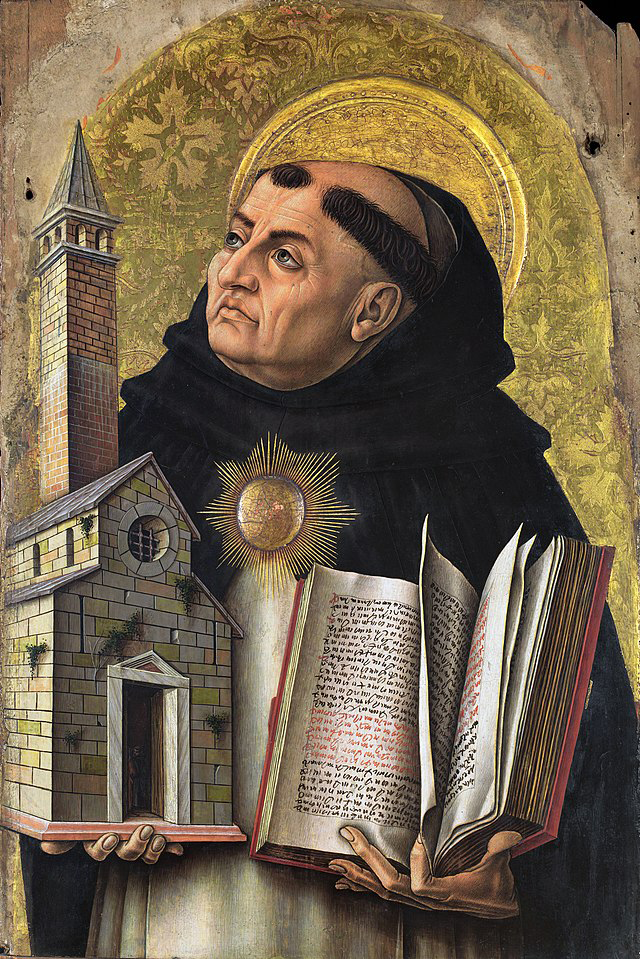
Thomas Aquinas, Wikimedia Commons

12th century theologian Thomas Aquinas didn’t think much of women.  He’d known less than a handful during his lifetime – his mother, who sent him off to a Benedictine monastery when he was five, as was the custom at the time, and later abducted and imprisoned him, with the help of her other sons, seeking to “rescue” him from his choice of becoming a Dominican priest; his two sisters who were sent to him while imprisoned to dissuade him from his choice; and the prostitute his brothers sent into his prison cell to try to tempt him to sin and break his vows – unsuccessfully. So perhaps it is no wonder that Question 92 of his Summa Theologica asks, “Should woman have been made in the original creation?” Though more likely his question was prompted by the milieu of misogyny in which he was raised and lived, having been educated in the theological tradition of Augustine who believed women to be the “lesser” sex and necessarily subject to men, and highly schooled in and known for reviving the thought of Aristotle, who said of women, “a woman is a misbegotten man.”[i]

Continue reading “The Purpose of Women by Beth Bartlett”

Daughters of Witches By Julia Park Tracey

“We are the daughters of the witches you couldn’t burn.”

That’s a popular meme going around the internet these days, as we await the joyful coming of our savior, Kamala Harris, or the End Times, with the Mango Mussolini. I say that only slightly in jest, because I do believe we are in a fraught time. A woman president could set us up for incredible progressive movement, while a Trump/Vance win could mark the beginning of the end of women’s rights altogether.

There’s no way not to be political in an essay about feminism and religion, so if the current election is not of interest to you, I say, enjoy your privileges while you can and I hope the leopards don’t eat your face, as another meme goes. Regardless, the bodies of witches and the bodies of all our women, young and old, are still interconnected, both by virtue of our gender and of our position as political pawns (again? still? It is to weep).

Continue reading “Daughters of Witches By Julia Park Tracey”

The Connection between Matilda Joslyn Gage’s Woman, Church and State and L. Frank Baum’s The Wonderful Wizard of Oz by Mark I. West

My introduction to Matilda Joslyn Gage (1826-1898) goes back to my long-standing interest in her son-in-law, L. Frank Baum. I regularly teach Baum’s The Wonderful Wizard of Oz in my children’s literature courses, and I always point out the book’s feminist qualities. I mention, for example, that Dorothy Gale, the central character in the novel, is one of the first female characters in American literature to go on a bona fide quest.  When I first started teaching this book, I wondered what caused Baum, a male writing in the late nineteenth century, to write such a feminist book. One day, while preparing for class, I came across a reference to Gage. This reference stated that Gage was a leading suffragette during the second half of the nineteenth century and that she lived with Baum and his family in Chicago when Baum was launching his career as a children’s author. After reading more about Baum’s life, I realized that Gage played a major role in shaping his nontraditional views on gender roles. However, I was still not sure what role she played in the development of women’s rights.

Continue reading “The Connection between Matilda Joslyn Gage’s Woman, Church and State and L. Frank Baum’s The Wonderful Wizard of Oz by Mark I. West”

Sojourner Truth, the photos by Beth Bartlett

Moderator’s Note: We inadvertently left out the photos from Beth’s posts on Sojourner Truth. The photos, all by themselves, pack an emotional punch and so we want to be sure they can be seen. These are Beth’s photos from Sojourner Truth Legacy Plaza in Akron, Ohio

You can see Beth’s posts here. Part 1 and Part 2

close- up of statue

Sojourner Truth: Part Two: The Speech and the Sojourner Truth Legacy Plaza by Beth Bartlett

Part one was posted yesterday.

Most of us are quite familiar with Sojourner Truth’s “Ain’t I a Woman?” speech as recorded by Frances Gage several years later, with its powerful “ain’t I a woman” refrain.  However, the actual speech as transcribed at the time by Marius Robinson, while similar in content, does not contain the refrain. Rather, Truth simply states that she is “a woman’s rights” woman.[i]  It is unlikely that she spoke in the southern dialect Gage used in her transcription, since Truth grew up knowing only Dutch, eventually learning English as spoken in New York, and probably spoke with a Dutch accent. Much of the content in the Gage version was fabricated – such as the statement that she bore thirteen children, when she only had five children, though she did cry out in a mother’s grief when she learned that her only son, Peter, had been illegally sold south to Alabama.[ii]

Continue reading “Sojourner Truth: Part Two: The Speech and the Sojourner Truth Legacy Plaza by Beth Bartlett”

Sojourner Truth: Part One: Her Life by Beth Bartlett

On May 29th, 1851, a striking, 6’ tall, African American woman rose to speak at the Women’s Rights Convention being held in Akron, Ohio. There Sojourner Truth gave her famous “Ain’t I a Woman Speech.” 

Originally named Isabella, and known as “Bell,” Truth was born into slavery in 1797, the second youngest of James (“Bomefree” – Dutch for “tree”) and Elizabeth (“Mau-mau Bett”) who were enslaved by a wealthy Dutch man, Johannes Hardenbergh, Jr., who had a large estate in Ulster County, New York, which was inherited by his son, Charles, when Truth was just an infant. Upon the death of Charles, at the young age of nine, she was sold at auction to John Nealy, where she “suffered ‘terribly-terribly’ with the cold”[i] and beatings. In her own words, “He whipped her till the flesh was deeply lacerated, and the blood streamed from her wounds – and the scars remain to the present day.”[ii] She prayed for deliverance, and soon after was sold to a fisherman and tavern owner, Martinus Schriver, where she led “a wild, out-of-door kind of life,” carrying fish, hoeing corn, foraging roots and herbs for beer.  Only a year later she was sold again to John J. Dumont, where she lived out the remainder of her enslavement until her emancipation by the State of New York in 1828. She described her life there as “a long series of trials” which she did not detail “from motives of delicacy,  . . . or because the relation of them might inflict undeserved pain on some now living”[iii] whom she regarded with esteem. Knowing the conditions of enslaved women, we can deduce what those trials entailed. Despite her affections for a man on a neighboring estate, who was beaten to death for visiting her when she was sick, she was forced to marry a much older man, Thomas, also enslaved by Dumont, with whom she bore five children. Because Dumont reneged on his promise to free her, she walked away with her infant daughter in 1827 and was taken in by the Van Wegener family where she lived for the next year. 

Continue reading “Sojourner Truth: Part One: Her Life by Beth Bartlett”

Women’s Rights: How Far Back in Time Will our Legal System Go? by Janet Maika’i Rudolph

Wikimedia Commons

I was in the process of writing this blogpost last week when the Arizona supreme court decided to turn abortion rights back to the civil war era (1864). This was a time when women had no rights at all and abortion from conception was illegal. But civil war era laws are downright quaint and modern compared the legal underpinnings of the supreme court’s Dobbs decision.  

In his decision, Mr. Alito cited four “great” and “eminent” legal authorities, Henry de Bracton, Edward Coke, Matthew Hale, and William Blackstone. For perspective here are their dates. 

Henry de Bracton  c. 1210 – c. 1268
Edward Coke 1552 – 1634
Mathew Hale 1609-1676
William Blackstone 1723 –1780

To help me understand Alito’s logic, I read up on some conservative commentary. Here is what I learned: When the founding fathers needed to create legal documents, they didn’t create them out of thin air. They relied on the logic of the four men (and others) listed above. Yes, they did pick some enlightened aspects of these thinkers of the time, esp. in regard to the rights of the common people in relation to royalty. The thought of commoners having rights was revolutionary in its day. But as we have learned so painfully, our founding fathers limited who those rights applied to. They did not take into consideration the rights of anyone other than landowners, which at the time meant white men.

Continue reading “Women’s Rights: How Far Back in Time Will our Legal System Go? by Janet Maika’i Rudolph”

The Policing of Muslim Women’s Speech: Invited, then Silenced on a Women’s History Month Panel by Dr. Hadia Mubarak  

Moderator’s Note: This is part 1 of a 2 part series. A version of this article first appeared in The Charlotte Post on March 25

In her paradigm-shifting book, Why I am No Longer a Feminist: A Feminist Manifesto, Jessa Crispin reminds us that having token “female representation” does not solve the problem of systemic oppression or marginalization.  I was recently reminded of this truth when a female co-panelist attempted to silence me twice, when I shared my perspective on women’s challenges in Gaza.

On March 20, I joined an all-female interfaith panel for an elite retirement community center in Charlotte, NC in honor of Women’s History Month. As three female panelists, we were invited to represent our respective faiths, Judaism, Islam, and Christianity. After we each responded to the scripted questions posed to us, community members began to ask us questions. One man stood up and said, “I have visited Jordan, Egypt, and Israel. Will it be safe to travel to Israel again given the current situation?”

Continue reading “The Policing of Muslim Women’s Speech: Invited, then Silenced on a Women’s History Month Panel by Dr. Hadia Mubarak  “

Legacy of Carol P. Christ: LET’S ASK MITT IF MORMON PATRIARCHAL BELIEFS AFFECT HIS VIEWS ON WOMEN’S EQUALITY

This was originally posted on September 10, 2012. Moderator’s Note: While Mitt Romney is not running for office at this time, there are many politicians, of varying religions, who are and who deserve to be questioned in this manner.

Why has Mitt Romney’s Mormon faith mostly been a non-question in his political life?  John Kennedy was asked if he would obey the Pope or make his own decisions, Jimmy Carter was asked how his Baptist faith would affect his Presidency, and Barack Obama was asked if he agreed with the sermons of his preacher.  Why is the press afraid to ask Mitt Romney if he agrees with the patriarchal teachings of his church and if so, if this affects his views on the rights of women?

Like other patriarchal institutions, the Mormon Church believes that women’s place is in the home.  Every Mormon man is a priest and a patriarch in his own home.  Mormon belief teaches that men are to make the final decisions in the family, that only they can be leaders in the church, and that they are the members of the Mormon community who should speak and act in the public (non-home) dimensions of life.  Traditional Mormons believe that “ [The] LDS [woman is] always [to] accept counsel from her husband, and not as just his opinion, but as God-inspired revelation.” 

Continue reading “Legacy of Carol P. Christ: LET’S ASK MITT IF MORMON PATRIARCHAL BELIEFS AFFECT HIS VIEWS ON WOMEN’S EQUALITY”