The Furious Sun in Her Mane: Nine Poems to Goddesses by Annie Finch

Poet’s Note: I composed this sequence of poems for performance, for chanting, and for devotion. I wanted people who would hear, read, memorize, and speak each poem to channel the original energetic patterns that the poets who best knew that Goddess used to connect with Her. So for each poem, I researched the meter and prosody of the original language in which that Goddess was first worshipped.  Then I carried the exact rhythmical pulse of Her language into my poem to Her in English.

The sequence was set to music by composer Laura Manning and choreographed by Georgia Bonatis, and I directed and performed a devotional dance collaboration version of it in 1994. That archival video of this performance has just been recovered for the first time in 31 years. It is now posted on my Youtube channel.

Continue reading “The Furious Sun in Her Mane: Nine Poems to Goddesses by Annie Finch”

As a Hen Gathers by Elanur Williams

Gustav Klimt, Garden Path with Chickens, 1916

In the early years of my childhood, my family lived for a short time on a poultry farm in Bandırma. Hens wandered freely, unconfined. The contours of that land have long since changed, replaced by refrigerated depots and industrial freezers that hum along the highways, the relentless march of capital. In the Gospels of Luke and Matthew, Jesus laments: “How often have I desired to gather your children together as a hen gathers her brood under her wings, and you were not willing.” These days, I find myself returning to the image of the mother hen—a figure who embodies a special wisdom that is seldom named, yet deeply and instinctively known.

Although I did not have a religious upbringing, I grew up embracing aspects of many faiths. My spiritual background is Alevi, and after inviting the Presbyterian faith into my life following my marriage, I find these layered identities influence each other in ways that are both intricate and transformative. In her sermon Who Is Jesus? Mother Hen, Reverend Agnes Norfleet lingers on the vulnerability of the mother hen metaphor, questioning what strength a hen can possibly offer in the face of the fox—Herod—and, more broadly, in the face of violence at large. Reverend Norfleet asks why Jesus does not invoke a more forceful or fiercer maternal figure—a lion, perhaps, or a bear? What does this choice imply for our activism and understandings of leadership? What unique wisdom does the mother hen offer?

Continue reading “As a Hen Gathers by Elanur Williams”

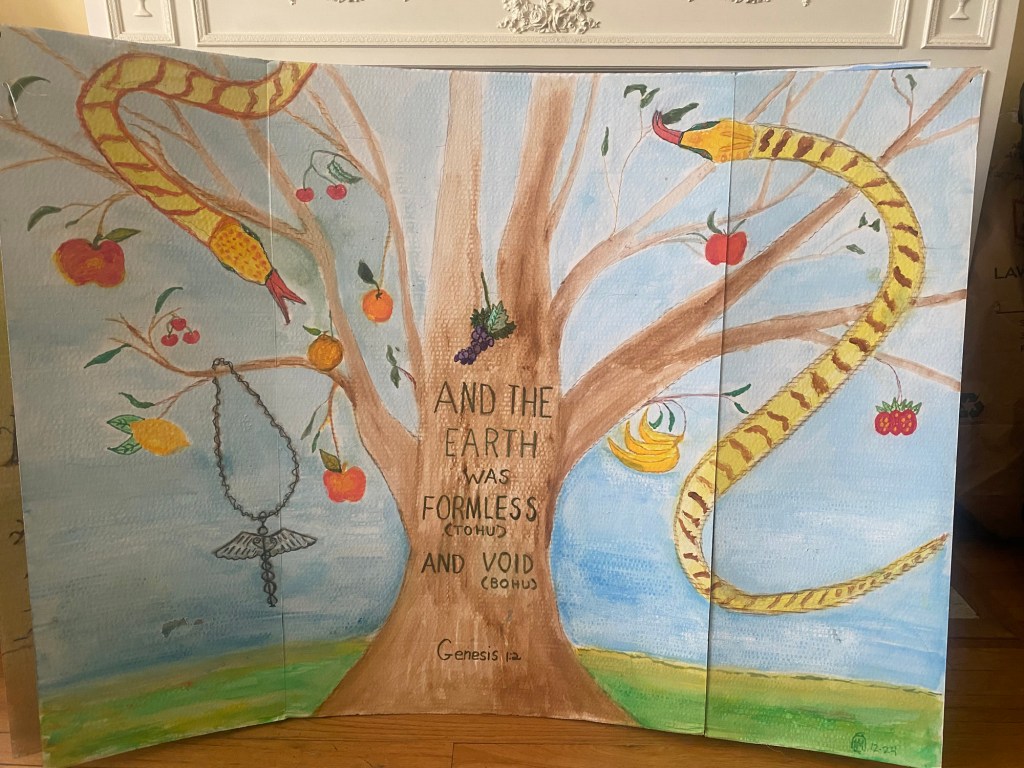
The Loving Tree By Janet Maika’i Rudolph

from Egyptian tomb of Pashedu ca. 1314-1200 BCE

Once there was a tree who loved two young children, twins, a boy and a girl.

Thay came everyday to play under her canopy. 

Gather her leaves and play fairies of the forest.

Climb her trunk and play in her branches

And sleep with their backs against her trunk

They loved the tree and the tree loved them. 

Time went by and the twins grew older.

They didn’t come to visit the tree as often.

One day when they did come, the tree asked them to play but they responded they needed money because they wanted to go on dates.

The tree responded, take my apples to sell.  But leave enough behind for the squirrels and birds and other animals so they can eat too. Leave enough behind for the seeds.

Continue reading “The Loving Tree By Janet Maika’i Rudolph”

Veiled by Michelle Wahila

Photos by Paige Gribb Photography
 https://paigegribbphotography.com/

Springtime in Paris brings the magnificence of cherry blossoms, the scent of sweet crêpes, and an influx of tourists eager to capture their own moment of passion on the cobblestone streets of the world’s most romantic city. I may be biased because Paris is my home, but there’s no denying its magic. With its art, history, cuisine, fashion, and architecture, the city offers extraordinary experiences. It’s no wonder so many couples choose to marry in the City of Light.

Years ago, when I entered the wedding industry, I did so reluctantly, only after leaving the one profession I had ever known – ministry. What I didn’t expect was that I would become a bridge for couples navigating the ever-widening gap between love and institutional religion. The so-called “rules” of tradition are often mislabeled as matters of faith but are more accurately named as remnants of the heteropatriarchy. They place enormous pressure on engaged couples. It’s no surprise that many of the eloping couples I meet in Paris have chosen their path simply because it is less stressful than trying to appease tradition, religion, family, or friends (or all of the above).

Continue reading “Veiled by Michelle Wahila”

An Omer Calendar of Biblical Women by Jill Hammer

Jill as the prophetess Huldah

Right before Passover every year, my wife and I visit a botanical garden to look at the spring flowers: daffodils, tulips, cherry and apple blossoms, magnolia.   One year, in 2004 or so, we were on our way there when I had an idea. I grabbed a pen and started scribbling long lists of biblical women.

“What are you doing?” my wife asked.

“Making an Omer Calendar,” I said. 

Since biblical times, there is a Jewish practice of counting the forty-nine days between the holiday of Passover (the barley harvest and festival of freedom) and the holiday of Shavuot (the first fruits festival and the season of receiving Torah).  These forty-nine days were the time of the barley and wheat harvest and were a fraught time for biblical farmers.  According to the Talmud, each day of the Omer must be counted along with a blessing.  One must count consecutively each day (usually in the evening) and one loses the right to say the blessing if one misses a full day of the count.  The Omer is often understood as a time of semi-mourning because of plagues said to occur during this time, but it is also a joyful season when nature’s abundance is at the forefront.  This seven-week period embodies both fear that the harvest will be damaged and gratitude for the harvest.

Continue reading “An Omer Calendar of Biblical Women by Jill Hammer”

Legacy of Carol P. Christ: Shadows Of The Goddess In Greek Orthodox Tradition: Easter And The Dormition Of The Virgin

This post was originally published on Aug. 13th, 2012

While I would not wish to argue that Greek Orthodoxy is in any way a “feminist” tradition, the shadow of the Goddess falls long over the two great festivals of spring and midsummer.

In Greek Othodox tradition, there are two major spiritual holidays– Easter in the spring and the Dormition/Assumption of the Virgin at midsummer.  The Panagia, She Who is All Holy, also known as Mother of God, Virgin, and Mary, is a central figure in people’s faith–dethroned neither by the Reformation nor by Vatican II.  Indeed when I speak of the need for the “rebirth of the Goddess” in Greece, I am often told, “the Panagia is our Goddess.”  This may not be theological orthodoxy, but it expresses a truth of practice. Continue reading “Legacy of Carol P. Christ: Shadows Of The Goddess In Greek Orthodox Tradition: Easter And The Dormition Of The Virgin”

Blodeuwedd; The Flower that Does Not Bloom and the Transhuman Death Spiral by Kelle Ban Dea

Blodeuwedd is often viewed as a Spring goddess, a personification of flower and bud and bloom. And why not; she is made of flowers after all; flowers and magic. It’s only when you read her original myth in the Fourth Branch of the Mabinogi that you realise how dark it is.

Of all the famous women – now seen as goddesses by many – in these ancient Celtic legends, Blodeuwedd is the only one who is not a mother, and therefore not seen as an aspect of the mother goddess, Modron. Bloduwedd cannot be a mother, because although she is made of flowers, she is a flower that will never bloom, that cannot reproduce.

In both ancient mythology and in the neopatriarchy we live in today, women who either cannot or will not be mothers (despite these being very different things; one a choice, one a lack of choice) are viewed with suspicion. As the opposite of the nurturing, fecund Mother, Bloduwedd instead brings betrayal and death to the hero of the tale. Yet, it was never Blodeuwedd at fault. She is created by the rapist magician Gwydion and given without her consent to be the wife of Lleu, the king, and our shining ‘hero’ of the story. Lleu has been cursed by his own mother to never have a human wife or children, so Bloduwedd is the best that Gwydion can conjure up, and he is celebrated for this marvellous feat of magic.

No-one, of course, bothers to ask Blodeuwedd what she might want.

Continue reading “Blodeuwedd; The Flower that Does Not Bloom and the Transhuman Death Spiral by Kelle Ban Dea”

Journey to Freedom: Harriet Tubman Still on the Move, part 2 by Maria Dintino

Part 1 appeared yesterday

Additional Developments

Although there’s a significant dearth of statues depicting real women in our country, Tubman’s image and legacy have done much to address this gap and put a serious dent in the bronze ceiling.

There are said to be at least 9 full-figure sculptures of Tubman with others in the works, along with plaques, busts,  parks and museums named in her honor. Also, three commemorative coins have been released, each depicting a particular phase in Tubman’s life.

Speaking of currency, the plan to replace President Andrew Jackson’s image with that of Harriet Tubman’s on the twenty-dollar bill is still in the works. It’s an important endeavor that’s taking far too long. Annie Linskey with The Philadelphia Tribune explains:

“There has never been a Black person on the U.S. currency, nor has there been a woman on a bill in the modern era, despite repeated attempts to diversify the currency.”

Continue reading “Journey to Freedom: Harriet Tubman Still on the Move, part 2 by Maria Dintino”

Sacred Secrets: The Legacy of Women’s Wisdom Across Generations by Rabbi Nadya Gross

From my earliest memories, I saw things that others didn’t see and knew things I had no business knowing. But at the time, I didn’t realize that others didn’t witness the dance of light around their bodies or the life forms at the base of trees. I didn’t know that the insights I had into people’s emotions were not universally shared. My curiosity led me to ask questions about these things… until my grandmother, Savta (Heb), took me into the kitchen (where everything important happened), closed the doors, and told me never to talk about these things with anyone except her. And so, my training began.

Savta was gifted in ways different from mine. She had grown up in a circle of women and their daughters, a circle where women educated each other, shared their unique gifts and insights, and passed down a legacy of wisdom.

The wisdom she shared with me was as ancient as the land on which we lived. We began with reverence for the Earth and all her elements—pre-patriarchal Goddess wisdom. We explored what it means to be intimately connected to all aspects of Creation, understanding that we are interdependent. Harm to a tree, an insect, or the water harms us. We learned that the respect we wish to receive from others must first be shown by us. I learned to never pick up a beautiful stone that caught my attention without first asking permission to remove it from its resting place. When harvesting fruit from one of the many trees in my grandparent’ yard, I expressed deep gratitude to the mother-tree whose body nurtured that fruit to ripeness.

Continue reading “Sacred Secrets: The Legacy of Women’s Wisdom Across Generations by Rabbi Nadya Gross”

Practicing Mistakes in Karate by Xochitl Alvizo

One of my earliest lessons from karate, which I am still working to integrate, is about the necessity of making mistakes. I used to apologize every time I make a mistake, “I’m sorry,” I’d immediately say to my instructor. She would smile at me and at the end of class would say, “You don’t have to apologize for making a mistake; your body is just learning to do this for the first time, so of course you’re going to make mistakes. Mistakes are part of the process.”   

The necessity of making mistakes was something I needed to learn to embrace. As with other areas of life, making mistakes in karate made me feel like a fool. I would get frustrated with myself and would feel embarrassed, and would feel like my teachers were disappointed in me too. But one of the things that has helped me embrace my mistakes is seeing how I have indeed improved in my practice. The mistakes I now make are new ones and are about higher level forms and techniques—things that used to absolutely seem impossible for me. 

Continue reading “Practicing Mistakes in Karate by Xochitl Alvizo”