Broken Roots? by Sara Wright

I write to
find out
who I am
becoming
and when
I implored
Sedna
to take
me back
to the sea
I came
to know
my roots
to Place
were
broken
by age
by betrayal
by loneliness
by advocating
for a planet
animals, trees
by people
who do not listen
by people who
will not see

like Mother Pine
moaning
outside
my door
I  too
moan
Unforgiving
Ice and Wind
Treachery on every path
Trees encased
in White

At the Bottom
of the Well
Water Murmured
accept
this Break

Underground
Mycorrhizal
threads remain
your Guides

Sedna
rises
meets you
on
dry land
for the second
time in
one year

Continue reading “Broken Roots? by Sara Wright”

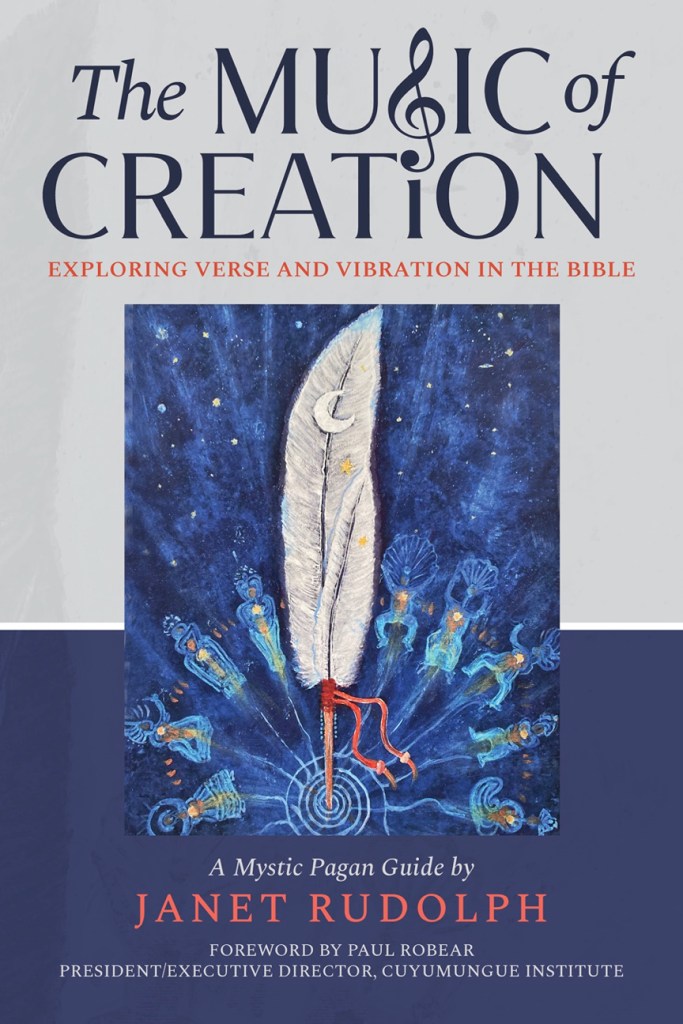
The Music of Creation by Janet Maika’i Rudolph

I am excited to announce my latest book: The Music of Creation: Exploring Verse and Vibration in the Bible. In this book I present pagan translations of the Bible and then lay out spiritual practices based on those verses. The practices make use of “the triple secret” of manifestation which is Mudra (body or hand position), Mantra (chant) and Mandala (image). Each has power on their own. Together they become even more compelling. Below are two excerpts from the book. The first is a template of chanting and the power it can have in our bodies and in our lives. 

Excerpt 1 – Below, I note four different ways to approach chanting. All have merit. They can be combined. In each, I use Hallelujah (in its meaning of praise) as an example.

First: Song, performance, vibration. Hallelujah has been a particular focus of song-writing with beautiful results. The top results which come to my mind are Leonard Cohen and Handel. Hallelujah is a wonderful example of a performance chant and a choral piece. 

Continue reading “The Music of Creation by Janet Maika’i Rudolph”

Women of the Hebrew Bible as Role Models for 2026 by Judith Maeryam Wouk

Miriam, Anselm Feuerbach, wikimedia commons, public domain

When you hear “Jezebel” do you think of a bold queen, co-regent with the king?  Does “Delilah” evoke a businesswoman concerned about securing a comfortable retirement?  Does “Miriam” call to mind a community leader who speaks truth to power?   

You don’t have to believe in, or even read, the Hebrew bible[1] to be aware of, and perpetuate, its misogynistic portrayal of women as either promiscuous or passive, subservient to their husbands and longing for sons.

Honouring and (re)discovering our spiritual lineage is an important part Feminism and Religion. In this, and future blogs, I will reframe the stories of Biblical women to examine their legacy as unconventional foremothers.  Let’s uncover their contributions which have been swallowed by the patriarchal focus that discounts or appropriates the contributions of women. 

Continue reading “Women of the Hebrew Bible as Role Models for 2026 by Judith Maeryam Wouk”

Confessions: Lunch with Ann by Margot Van Sluytman

This is not Augustine’s confessions. This is not an essay on what love should mean. This is a poetic evocation of recognizing the beauty of friendship, the beauty of companionship. The blessing of breaking bread together and sharing in conversation that is the heart of who and how we are. Who and how we are forever becoming. Even when the Muse abandons us.
     My dear friend, Ann, and I shared a wonderful lunch, talking, tears, supreme laughter, exquisite food. During that conversation, it became clear to me that the poetry of life is love that is situated where kindness and kinship and commitment highlight our meaning, our meaning for being and doing, which is intimately linked, for many of us, with our pens to the page. Fingers to the keyboard. Twinned and intertwined with lushness of choice.
     A choice to have boundaries, whereby though the heart and the flesh can feel moved by what may present itself to be love, stepping back and feeling with the intellect of the heart and the intellect of the mind what is not being said, what is not being expressed warrants keen attention.  A life-changing recognition of the possibility to wash away miasma and mist and pretence. And to stare directly into the depth and clarity that is: Wisdom. She Who Is. Sophia Speaking.

Continue reading “Confessions: Lunch with Ann by Margot Van Sluytman”

Legacy of Carol P. Christ: Love Divine, All Loves Excelling

This was first posted on 09/09/11 and then again on 5/23/22

A founding mother of the study of women and religion and feminist thealogy, Carol has been active in social justice, anti-war, feminist, anti-nuclear, and environmental causes for many years.  Her books include  She Who Changes and Rebirth of the Goddess and the widely used anthologiesWomanspirit Rising and Weaving the Visions.

In my last blog I wrote that the image of God as a dominating other who enforces his will through violence–found in the Bible and in the Christian tradition up to the present day–is one of the reasons I do not choose to work within the Christian tradition.  To be fair, there is another image of God in Christian tradition that I continue to embrace.  “Love divine, all loves excelling” is the opening line of a well-known hymn by Charles WesleyCharles Hartshorne invoked these words and by implication the melody with which they are sung as expressing the feelings at the heart of the understanding of God that he wrote about in The Divine Relativity.

Love divine, all loves excelling also expresses my understanding of Goddess or as I sometimes write Goddess/God.  Though I am no longer a Christian, but rather an earth-based Goddess feminist, I freely admit that I learned about the love of God while singing in Christian churches.  Hartshorne wrote that he knew the love of God best through the love of his own mother, and I can say that this is true for me as well.  My mother was not perfect, and she did not understand why I wanted to go to graduate school, my feminism, or my adult political views, but I never doubted her love or my grandmothers’ love for me.  (I count myself lucky.  I know others did not have this experience.)  Like Hartshorne, I also learned about the love of God through the world that I always understood to be God’s body.  Running in fields and hills, swimming in the sea, standing under redwood trees, and encountering peacocks in my grandmother’s garden, I felt connected to a power greater than myself.   Continue reading “Legacy of Carol P. Christ: Love Divine, All Loves Excelling”

Omen by Sara Wright

I was driving down the road when I noticed a dead owl. Sun glare blinded me, but I stopped to identify the bird.

It has been many years since I picked up dead owls on the road – thirty five years in all. I began this practice of bringing home the bodies of these creatures when I first moved to the mountains. Finding so many dead owls in a brief span of five years was frightening, but someone in me knew that I needed to honor these Harbingers of Night. Yet the last thing I wanted was to be identified or aligned with an owl, so my behavior rose out a body that never lies. Visions of my mother’s love of owls clouded my mind. Within months of this mountain move a Navajo Medicine woman informed me that I had Owl as a Familiar. Horrified, I resisted mightily. Yet despite what seemed like a curse, I was still compelled to sculpt owl pots out of clay for five years. The losses I endured during this time changed the course of my life.

 I taught myself how to dismember owls. I burned owl remains in my woodstove as a symbol of deep respect and out of fear. I always kept feathers and wings in honor of these mysterious night beings not understanding why.

Continue reading “Omen by Sara Wright”

Anne Brontë’s Agnes Grey: Lifting the Veil on Cruelty, part 2 by Maria Dintino

Part 1 was posted yesterday.

Here the reader further witnesses how young Tom treats his little sisters which is consistently cruel-hearted. Tom continues to describe how he will harm the helpless birds while Agnes desperately works to persuade him otherwise:

“But you shall see me fettle ’em off. My word, but I will wallop ’em? See if I don’t now. By gum! but there’s rare sport for me in that nest.”

“But, Tom,” said I, “I shall not allow you to torture those birds. They must either be killed at once or carried back to the place you took them from, that the old birds may continue to feed them.”

“But you don’t know where that is, Madam: it’s only me and uncle Robson that knows that.”

“But if you don’t tell me, I shall kill them myself—much as I hate it.”

“You daren’t. You daren’t touch them for your life! because you know papa and mamma, and uncle Robson, would be angry. Ha, ha! I’ve caught you there, Miss!”

“I shall do what I think right in a case of this sort without consulting any one. If your papa and mamma don’t happen to approve of it, I shall be sorry to offend them; but your uncle Robson’s opinions, of course, are nothing to me.”

This young charge of Agnes’s is threatening and manipulating her as he and the other children do often. Tom doesn’t realize he has hit a nerve with Agnes, where the brutal treatment of the most vulnerable is unbearable. This situation is indicative of the overall treatment she receives as a governess, as one less-worthy-than and stripped of power, yet blamed for the misbehavior of her charges.

“So saying—urged by a sense of duty—at the risk of both making myself sick and incurring the wrath of my employers—I got a large flat stone, that had been reared up for a mouse-trap by the gardener; then, having once more vainly endeavoured to persuade the little tyrant to let the birds be carried back, I asked what he intended to do with them. With fiendish glee he commenced a list of torments; and while he was busied in the relation, I dropped the stone upon his intended victims and crushed them flat beneath it. Loud were the outcries, terrible the execrations, consequent upon this daring outrage; uncle Robson had been coming up the walk with his gun, and was just then pausing to kick his dog.

“Tom flew towards him, vowing he would make him kick me instead of Juno. Mr. Robson leant upon his gun, and laughed excessively at the violence of his nephew’s passion, and the bitter maledictions and opprobrious epithets he heaped upon me. “Well, you are a good ’un!” exclaimed he, at length, taking up his weapon and proceeding towards the house. “Damme, but the lad has some spunk in him, too. Curse me, if ever I saw a nobler little scoundrel than that. He’s beyond petticoat government already: by God! he defies mother, granny, governess, and all! Ha, ha, ha! Never mind, Tom, I’ll get you another brood to-morrow.”

Uncle Robson’s appalling show of support and praise for Tom’s egregious behavior toward his governess underscores a deeply engrained and condoned misogyny. But here our usual grin-and-bear-it Agnes will not back down or be silenced.

“If you do, Mr. Robson, I shall kill them too,” said I.

“Humph!” replied he, and having honoured me with a broad stare—which, contrary to his expectations, I sustained without flinching—he turned away with an air of supreme contempt, and stalked into the house. Tom next went to tell his mamma.”

Agnes has risked her position in defense of her values, but Uncle Robson, who it is noted never pays his nieces any heed, has instilled and upholds his nephew’s cruel ways, no doubt leading him to become a person who will kick his dogs and treat all creatures deemed lesser, including girls and women, with disdain. Little Tom is “beyond petticoat government already,” encouraged and rewarded for not listening to any of the women in his life. Following the example of his father, uncle, and many of the other men in his life, Tom has already learned to disregard what women have to say.

And Tom’s mother, Mrs. Bloomfield, buys into the dysfunction wholeheartedly. The passage continues with an interaction between Agnes and lady of the house, with her defending the violent behavior of her son and blaming Agnes for interfering with his fun and games.

“It was not her [Mrs. Bloomfield’s] way to say much on any subject; but, when she next saw me, her aspect and demeanour were doubly dark and chilled. After some casual remark about the weather, she observed—“I am sorry, Miss Grey, you should think it necessary to interfere with Master Bloomfield’s amusements; he was very much distressed about your destroying the birds.”

“When Master Bloomfield’s amusements consist in injuring sentient creatures,” I answered, “I think it my duty to interfere.”

“You seemed to have forgotten,” said she, calmly, “that the creatures were all created for our convenience.”

I thought that doctrine admitted some doubt, but merely replied—“If they were, we have no right to torment them for our amusement.”

“I think,” said she, “a child’s amusement is scarcely to be weighed against the welfare of a soulless brute.”

“But, for the child’s own sake, it ought not to be encouraged to have such amusements,” answered I, as meekly as I could, to make up for such unusual pertinacity. “‘Blessed are the merciful, for they shall obtain mercy.’”

“Oh! of course; but that refers to our conduct towards each other.”

“‘The merciful man shows mercy to his beast,’” I ventured to add.

“I think you have not shown much mercy,” replied she, with a short, bitter laugh; “killing the poor birds by wholesale in that shocking manner, and putting the dear boy to such misery for a mere whim.”

“I judged it prudent to say no more. This was the nearest approach to a quarrel I ever had with Mrs. Bloomfield; as well as the greatest number of words I ever exchanged with her at one time, since the day of my first arrival.”

Agnes knows her place and if she wants to maintain her position to both assist her family and to prove she can handle the role, she must monitor herself and bite her tongue around her employers and their children. In both Agnes’s positions, the parents are portrayed as overly indulgent and uninvolved, allowing the children to misbehave and manipulate at every turn. The parents consistently take their children’s side and refuse to see any fault in them, lest it cast blame on their parenting. This creates an especially impossible arrangement for the governess to have any influence on the children, let alone get them to care about and complete their lessons.

Anne’s resting place at St. Mary’s Church in the seaside town of Scarborough, North Yorkshire.

At a certain point in the story it becomes quite clear how all will unfold, yet one cannot stop reading!

In the end, Agnes is rewarded with the love of one she has admired for some time. The icing on this happy-ending cake is that she is also reunited with the neglected dog, Snap, that one of the young women in her charge had given away, breaking Agnes’s heart. This delightful reunion takes place on the beach, a setting Anne Brontë herself cherished.

If one cannot bear the truth, don’t read Anne Brontë’s novels. Yet, it’s worth keeping in mind that if the ugly truth is kept undercover, it’s less likely to be addressed.

Anne Brontë is a Nasty Woman Writer.

© Maria Dintino 2024

Works Cited & Resources

Brontë, Anne. Agnes Grey. The Project Gutenberg eBook of Agnes Grey, 4 December 2020. https://www.gutenberg.org/files/767/767-h/767-h.htm

Ellis, Samantha. “Anne Brontë: the sister who got there first.” The Guardian. 6 January 2017.  https://www.theguardian.com/books/2017/jan/06/anne-bronte-agnes-grey-jane-eyre-charlotte

Holland, Nick. “Agnes Grey: Nothing short of genius.” Anne Brontë Blog, 9 April 2017.  https://www.annebronte.org/2017/04/09/agnes-grey-nothing-short-of-genius/

Requiem? by Sara Wright

A requiem for the seasons is an act of living remembrance for what is vanishing, be that long-cherished seasonal moments, forms of celebration that once tied us to nature’s cycles, and to more than human species – some that are going extinct.

Cheeping twittering birds awakened me at dawn. The first snow of the season cast a spell over the landscape last night and this  generous dusting brought in the wild turkeys… I wished all good morning as I scattered seed under the crabapple. A couple of very friendly individuals followed me back to the door. My little dog Coalie is spellbound. She loves these birds.

I noted turkey hieroglyphics on the doormat as I came in but otherwise took no pleasure from the white shrouded landscape. I used to love snow but because each of the seasons is warming, we are getting mixed precipitation on a regular basis beginning in mid – November. The first snow opens an icy door to winters that are dominated by continuous freeze thaws. Last year I considered myself fortunate to have been able to snowshoe as long as I did.

Continue reading “Requiem? by Sara Wright”

Holding Our Brokenness by Elizabeth Cunningham

Dear FAR readers, here is a selection from my new collection Holding Our Brokenness, a gathering of poems. I chose these particular poems for their connection to feminism and/or religion. I hope you will enjoy them.

The Old One Speaks 

You must be unmade here
inside my grey cloak
inside my cold womb
here where the ice forms
and breaks
at the river’s edge.

What Kali Tells Me  

It’s all in the rhythm.
Falseness throws you off beat.
Rhythm renews your strength
with every step. That’s how time
becomes timelessness.

Continue reading “Holding Our Brokenness by Elizabeth Cunningham”

Margaret Fuller (1810-1850): A Thanksgiving Revelation by Maria Dintino

Moderator’s Note: This piece is in co-operation with The Nasty Women Writers Project, a site dedicated to highlighting and amplifying the voices and visions of powerful women. The site was founded by sisters Theresa and Maria Dintino. To quote Theresa, “by doing this work we are expanding our own writer’s web for nourishment and support.” This was originally posted on their site on November 19, 2024. You can see more of their posts here. 

As the Thanksgiving holiday rolls around, I am reminded of Margaret Fuller’s Thanksgiving revelation, one she later wrote about in her journal. This revelation resonates annually for its gentle reminder of the value of being willingly and patiently engaged, of releasing resistance in the face of what cannot readily be altered.

Joy Harjo, American poet, musician, playwright, and author. She served as 23rd US Poet Laureate, the first Native American to hold that honor. (Wikipedia) Learn more at joyharjo.com.

As I re-read Fuller’s account, I think about something former US Poet Laureate Joy Harjo said when she joined us a few years back at Flagler College in St Augustine, Florida for a virtual event. I don’t remember the exact question one of the listeners asked, but I’ll never forget Harjo’s response. She answered, “Every job is a service job.”

The truth in this statement struck me. I’d never considered my many jobs over the years, both inside and outside the home, as service jobs, but indeed they were.

Continue reading “Margaret Fuller (1810-1850): A Thanksgiving Revelation by Maria Dintino”