Three poems by Rebecca Rogerson

Don’t Take Me to Church

He never let me eat communion because I wasn’t a catholic, but it was okay for me to eat his dick. My tiny palms forced to stroke him, the same dextrous hands that coloured in the lines. 

I knew his God wasn’t my God. I knew she saw everything there was to see and that he wouldn’t reach salvation; no matter how many Hail Marys he said at mass in Ireland.

The Virgin Mary knew what he stole from me, what they steal from all of us.

I couldn’t fall apart on Sundays at noon when he took me to church—before he took me home after he did what he did—to the little Jewish girl who didn’t know she was Jewish.

I couldn’t remember it because I buried it in Survive, until, it was resurrected by nightmares and demons who professed caring and brought me to altars of despair to vomit up all the darkness, and when there was no more left to cleanse or tear out; light ripped in.


No one talks about the embarrassment that goes along with the telling, sharing and surfacing of sexual violence. How it comes up, how it comes back. How we’re always haunted by the deadbeat dead and grabby grandfathers who try to reach from there into here, pretending they are made of heaven.

I fled a friend’s choir concert because perpetrators keep stealing time, moments, sleep, joy, and friendship, in churches and baths. On my flight, I hunted for nature, soil and anything else that felt most alive in the hilly town of Nelson. Pretending I was like everyone else, I hid the panic that strikes broken hearts.

Continue reading “Three poems by Rebecca Rogerson”

Two Poems by Rebecca Rogerson

ROSE WATER

I am the holy place somewhere in the stars of eternity,
 someone’s daughter who seeks reprieve somewhere.

Yetta changed her name to Mary. She tried to erase her past, not as a Jew, well maybe some of that, but more as a Jew molested by her father—a frum[1], “Monster”, his daughters called him.

On my altar sits my tallit alongside a Menorah with seven brass holders. No stars of David—before or after the decimation of Gaza. Can rose water sweeten our hearts? We pour it graciously in our hands, hoping the lost petals heal our guts and brighten our thoughts. She searches hungrily for hope in glass bottles adorned with Farsi, that cost $4.29 each.

Continue reading “Two Poems by Rebecca Rogerson”

Journey to Freedom: Harriet Tubman Still on the Move, part 2 by Maria Dintino

Part 1 appeared yesterday

Additional Developments

Although there’s a significant dearth of statues depicting real women in our country, Tubman’s image and legacy have done much to address this gap and put a serious dent in the bronze ceiling.

There are said to be at least 9 full-figure sculptures of Tubman with others in the works, along with plaques, busts,  parks and museums named in her honor. Also, three commemorative coins have been released, each depicting a particular phase in Tubman’s life.

Speaking of currency, the plan to replace President Andrew Jackson’s image with that of Harriet Tubman’s on the twenty-dollar bill is still in the works. It’s an important endeavor that’s taking far too long. Annie Linskey with The Philadelphia Tribune explains:

“There has never been a Black person on the U.S. currency, nor has there been a woman on a bill in the modern era, despite repeated attempts to diversify the currency.”

Continue reading “Journey to Freedom: Harriet Tubman Still on the Move, part 2 by Maria Dintino”

Journey to Freedom: Harriet Tubman Still on the Move, part 1 by Maria Dintino

Moderator’s Note: This post is brought to you by a collaboration by FAR and Nasty Women Writers written and hosted by Maria and Theresa Dintino. This post originally appeared on their website on Feb. 20,2024. It has been updated to reflect recent events. the post is subtitled: Nasty Women Writers: Breaking the Bronze Ceiling – Statues of Real Women in Public Spaces

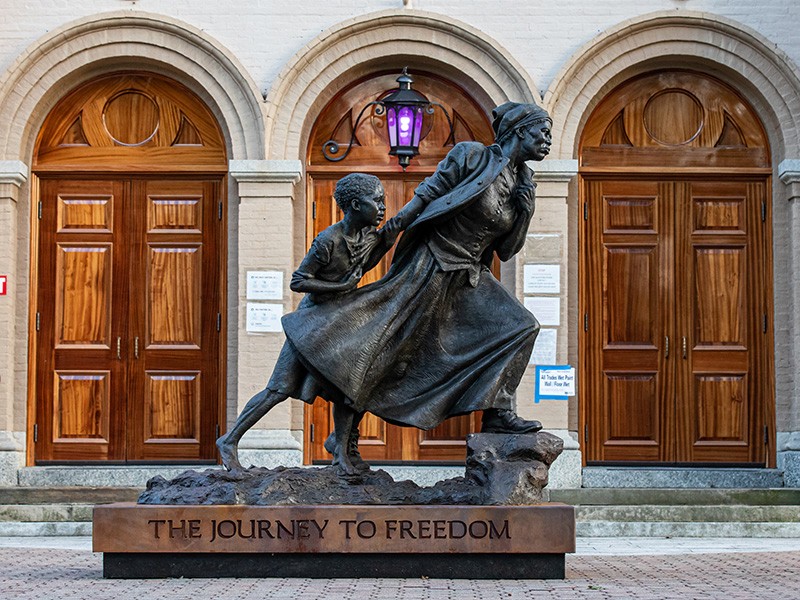
It’s quite fitting that the 9-foot bronze statue of Harriet Tubman, named Journey to Freedom is still on the move, as was Tubman for much of her life.

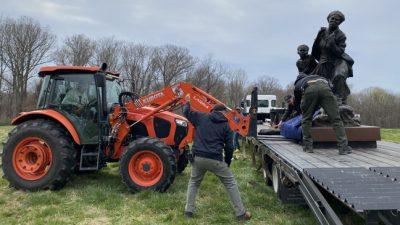
Since 2020, the statue has traveled around the country. It’s currently on Hilton Head Island, South Carolina, in Historic Mitcheville Freedom Park. The monument will remain on Hilton Head through April 2025 and from there be transported to Vienna, Virginia.

Continue reading “Journey to Freedom: Harriet Tubman Still on the Move, part 1 by Maria Dintino”

Preaching with a Predator in the First Pew by Angela Yarber

Seeing him in the first pew was distracting. Legs splayed in expert manspreading fashion, both arms draped unaware across either side of the backrest, belly protruding over a worn leather belt. He wasn’t a tall man, yet his sprawling body occupied nearly six feet of space. A slight smirk was always smeared across his lips and his eyes were fixed on me.

Preaching to a predator is never easy. So, while I could never imagine what it would be like to speak truth to power like Bishop Budde at the National Prayer Service, I’m confident that, like me, every clergywoman in America knows what it’s like for a pussy grabber to leer at you from the first pew. Even the finest vestments, highest clerical honors, and the divine herself cannot protect you from that.

Continue reading “Preaching with a Predator in the First Pew by Angela Yarber”

“Now I Will Have Respect”; “Now I Will Be Looked Up To” – Women Assert Their Worth in the Christmas Story by Liz Cooledge Jenkins

“The Giver of Breath has looked upon me with kindness and has taken away my shame. Now I will have respect in the eyes of my people.” -Elizabeth (Luke 1:25, First Nations Version [FNV])

“From deep in my heart I dance with joy to honor the Great Spirit. Even though I am small and weak, he noticed me. Now I will be looked up to by all. The Mighty One has lifted me up!” -Mary (Luke 1:46-49a, FNV)

Two women, one older, one younger. Both unexpectedly pregnant. Both key players in the Christian Advent story. Both living in a world, not unlike ours today, where women were not fully acknowledged as complete human beings, with all the strength and agency this entails. And both, for this reason, starving for the respect of their loved ones and communities.

Continue reading ““Now I Will Have Respect”; “Now I Will Be Looked Up To” – Women Assert Their Worth in the Christmas Story by Liz Cooledge Jenkins”

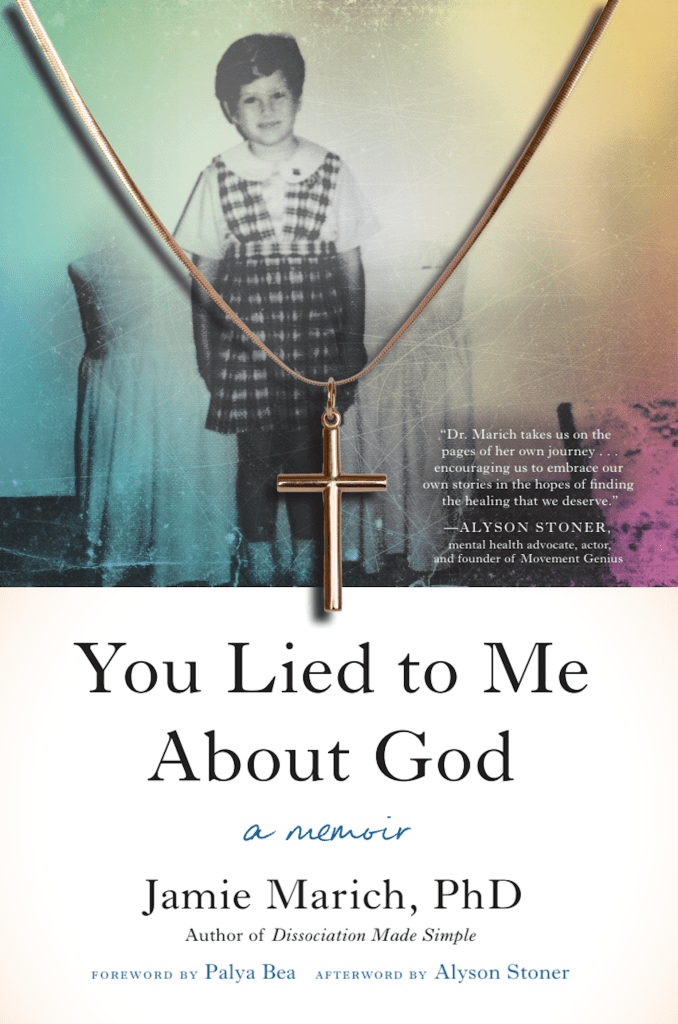
You Lied to Me About God, a memoir by Jamie Marich, PHD, book review by Janet Maika’i Rudolph

This was a hard book for me to review. Perhaps because she writes about such difficult issues and yet she does so in a compelling and at times even humous manner.  I feel a responsibility and yet find it hard to capture how she manages a breezy manner while discussing heavy material. Perhaps, even though our backgrounds are vastly different, I was also relating to so much of what she said. Jamie also covers so much ground; it is hard to pick out individual aspects to discuss.

As a child Jamie Marich was caught in the web of different religious systems, Catholicism from her mother and Evangelical from her father. They were at soul-hurting odds with each other (both parents and religions). Each one proclaimed they were the one true path so there was the ever-present threat of choosing the wrong one and facing a parent’s wrath along with that of eternal damnation. She labels this spiritual trauma. It cuts to the soul of a person being trapped into a no-win situation. It’s a conflict-driven, shame-filled, guilt-ridden way to grow up.

Continue reading “You Lied to Me About God, a memoir by Jamie Marich, PHD, book review by Janet Maika’i Rudolph”

Women’s Bodies As Battlefield by Janet Maika’i Rudolph

Elizabeth Cady Stanton wrote in the introduction to her book The Women’s Bible:

The Bible teaches that woman brought sin and death into the world, that she precipitated the fall of the race, that she was arraigned before the judgement seat of Heaven, tried, convicted and sentenced. Marriage for her was to be a condition of bondage, maternity, a period of suffering and anguish, and in silence and subjection, she was to play the role of a dependent on man’s bounty for all her material wants . .

We are facing the long-term results of these biblical writings. This upcoming election is so unsettling because it is showing patriarchy in all its ugliness. We see how this is being played out, especially regarding abortion, but in all areas of the functioning of women’s bodies. The reason abortion is at the foundation of it all is that the drive to police women’s bodies is the crux which justifies all sorts of cruelties. It is the same with racism. These are issues that span the pantheon of rights; human, economic, healthcare, bodily autonomy. It takes a police state to quell all of these.

Continue reading “Women’s Bodies As Battlefield by Janet Maika’i Rudolph”

Censored Angel: Anthony Comstock’s Nemesis. A Novel by Joan Koster

“I would lay down my life for the cause of sex reform, but I don’t want to be swept away. A useless sacrifice.” Ida C. Craddock, Letter to Edward Bond Foote, June 6, 1898

In 1882, Ida C. Craddock applied to the all-male undergraduate school of University of Pennsylvania. With the highest results on the entrance tests, the faculty voted to admit her. But her admission was rejected by the Board of Trustees, who said the university was not suitably prepared for a female. (U of P only became co-ed in 1974)

With her aspirations blocked, Ida left home determined to leave her mark on women’s lives by studying and writing about Female Sex Worship in early cultures. At the time, little information was available to women about sexual relations. To do her research, Ida resorted to having male friends take books forbidden to females, such as the Karma Sutra, out of the library for her.

An unmarried woman, she turned to spirituality and the practice of yoga, a newly introduced practice to the American public at the time, as a way to learn about sex. In her journals, she describes her interaction with angels from the borderlands, and in particular, her sexual experiences with Soph, her angel husband through what was likely tantric sex.

Continue reading “Censored Angel: Anthony Comstock’s Nemesis. A Novel by Joan Koster”

The Purpose of Women by Beth Bartlett

Thomas Aquinas, Wikimedia Commons

12th century theologian Thomas Aquinas didn’t think much of women.  He’d known less than a handful during his lifetime – his mother, who sent him off to a Benedictine monastery when he was five, as was the custom at the time, and later abducted and imprisoned him, with the help of her other sons, seeking to “rescue” him from his choice of becoming a Dominican priest; his two sisters who were sent to him while imprisoned to dissuade him from his choice; and the prostitute his brothers sent into his prison cell to try to tempt him to sin and break his vows – unsuccessfully. So perhaps it is no wonder that Question 92 of his Summa Theologica asks, “Should woman have been made in the original creation?” Though more likely his question was prompted by the milieu of misogyny in which he was raised and lived, having been educated in the theological tradition of Augustine who believed women to be the “lesser” sex and necessarily subject to men, and highly schooled in and known for reviving the thought of Aristotle, who said of women, “a woman is a misbegotten man.”[i]

Continue reading “The Purpose of Women by Beth Bartlett”